Why there are Amazon links here: Brave Review is paid a commission for qualifying Amazon purchases made through the links below. Your price does not change, and using our links is entirely optional. How this works
Treatlife Smart Light Switch vs Treatlife 3 Way Smart Switch: Single-Pole or Multi-Way Control
The choice between the Treatlife Smart Light Switch and the Treatlife 3 Way Smart Switch comes down to one question: how many switches control the light. The single-pole four-pack suits rooms wired with one wall switch, while the 3-way four-pack suits hallways, stairwells and large rooms where two switches share the same fixture. Both are Wi-Fi switches from the same brand, both need a neutral wire, and both work with the major voice assistants. The sections below break down the differences so the right pack can be picked in minutes.
Treatlife Smart Light Switch vs Treatlife 3 Way Smart Switch at a Glance
| Product | Key Spec | Best Use | Price Tier |
|---|---|---|---|
| Treatlife Smart Light Switch Single Pole (4 Pack) | Single-pole wiring, 2.4GHz Wi-Fi, neutral wire required | Bedrooms, living rooms, kitchens and other single-switch circuits | Budget |
| Treatlife 3 Way Smart Switch (4 Pack) | 3-way wiring, 2.4GHz Wi-Fi, neutral wire required | Hallways, staircases and rooms with two switch points | Mid-range |
The single-pole pack is the cheaper route to smart lighting in standard rooms. The 3-way pack costs more because each unit has to handle the traveler-wire logic that lets two switches control one fixture. Buyers replacing an existing 3-way circuit cannot substitute the single-pole model, and buyers with only single-pole circuits gain nothing from paying for 3-way hardware.
Treatlife Smart Light Switch Single Pole (4 Pack)
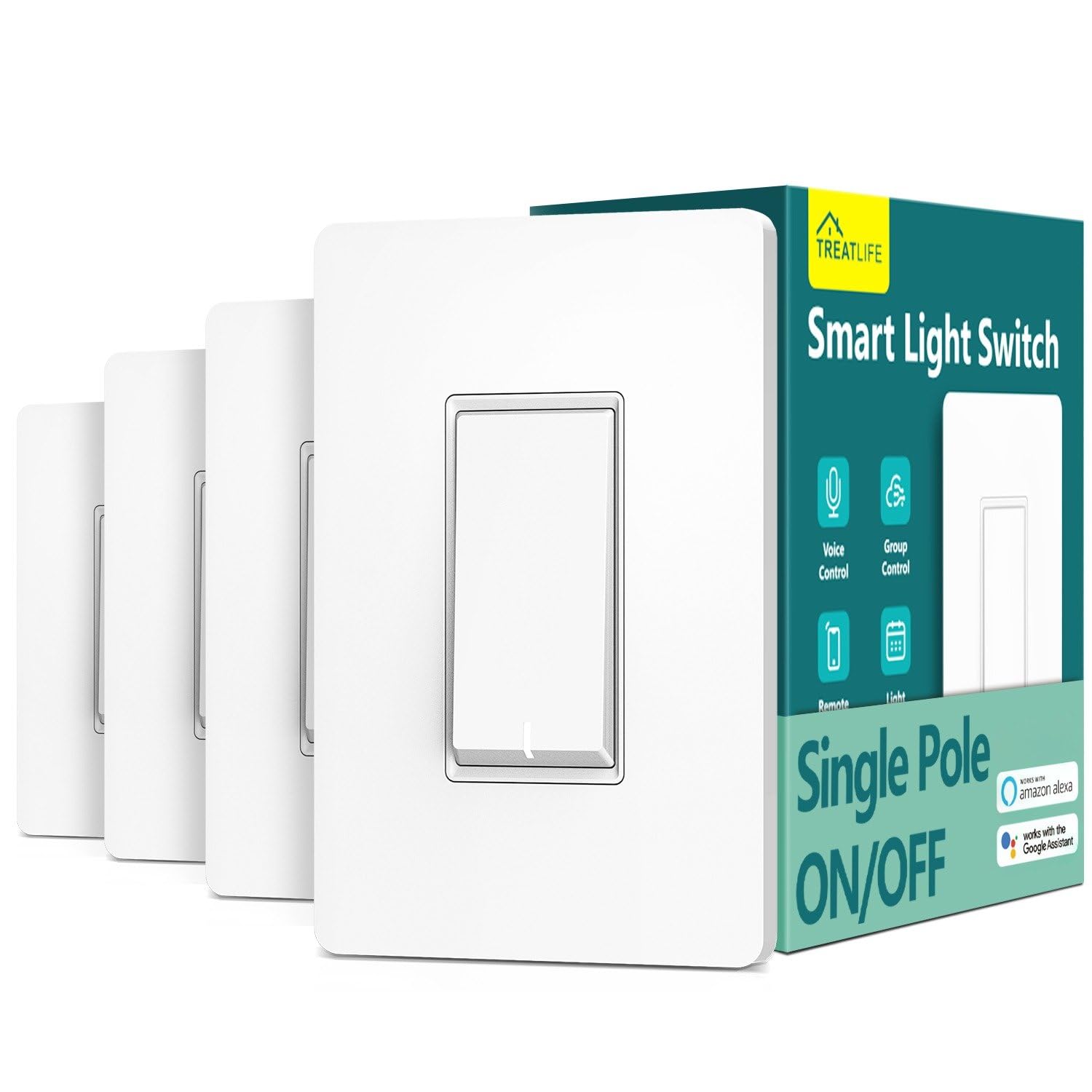
Type: Single-pole smart light switch
Connectivity: 2.4GHz Wi-Fi
Voice Assistants: Alexa, Google Home, SmartThings
Hub Required: No
Neutral Wire: Required
Certification: FCC Listed
Pack Size: 4 switches
This is the standard smart-switch format: one wall plate position, one switch, one fixture or circuit. The switch replaces a conventional single-pole toggle, connects directly to the home’s 2.4GHz Wi-Fi network, and needs no separate hub or bridge. The Treatlife app handles timers and schedules, and the Alexa, Google Home and SmartThings integrations cover voice control and broader smart-home routines.
The four-pack pricing makes this the budget-friendly way to smarten several rooms at once. A buyer with four bedrooms, a living room and a kitchen can cover most of the high-traffic circuits in one purchase. The FCC listing is a baseline safety marker rather than a premium feature, but it is worth noting at this price. The trade-off is that this model only works on single-pole circuits: a room with a second switch on the same light needs the 3-way version instead.
Trade-off: The four-pack format only pays off if at least three or four single-pole circuits need converting; a buyer with one or two rooms is paying for spares.
Check the current price on Amazon
Treatlife 3 Way Smart Switch (4 Pack)

Type: 3-way smart light switch
Connectivity: 2.4GHz Wi-Fi
Voice Assistants: Alexa, Google Home, SmartThings
Hub Required: No
Neutral Wire: Required
Certification: FCC
Pack Size: 4 switches
The 3-way version is built for circuits where two wall switches control the same light. That wiring pattern is common on staircases, in long hallways and at either end of large rooms, and it is where the single-pole model cannot go. The switch keeps the existing multi-way behavior, adds app scheduling and remote control, and still connects directly to 2.4GHz Wi-Fi without a hub. The four-pack covers up to four 3-way circuits, or a mix of 3-way and single-pole positions depending on how each switch is wired.
The extra wiring logic is what pushes the price above the single-pole pack. Buyers with several multi-way circuits will find the pack size sensible; a home with only one 3-way circuit will end up with spare units. The trade-off here is cost and complexity: the 3-way wiring is less forgiving to install than a single-pole swap, and this pack only makes sense where at least a couple of multi-way circuits exist.
Trade-off: The 3-way pack costs more per switch and demands correct traveler-wire identification at install, so it is a poor fit for homes with no multi-way circuits.
Check the current price on Amazon
How the Two Treatlife Switches Compare
Wiring and Circuit Type
The single-pole switch replaces one switch on a one-switch circuit. The 3-way switch replaces one or both ends of a two-switch circuit. This is the dimension that decides the purchase: a buyer cannot use the single-pole model on a 3-way circuit, and buying the 3-way model for a single-pole circuit wastes the extra hardware and the extra cost. The circuit type in the wall, not preference, sets the choice.
Neutral Wire Requirement
Both models require a neutral wire in the switch box. That is common for smart switches, because the electronics need constant power, but older homes sometimes lack neutrals in switch boxes. A buyer who has not checked the wiring should do so before ordering either pack. Neither model works around a missing neutral.
Connectivity and Voice Control
Both packs use 2.4GHz Wi-Fi only, so neither connects to a 5GHz network. Both work with Alexa, Google Home and SmartThings, both run without a hub, and both support app-based schedules and timers. On the smart features that matter day to day, the two are effectively identical. The difference is purely the circuit they serve.
Pack Size and Value
Both come as four-packs. The single-pole pack is the cheaper of the two, so per-switch cost is lower. The 3-way pack carries a premium for the multi-way circuitry. For a whole-home rollout, the sensible approach is often one pack of each: single-pole switches for bedrooms and living spaces, 3-way switches for hallways and stairs.
Installation Effort
The single-pole swap is the simpler job: line, load, neutral and ground. The 3-way install adds traveler wires and requires identifying the common terminal, which is where most mistakes happen. Neither is a hard job for a confident DIYer, but the 3-way model rewards careful labeling before disconnecting the old switch.
Which Should You Buy?
Choose the Treatlife Smart Light Switch Single Pole if the circuits to be converted each have one wall switch, the budget matters, and three or four rooms need smart control at once.
Choose the Treatlife 3 Way Smart Switch if the home has hallways, stairs or large rooms with two switch points on the same light, and at least a couple of those circuits need converting.
A mixed home usually needs both packs. Buyers should count the single-pole and 3-way circuits first, then order the pack that matches the larger count.
FAQ
-
Can the Treatlife single-pole switch be used on a 3-way circuit?
No. The single-pole model controls one switch point only. A 3-way circuit needs the 3-way switch. -
Do both Treatlife switches need a neutral wire?
Yes. Both product names state that a neutral wire is required, so the switch box must have one available. -
Do these switches need a hub?
No. Both connect directly to 2.4GHz Wi-Fi and work without a separate hub or bridge. -
Do both work with Alexa and Google Home?
Yes. Both list Alexa, Google Home and SmartThings support, along with app-based scheduling and timers. -
Can these switches run on a 5GHz network?
No. Both are 2.4GHz Wi-Fi only, which is standard for smart switches at this price. -
Is the 3-way switch worth it for a single-pole circuit?
No. It costs more and adds wiring complexity without any benefit on a one-switch circuit. -
How many switches come in each pack?
Both packs contain four switches, so buyers should match the pack to the number of circuits being converted.
Bottom Line
For most homes, the decision is dictated by the wiring rather than by features, since the two switches are otherwise nearly identical. Buyers converting standard one-switch rooms should take the Treatlife Smart Light Switch Single Pole four-pack for its lower cost per switch. Buyers with hallway or staircase circuits need the Treatlife 3 Way Smart Switch four-pack, and homes with both circuit types are best served by one pack of each.
