Why there are Amazon links here: Brave Review is paid a commission for qualifying Amazon purchases made through the links below. Your price does not change, and using our links is entirely optional. How this works
Best Split Charge Relay for a Leisure Battery: 5 Dual Battery Isolator Kits
A split charge relay for a leisure battery keeps the starter battery and the auxiliary battery separate while the engine runs, then links them so the alternator can top up the leisure side. The five kits below cover the full range: a budget board-only unit, mid-priced kits with LED voltmeters, and a long-cable premium kit for lithium setups. Campervan converters, boat owners and truck operators will each find a fit. The overview table below shows the differences at a glance; full reviews follow.
Overview of the Picks
| Product | Key Spec | Best Use | Price Tier |
|---|---|---|---|
| Voltage Sense Relay VSR w/s 6m Cable (VEVOR) | 12V 140A, 6m cable | Full kit for campervans and boats | Mid |
| Battery Isolator 12V 140Amp Manual/Automatic Smart VSR Kit | 12V 140A, 6m cable, LED display | Campervan and SUV builds wanting a readout | Mid |
| Split Charge Relay Kit Auto/Manual VSR with LED Voltmeter | 12V 140A, 3m cable, IP68 | Trucks and UTVs with short cable runs | Budget |
| Manual/Auto Modes VSR-Voltage Sensitive Relay | 12V 140A, LED screen | Lowest-cost entry into VSR charging | Budget |
| VEVOR Dual Battery Isolator Kit, 20 ft 6AWG | 12V 140A, 20 ft 6AWG, lithium compatible | Long runs and lithium leisure banks | Premium |
1. Voltage Sense Relay VSR w/s 6m Cable — VEVOR Split Charge Relay Kit
Type: Voltage sensitive relay (VSR)
System voltage: 12V
Current rating: 140 Amps
Cable length: 6m
Modes: Automatic dual battery isolation
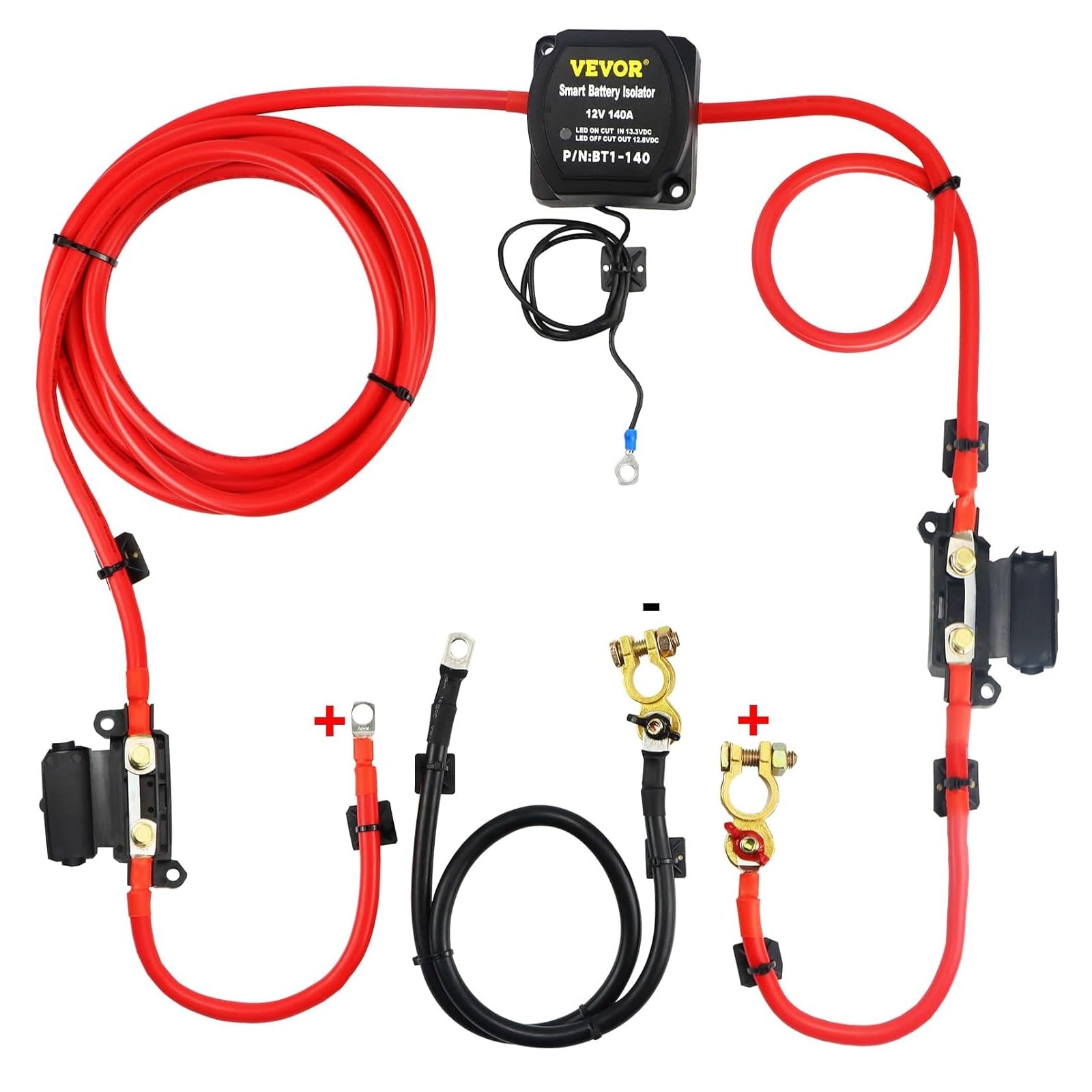
Voltage Sense Relay VSR w/s 6m Cable — VEVOR Split Charge Relay Kit
The VEVOR kit packages the relay with a 6m cable run, which is the practical length for routing from an engine bay to a leisure battery tucked under a campervan bed or into a boat locker. The 140 Amp rating covers the charging currents of a typical single alternator without the relay becoming the bottleneck. Automatic voltage sensing means the unit closes only when the alternator is lifting the starter battery, so the leisure side cannot drain the cranking battery while parked. It is aimed at buyers who want one box with the wiring included rather than sourcing cable separately.
This is the pick for a campervan or small yacht conversion where the leisure battery sits several metres from the engine. The 6m cable saves a separate purchase and keeps the install to one order. Buyers running a very high-output alternator or a large lithium bank should check the continuous rating against their setup before committing.
Trade-off: Automatic-only operation leaves no manual override, so a buyer who wants to force-link the batteries for a self-jump start will need a different unit.
2. Battery Isolator 12V 140Amp Manual/Automatic Smart VSR Kit with LED Display
Type: Voltage sensitive relay (VSR)
System voltage: 12V
Current rating: 140 Amps
Cable length: 6m
Modes: Manual and automatic
Display: LED

Battery Isolator 12V 140Amp Manual/Automatic Smart VSR Kit with LED Display
This kit adds two things the VEVOR unit lacks: a manual mode and an LED display. Manual mode lets the owner link the two batteries on demand — useful for a deliberate self-jump or for topping the leisure bank from the starter side in an emergency. The LED readout gives a live voltage reference so the state of the charging system can be checked without reaching for a multimeter. The 6m cable and 140 Amp rating match the VEVOR kit, so the choice between them comes down to features rather than capacity.
It suits the campervan or SUV owner who wants visibility into the electrical system and a fallback manual control. The display is a genuine convenience on a long trip where a failing alternator or a loose connection would otherwise go unnoticed until the fridge stops.
Trade-off: The extra display and switch gear add failure points a plain relay does not have, so a buyer who values simplicity above all may prefer the basic unit.
3. Split Charge Relay Kit Auto/Manual VSR with LED Voltmeter — IP68
Type: Voltage sensitive relay (VSR)
System voltage: 12V
Current rating: 140 Amps
Cable length: 3m
Modes: Automatic and manual
Protection: IP68
Display: LED voltmeter

Split Charge Relay Kit Auto/Manual VSR with LED Voltmeter — IP68
The IP68 rating is the headline here. A relay mounted in a truck bed, a UTV tray or a boat bilge sees spray, dust and vibration, and an IP68 housing is built to shrug that off. The 3m cable is shorter than the 6m kits, which is fine for a compact install where the two batteries sit close together — a truck with the auxiliary battery in the same bay, or a UTV with a small second battery nearby. Manual and automatic modes plus an LED voltmeter round out the feature set at the lowest price of the cabled kits.
This is the pick for trucks, UTVs and small boats where the run between batteries is short and the environment is harsh. The IP68 sealing is the reason to choose it over the cheaper board-only option. Buyers with a long cable run should measure first, because 3m runs out quickly on a full-size van.
Trade-off: The 3m cable is the shortest in this roundup, so a van or RV with the leisure battery at the rear will need to extend the wiring or pick a longer kit.
4. Manual/Auto Modes VSR-Voltage Sensitive Relay with LED Screen
Type: Voltage sensitive relay (VSR)
System voltage: 12V
Current rating: 140 Amps
Modes: Manual and automatic
Display: LED screen

Manual/Auto Modes VSR-Voltage Sensitive Relay with LED Screen
This is the relay on its own, without the cable kit, and the price reflects that. It carries the same 12V 140 Amp rating and the same manual/automatic modes as the cabled kits, plus an LED screen for voltage. For a buyer who already has cable, fuses and connectors on the shelf, buying the relay alone is the cheapest route into voltage-sensing charging. The compact body fits tight spaces where a bundled kit’s wiring would be surplus.
It suits the DIY installer with parts in hand and the ATV, UTV or small boat owner with a short, simple run. It is not the right first purchase for someone starting from nothing, because the missing cable and hardware turn a cheap relay into a project.
Trade-off: No cable or installation hardware is included, so the low price only holds for buyers who already own the wiring, fuses and connectors.
5. VEVOR Dual Battery Isolator Kit, 20 ft 6AWG, Lithium Compatible
Type: Voltage sensitive relay (VSR)
System voltage: 12V
Current rating: 140 Amps
Cable: 20 ft, 6AWG
Modes: Manual and automatic
Display: LCD screen with voltmeter
Compatibility: Lithium batteries
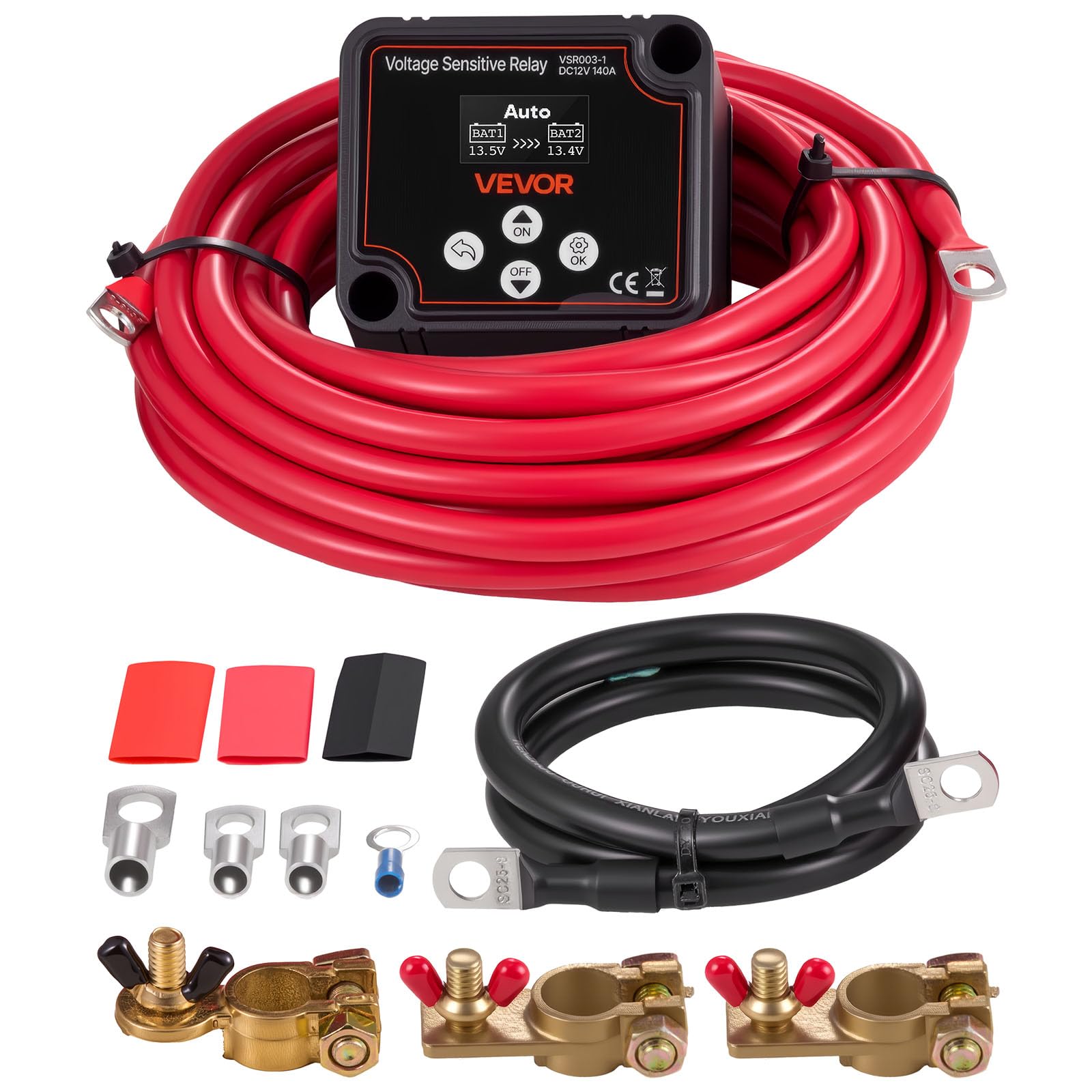
VEVOR Dual Battery Isolator Kit, 12V 140 Amp 20 ft 6AWG — Lithium Compatible
The 20 ft run of 6AWG cable is the defining feature: that is enough to reach a leisure battery at the back of a long van or a boat’s aft locker without splicing, and 6AWG keeps voltage drop low over that distance. Lithium compatibility matters because a lithium leisure bank has different charging expectations from lead-acid, and a VSR that names lithium in its spec is signalling it will not fight the battery’s own management. Manual and automatic modes, an LCD screen with voltmeter, and the 140 Amp rating complete a kit that is clearly the premium option here.
This is the pick for a long-wheelbase campervan, a boat with a distant battery locker, or any build running a lithium leisure battery. The cable alone justifies much of the price difference over the shorter kits. Buyers with a short run and a lead-acid battery are paying for cable they will coil up and never use.
Trade-off: The long 6AWG cable and LCD screen push this to the top of the price range, and a short-run lead-acid install will not use the extra length or the lithium-friendly design.
Before You Buy
- Cable length: Measure the actual route from starter battery to leisure battery, including bends and bulkheads. A 3m kit rarely covers a full-size van; 6m is the safer default and 20 ft covers long wheelbases.
- Current rating: Match the relay’s amp rating to the alternator’s charging output and the leisure bank’s acceptance rate. A 140 Amp relay suits most single-alternator setups.
- Battery chemistry: A lithium leisure battery needs a VSR rated for it. Lead-acid and AGM are served by any of these kits.
- Modes: Automatic-only is simplest; manual override adds a self-jump option and a fallback if the sensing circuit misbehaves.
- Environmental sealing: An IP68-rated relay is the right call for truck beds, UTV trays and boat bilges where spray and dust are constant.
- Included accessories: A relay-only purchase needs cable, fuses, connectors and a mounting solution bought separately — factor that into the total cost.
- Display: An LED or LCD voltmeter is a convenience for spotting charging faults early, not a substitute for a proper battery monitor.
Frequently Asked Questions
-
What does a split charge relay for a leisure battery actually do?
It links the starter battery to the leisure battery only when the engine is running and the alternator is charging, so the leisure side tops up in transit and cannot flatten the cranking battery when parked. -
Is a voltage sensitive relay the same as a split charge relay?
A VSR is a type of split charge relay that switches on voltage rather than a signal from the ignition. All five kits here are VSRs, and all do the same core job. -
Can these relays charge a lithium leisure battery?
Only the VEVOR 20 ft kit names lithium compatibility. A lithium bank has its own management system, so buyers should confirm the relay is rated for that chemistry before pairing them. -
How long a cable run is needed?
It depends on where the two batteries sit. A 3m kit suits compact installs, 6m covers most campervans, and the 20 ft kit handles long wheelbases and distant boat lockers. -
Does the relay replace a battery monitor?
No. The LED and LCD displays show voltage as a quick reference, but a dedicated battery monitor is the tool for tracking state of charge and consumption. -
Can a manual mode damage the batteries?
Manual mode links the batteries on demand, which is useful for a self-jump. Leaving it engaged while parked will let the two batteries drain together, so it should be treated as a temporary override.
Bottom Line
The VEVOR 20 ft 6AWG kit is the top pick for most buyers: the long cable reaches a rear-mounted leisure battery without splicing, the 6AWG conductor keeps voltage drop in check, and the lithium compatibility future-proofs the install. Buyers on a tight budget with a short run should look at the IP68 3m kit instead, and DIY installers with wiring already on the shelf get the best value from the relay-only unit. Check the current price on the VEVOR 20 ft kit before ordering.
