Why there are Amazon links here: Brave Review is paid a commission for qualifying Amazon purchases made through the links below. Your price does not change, and using our links is entirely optional. How this works
Best WiFi Extender That Actually Helps for Whole-Home Coverage
A WiFi extender only earns its place when it closes the dead zone without dragging the network down. The five picks below cover the realistic cases: a small home with one weak room, a larger house with a gigabit connection, a household packed with devices, and a whole-home replacement for buyers tired of patchwork. Each entry states what it is for, who it suits and where it falls short, so the choice takes minutes rather than a weekend of research. The overview table below lines up every pick before the detailed reviews.
Overview of the Top WiFi Extenders
| Product | Key Spec | Best Use | Price Tier |
|---|---|---|---|
| TP-Link AC1200 WiFi Extender RE315 | 1.2Gbps, 1,600 sq. ft., 32 devices | Small homes and single dead rooms | Budget |
| TP-Link AC1900 WiFi Range Extender RE550 | Dual-band AC1900, 2,200 sq. ft., gigabit port | Mid-size homes with wired devices | Mid-range |
| TP-Link RE615X AX1800 WiFi 6 Range Extender | WiFi 6, 1.8G, 2,100 sq. ft., 64 devices | Device-heavy homes wanting WiFi 6 | Mid-range |
| TP-Link Deco S4 Mesh AC1900 WiFi System | 3-pack mesh, 5,500 sq. ft., replaces router | Whole-home coverage across floors | Premium |
| Dual-Band WiFi Extender Signal Booster 5G | 1200Mbps, 5,000 sq. ft., 35 devices | Budget buyers with very large spaces | Budget |
1. TP-Link AC1200 WiFi Extender RE315

Type: Dual-band wall-plug extender
Speed: 1.2Gbps across 5GHz and 2.4GHz
Coverage: Up to 1,600 sq. ft.
Device Load: Up to 32 devices
Ports: One Ethernet port
Mesh Compatibility: EasyMesh
The RE315 is the entry point into the range, and it is built for the simplest job on the list: pushing a usable signal into one or two rooms that the router cannot reach. The dual-band design splits traffic between the faster 5GHz band and the longer-reaching 2.4GHz band, and the single Ethernet port lets a desktop, console or TV connect by cable instead of wireless. The wall-plug body keeps installation to a socket and a phone, with no separate power brick. EasyMesh compatibility means it can join a compatible mesh network later rather than being stranded as a standalone unit.
The RE315 suits renters, apartment dwellers and anyone with a router in one corner and a dead bedroom in the other. It is the pick for buyers who want the dead zone gone for the smallest outlay and do not need to feed a dozen screens at once. The trade-off is headroom: at 1.2Gbps and 32 devices, a household streaming in several rooms simultaneously will feel the ceiling sooner than with the larger picks.
Check the current price on Amazon
2. TP-Link AC1900 WiFi Range Extender RE550
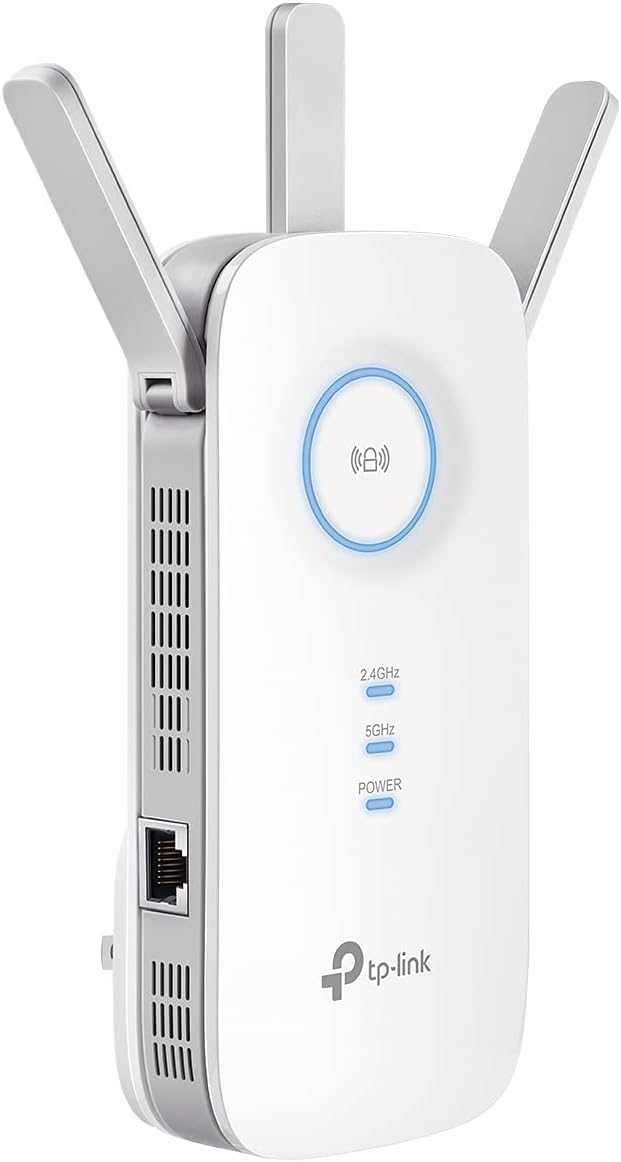
Type: Dual-band wall-plug extender
Speed: AC1900 dual-band
Coverage: Up to 2,200 sq. ft.
Device Load: Up to 32 devices
Ports: Gigabit Ethernet
Setup: App-based
Mesh Compatibility: EasyMesh
The RE550 is the step up for households where the extender has to carry real traffic, not just a phone and a laptop. The AC1900 rating gives it more throughput than the budget pick, and the gigabit Ethernet port is the meaningful upgrade: a wired device behind the extender runs at full gigabit speed rather than being capped by a slower port. App-based setup keeps configuration on a phone, and EasyMesh compatibility lets it slot into a compatible network.
This is the pick for a mid-size home with a home office, a console or a NAS in the far room, where a cable run is impractical but wireless alone is not enough. It earns its place because the gigabit port solves a problem the cheaper units cannot. The trade-off is that the device load stays at 32, so a large family with many connected gadgets should look at the WiFi 6 model instead.
Check the current price on Amazon
3. TP-Link RE615X AX1800 WiFi 6 Range Extender

Type: Dual-band wall-plug extender with WiFi 6
Speed: AX1800, 1.8G
Coverage: Up to 2,100 sq. ft.
Device Load: Up to 64 devices
Ports: Ethernet
Setup: App-based
Mesh Compatibility: EasyMesh
The RE615X is the pick for a household where the device count is the bottleneck. WiFi 6 handles many simultaneous connections more gracefully than older standards, and the 64-device rating is double the two AC models above. The 1.8G dual-band throughput and 2,100 sq. ft. coverage put it in the same physical territory as the RE550, but the newer wireless standard is what separates it. App setup and an Ethernet port round out the package.
Buyers with a WiFi 6 router, a house full of phones, tablets, cameras and smart speakers, and a far room that still drops should start here. It earns its place because the device ceiling is the spec that most often causes an extender to disappoint, and this one raises it. The trade-off is that WiFi 6 benefits only materialize with a WiFi 6 router; on an older router the extra capability goes largely unused.
Check the current price on Amazon
4. TP-Link Deco S4 Mesh AC1900 WiFi System (3-Pack)

Type: Mesh WiFi system, 3-pack
Speed: AC1900
Coverage: Up to 5,500 sq. ft.
Ports: Gigabit
Function: Replaces the router and extender
Voice Control: Works with Alexa
The Deco S4 is not an extender in the traditional sense — it replaces the router and the extender with three mesh units that share one network name. That design removes the handoff problem where a phone clings to a weak signal instead of switching to the closer extender. Coverage reaches up to 5,500 sq. ft. across the three units, and the gigabit ports keep wired devices fast. Setup runs through the Deco app, and the system works with Alexa for voice control.
This is the pick for a multi-floor house or a long property where one extender would never be enough, and for buyers who would rather solve the problem once than add another box every year. It earns its place because a mesh system is the only option here that eliminates the dead zone at the source. The trade-off is commitment: it replaces the existing router, so the setup is a full network change rather than a plug-in addition, and the upfront cost is the highest on the list.
Check the current price on Amazon
5. Dual-Band WiFi Extender Signal Booster 5G

Type: Dual-band wall-plug extender
Speed: 1200Mbps
Coverage: Up to 5,000 sq. ft.
Device Load: Up to 35 devices
Bands: 5G and 2.4GHz dual-band
Ports: Ethernet
The budget-friendly option on this list pairs a 1200Mbps dual-band radio with a stated coverage figure that dwarfs its price class. The 5GHz band carries the faster traffic while the 2.4GHz band reaches further through walls, and the Ethernet port allows a wired connection at the extender. The 35-device rating sits just above the AC1200 pick. For a buyer who needs a large space covered on a tight budget, the numbers are appealing on paper.
This pick suits cost-conscious buyers with a sprawling single-floor home or a garage, shed or converted space far from the router. It earns its place as the value alternative for sheer stated coverage. The trade-off is that a 1200Mbps radio cannot defy physics: at the edge of a very large space, throughput will fall well below what the coverage figure implies, and buyers expecting gigabit-class speed across 5,000 sq. ft. will be disappointed.
Check the current price on Amazon
Before You Buy
- Coverage vs. reality: Stated square footage assumes open space; walls, floors and appliances cut it substantially, so size the pick one step above the measured area.
- Router standard: A WiFi 6 extender only pays off with a WiFi 6 router; matching the extender to the router’s standard avoids paying for unused capability.
- Device count: The device rating is the spec most likely to cause regret — count phones, tablets, TVs, consoles, cameras and smart plugs before choosing.
- Wired ports: A gigabit Ethernet port matters for consoles, desktops and TVs; a slower port caps wired speed regardless of the wireless rating.
- Mesh vs. extender: An extender adds to an existing network; a mesh system replaces the router and removes handoff issues, at a higher cost and with a full reconfiguration.
- Placement: The extender must sit in a spot with a usable router signal, roughly midway between router and dead zone — placing it inside the dead zone defeats the purpose.
- Setup method: App-based setup is the norm on current models; check that the app is available for the phone in use before buying.
Frequently Asked Questions
-
Will a WiFi extender actually help, or just add another weak signal? It helps when placed where the router signal is still usable — roughly halfway to the dead zone. Placed inside the dead zone, it repeats a weak signal and helps little.
-
Does an extender slow down the network? A traditional extender halves throughput on the repeated band because it talks to the router and the device on the same radio. A mesh system or a wired backhaul avoids most of that penalty.
-
Is a mesh system better than an extender? For a multi-floor home or a large area, yes — mesh removes handoff problems and covers more ground. For one dead room, a single extender is cheaper and simpler.
-
Does a WiFi 6 extender help with an older router? Only marginally. The newer standard’s benefits depend on both ends supporting it, so an older router limits what the extender can deliver.
-
How many devices can an extender handle? The picks here range from 32 to 64 devices. Exceeding the rating causes drops and slowdowns, so count connected gadgets before choosing.
-
Can an extender be used with a wired connection? Yes — every pick here has an Ethernet port, and connecting a device by cable at the extender typically gives the most stable result.
Bottom Line
For most buyers, the TP-Link AC1900 WiFi Range Extender RE550 is the safest single choice: enough throughput for real traffic, a gigabit port for wired devices, and app setup without a full network overhaul. Households with many devices should step up to the WiFi 6 RE615X, while a multi-floor home is better served by the Deco S4 mesh system. Buyers on the tightest budget can start with the RE315 for a single dead room.