Why there are Amazon links here: Brave Review is paid a commission for qualifying Amazon purchases made through the links below. Your price does not change, and using our links is entirely optional. How this works
Geevon Water Leak Detectors vs Tecknet Water Leak Detectors: Ten Alarms or a Phone in Your Pocket
The choice between these two comes down to one question: does the buyer want to be told about a leak by a siren in the next room, or by a notification on a phone that could be anywhere? The Geevon set covers a whole house with ten standalone alarms and no setup. The Tecknet pair costs more per unit but adds app alerts, WiFi reporting and a fully sealed housing. This comparison lays out the differences that actually matter, then names the buyer each one suits.
Geevon Water Leak Detectors

Type: Standalone water leak alarm
Pack Size: 10 detectors
Alarm: 100dB sensor alarm
Power: Batteries included
Placement: Basement, bathroom, laundry room, sink, garage, wine cellar, RV, window
The Geevon set is built around coverage and simplicity. Ten self-contained units mean a leak can be caught under a sink, behind a washing machine and beside a water heater at the same time, with no hub, no app and no network to configure. Batteries come in the box, so the whole set can be placed the day it arrives.
Each unit works on its own: water bridges the contacts, the alarm sounds at 100dB, and anyone within earshot investigates. That is the entire mechanism, and it is the reason the pack is worth considering for outbuildings, RVs and rental properties where WiFi may be weak or absent. The trade-off is that a standalone alarm is only as useful as the nearest pair of ears.
Trade-off: Ten alarms share one budget, so the housings and sensing contacts are built to a price, and no unit can alert anyone who is not within hearing range.
Tecknet Water Leak Detectors
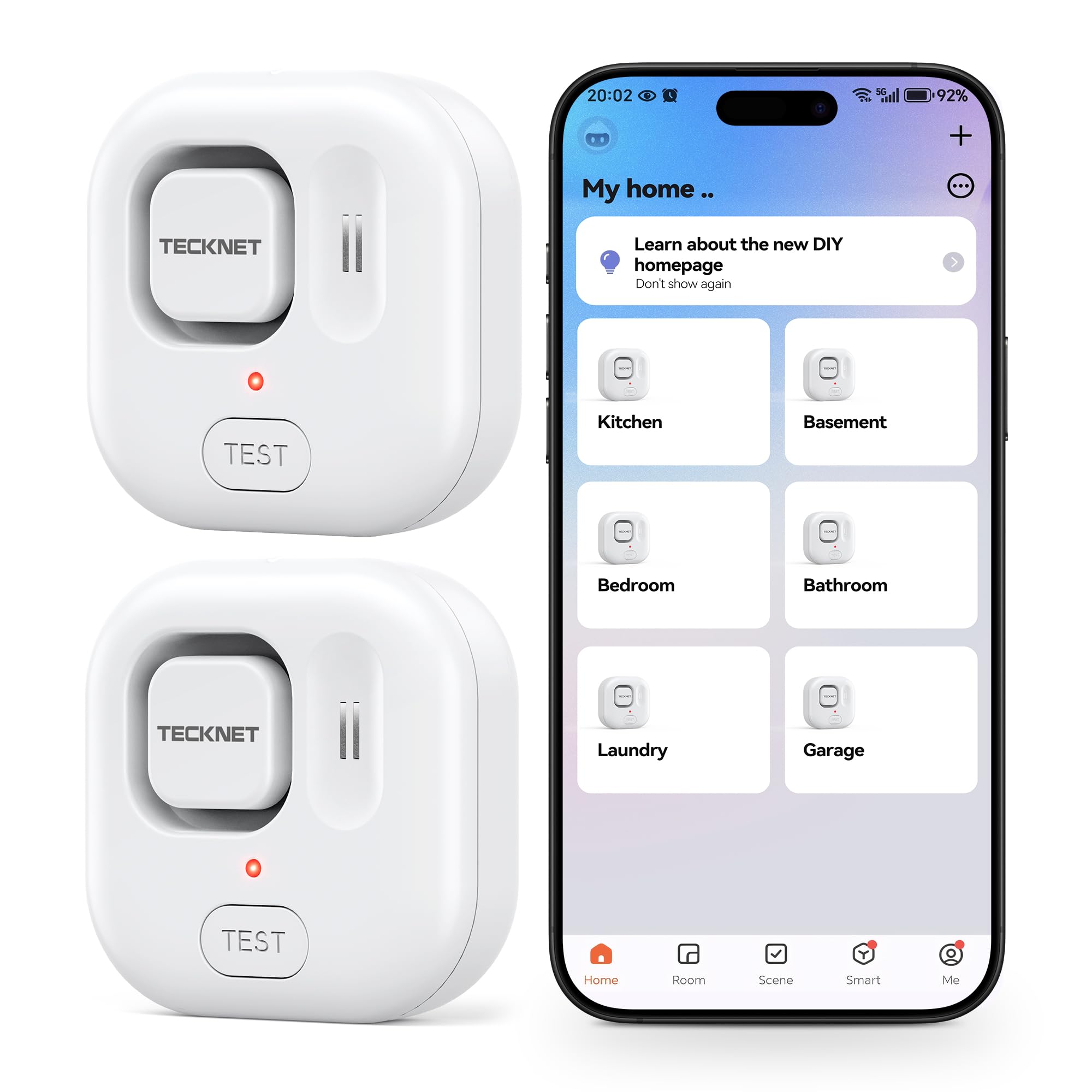
Type: WiFi smart leak sensor
Pack Size: 2 sensors
Alarm: 120dB local alarm plus app alerts
Weatherproofing: IP67 waterproof
Connectivity: WiFi, no hub required
Power: Battery included
The Tecknet pair is the connected option. Each sensor joins the home WiFi network directly, with no hub or bridge in the chain, and pushes an alert to a phone when water is detected. A 120dB siren also sounds locally, so the unit works as a conventional alarm for anyone at home while the app covers the times nobody is.
The IP67 rating is the detail that separates it from most budget leak sensors. That level of sealing means the housing tolerates splashes and damp surroundings, which makes it a more realistic fit for a basement floor, under a kitchen sink or beside a washing machine than an open-contact design. Two sensors is a small kit, though, and the app is the whole point of the product — a buyer who will not keep a phone to hand gains little over a plain alarm.
Trade-off: Coverage is thin at two units per pack, and the app alert is only as reliable as the home WiFi network it depends on.
Geevon vs Tecknet: Side-by-Side Comparison
| Attribute | Geevon Water Leak Detectors | Tecknet Water Leak Detectors |
|---|---|---|
| Type | Standalone leak alarm | WiFi smart leak sensor |
| Pack size | 10 detectors | 2 sensors |
| Alarm volume | 100dB | 120dB |
| App alerts | No | Yes |
| Hub required | No | No |
| Waterproofing | Not rated | IP67 waterproof |
| Power | Batteries included | Battery included |
| Best use | Whole-home coverage, RVs, outbuildings | Remote monitoring while away |
The Comparison
Coverage and Pack Size
Geevon wins on raw coverage. Ten units let a buyer blanket the usual leak spots — under the kitchen sink, behind the washer, beside the water heater, in the basement, in the RV — without rationing. Tecknet ships two, so the buyer has to pick the two places that matter most or buy multiple packs.
That difference matters more than it first appears. Most water damage starts in a spot nobody watches, and the more sensors in place, the better the odds one is sitting in the right place. For a first-time setup in a large house, the Geevon pack covers more ground for less outlay per unit.
Alerting: Siren vs Phone
The alerting model is the real fork in the road. Geevon relies entirely on a 100dB siren: loud enough to carry through a floor, useless if nobody is home. Tecknet sounds a louder 120dB alarm and also sends an app notification, which is the only way to learn about a burst pipe while at work or on holiday.
Buyers who are frequently away from home should weight this heavily. A leak that runs for eight hours before anyone returns is a different repair bill from one caught in ten minutes, and only the Tecknet can shorten that window remotely.
Build and Water Resistance
Tecknet’s IP67 rating is a genuine advantage in wet rooms. A sensor sitting on a basement floor or under a sink will get splashed, and a sealed housing is built for that. The Geevon units are conventional standalone alarms, and while they are designed to sit on a damp floor, they carry no equivalent water-resistance claim.
Neither product is a substitute for a plumber’s inspection, but for longevity in a genuinely wet location the Tecknet housing is the more reassuring of the two.
Setup and Dependence on WiFi
Geevon is the simpler install by a wide margin: place the units, and the job is done. There is no network to join, no account to create and no dependence on a router staying up during a storm — which is precisely when a basement is most likely to flood.
Tecknet needs a working 2.4GHz WiFi network and the app configured before it does anything useful. That is a one-time task, but it also means the product’s headline feature fails silently if the network drops or the router is replaced and the credentials change.
Cost per Sensor
The Geevon pack spreads its cost across ten detectors, which makes it the cheaper option per point of coverage. Tecknet’s two-sensor pack carries a higher per-unit cost, and the premium buys the WiFi radio, the app and the sealed housing rather than more sensors.
Buyers comparing on price alone will find Geevon the better value. Buyers comparing on the value of an early warning while away will find the per-unit maths less relevant.
Which Should You Buy?
Choose Geevon if the priority is covering a whole property quickly and cheaply, the building has weak or no WiFi in the places that leak, or the sensors are destined for an RV, garage or rental where a simple siren is all that is needed. It also suits buyers who want a set in place today with no configuration.
Choose Tecknet if the home is regularly empty during the day, the buyer wants a phone alert rather than relying on someone being within earshot, or the sensor will sit in a genuinely wet spot where an IP67 housing earns its keep. Two units is a small kit, so plan on buying more than one pack for a full house.
FAQ
-
Do the Geevon detectors need WiFi or a smartphone?
No. They are standalone alarms that sound a 100dB siren when water reaches the sensor, with no hub, app or network involved. -
Does the Tecknet sensor need a hub?
No. The product connects directly to WiFi, so there is no separate bridge or hub to buy. -
Can the Tecknet sensor alert a phone while the homeowner is away?
Yes. App alerts are the core feature, and they work anywhere the phone has a connection, provided the sensor is online. -
Which set covers more of a house?
Geevon, by a wide margin. Ten detectors against two means far more rooms can be monitored out of one box. -
Is the Tecknet sensor suitable for a basement or under a sink?
The IP67 waterproof rating makes it the better choice for damp, splash-prone locations of the two. -
Which alarm is louder?
Tecknet at 120dB, against 100dB on the Geevon units. Both are loud enough to be heard through a wall or floor. -
Do both come with batteries?
Yes. Batteries are included with both products, so neither needs a separate purchase to get started.
Bottom Line
For most buyers the Geevon Water Leak Detectors are the better first purchase: ten alarms, batteries in the box, no network to configure and enough coverage to protect the places that actually leak. The Tecknet pair earns its place for a specific buyer — one who is away often and needs a phone alert, or who wants the sealed IP67 housing in a wet room. Buy the Geevon set to cover the house; add a Tecknet pack for the one or two spots that need remote monitoring.
