Why there are Amazon links here: Brave Review is paid a commission for qualifying Amazon purchases made through the links below. Your price does not change, and using our links is entirely optional. How this works
Best Network Setup for a Smart Home for Whole-Home Coverage
A smart home lives or dies on its Wi-Fi. Doorbells, cameras, thermostats, and robot vacuums all compete for bandwidth, and a single router often cannot reach every corner. The five picks below cover the best network setup for a smart home across three buyer profiles: budget-focused households adding a few devices, mid-size homes that need reliable mesh coverage, and large or multi-gig homes running dozens of connected gadgets. The overview table below shows each option at a glance, and the reviews that follow explain who each one suits.
Overview of the Picks
| Product | Key Spec | Best Use | Price Tier |
|---|---|---|---|
| TP-Link Deco X55 AX3000 (3-Pack) | Wi-Fi 6, 6,500 sq ft, 3 Gigabit ports per unit | Best overall for most smart homes | Mid-range |
| Deco 7 Pro Tri-Band WiFi 7 BE10000 (3-Pack) | Wi-Fi 7, 7,600 sq ft, 4 x 2.5G ports | Best for large homes and heavy device loads | Premium |
| Google WiFi AC1200 Mesh Bundle (3-Pack) | Wi-Fi 5, 4,500 sq ft, easy setup | Best simple setup for smart-home beginners | Mid-range |
| NETGEAR Orbi 370 Series WiFi 7 (3-Pack) | Wi-Fi 7, 6,000 sq ft, 70 devices | Best for device-dense homes | Upper mid-range |
| TP-Link AC1200 WiFi Extender (RE315) | Wi-Fi 5, 1,600 sq ft, 32 devices | Best budget fix for a single dead zone | Budget |
1. TP-Link Deco X55 AX3000 WiFi 6 Mesh System (3-Pack)

Wireless Standard: Wi-Fi 6 (AX3000)
Coverage: Up to 6,500 sq ft
Ports: 3 Gigabit ports per unit
Backhaul: Supports Ethernet backhaul
Pack Size: 3 units
Replaces: Wireless router and extender
TP-Link Deco X55 AX3000 WiFi 6 Mesh System, Deco X55(3-Pack)
The Deco X55 is the sensible default for most smart homes. Three units blanket a mid-size house in Wi-Fi 6 coverage, and each node carries three Gigabit ports, which matters when a hub, a TV, and a game console all want a wired connection. Ethernet backhaul support means the system can run its inter-unit traffic over cable if the house is pre-wired, freeing wireless bandwidth for devices. The design is compact and unobtrusive, so nodes can sit on a shelf or console without drawing attention. It replaces both an existing router and any extenders, simplifying the network into one managed mesh.
This pick suits households with a growing collection of smart devices that want a single, well-supported mesh without paying flagship prices. It earned its place as the best overall because it balances coverage, wired flexibility, and price better than anything else here. The caution: Wi-Fi 6 is now a generation behind Wi-Fi 7, so buyers planning to keep the system for many years may find it dated sooner than expected.
Trade-off: The AX3000 class tops out well below the multi-gig speeds newer devices can use, so it is a poor match for buyers already running heavy local-network transfers.
2. Deco 7 Pro Tri-Band WiFi 7 BE10000 Whole Home Mesh System (3-Pack)
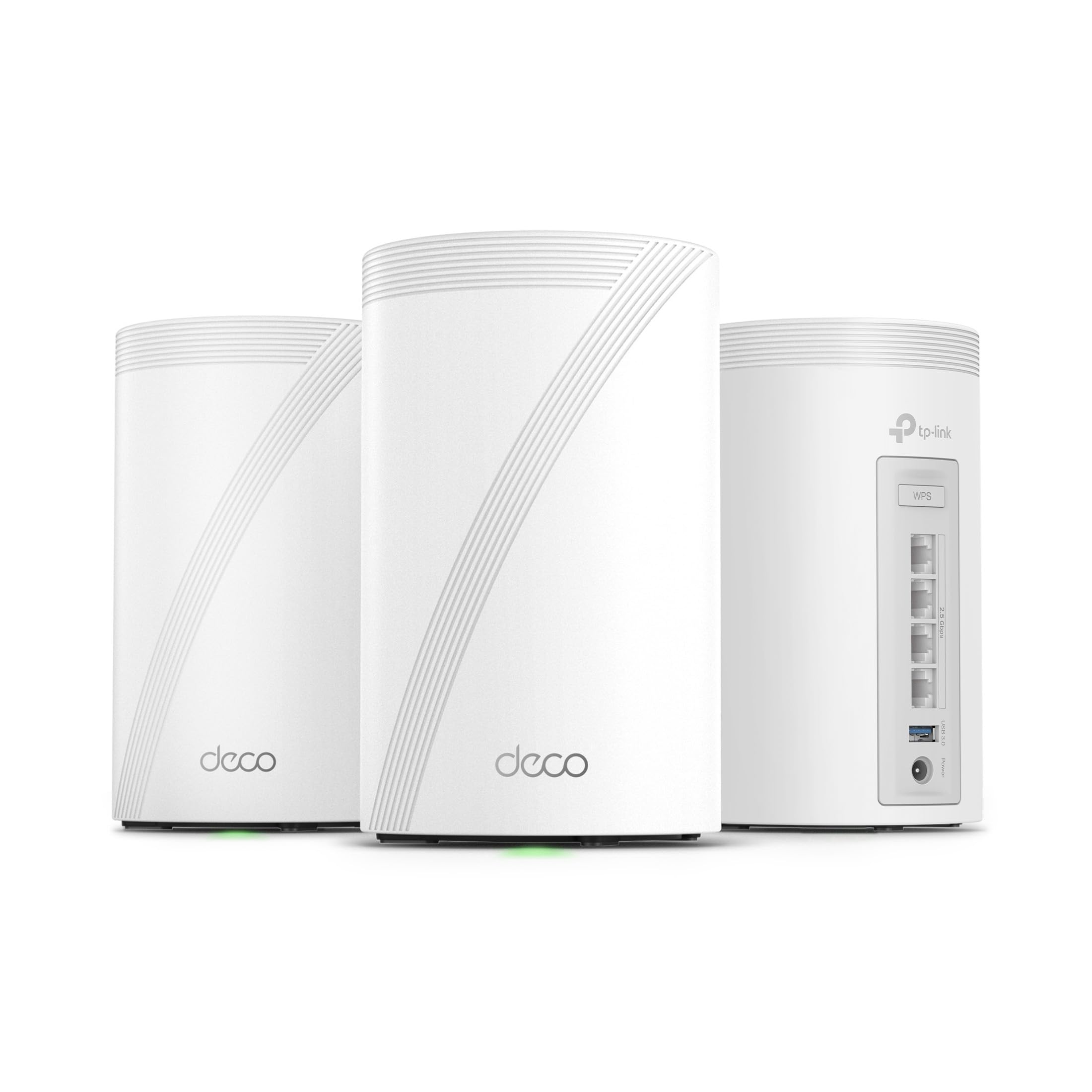
Wireless Standard: Wi-Fi 7 (BE10000, tri-band)
Coverage: Up to 7,600 sq ft
Ports: 4 x 2.5G ports
Backhaul: Wired backhaul supported
Antennas: 4 x smart internal
Features: VPN, HomeShield, AI-Roaming
Streams: 6-stream
Deco 7 Pro Tri-Band WiFi 7 BE10000 Whole Home Mesh System 6-Stream 10 Gbps
The Deco 7 Pro is the premium answer for large homes with dozens of connected devices. Tri-band Wi-Fi 7 with six streams gives the network room to separate smart-home traffic from streaming and gaming, while four 2.5G ports per unit make it a genuinely fast wired backbone. AI-Roaming helps devices hand off between nodes as they move through the house, which keeps cameras and phones from clinging to a distant unit. HomeShield and VPN support add network-level security and remote access without extra hardware. Coverage reaches up to 7,600 sq ft across the three-pack.
This system suits buyers in big or multi-story homes who run many devices and want headroom for years. It earned its place as the top choice for performance and future-proofing. The caution: at this price, the system is overkill for a small apartment or a household with only a handful of smart devices, and the extra capability goes unused.
Trade-off: The premium price only pays off in a large, device-heavy home; smaller households will spend far more than their needs justify.
3. Google WiFi AC1200 Mesh Router System Bundle (3-Pack)

Wireless Standard: Wi-Fi 5 (AC1200)
Coverage: Up to 4,500 sq ft
Pack Size: 3 units
Setup: Easy setup
Signal: Seamless for smart-home devices
Color: Snow
The Google WiFi bundle is built for simplicity. Setup is guided and quick, and the three-unit mesh spreads a seamless signal across a mid-size home so smart devices stay connected as they move between rooms. The AC1200 class is modest, but for doorbells, bulbs, plugs, and speakers, raw speed is rarely the bottleneck. The snow-white finish blends into walls and shelving, and the system manages handoffs automatically. It is a clean, low-fuss entry into whole-home mesh networking.
This pick suits first-time mesh buyers and renters who want reliable coverage without configuration work. It earned its place as the easiest setup here. The caution: Wi-Fi 5 is the oldest standard in this roundup, so the system offers the least headroom for future high-bandwidth devices and heavy 4K streaming across many rooms.
Trade-off: The older Wi-Fi standard limits long-term usefulness for households that plan to add many high-speed devices.
4. NETGEAR Orbi 370 Series WiFi 7 Mesh System (3-Pack)

Wireless Standard: Wi-Fi 7 (dual-band)
Coverage: Up to 6,000 sq ft
Speed: Up to 5 Gbps
Devices: Up to 70 devices
Port: 2.5 Gig port
Pack Contents: Router + 2 satellite extenders
Security: Security features included
NETGEAR Orbi 370 Series WiFi 7 Mesh System, Up to 6,000 sq ft., 3 Pack
The Orbi 370 Series targets device-dense homes. Its stated capacity of up to 70 devices fits a house full of cameras, sensors, and screens, and the 2.5 Gig port gives the main router a fast wired uplink. Wi-Fi 7 support with speeds up to 5 Gbps keeps the network current, while built-in security features add a layer of protection for always-on smart devices. The three-piece kit pairs a router with two satellite extenders for up to 6,000 sq ft of coverage. Dual-band operation keeps the hardware simpler than tri-band rivals.
This pick suits households where device count is the real constraint, not raw speed. It earned its place as the best option for crowded networks. The caution: dual-band Wi-Fi 7 gives up the extra lane that tri-band systems use for backhaul, so performance in very large homes may trail pricier tri-band mesh kits.
Trade-off: The dual-band design is a step behind tri-band systems for heavy backhaul traffic in big, multi-floor homes.
5. TP-Link AC1200 WiFi Extender (RE315)

Wireless Standard: Wi-Fi 5 (AC1200, dual-band)
Coverage: Up to 1,600 sq ft
Devices: Up to 32 devices
Port: One Ethernet port
Compatibility: EasyMesh compatible
Speed: Up to 1.2 Gbps
TP-Link AC1200 WiFi Extender Dual Band 5GHz/2.4GHz (RE315)
The RE315 is the budget fix for a single weak spot. It boosts a home signal across up to 1,600 sq ft and supports up to 32 devices, which covers a garage, a back bedroom, or a patio camera. Dual-band operation lets it use the 5GHz band for speed and 2.4GHz for range, and EasyMesh compatibility means it can join a compatible mesh network rather than running as a lone extender. One Ethernet port allows a wired device to connect at the edge of coverage. At this price, it is the cheapest way to close a gap.
This pick suits buyers who already have a working router and just need one dead zone eliminated. It earned its place as the budget entry. The caution: an extender repeats an existing signal rather than creating a new mesh, so it cannot match a full mesh system for whole-home coverage or seamless roaming.
Trade-off: As a single extender, it solves one weak area but will not deliver the consistent whole-home mesh that multi-unit systems provide.
Before You Buy
- Coverage: Match the system’s stated square footage to the home, with some margin for walls and floors that weaken signal.
- Wireless standard: Wi-Fi 6 and Wi-Fi 7 offer more headroom than Wi-Fi 5; older standards suit light device loads and tight budgets.
- Device capacity: Count cameras, plugs, bulbs, and screens, then choose a system rated well above that number.
- Ports: Wired ports matter for hubs, consoles, and TVs; check how many each unit provides.
- Backhaul: Ethernet backhaul improves mesh performance in pre-wired homes; confirm the system supports it.
- Compatibility: EasyMesh-compatible extenders can join compatible mesh networks; check before mixing brands.
- Budget: A single extender costs far less than a mesh kit but fixes less; a full mesh system is the better long-term buy for whole-home coverage.
Frequently Asked Questions
- Is a mesh system better than an extender for a smart home? A mesh system generally wins for whole-home coverage because units cooperate and hand off devices seamlessly, while an extender repeats an existing signal and suits a single dead zone.
- Does a smart home need Wi-Fi 7? Not necessarily. Wi-Fi 6 handles most smart devices well, but Wi-Fi 7 offers more headroom for large homes and many high-bandwidth devices.
- How many mesh units does a typical home need? A three-pack suits most mid-size homes; larger or multi-story houses may benefit from more coverage or a system rated for greater square footage.
- Can an extender join an existing mesh network? Some extenders are EasyMesh compatible and can join compatible mesh networks, but mixing brands and standards should be checked first.
- Where should mesh nodes be placed? Nodes work best spaced apart with clear lines between them, avoiding corners and metal obstructions that weaken signal.
- Do wired ports matter for smart-home hubs? Yes. Hubs, consoles, and TVs benefit from a wired connection, so port count per unit is worth checking.
Bottom Line
For most smart homes, the TP-Link Deco X55 AX3000 three-pack is the best network setup for a smart home: it covers a mid-size house, offers three Gigabit ports per unit, and supports Ethernet backhaul at a reasonable price. Buyers with large, device-heavy homes should step up to the Deco 7 Pro, while anyone chasing a single dead zone can start with the budget RE315 extender. Check the Deco X55 price on Amazon to confirm current availability.
