Why there are Amazon links here: Brave Review is paid a commission for qualifying Amazon purchases made through the links below. Your price does not change, and using our links is entirely optional. How this works
Best Motion Alerts for Reducing False Alerts From Passers By
A driveway alarm that screams at every passing car, jogger and raccoon is worse than no alarm at all. The five systems below are picked for how well they can be aimed, tuned and placed so that passers by stop triggering the chime. They suit homeowners with a long drive, small-business owners watching an entrance, and property managers who need an alert on a back or emergency door. The overview table shows the differences at a glance, then each pick is reviewed in turn.
Overview Of The Picks
| Product | Key Spec | Best Use | Price Tier |
|---|---|---|---|
| Wireless Outdoor Weather Resistant Motion Sensor & Detector (1 Receiver + 2 Sensors) | 1/2 mile range, two sensors | Large yards needing coverage in two zones | Mid |
| Non-APP Solar Wireless Driveway Alarm (1 Receiver + 1 Sensor) | Solar-powered sensor, 1/2 mile range | Driveways far from an outlet | Mid |
| Motion Detector Security Alert Monitor System (500FT) | 500 ft range, loud chimes | Budget driveway watch | Budget |
| Motion Sensor Doorbell Alarm Buzzer (500Ft, 32 Tunes) | 32 tunes, 5 volume levels | Shop and office entrances | Budget |
| STI-6400 Exit Stopper Multifunction Door Alarm | Door-mounted exit alarm | Emergency and back doors | Premium |
Wireless Outdoor Weather Resistant Motion Sensor & Detector (1 Receiver + 2 Sensors)

Type: Wireless motion sensor and receiver kit
Sensors included: Two, plus one receiver
Stated range: 1/2 mile
Weather resistance: Weather resistant
Placement: Outdoor and indoor
Installation: DIY, no wiring between units
This is the pick for a property with two separate approaches, such as a driveway plus a side gate. The kit ships with a single plug-in receiver and two battery-powered sensors, so both zones report to one chime inside the house. The half-mile rating is the headline figure: it means sensors can sit well away from the house without losing the signal, which is exactly the situation where false alerts are easiest to fix. Buyers who want to cover more ground without buying twice will find the two-sensor bundle the sensible starting point.
The reason it helps with passers by is placement. With two sensors, one can be angled at the driveway apron and the other at a door or shed, so each covers a narrow slice of ground rather than a wide sweep of pavement. That said, the kit gives no fine-grained sensitivity control described in the listing, so a sensor aimed at a public sidewalk will still chirp at foot traffic. Careful aiming is the buyer’s job here, not the product’s.
Trade-off: Two sensors and one receiver cover two zones well, but a third approach means buying another kit, and the weather resistance is a housing claim rather than a guarantee against years of direct sun and rain.
Non-APP Solar Wireless Driveway Alarm (1 Receiver + 1 Sensor)
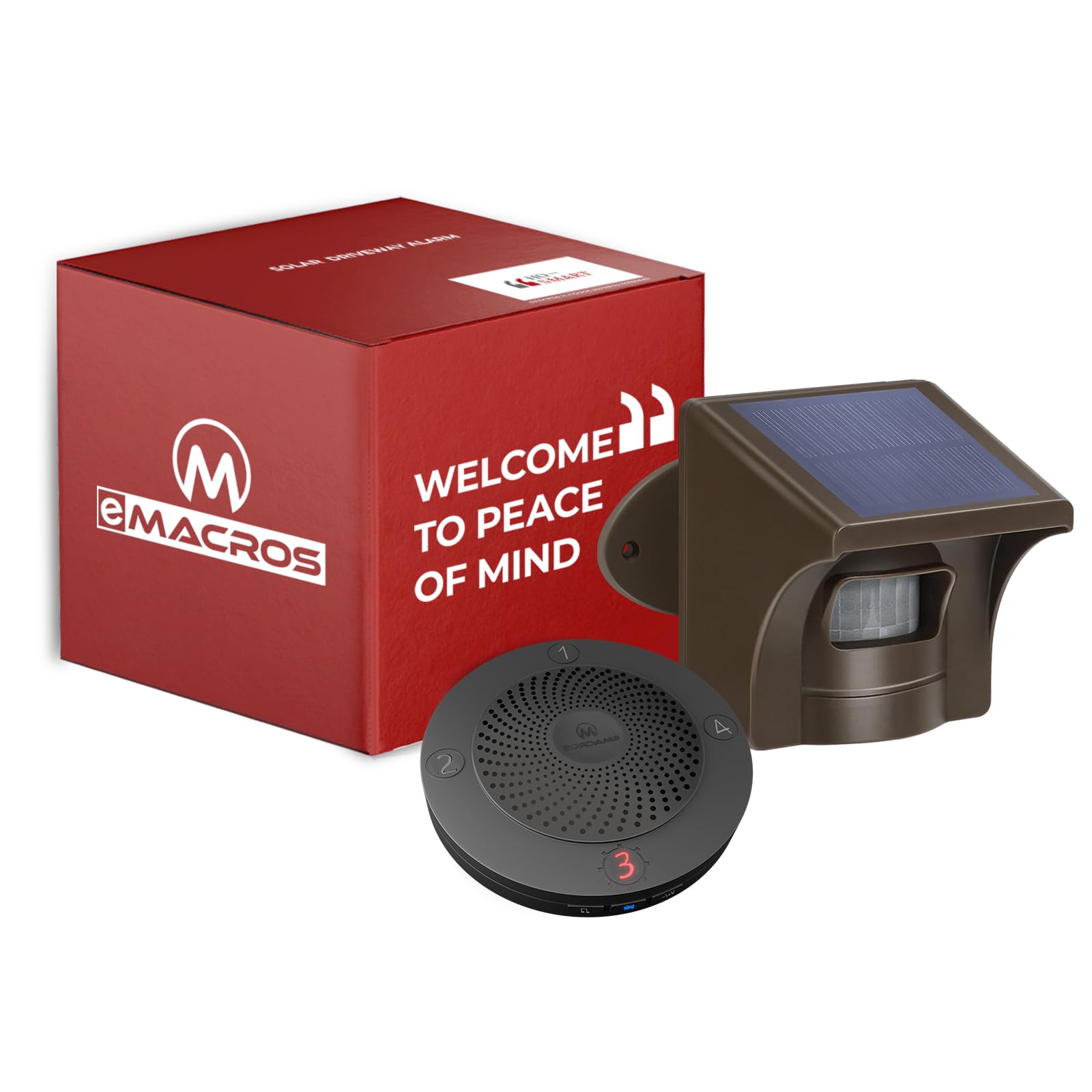
Type: Wireless driveway alarm
Sensors included: One
Power source: Solar sensor, plug-in receiver
Stated range: 1/2 mile
Weather resistance: Weatherproof sensor
App required: None
The solar sensor is the point of this model. A sensor at the end of a long drive is usually nowhere near an outlet, and a solar panel on the housing means no ladder work to swap batteries every few months. The half-mile range pairs with that: the receiver plugs in indoors and the sensor can sit at the far gate. Because there is no app, setup is a pairing button rather than a phone, which suits buyers who do not want another account in their life.
For false alerts, the single sensor is a limitation and an advantage. One sensor means one job, so it can be aimed squarely down the drive and kept away from the road edge. But there is no second zone and no backup, so a sensor that picks up the sidewalk has to be physically moved and re-aimed rather than adjusted from a menu.
Trade-off: Solar charging depends on the panel getting real sun, so a sensor shaded by trees or a fence will need repositioning, and a single sensor leaves no spare if one zone proves too noisy.
Motion Detector Security Alert Monitor System (500FT)

Type: Wireless motion alert system
Sensors included: One
Receiver: Plug-in, loud chimes
Stated range: 500 ft
Weather resistance: Weatherproof sensor
Placement: Outdoor detection, indoor receiver
This is the budget entry, and its 500 ft range reflects that. For a typical suburban driveway, 500 ft is plenty, and a shorter reach is actually a quiet benefit: a sensor that cannot hear the road two houses down is a sensor that will not wake the household for a car that never came near. The plug-in receiver produces a loud chime, which is the right call for a system whose only job is to make someone look up.
It suits a single-approach property on a budget, and buyers who want an alert on a driveway or a back patio without spending much. The caution is range and expansion. Five hundred feet leaves little margin on a rural lot, and the listing describes one sensor, so covering a second approach means a second kit rather than an add-on.
Trade-off: The short range and single sensor make this a one-zone system, and a loud fixed chime is hard to soften for buyers who want a gentle notification rather than a startle.
Motion Sensor Doorbell Alarm Buzzer Store Entrance Alert Bell (500Ft Range, 32 Tunes, 5 Level Volume)

Type: Wireless motion sensor door chime
Sensors included: One
Stated range: 500 ft
Tunes: 32
Volume levels: 5
Intended use: Business entry and indoor alarm
The tunable chime is what earns this one a place on a list about false alerts. Thirty-two tunes and five volume steps mean the alert can be set to a soft, distinctive sound for a doorway that sees constant foot traffic, rather than a siren that demands attention every time. A shop owner who wants to know a customer came in, without a jolt, has a real choice here. The 500 ft range is modest and fits a storefront or a small office.
For passers by specifically, the value is the gentle end of the volume range. A quiet chime at a back door is easier to live with than a loud alarm, and a distinctive tune makes it obvious whether the motion is at the entrance or elsewhere. The trade-off is that this is a door chime at heart: it is built for an entrance, and the listing describes indoor use for the receiver, so it is not the tool for a long rural driveway.
Trade-off: Thirty-two tunes are more novelty than function, and a chime designed for entrances offers no aiming or sensitivity adjustment, so a sensor pointed at a busy walkway will still ring.
Safety Technology International STI-6400 Exit Stopper Multifunction Door Alarm

Type: Door-mounted exit alarm
Function: Multifunction door alarm
Intended use: Emergency and unauthorized doors
Mounting: Door-mounted
Trigger: Door opening, not motion detection
Price tier: Premium
The Exit Stopper solves the passer-by problem a different way: it does not watch for motion at all. It mounts on the door and sounds when the door opens, so a person walking past on the pavement triggers nothing. For a back door, a fire exit or a stockroom door that should stay shut, that is a cleaner rule than any motion sensor can offer. The multifunction design lets the unit serve as a deterrent and an alert depending on how it is set.
It suits property managers, retail back-of-house staff and anyone whose real concern is a specific door rather than a patch of ground. The premium price reflects the commercial-grade intent. The caution is scope: a door alarm cannot tell a trespasser from a delivery driver who opened the wrong door, and it does nothing for an open driveway or yard.
Trade-off: It only protects the door it is mounted on, and the premium price buys a single-point alarm rather than the wide-area coverage a motion kit provides.
Before You Buy
- Detection type: A motion sensor watches an area; a door alarm watches a single opening. Matching the type to the actual worry is the first decision.
- Range: A half-mile system tolerates a long drive and a distant sensor. A 500 ft system is enough for most suburban lots, with little margin on rural property.
- Aiming: Sensors that can be angled at a narrow strip of ground, rather than a wide sweep, are the single biggest defense against alerts from passers by.
- Power: Solar sensors avoid battery swaps in awkward spots but need direct sun. Battery and plug-in units are simpler but need access.
- Chime control: Adjustable volume and multiple tunes let an alert be softened for a busy entrance. A fixed loud chime is a poor fit for a door on a public walkway.
- Expansion: Check whether extra sensors can be added to the same receiver, or whether a second approach means a second full kit.
- Weather exposure: Housings rated weather resistant or weatherproof still vary in how they handle years of sun and driven rain, so mounting under an eave helps.
Frequently Asked Questions
-
How do I stop a driveway alarm from triggering on people walking past?
Aim the sensor down the drive rather than across the pavement, and keep it back from the road edge so its detection zone starts on the property. A sensor with a narrow, deliberate aim does most of the work. -
Is a longer range better for avoiding false alerts?
Not automatically. A longer range means the sensor can sit farther from the house, which helps placement, but a sensor aimed at a public path will still alert at any range. Aim and position matter more than the distance figure. -
Can a door alarm replace a motion sensor?
Only if the concern is a specific door. A door-mounted alarm ignores everyone outside, which eliminates passer-by alerts entirely, but it offers no coverage of a driveway, yard or open approach. -
Do solar driveway sensors work in shade?
A solar sensor needs meaningful sun on its panel to keep the battery topped up. A shaded fence line or heavy tree cover will shorten runtime, so the panel position matters as much as the sensor position. -
How many sensors does a typical property need?
One sensor covers a single approach such as a driveway. A second sensor is worth it when there is a side gate, a shed or a back path that also needs watching, since each sensor can be aimed separately. -
Will a quieter chime still be useful?
Yes, for entrances with constant foot traffic. A soft, distinctive tone at a lower volume level tells the household someone came in without demanding a reaction, which is exactly what a busy doorway needs.
Bottom Line
For most buyers trying to cut false alerts from passers by, the wireless kit with two sensors and one receiver is the strongest choice: two separately aimed zones cover a driveway and a side approach, and the half-mile range lets each sensor sit where it sees the property rather than the street. Buyers with a single door to protect should look at the Exit Stopper instead, since it ignores everyone who never touches the door. Check the current price on the top pick before deciding.
