Why there are Amazon links here: Brave Review is paid a commission for qualifying Amazon purchases made through the links below. Your price does not change, and using our links is entirely optional. How this works
Jackery HomePower 3000 vs Jackery HomePower 3600 Plus: Capacity or Expandability
The Jackery HomePower 3000 and the HomePower 3600 Plus are two large LFP home backup stations that sit close together in price and power output, so the decision comes down to what happens after the first battery is full. This comparison breaks down the differences that actually matter — stored energy, expansion, output, and household fit — and names the buyer each one serves. The short version: one is a self-contained unit, the other is the entry point to a modular system.
Jackery HomePower 3000 Portable Power Station
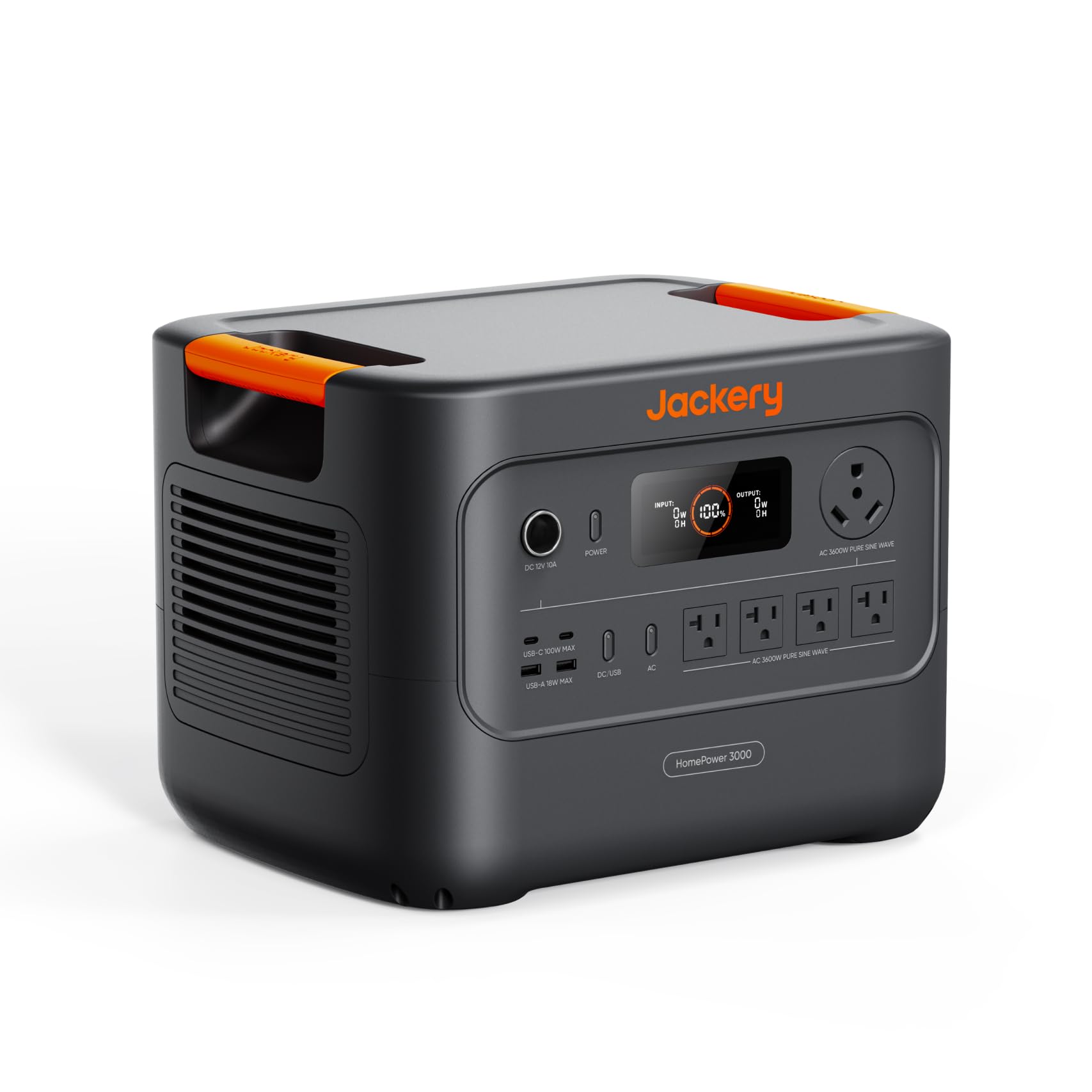
Battery Chemistry: LFP (lithium iron phosphate)
Capacity: 3072Wh
AC Output: 3600W
Surge Rating: 7200W
Intended Use: Essential home backup, power outages
Solar Input: Solar panel optional, sold separately
The HomePower 3000 is the fixed-capacity option: 3072Wh of LFP storage feeding a 3600W AC inverter with a 7200W surge ceiling. That surge figure is the headline for households with motor-driven loads, because well pumps, furnaces, and compressors pull far more at startup than they do while running. LFP chemistry is the right call at this size — it tolerates deep discharges and holds up over many cycles better than older lithium blends.
In practice this is a whole-home-essentials box rather than a whole-home box. Refrigeration, lighting, networking gear, medical devices, and a few small appliances run comfortably; central air conditioning and electric resistance heat do not. Buyers who want a single unit that covers the critical circuits and nothing more will find the capacity honest and the footprint manageable.
Trade-off: The 3000 has no expansion path, so the 3072Wh bought on day one is the ceiling — households that add loads later have to buy a second station rather than a battery module.
Check the current price on Amazon
Jackery HomePower 3600 Plus

Battery Chemistry: LFP (lithium iron phosphate)
Capacity: 3584Wh
Expansion: Expandable to 21kWh
AC Output: 3600W
Intended Use: Essential home backup, power outages
Solar Input: Solar panel optional, sold separately
Included: AC charging cable
The HomePower 3600 Plus starts with a slightly larger 3584Wh bank and the same 3600W AC output, but the number that defines it is the expansion ceiling: 21kWh. That is roughly six times the starting capacity, reached by stacking additional battery modules onto the base unit. For a buyer planning a backup system rather than buying a backup battery, that changes the math considerably.
The included AC cable is a small but real convenience — the unit can be charged from a wall outlet out of the box without hunting for a cord. The LFP cells and the 3600W inverter put it in the same performance class as the 3000, so the difference between the two is not how much power they deliver but how much energy they can hold over time.
Trade-off: The 3600 Plus only pays off if the expansion actually happens — the base capacity is barely above the 3000’s, so a buyer who never adds modules pays a premium for a growth path they do not use.
Check the current price on Amazon
Side-by-Side Specifications
| Specification | HomePower 3000 | HomePower 3600 Plus |
|---|---|---|
| Battery chemistry | LFP | LFP |
| Base capacity | 3072Wh | 3584Wh |
| Maximum capacity | 3072Wh (fixed) | 21kWh (expandable) |
| AC output | 3600W | 3600W |
| Surge rating | 7200W | Not stated in name |
| Intended use | Essential home backup | Essential home backup |
| Solar charging | Panel optional | Panel optional |
| Included cable | — | AC cable |
| Price tier | Upper mid-range | Upper mid-range |
How the Two Compare
Capacity and expansion. The 3600 Plus holds 512Wh more out of the box — a difference of roughly one refrigerator-day, not a transformation. The real gap is the ceiling: 21kWh versus a hard stop at 3072Wh. Dimension verdict: the 3600 Plus wins decisively, but only for buyers who will expand.
Power output. Both deliver 3600W of AC output, so both run the same class of appliances and both handle the same essential-circuits panel. The 3000 additionally states a 7200W surge rating in its name, which matters for well pumps and compressors; the 3600 Plus name does not state a surge figure, so buyers with large motor loads should confirm that detail before committing. Dimension verdict: even on continuous output, slight edge to the 3000 on documented surge headroom.
Charging and setup. The 3600 Plus ships with an AC cable, which means wall charging works immediately. The 3000’s name does not list an included cable, so buyers should expect to supply their own or check the box contents. Both accept optional solar panels, and neither includes one — solar charging is an add-on cost for either unit. Dimension verdict: small convenience win for the 3600 Plus.
Footprint and household fit. A single 3072Wh station is easier to place, move, and store than a base unit plus a stack of modules. The 3000 suits apartments, garages, and households that want one box in the corner. The 3600 Plus grows into a small battery wall, which suits homeowners with a dedicated utility space and a long-term plan. Dimension verdict: the 3000 for simplicity, the 3600 Plus for scale.
Cost per usable watt-hour. Both sit in the upper mid-range of the home backup market, and the 3600 Plus carries a premium for its expansion hardware. Paid once and never expanded, that premium buys very little over the 3000. Paid once and expanded to 21kWh over a few years, it buys a system the 3000 cannot match at any price. Dimension verdict: depends entirely on the buyer’s timeline.
Which Should You Buy?
Choose the Jackery HomePower 3000 if the goal is one self-contained station for essential circuits during outages, the budget is fixed, and there is no intention of building out a larger battery bank later. It is the simpler purchase and the easier unit to live with in a smaller home.
Choose the Jackery HomePower 3600 Plus if the plan is a backup system that grows — starting with essentials now and adding modules as budget and needs allow, up to a 21kWh ceiling. The included AC cable and the expansion architecture make it the better long-term foundation.
FAQ
-
What is the main difference between the HomePower 3000 and the HomePower 3600 Plus?
Expansion. The 3000 is fixed at 3072Wh; the 3600 Plus starts at 3584Wh and expands to 21kWh with additional modules. -
Do both units use LFP batteries?
Yes. Both product names specify LFP (lithium iron phosphate) chemistry, which is the more durable option for deep-cycling backup use. -
Can either unit run a whole house?
Neither is a whole-home solution on its own. Both are marketed for essential home backup, meaning critical circuits rather than central air conditioning or electric resistance heating. -
Is a solar panel included?
No. Both names list solar panels as optional and sold separately, so solar charging is an additional purchase for either unit. -
Which one is better for an apartment?
The HomePower 3000. It is a single unit with no expansion stack to store, which suits smaller spaces and buyers who want one box and nothing more. -
Does the HomePower 3600 Plus include a charging cable?
Yes. Its name lists an AC cable in the box, while the HomePower 3000’s name does not list one. -
Which unit has more surge capacity?
The HomePower 3000 states a 7200W surge rating in its name. The 3600 Plus name does not state a surge figure, so buyers with large motor loads should verify before buying.
Bottom Line
For most households the Jackery HomePower 3600 Plus is the smarter buy: it matches the 3000 on output, holds slightly more energy from day one, includes an AC cable, and leaves the door open to a 21kWh system instead of a dead end. The HomePower 3000 remains the right pick for buyers who know their backup needs will not grow and prefer a single, simpler unit.
