Why there are Amazon links here: Brave Review is paid a commission for qualifying Amazon purchases made through the links below. Your price does not change, and using our links is entirely optional. How this works
ALLWEI Portable Power Station 300W: 256Wh of Quiet Backup Power
The ALLWEI Portable Power Station 300W is a compact lithium-iron-phosphate battery box built for camping trips, CPAP users, and short home outages. It is not a whole-home generator and it will not run a space heater, but it covers the small loads that matter most when the grid drops. This review covers its specifications, what each one means in practice, and where a 256Wh unit falls short.
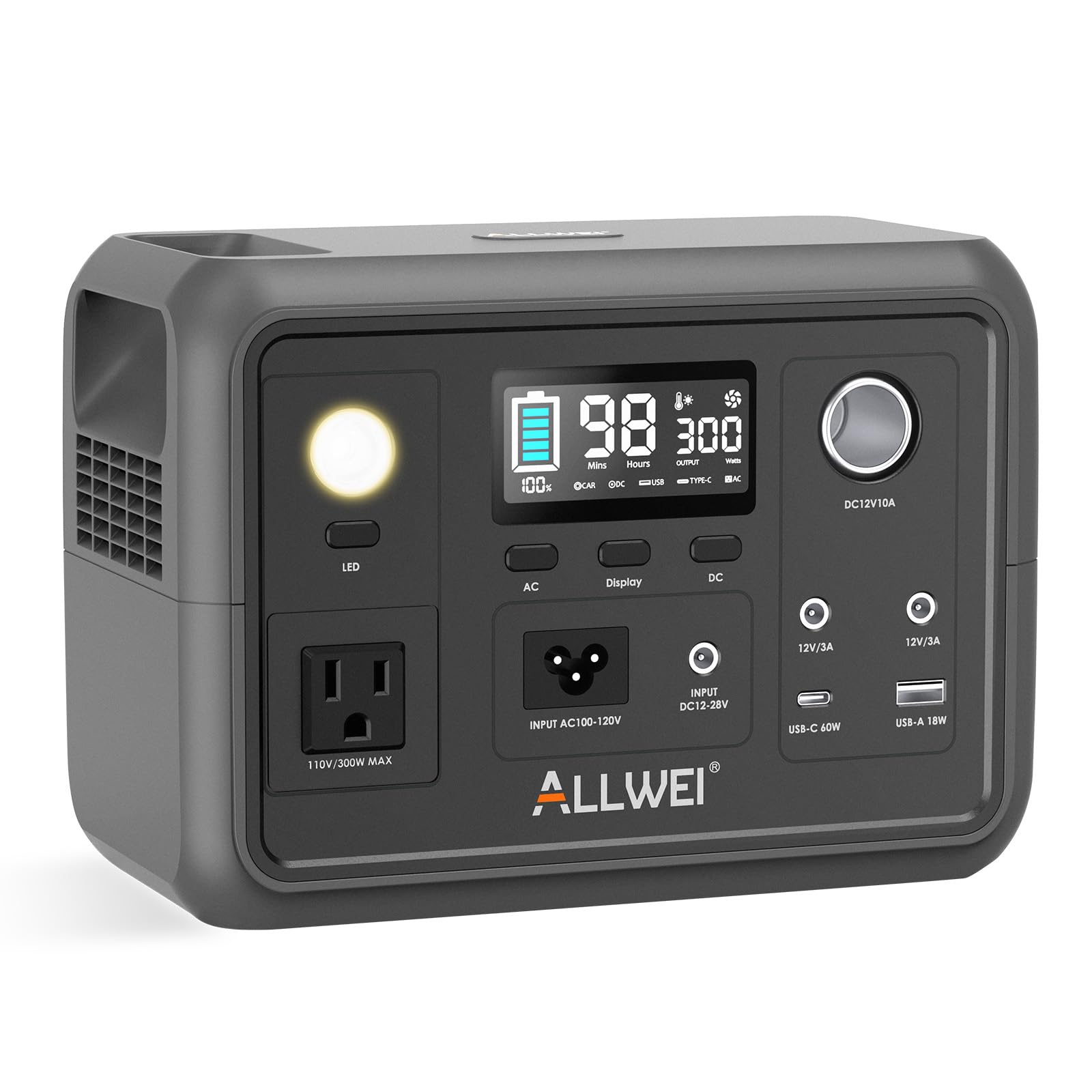
Features and Specifications
Battery Chemistry: LiFePO4 (lithium iron phosphate)
Capacity: 256Wh
AC Output: 300W, pure sine wave
USB-C Output: PD 60W fast charging
Charging Technology: MPPT solar charge controller
Safety System: BMS (battery management system)
Form Factor: Compact, built for camping, home backup, and CPAP use
The headline here is the battery chemistry. LiFePO4 cells tolerate deep discharges and high heat better than the older lithium-ion packs that dominate the budget tier, and they hold their capacity across far more charge cycles. For a unit that may sit in a closet for months and then be asked to run a CPAP machine all night, that durability matters more than raw watt-hours.
The 300W pure sine wave inverter is the second key spec. Pure sine wave means the AC output mimics wall power closely enough that sensitive electronics — laptops, medical devices, modem routers — run without the buzzing or overheating that modified sine wave inverters can cause. The 300W ceiling caps what the unit can start, so buyers should check the surge wattage of anything with a motor before plugging it in.
Build and Form Factor
The compact housing is the point of this unit. At 256Wh, the battery pack stays light enough for one person to carry from a car to a tent, which is the whole reason a camper would choose it over a larger station. The trade-off is that the same small shell leaves little room for expansion, so capacity is fixed for the life of the product.
Buyers who need to power a campsite for a weekend should plan around the 256Wh figure rather than against it. Phone charging, a laptop, a fan, and a few hours of lighting are realistic; a portable fridge running continuously is not. The unit suits the light-load camper, not the off-grid cabin crowd.
Capacity and Real-World Runtime
Capacity is where the price tier shows most clearly. A 256Wh battery is roughly a quarter of what mid-size stations offer, and that shapes every runtime calculation. A CPAP machine drawing modest wattage can typically run through a night, which is exactly the use case the product name calls out.
The honest caution is that 256Wh disappears quickly under heavier loads. Anything drawing several hundred watts will drain the pack in well under an hour, and buyers who expect to run power tools or a microwave should look at a larger class of station entirely. This unit is a bridge through a short outage, not a substitute for a generator.
Power Output and Charging
The PD 60W USB-C port is the most useful feature for daily carry. It fast-charges a modern laptop or phone at speeds close to a wall charger, which makes the unit practical as a large power bank even when the AC outlets go unused. The pure sine wave AC outlets handle the devices that need a real wall-style socket.
The MPPT controller is a quiet but important inclusion. Maximum power point tracking squeezes more usable energy out of a solar panel than a basic charge controller, so a compatible panel refills the battery faster on a sunny day. Buyers should note that the panel is a separate purchase — the station does not ship with one.
Protection and Maintenance
The BMS watches cell voltage, current, and temperature, and it is the reason a LiFePO4 pack can be left plugged in without much worry. It shuts the output down before a cell is pushed too far, which protects both the battery and whatever is plugged in.
Maintenance is minimal by design. LiFePO4 cells do not need the periodic full-discharge cycling that older chemistries demanded, and the pack tolerates being stored at partial charge. A buyer should still recharge it every few months during long storage so the cells do not drift too far down.
Trade-off: The 256Wh capacity is genuinely small, so the unit only makes sense for light loads and short outages — anyone planning to run appliances or a fridge for hours needs a bigger station.
Check the current price on Amazon
Who It Suits and Who It Doesn’t
This station fits three buyer profiles well. The camper who wants to charge phones, run a laptop, and keep a light on at night will find the size and weight right. The CPAP user who needs a night of backup power has a unit whose capacity and pure sine wave output are matched to that job. And the apartment dweller facing short outages gets a compact box that keeps the router and a few devices alive without a gas generator.
It does not suit buyers planning to power a fridge, a space heater, or power tools. It also is not the right choice for anyone who wants to run a whole home during a multi-day outage — that job belongs to a much larger station or a fuel generator. Buyers who need solar charging should budget for a panel, since none is included.
FAQ
-
How long does the ALLWEI 300W power station last on a full charge?
Runtime depends entirely on the load. A phone or laptop draws little and lasts many hours; a device pulling several hundred watts drains the 256Wh pack in well under an hour. Buyers should add up the wattage of everything they plan to run. -
Can the ALLWEI 300W run a CPAP machine overnight?
Yes, this is one of the use cases the product is built for. The pure sine wave output keeps the machine running cleanly, and 256Wh is generally enough for a night of typical CPAP use. Heated humidifiers draw more and shorten runtime. -
Is the 300W output enough for a mini fridge?
Probably not for continuous use. Compressor fridges draw a surge on startup that can exceed the 300W ceiling, and even if it starts, the battery would drain quickly. A larger station is the safer choice. -
What kind of battery does the ALLWEI 300W use?
It uses a LiFePO4 battery, which is more heat-tolerant and longer-lived than standard lithium-ion. That chemistry is a big part of why the unit is worth considering at this size. -
Can the ALLWEI 300W be charged with a solar panel?
Yes. The built-in MPPT controller is designed for solar input, and it extracts more power from a panel than a basic controller would. The panel itself is sold separately. -
How fast does the USB-C port charge a laptop?
The PD 60W port delivers up to 60W, which is enough to fast-charge most modern laptops and phones at close to wall-charger speed. Older devices that do not support USB-C PD will charge more slowly. -
Is a pure sine wave inverter important?
For sensitive electronics and medical devices, yes. Pure sine wave output matches wall power closely and avoids the hum and heat that modified sine wave inverters can cause. This unit uses a pure sine wave inverter. -
Can the ALLWEI 300W be stored plugged in?
The battery management system protects the cells during storage, and LiFePO4 tolerates partial charge well. A periodic top-up every few months keeps the pack healthy during long idle periods. -
How heavy is the ALLWEI 300W power station?
The compact form factor is designed for one-person carry, which is a key reason campers choose it. Buyers who need to move a station frequently will appreciate the smaller shell compared with larger-capacity units. -
Does the ALLWEI 300W come with a solar panel?
No. The station supports solar charging through its MPPT controller, but the panel is a separate purchase. Buyers planning off-grid use should factor that into the total cost.
Bottom Line
The ALLWEI Portable Power Station 300W is the right pick for buyers who need a light, compact LiFePO4 station for camping, CPAP backup, or short outages — and the wrong pick for anyone expecting to run appliances. Its pure sine wave output, 60W USB-C fast charging, and MPPT solar input cover the essentials at this capacity, and the honest limit is the 256Wh pack itself. Buyers with realistic light-load expectations will get exactly what they need.