Why there are Amazon links here: Brave Review is paid a commission for qualifying Amazon purchases made through the links below. Your price does not change, and using our links is entirely optional. How this works
Taco 400-4 1/8-Inch-NPT Float Air Hy-Vent (3-Pack): Automatic Air Removal for Hydronic Heating Systems
The Taco 400-4 Float Air Hy-Vent is a small automatic air eliminator built for hydronic heating systems, and this three-pack covers the high points of a typical residential loop. It suits homeowners and contractors who need to purge trapped air from baseboard, radiator, or radiant circuits without manually bleeding every zone. This review covers the product’s construction, how the float mechanism works, where it installs, what maintenance it needs, and where it falls short. The short answer: it is a straightforward, low-cost service part that works best as a planned replacement rather than an emergency fix.
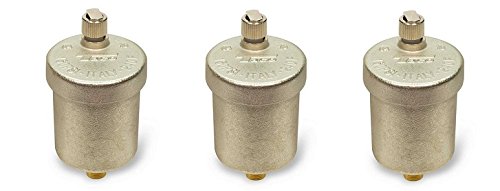
Features and Specifications
Product Type: Automatic float-type air vent (Hy-Vent)
Connection Size: 1/8-inch NPT
Quantity: 3-pack
Intended Use: Hydronic heating systems
Operation: Mechanical float-actuated air release
Installation Point: High points of heating loops and near boilers
Brand: Taco
The 1/8-inch NPT thread is the smallest common plumbing connection size, and that matters more than anything else on this list. It means the vent fits the small tappings found on air scoops, zone valve bodies, and the top of boiler headers, not main pipe runs. Buyers who assume this is a 1/2-inch or 3/4-inch vent will be disappointed at the box, so the thread size should be confirmed against the existing fitting before ordering.
The three-pack is the real value here. Hydronic systems rarely have just one vent; a multi-zone house might have three or four high points that each need one. Buying a single vent and paying separate shipping three times costs more than this bundle, and having a spare on the shelf means a failed vent gets swapped the same day instead of waiting on a delivery.
Build and Materials
The Hy-Vent line is a mechanical device, not an electronic one. Inside the brass or bronze body sits a float connected to a valve seat. When air accumulates, the float drops and opens the seat, letting air escape. When water rises back into the chamber, the float lifts and seals the valve closed. There is no solenoid, no power supply, and nothing to wire — which is exactly why these vents survive for years in a hot, wet, pressurized environment.
The body is metal, which is the right call for a heating loop. Plastic-bodied vents exist at lower price points, but they tend to fail sooner when exposed to treated boiler water and repeated heat cycles. Metal construction also means the threads hold up to being tightened and removed more than once, which matters for a part that gets serviced.
The float mechanism is the wear point. A float that sticks open will weep water continuously; a float that sticks closed will let air accumulate and leave radiators cold at the top. Neither failure is catastrophic, but both are the reason vents get replaced rather than repaired.
Capacity and Sizing
The 1/8-inch connection limits this vent to small-volume air release duty. That is the correct role for a Hy-Vent: it is not a main air separator and it is not designed to handle the large air slugs that come with a freshly filled system. It removes the small, steady accumulation of air that builds up in a closed loop over weeks and months.
For a system that has just been drained and refilled, the vent will help, but it will not replace a proper purge. Buyers should expect to bleed the loop manually first and let the Hy-Vent handle the residual air afterward. Sizing it against a large air separator is a mismatch; sizing it against a high-point vent on a zone is exactly right.
Installation and Maintenance
Installation is a thread-and-tighten job at a high point in the loop, ideally where air naturally collects. The vent should be mounted vertically with the discharge port unobstructed, and the fitting should be sealed with thread tape or pipe dope rated for heating systems. No wiring, no commissioning procedure, no settings.
Maintenance is minimal but not zero. The vent should be checked periodically for weeping at the discharge port, which signals a float that is not seating. In hard-water areas, mineral scale can build on the float and seat, so a vent that has been in service for years may need replacement rather than cleaning. The three-pack makes that replacement cheap and immediate.
Trade-off: The 1/8-inch NPT connection is the smallest standard size, so this vent only fits small tappings and will not substitute for a larger high-capacity air eliminator on a big system.
Check the current price on Amazon
Who It Suits and Who It Does Not
This vent is for the buyer who already knows the thread size needed and wants a spare or three on hand. That includes homeowners maintaining their own hydronic system, HVAC and plumbing contractors who keep common service parts stocked, and anyone replacing a failed vent on a baseboard or radiator loop. The three-pack is the practical unit for that buyer.
It is not for someone diagnosing a system for the first time. If the radiators are cold at the top and the cause has not been identified, buying a vent before confirming the thread size and the failure point is a guess. It is also not for a system that needs a main air separator, and it is not a substitute for a proper system purge after a drain and refill.
FAQ
-
What does a Taco 400-4 Float Air Hy-Vent actually do?
It automatically releases trapped air from a hydronic heating loop. A float inside the body drops when air collects, opening a valve that lets the air escape, then rises when water returns and seals the valve closed. -
What size is the connection on this vent?
The connection is 1/8-inch NPT, the smallest common plumbing thread size. Buyers should confirm that size against the existing fitting before ordering, because it will not fit a 1/2-inch or 3/4-inch tapping without an adapter. -
How many vents come in the pack?
Three. The three-pack suits a multi-zone system with several high points, or a single system plus spares for future replacement. -
Where should the vent be installed?
At a high point in the heating loop, mounted vertically, with the discharge port clear. Air collects at high points, so that is where the vent does its job. -
Does it need power or wiring?
No. It is a purely mechanical float device with no electrical connection and no settings to configure. -
How often does it need to be replaced?
There is no fixed schedule. The vent is replaced when it weeps continuously at the discharge port or stops releasing air. In hard-water areas, scale can shorten that interval. -
Will it fix cold radiators?
It can, if trapped air is the cause. Cold radiators at the top with warm bottoms are a classic air symptom. If the whole radiator is cold, the cause is more likely circulation or a zone valve issue, and a vent will not solve it. -
Can it replace a main air separator?
No. The 1/8-inch vent handles small, steady air accumulation. A system that needs large air volumes removed during fill or that has persistent air problems needs a proper air separator. -
Does it work on radiant floor systems?
Yes, at high points in the loop. Radiant manifolds often have their own air vents, so buyers should check whether the manifold already includes one before adding this. -
What is the advantage of buying three instead of one?
Cost per unit and same-day replacement. A failed vent leaves the system running with air in it, and having a spare on the shelf avoids a second order and a second wait.
Bottom Line
The Taco 400-4 1/8-Inch-NPT Float Air Hy-Vent (3-Pack) is a sensible, low-cost service part for anyone maintaining a hydronic heating system, provided the 1/8-inch NPT size matches the existing fitting. The mechanical float design needs no power and no setup, the metal body holds up to boiler water and heat cycling, and the three-pack covers a multi-zone loop or supplies spares for future replacement. Buyers who need a larger air eliminator, or who have not yet confirmed the thread size, should look elsewhere first.