Why there are Amazon links here: Brave Review is paid a commission for qualifying Amazon purchases made through the links below. Your price does not change, and using our links is entirely optional. How this works
Best Solar Panel Kit for a Flat Roof for Off-Grid Power and Easy Mounting
Flat roofs are the awkward customer of the solar world: no pitch to shed snow, no rafters to hook into, and often a membrane or metal surface that punishes the wrong bracket. This guide narrows the field to five kits and mounting sets that suit flat-roof and low-slope installs, from a bare-bones 200W starter to a 400W system with MPPT charging. It is written for three kinds of buyer: the RV or van owner who wants a portable kit, the shed or cabin owner building a small off-grid array, and the homeowner mounting panels flat on a garage or outbuilding. The overview table below gets a reader to a shortlist in under a minute; the reviews explain the trade-offs.
The Picks at a Glance
| Product | Key Spec | Best Use | Price Tier |
|---|---|---|---|
| ECO-WORTHY 200W 12V/24V Kit | 200W mono panel, 30A PWM controller | Small cabins, RVs, first off-grid setup | Budget |
| Renogy 400W Premium Kit | 4x100W mono panels, 40A MPPT, Bluetooth | Whole-system builds needing efficient charging | Premium |
| ECO-WORTHY 260W Flexible Kit | 2x130W flexible mono panels, 30A controller | Boats, curved and uneven surfaces | Mid-range |
| ECO-WORTHY 400W Premium Kit | 4x100W panels, 40A MPPT, Bluetooth | Home, RV, and boat arrays at 12V | Mid-range |
| Aluminium Solar Panel Brackets | 20 black mid-clamps, 30mm/35mm | Flat, metal, and tin roof mounting | Budget accessory |
1. ECO-WORTHY 200 Watts 12 Volt/24 Volt Solar Panel Kit

Panel Type: Monocrystalline
Total Output: 200 watts
System Voltage: 12V / 24V
Controller: 30A PWM charge controller
Intended Use: RV, camper, vehicle, caravan, off-grid
ECO-WORTHY 200 Watts 12 Volt/24 Volt Solar Panel Kit is the entry point of this group. The monocrystalline panel is the efficient cell type, and the dual 12V/24V rating means the same kit can serve a small 12V cabin battery bank or step up to a 24V system later. The 30A PWM controller is the honest weak spot: PWM charging is simpler and cheaper than MPPT, and it wastes more of the panel’s output when battery voltage sits well below the panel’s peak voltage. For a 200W array on a short cable run, that loss is tolerable; for anything larger, it is not.
The kit suits the buyer who wants one box, one panel, and a controller that will charge a leisure battery in a camper or a small shed. It earns its place as the budget pick because the panel quality is sound even where the controller is basic. The caution is straightforward: buyers planning to expand past 200W, or running long cable runs from a flat roof down to a battery bank, will outgrow the PWM controller quickly and end up buying an MPPT unit separately.
Trade-off: The low entry price is bought with a PWM controller that leaves real power on the table compared with MPPT.
2. Renogy 400Watt Premium Solar Kit with 40A MPPT Charge Controller

Panel Type: Monocrystalline
Configuration: 4 x 100W panels
Total Output: 400 watts
Controller: 40A MPPT charge controller
Extras: Bluetooth module, Z-brackets, cables, adaptor kit
Renogy 400Watt Premium Solar Kit is the most complete system here and the one to beat for anyone building a serious off-grid array. Four 100W monocrystalline panels give flexible layout options on a flat roof, where panels can be spaced and angled rather than forced into one long run. The 40A MPPT controller is the headline: maximum power point tracking squeezes noticeably more charge out of the same panels than PWM, especially in cold mornings and partial shade. The included Bluetooth module lets the controller be monitored from a phone, and the Z-brackets, cables, and adaptor kit mean fewer separate orders.
This is the pick for the buyer who wants a system that works properly the first time and does not want to source mounting hardware piecemeal. It is not for the casual buyer testing the water — the outlay is the highest in this group, and the 400W array needs roof space and a battery bank sized to absorb it. Buyers with a single small battery should look at the 200W kit instead.
Trade-off: The premium price buys MPPT and a full accessory bundle, which is wasted on a buyer with only one small battery to charge.
3. ECO-WORTHY 260Watt 12Volt Flexible Solar Panel Kit
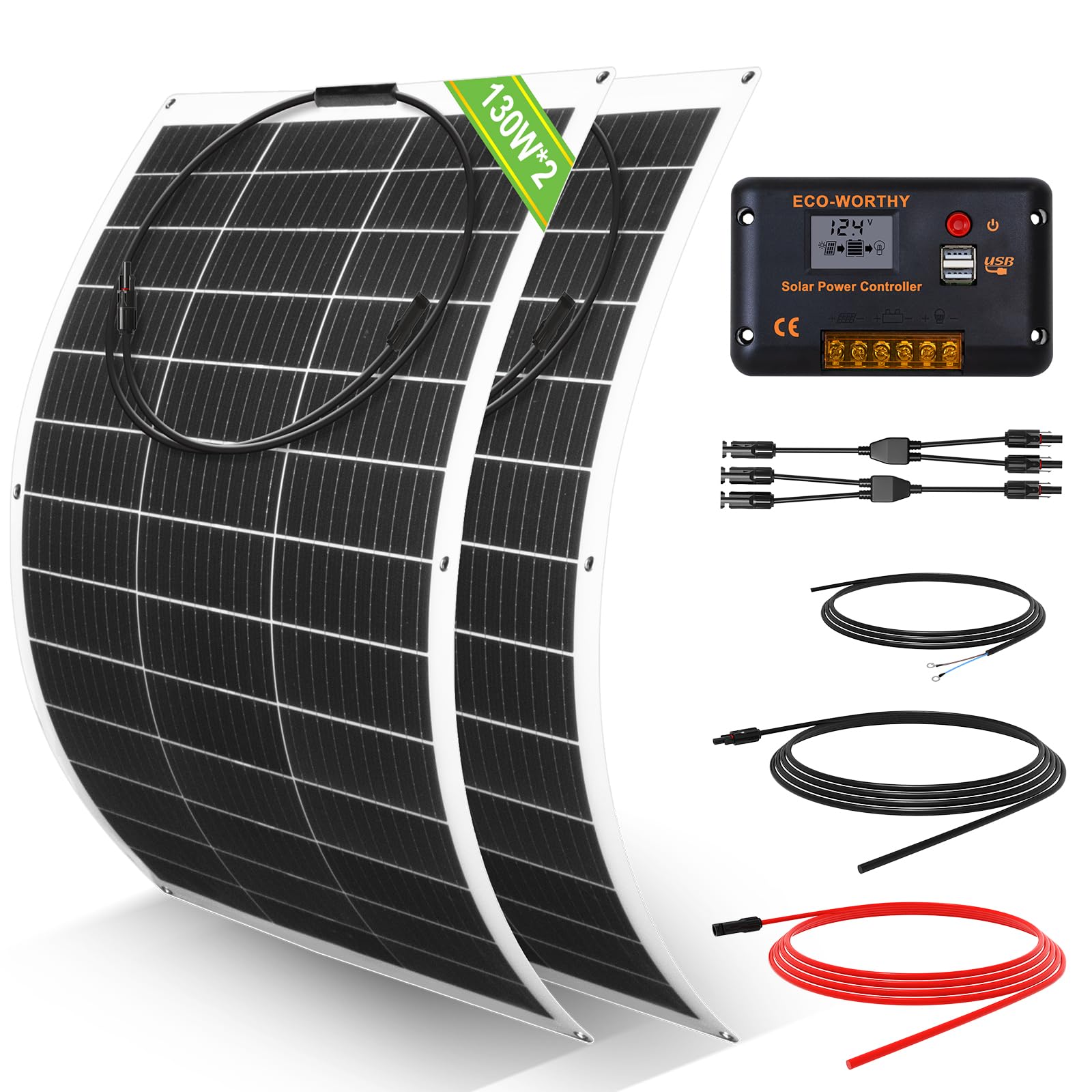
Panel Type: Flexible monocrystalline
Configuration: 2 x 130W panels
Total Output: 260 watts
System Voltage: 12V
Controller: 30A 12V charge controller
Extras: Solar cable, tray cable, Y branch
ECO-WORTHY 260Watt Flexible Solar Panel Kit solves the problem the rigid kits cannot: a flat roof is rarely perfectly flat, and a boat deck or a slightly curved shed roof will not take a framed panel without a mounting frame. These flexible panels bond or strap down over uneven surfaces, which makes them the right answer for marine use and for roofs with a gentle curve. The 30A controller and the included cable, tray cable, and Y branch mean the wiring is largely covered out of the box.
The kit suits the boat owner and the buyer with a non-standard roof surface. It is not for the buyer who wants maximum output per dollar — flexible panels generally cost more per watt than rigid ones and, being frameless, they rely on the surface beneath them for support and airflow. Buyers mounting on a hot flat roof should note that flexible panels bonded flat lose some efficiency to heat build-up, so a small air gap or a raised mount is worth planning for.
Trade-off: Flexible panels trade output-per-dollar and heat dissipation for the ability to fit surfaces a rigid frame cannot.
4. ECO-WORTHY 400 Watt 12 Volt Premium Solar Panel Kit

Panel Type: Monocrystalline
Configuration: 4 x 100W panels
Total Output: 400 watts
System Voltage: 12V
Controller: 40A MPPT charge controller
Extras: Bluetooth module, mounting Z-brackets
ECO-WORTHY 400 Watt 12 Volt Premium Solar Panel Kit matches the Renogy kit on paper — four 100W panels, a 40A MPPT controller, and a Bluetooth module — at a lower price tier. That makes it the value alternative for a 400W flat-roof array, and the 12V system voltage keeps it compatible with the most common battery banks in RVs, boats, and small cabins. The Z-brackets are included, so the panels can be raised off the roof surface for airflow rather than bonded flat.
It suits the buyer who wants MPPT charging and a full 400W array without paying the premium-brand price. It is not for the buyer who needs a turnkey kit with every cable and adaptor included — the accessory bundle is leaner than the Renogy’s, so a cable run from roof to battery may need extra parts. Buyers should also confirm the controller’s amp rating against the array before adding panels later, since 40A is the ceiling for this setup.
Trade-off: The lower price comes with a thinner accessory bundle, so some buyers will need to source cabling separately.
5. Aluminium Solar Panel Brackets, 20pcs Mid Clamps for Flat Roof

Material: Aluminium
Quantity: 20 pieces
Type: Mid clamps
Sizes: 30mm / 35mm
Finish: Black
Intended Use: Metal roof, tin roof, flat roof, sheet roof, RV
Aluminium Solar Panel Brackets is not a solar kit, and it is included deliberately: most flat-roof kits ship with Z-brackets that suit a pitched roof, not a membrane or metal deck. These aluminium mid-clamps work with Unistrut-style rail, which is the standard way to mount panels flat on a metal or sheet roof without drilling through the panel frame. The 30mm/35mm sizing covers the common frame thicknesses, and the black finish keeps the hardware visually discreet on a dark roof.
The set suits the buyer who is mounting any of the rigid kits above on a metal, tin, or flat roof and needs proper rail clamps rather than Z-brackets. It is not for the buyer who already has a pitched roof with rafters to hook into — standard Z-brackets are cheaper and simpler there. Buyers should also note that mid-clamps need end clamps or a rail system to complete the mount, so this is one component of a mounting solution rather than the whole of it.
Trade-off: Mid-clamps alone do not complete a mount; they need rail and end clamps, which adds cost and planning.
Before You Buy
- Mounting surface: A flat membrane or metal roof needs rail-and-clamp hardware, not the Z-brackets bundled with most kits; a pitched roof can use Z-brackets directly.
- Controller type: MPPT controllers extract meaningfully more charge than PWM on the same panels, so a PWM kit is a budget choice with a real efficiency cost.
- System voltage: Confirm whether the battery bank is 12V or 24V before buying; a dual-voltage kit like the 200W ECO-WORTHY is more flexible than a 12V-only system.
- Accessory bundle: Check whether cables, adaptors, and mounting hardware are included — the Renogy kit is the most complete, and the ECO-WORTHY 400W the leanest.
- Roof space and layout: Four 100W panels need more usable area than two 130W flexible panels, and flat-roof spacing affects shading and airflow.
- Battery bank sizing: A 400W array needs a battery bank large enough to absorb the charge; pairing it with one small battery wastes capacity.
- Heat and airflow: Panels bonded flat to a hot roof run warmer and lose efficiency, so a raised mount or air gap is worth planning into the install.
Frequently Asked Questions
-
Can a solar panel kit be mounted on a flat roof?
Yes, but the mounting hardware matters more than on a pitched roof. Rail-and-clamp systems like aluminium mid-clamps on Unistrut are the standard approach for flat, metal, and membrane roofs. -
Is MPPT worth the extra cost over PWM?
For most buyers, yes. MPPT controllers extract more usable power from the same panels, and the gap widens in cold weather and partial shade. PWM is acceptable only for small arrays on a tight budget. -
How many panels fit on a typical flat roof?
That depends on the roof area and panel dimensions, which vary by product. Buyers should measure usable space and leave room for spacing, shading, and access before committing to a 400W four-panel array. -
Do flexible panels work on a flat roof?
They work best on curved or uneven surfaces such as boat decks. On a hot flat roof, bonding them directly reduces airflow and can cost efficiency, so a raised mount is preferable where possible. -
What else is needed beyond the kit?
Most kits include panels, a controller, and some cabling, but a flat-roof install often needs rail, clamps, and a longer cable run to the battery bank. The Renogy kit is the most complete; the others may need extra parts. -
Can these kits run a house?
These are off-grid kits suited to RVs, cabins, boats, and small systems. A full home installation involves different equipment, permits, and grid-tie considerations outside the scope of these kits.
Bottom Line
For most flat-roof buyers, the Renogy 400Watt Premium Solar Kit is the best solar panel kit for a flat roof because it pairs four mono panels with a 40A MPPT controller and includes the Bluetooth module, Z-brackets, cables, and adaptor kit in one order. Buyers on a tighter budget should take the ECO-WORTHY 400W Premium Kit for the same MPPT charging at a lower tier, and anyone mounting on metal or membrane should add the aluminium mid-clamps to the order.
