Why there are Amazon links here: Brave Review is paid a commission for qualifying Amazon purchases made through the links below. Your price does not change, and using our links is entirely optional. How this works
EF EcoFlow Delta 3 Max Plus: Home Backup Without the Generator
The EF EcoFlow Delta 3 Max Plus is a 2048Wh portable power station built for households that want backup power without a fuel generator, plus RV owners and campers who need serious capacity on the road. This review covers what the unit’s specifications actually mean in daily use, where the 3000W output helps and where it does not, and which buyers should look elsewhere. It is a single-product review, so the focus stays on this one model and the decision in front of the reader.
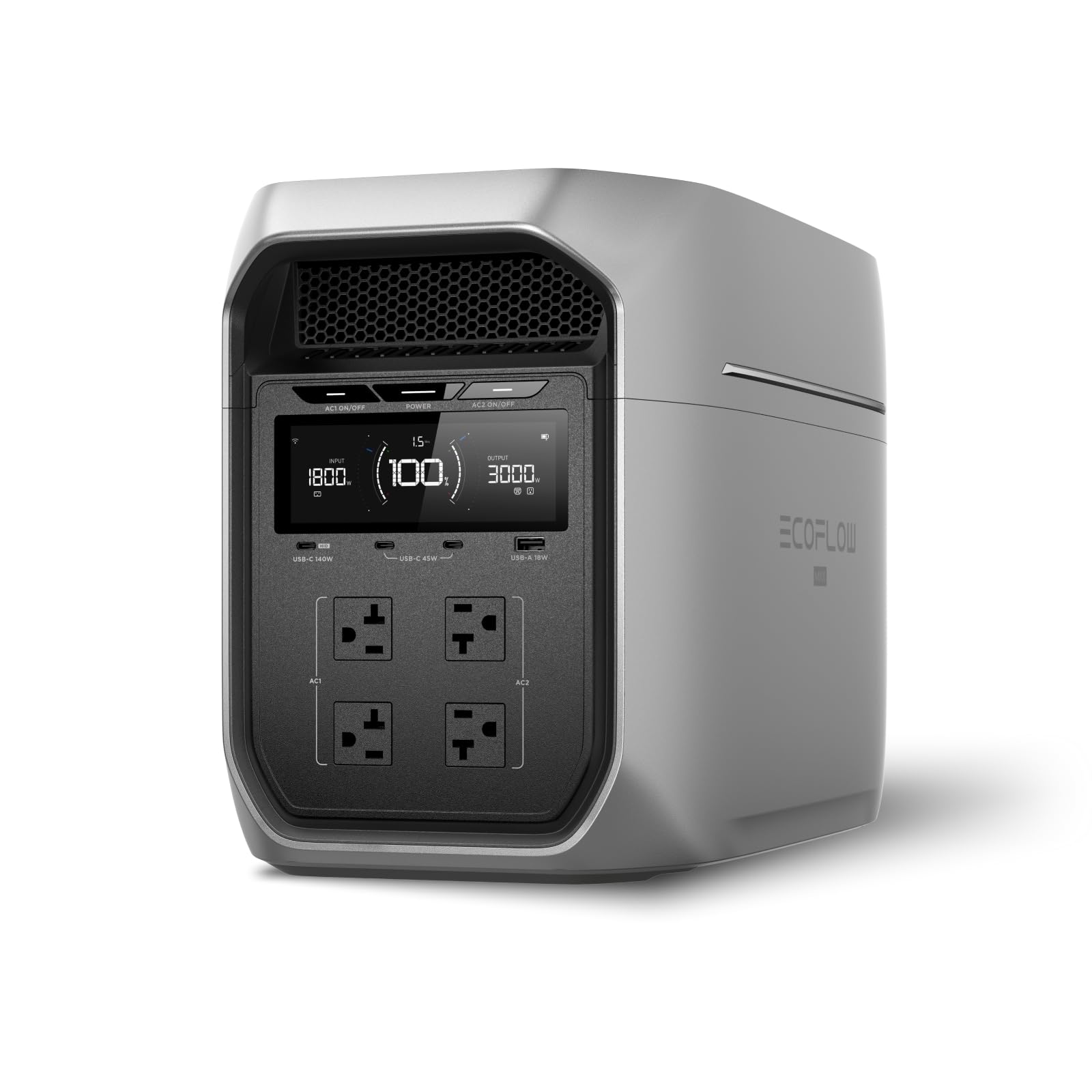
Features and Specifications
Type: Portable power station / solar generator
Capacity: 2048Wh
Rated Output: 3000W
X-Boost Output: 3800W
Recharge Time: 0–80% in 64 minutes
Solar Input: Solar panel optional (sold separately)
Intended Use: Home backup, RV, camping
The headline figure here is capacity. At 2048Wh, the Delta 3 Max Plus sits in the upper-middle of the portable power station market — enough to run a refrigerator through an extended outage, keep a router and phones alive for days, or power a small RV’s essentials overnight. It is not a whole-home solution, and it is not meant to be.
The 3000W rated output and 3800W X-Boost figure are the other half of the story. X-Boost is EcoFlow’s method of running appliances that draw more than the rated wattage, which matters for things like space heaters, kettles and power tools that briefly spike above their label rating. Buyers should treat X-Boost as a helpful margin rather than a license to run a clothes dryer.
Build and Portability
A 2048Wh battery is heavy, and the Delta 3 Max Plus is a wheeled, handle-equipped unit designed to be moved rather than carried long distances. The form factor follows the category: a boxy chassis with recessed handles, a top surface that can take light loads, and output panels on the front. Buyers who plan to lift it into a truck bed alone should expect a two-person job or a ramp.
The trade-off here is straightforward. Capacity and portability pull against each other, and this unit leans toward capacity. It fits in a garage, a closet or an RV bay; it does not fit in a backpack, and it is not the model to choose for tent camping where weight matters.
Capacity and Real-World Runtime
Runtime is the number buyers actually care about, and it is always an estimate rather than a promise. A 2048Wh battery running a typical full-size refrigerator will last well under a day once compressor cycling and inverter losses are factored in; running LED lighting, a laptop, a router and phone chargers will stretch into multiple days. The practical rule is to add up the wattage of everything intended to run and divide the capacity by that figure.
The category’s honest limitation applies here too: this is a battery, not a generator. It stores a fixed amount of energy and then needs recharging. Buyers planning multi-day outages need either a solar panel or a plan for recharging from a vehicle or a working outlet elsewhere.
Power Output and X-Boost
The 3000W continuous rating covers most household essentials and a good range of tools. The 3800W X-Boost ceiling widens that to appliances with high startup draws, which is where many portable stations fall short. It is a genuine convenience for RV owners running a microwave or an induction cooktop.
The caution is that X-Boost is a peak allowance, not a continuous rating. Running high-draw appliances for long stretches will drain the battery quickly and can push the unit toward its thermal limits. Buyers whose main goal is running a large appliance for hours at a time should size up rather than lean on X-Boost.
Recharging Speed
The 0–80% recharge in 64 minutes is the specification most likely to change how the unit gets used. Fast AC recharging means an outage can be met with a short window on a working outlet or a brief run from a vehicle inverter, rather than an overnight charge. For RV owners moving between hookups, it turns a lunch stop into a meaningful top-up.
The trade-off is that fast charging generates heat and puts more stress on the cells than slow charging. Buyers who do not need speed should not feel obliged to use it every cycle. Solar recharging is available but requires a panel, which is sold separately — a real added cost that buyers should factor into the total budget before comparing this unit to cheaper alternatives.
Maintenance and Long-Term Ownership
A power station needs less maintenance than a fuel generator: no oil changes, no carburetor cleaning, no stale fuel. The routine is storage discipline — keeping the unit in a cool, dry place and topping the battery periodically so it does not sit fully drained for months. That alone makes it a better fit for households that want backup power they do not have to think about.
The trade-off is battery aging. Lithium cells lose capacity over years and charge cycles, and a sealed unit cannot be serviced by the owner. Buyers should treat this as a long-lived appliance rather than a permanent fixture, and should expect the usable capacity to decline gradually with heavy use.
Trade-off: The Delta 3 Max Plus is heavy for its class and its capacity is finite, so buyers planning multi-day outages need to budget for a solar panel or another recharge source on top of the unit itself.
Check the current price on Amazon
Who It Suits and Who It Does Not
This unit suits homeowners who want a plug-and-play backup for refrigerators, lights and communications during outages, and RV owners who want to run appliances without hookups. It also suits campers who drive to their site and can handle the weight.
It does not suit backpackers, tent campers counting ounces, or buyers whose main goal is running a large appliance continuously for many hours. Those buyers need more capacity or a different category of equipment entirely.
FAQ
-
How long will the EcoFlow Delta 3 Max Plus run a refrigerator?
A 2048Wh battery running a typical refrigerator will last well under a full day once compressor cycling and inverter losses are counted. Actual runtime depends on the fridge’s efficiency, ambient temperature and how often the door opens. -
Can the Delta 3 Max Plus run a space heater?
Many space heaters draw close to or above the 3000W rated output, and the 3800W X-Boost allowance can cover brief spikes. Buyers should check the heater’s label wattage before assuming it will run continuously. -
Does it come with a solar panel?
No. The product listing describes the solar panel as optional, which means it is sold separately. Buyers planning to recharge off-grid should budget for a compatible panel. -
How fast does it recharge from a wall outlet?
The unit reaches 0–80% in 64 minutes on AC. A full charge takes longer, and the exact time depends on the outlet and the charging mode selected. -
Is 2048Wh enough for a whole home?
No. It is enough for essential circuits — refrigeration, lighting, communications and medical devices — but not for whole-home backup. Buyers wanting to run a full panel need a larger system. -
Can it be used indoors?
Yes. Unlike a fuel generator, a battery power station produces no exhaust, which makes it suitable for indoor use during an outage. It should still be kept in a ventilated, dry space and away from water. -
How much does the Delta 3 Max Plus weigh?
The unit is heavy for its capacity class and is designed to be wheeled rather than carried. Buyers who need to lift it regularly should plan for help or a ramp. -
Can it power a CPAP machine overnight?
Yes. A CPAP draws little power relative to the unit’s capacity, so it can run overnight with capacity to spare for phones and lighting. Buyers with medical devices should confirm the device’s wattage and any manufacturer requirements first. -
What is X-Boost and should it be relied on?
X-Boost is a feature that lets the unit run appliances drawing above its rated output for short periods. It is useful for startup surges, but buyers should not treat it as a continuous rating for high-draw appliances. -
How should the unit be stored when not in use?
In a cool, dry place with a partial charge, topped up periodically. Storing a lithium battery fully drained for long periods shortens its life.
Bottom Line
The EF EcoFlow Delta 3 Max Plus is the right pick for buyers who want serious backup capacity without fuel, exhaust or maintenance — homeowners protecting essentials, RV owners running appliances off-grid, and campers who drive to their site. Its fast recharge and X-Boost headroom make it more flexible than its capacity alone suggests. Buyers who need whole-home coverage or who plan to carry their power station on their back should look at a different class of product.
