Why there are Amazon links here: Brave Review is paid a commission for qualifying Amazon purchases made through the links below. Your price does not change, and using our links is entirely optional. How this works
Best Programmable Thermostat for a Household with a Baby
A thermostat matters more once a baby is in the house: nights get broken, routines shift, and a room that runs hot or cold costs sleep for everyone. The five picks below cover the realistic spread of buyers — a parent on a tight budget who just wants a steady, scheduled temperature, a renter or first-time homeowner who wants Wi-Fi control from a phone during a nap, and a household that wants a big color touchscreen on the wall. The overview table shows the differences at a glance; each review below explains who the unit suits and where it falls short.
Overview of the Picks
| Product | Key Spec | Best Use | Price Tier |
|---|---|---|---|
| RTH20B Honeywell Home X2P | 5-2 day schedule, 1 heat/1 cool | Lowest-cost scheduled control | Budget |
| Sensi Smart Thermostat ST55 | Wi-Fi, Alexa, Energy Star | Phone control on a mid budget | Mid |
| Honeywell Home RTH9585WF1004 | 7-day, color touchscreen, Wi-Fi | Full weekly control with a smart display | Upper mid |
| Honeywell Home RTH8560D | 7-day, touchscreen, no Wi-Fi | Programming without an app | Mid |
| Suuwer Non-Programmable | Non-programmable, blue backlight | Simple manual control | Budget |
RTH20B Honeywell Home X2P Programmable Thermostat
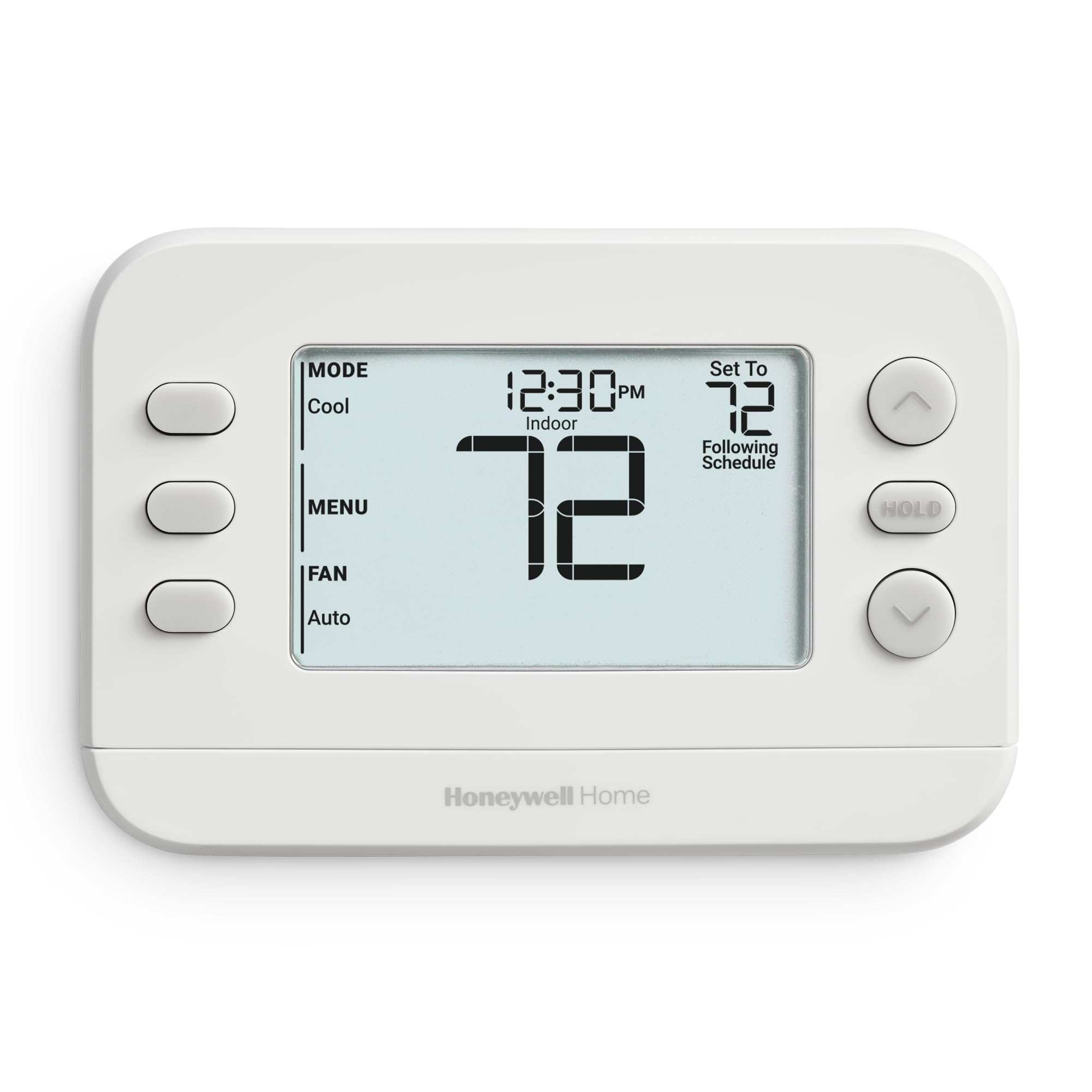
Type: Programmable, single-stage
Schedule: 5-2 day (weekday and weekend)
System Compatibility: 1 heat / 1 cool
Display: Digital, white housing
The RTH20B is the straightforward option: a white wall unit that holds one schedule for weekdays and a separate one for weekends, which fits a household whose week has a predictable shape. It handles single-stage 1 heat/1 cool systems only, so it is a replacement for a conventional furnace-and-AC setup rather than a heat pump or multi-stage system. There is no Wi-Fi and no app, which means no account, no firmware, and nothing to reconnect after a router reset. For a nursery, that simplicity is the point — the schedule is set once and left alone.
This pick suits the parent who wants a set-and-forget routine and does not want to manage another app, and it is the cheapest way into scheduled heating and cooling here. It is not for a household with a heat pump, zoned system, or anyone who expects to adjust the temperature from a phone in another room. Trade-off: the 5-2 schedule cannot give every day its own program, so a household with an irregular week will feel the limit.
Sensi Smart Thermostat ST55
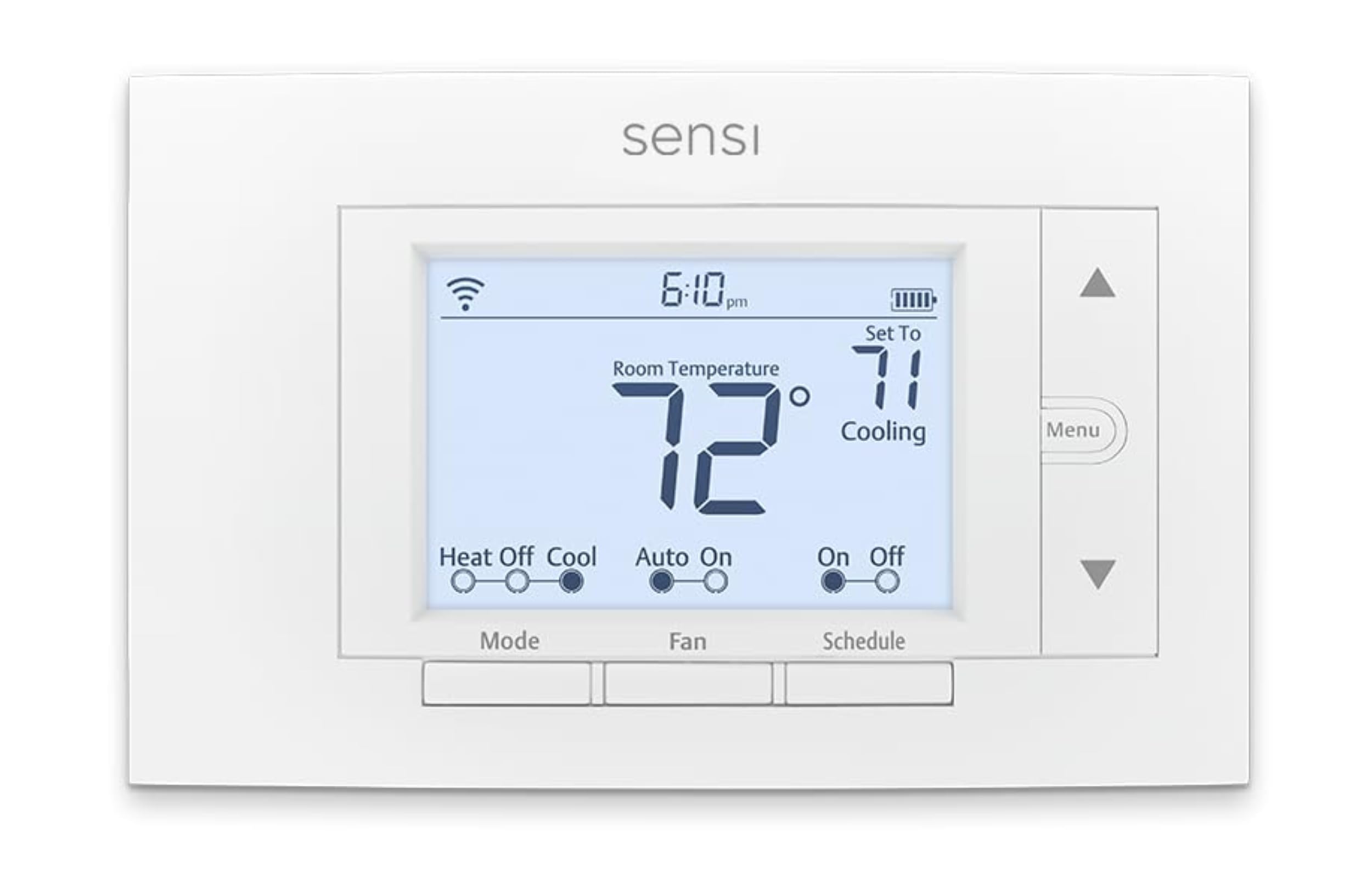
Type: Smart, Wi-Fi programmable
Voice Control: Alexa
Certification: Energy Star certified
Installation: DIY
The Sensi ST55 is the middle path: a Wi-Fi thermostat that a homeowner can install without a contractor, controlled from a phone and by Alexa. Energy Star certification means the unit meets an efficiency standard rather than simply adding an app to a basic dial. The practical benefit with a baby is remote adjustment — a parent can nudge the temperature from the nursery or from bed instead of walking to a hallway keypad.
This pick suits the household that wants app and voice control but does not want to pay touchscreen prices, and it is a good fit for a first-time buyer replacing an old manual unit. It is not for someone who wants no cloud account or no phone dependency at all. Trade-off: the plain display and plastic housing sit a tier below the premium Honeywell, and the app becomes the main way the schedule is managed — households that dislike that should look at the RTH8560D.
Honeywell Home RTH9585WF1004 Wi-Fi Smart Color Thermostat

Type: Smart, Wi-Fi programmable
Schedule: 7 day
Display: Color touchscreen
Certification: Energy Star
Voice Control: Alexa ready
The RTH9585WF1004 is the premium pick, and the color touchscreen is what separates it: a large, readable display that shows the current setting and schedule clearly from across a hallway. Seven-day programming gives every day of the week its own schedule, which matters in a house where one parent works weekends or a baby’s nap pattern changes the daytime setpoint. Wi-Fi and Alexa readiness put it in the same remote-control class as the Sensi, with a much better interface.
This pick suits the household that wants full weekly control and a display that is easy to read and adjust at the wall, and it is the natural choice for a main living area visible from the nursery door. It is not for a buyer on a tight budget, or for anyone who wants a thermostat that stays offline. Trade-off: the color screen and Wi-Fi stack make this the most expensive unit here, and the touchscreen is more to clean and more to go wrong than a simple button panel.
Honeywell Home RTH8560D 7 Day Programmable Touchscreen Thermostat

Type: Programmable, non-Wi-Fi
Schedule: 7 day
Display: Touchscreen
The RTH8560D takes the best part of the premium Honeywell — seven-day programming and a touchscreen — and leaves out the Wi-Fi. The result is a wall unit that gives every day its own schedule, set directly on the screen, with no app, no account, and no network to maintain. For a household that wants detailed scheduling but does not want a smart-home device in the nursery hallway, this is the practical compromise.
This pick suits parents who want real weekly programming and a modern touchscreen but prefer to keep the thermostat offline, and it makes sense for a home where the router sits far from the wall unit. It is not for anyone who wants to check or change the temperature from a phone. Trade-off: without Wi-Fi there is no remote adjustment, so every schedule change happens at the wall — inconvenient during a contact nap or a night feed.
Suuwer Non-Programmable Thermostat

Type: Non-programmable, single-stage
System Compatibility: 1 heat / 1 cool conventional
Display: Blue backlight
The Suuwer is the simple manual option: a single-stage 1 heat/1 cool thermostat with a blue backlit display and no scheduling at all. The temperature is set by hand and stays where it is put. That sounds like a step backward, but for some households it is exactly right — a caregiver who is home all day, a rented nursery where the existing wiring is basic, or a backup unit for a garage conversion or spare room.
This pick suits the buyer who wants the lowest-cost, lowest-complexity replacement and does not need a schedule, and it is a reasonable stopgap while a bigger HVAC decision is pending. It is not for anyone who wants overnight setbacks or weekday-versus-weekend programming — the whole point of a programmable unit is missing here. Trade-off: with no schedule, the household pays to heat or cool an empty house during the day, which offsets the low purchase price over a season.
Before You Buy
- Compatibility: Match the unit to the system — the RTH20B and Suuwer are single-stage 1 heat/1 cool only, so a heat pump or multi-stage system needs a different model.
- Wiring: A thermostat replacement assumes the existing low-voltage wiring is intact; a unit with more features may need an additional wire, so check the wall before ordering.
- Schedule granularity: A 5-2 schedule covers weekdays and weekends separately, while a 7-day unit programs each day on its own — pick based on how irregular the household week is.
- Connectivity: Wi-Fi models need a stable router signal at the wall location; a non-Wi-Fi unit such as the RTH8560D avoids that dependency entirely.
- Placement: Keep the thermostat away from cribs, drapes, and direct sun so the reading reflects the room rather than the furniture.
- Display and controls: A touchscreen is easier to read across a hallway but harder to operate quietly in a dark room than a simple button panel.
Frequently Asked Questions
-
Is a programmable thermostat safe to use in a house with a baby?
Yes — these are standard low-voltage wall thermostats. The practical concern is placement and a stable setpoint, not the device itself. -
Which pick is best for adjusting the temperature during the night?
A Wi-Fi model such as the Sensi ST55 or the Honeywell RTH9585WF1004, since both allow changes from a phone without walking to the wall. -
Does a 5-2 schedule work for a household with a baby?
It can, if weekdays and weekends look different but each day within them is similar. A household with shift work or variable nap routines is better served by a 7-day unit. -
Do these thermostats need a professional to install?
The Sensi ST55 is sold as a DIY install, and the others are standard replacements, but a household unsure about wiring should use an HVAC technician. -
Is a non-programmable thermostat ever the right choice?
Yes — for a caregiver home all day, a rental with basic wiring, or a spare room where a schedule would never be used. -
What is the main difference between the two Honeywell touchscreen models?
The RTH9585WF1004 adds Wi-Fi and a color screen; the RTH8560D keeps the seven-day touchscreen programming but stays offline.
Bottom Line
For most households with a baby, the Sensi Smart Thermostat ST55 is the pick that balances price, app control, and easy installation — it lets a parent adjust the temperature from another room without paying touchscreen prices. A household that wants the best wall interface and full seven-day control should step up to the Honeywell Home RTH9585WF1004, while a tight budget or a preference for an offline unit points to the RTH20B or the RTH8560D.
