Why there are Amazon links here: Brave Review is paid a commission for qualifying Amazon purchases made through the links below. Your price does not change, and using our links is entirely optional. How this works
Best WiFi Extender for a House with Thick Stone Walls: 5 Picks That Punch Through
Stone walls block WiFi the way few other building materials do. Signal dies inside the masonry, so a router in one room can leave the far end of a stone farmhouse or a brick townhome stranded. The five picks below cover the realistic scenarios: a quick indoor fix, a mesh-friendly budget unit, a heavy-duty outdoor bridge for signal that has to cross a wall to reach an outbuilding, and a couple of high-power indoor repeaters. Most buyers fall into one of three groups — a renter who wants a plug-in fix, a homeowner wiring a whole stone house, or someone trying to reach a detached garage or garden room.
The Picks at a Glance
| Product | Key Spec | Best Use | Price Tier |
|---|---|---|---|
| 2026 WiFi Extender Signal Booster (15000 sq.ft) | 15000 sq.ft coverage, Ethernet port, 1-tap setup | Large stone homes wanting a simple plug-in repeater | Budget |
| TP-Link AC1200 WiFi Extender (RE315) | AC1200 dual band, EasyMesh, one Ethernet port | Small stone apartments and mesh upgrades | Budget |
| WAVLINK WiFi 7 BE5100 Outdoor Extender | IP67 waterproof, 4 x 8dBi antennas, 2.5 Gbps Ethernet | Bridging signal to outbuildings across a stone wall | Premium |
| NETGEAR WiFi Mesh Range Extender EX7000 | AC1900 dual band, mesh smart roaming, 35 devices | Whole-floor coverage in a large stone house | Premium |
| 2026 Upgraded WiFi Extender (18000 sq.ft) | 18000 sq.ft coverage, Ethernet port, 15X signal amplifier | Very large stone properties needing maximum reach | Budget |
1. 2026 WiFi Extender Signal Booster for Home — Best Budget Pick for Large Stone Homes
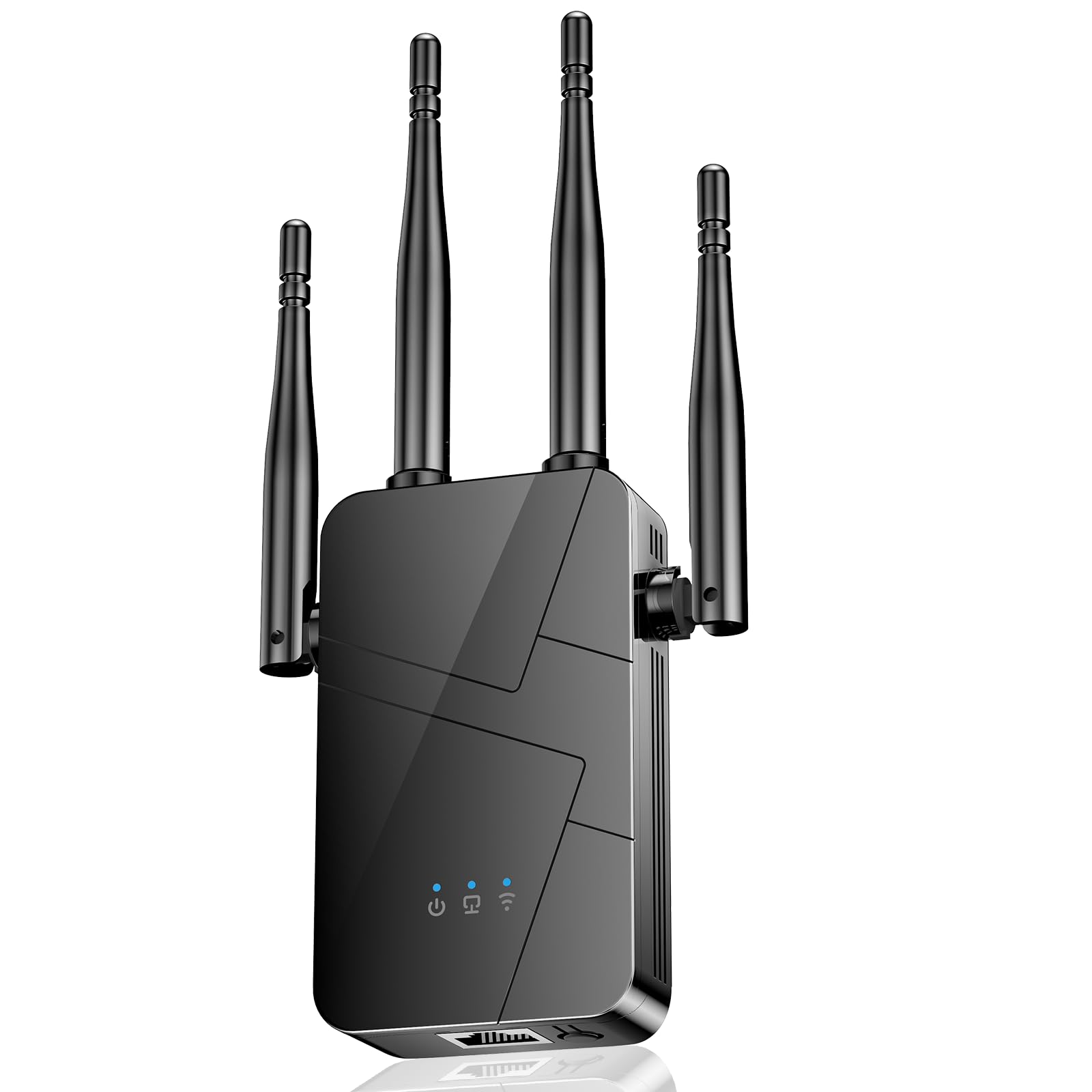
Coverage Claim: 15000 sq.ft
Type: Indoor WiFi repeater
Ports: Ethernet port
Setup: 1-tap setup
Compatibility: 99% of devices
Price Tier: Budget
2026 WiFi Extender Signal Booster for Home
This is the simplest way to push a weak signal deeper into a stone house. It repeats an existing network, broadcasts a second SSID, and gives buyers an Ethernet port for a wired device in the room where the stone is thickest. The 1-tap setup is aimed at people who do not want to log into a router admin page, and the "99% of devices" claim means it should work with phones, laptops, smart TVs and printers without fuss.
It suits a homeowner with a large footprint and a modest budget who wants signal in one or two dead rooms, not a whole-house mesh. The caveat is that repeaters halve throughput on the rebroadcast band, and a stone house already starts from a weak signal — so the extender needs to sit in a spot where the original signal is still decent, not at the dead end of the house. A buyer expecting full speed at the far wall will be disappointed.
Trade-off: Maximum coverage claims assume open space, and stone walls will cut that reach sharply, so placement near a doorway or window matters more than the number on the box.
2. TP-Link AC1200 WiFi Extender (RE315) — Best Small-Room and Mesh-Compatible Pick

Speed Class: AC1200 dual band (5GHz / 2.4GHz)
Coverage Claim: Up to 1600 sq.ft
Device Support: Up to 32 devices
Mesh: EasyMesh compatible
Ports: One Ethernet port
Price Tier: Budget
TP-Link AC1200 WiFi Extender (RE315)
The RE315 is the sensible pick when the goal is one stubborn room rather than a whole stone house. Dual band means the 2.4GHz side does the wall-penetrating work while the 5GHz side handles speed at close range. EasyMesh compatibility is the real draw: it lets the unit join a mesh network rather than sit as a separate repeater, so buyers with a mesh router can add coverage without a second login.
It fits renters, small stone apartments, and anyone who already owns a mesh system and just needs one more node. It is not the right tool for a sprawling stone farmhouse — 1600 sq.ft and 32 devices is a modest ceiling, and the single Ethernet port limits wired devices to one. Buyers who need to cover multiple floors should look at the higher-capacity picks.
Trade-off: The compact size and low price mean limited antenna gain, so it works best placed close to the router and in line of sight through a doorway.
3. WAVLINK WiFi 7 BE5100 Outdoor Extender — Best for Outbuildings Across a Stone Wall
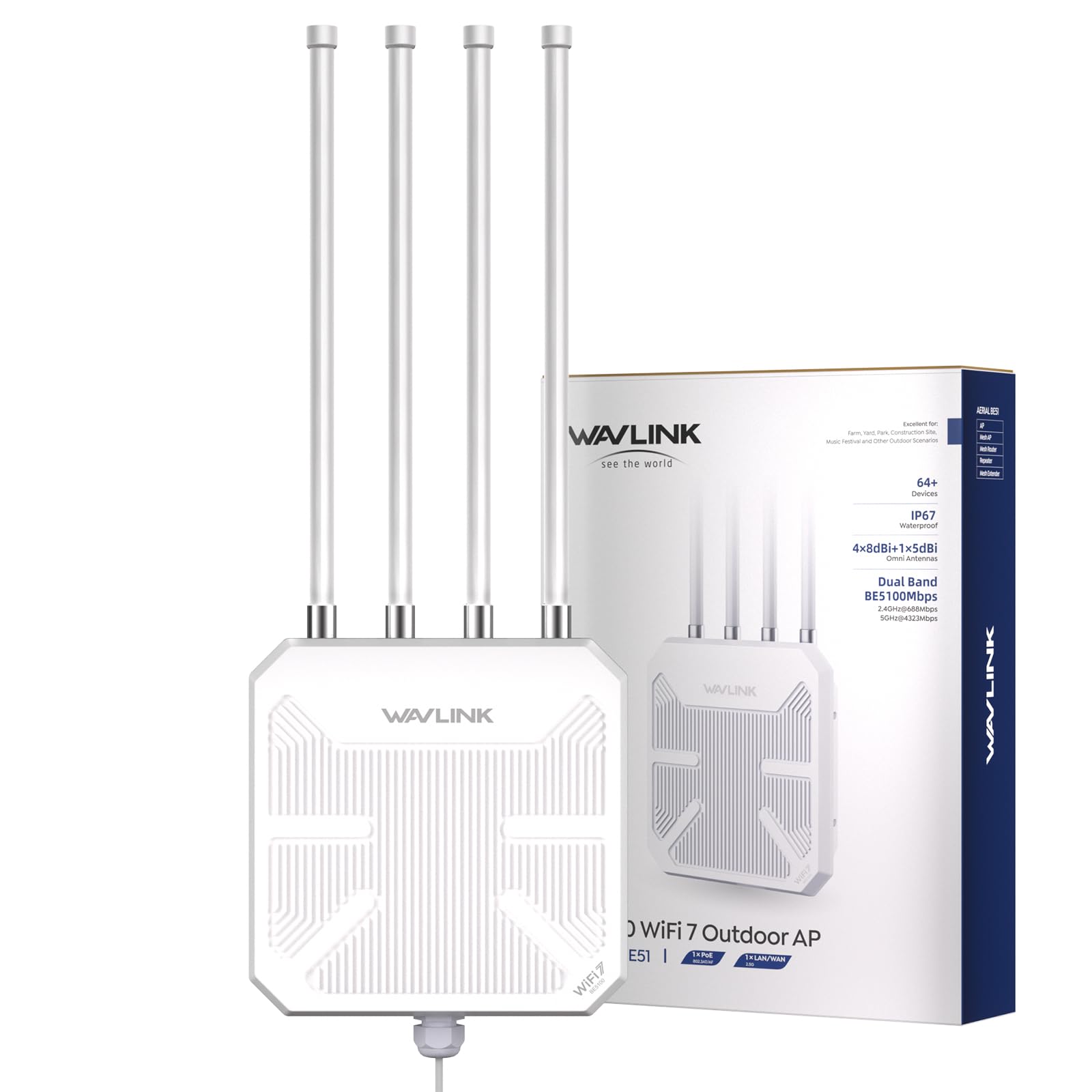
Standard: WiFi 7 (BE5100)
Weatherproofing: IP67 waterproof
Antennas: 4 x 8dBi
Power: POE powered
Ports: 2.5 Gbps Ethernet
Modes: Repeater, AP, Mesh Router
Coverage Claim: Up to 2800 sq.ft
Price Tier: Premium
WAVLINK WiFi 7 BE5100 Outdoor WiFi Extender
This is the pick for the hardest stone-house problem: getting signal from the main building to a detached garage, garden office or annex. Mounted outside, it can shoot signal across a courtyard or through an exterior stone wall instead of trying to fight through interior masonry. IP67 waterproofing means it survives rain and dust, POE power means one cable carries both data and electricity, and the four 8dBi antennas give it the gain a wall-penetrating job needs.
It suits a homeowner with an outbuilding and a willingness to run a cable, and it is the only pick here built for outdoor mounting. It is overkill for a single dead bedroom, and it is the most expensive unit on the list by a wide margin. Buyers without a POE switch or injector need to plan for that extra hardware.
Trade-off: The premium price and POE requirement make it a poor fit for a simple indoor dead-zone fix, and outdoor mounting needs a cable run most casual buyers will not want to tackle.
4. NETGEAR WiFi Mesh Range Extender EX7000 — Best High-Capacity Indoor Pick

Speed Class: AC1900 dual band (up to 1900 Mbps)
Coverage Claim: Up to 2100 sq.ft
Device Support: Up to 35 devices
Mesh: Mesh smart roaming
Price Tier: Premium
NETGEAR WiFi Mesh Range Extender EX7000
The EX7000 is the indoor workhorse of the group. AC1900 dual band gives it more throughput than the budget repeaters, and mesh smart roaming means devices hand off between the router and the extender without a manual reconnect — useful in a stone house where a phone moves from a thick-walled kitchen to a thinner upstairs room. The 35-device ceiling covers a family with TVs, phones, laptops and smart home gear.
It suits a large stone home where the goal is one floor of solid coverage rather than a single room. The caution is age: this is an older AC-class unit at a premium price, and buyers who already run a WiFi 6 or WiFi 7 router may be paying for a standard their network has moved past. It is also a mains-powered desktop unit, not a plug-in wall wart, so it needs shelf space near an outlet.
Trade-off: The premium price buys AC-class hardware, so buyers with a newer router should weigh whether a current-standard extender would serve them better for similar money.
5. 2026 Upgraded WiFi Extender for Home — Best Maximum-Reach Budget Option

Coverage Claim: Up to 18000 sq.ft
Type: Indoor WiFi repeater
Ports: Ethernet port
Amplifier: 15X signal amplifier
Compatibility: 99% of routers
Price Tier: Budget
2026 Upgraded WiFi Extender for Home
This is the largest coverage claim on the list at a budget price, aimed squarely at buyers with a big stone property and a small budget. The 15X signal amplifier is the headline feature, and the Ethernet port lets a wired device sit in the room with the weakest signal. It works with the vast majority of routers, so it drops into an existing setup without a mesh system.
It suits someone covering a very large footprint who accepts the trade-offs of a repeater rather than a mesh. The caution is the same one that applies to every high-claim repeater: the sq.ft figure assumes open space, and stone walls will shrink it dramatically, so real-world placement matters more than the number. Buyers wanting guaranteed performance across a whole stone house should consider a mesh system instead.
Trade-off: A very large coverage claim at a budget price usually means the unit relies on placement and antenna gain rather than premium components, so realistic expectations matter.
Before You Buy
- Wall material: Stone and masonry absorb 2.4GHz signal far more than drywall, so an extender needs to sit where the original signal is still usable — usually near a doorway or window in the thick wall.
- Coverage claims: Sq.ft figures assume open space. Halve them for a stone house and plan on more than one unit for a large property.
- Band choice: 2.4GHz penetrates stone better; 5GHz is faster but struggles through masonry. Dual-band units let buyers pick per room.
- Mesh compatibility: If the router is a mesh system, choose an extender that joins the mesh (EasyMesh or smart roaming) rather than creating a second network.
- Placement and power: Repeaters need a mains outlet roughly midway between router and dead zone, not at the dead end of the house.
- Wired backhaul: An Ethernet port on the extender allows a wired device or a wired link back to the router, which beats wireless repeating through stone.
- Outdoor needs: For detached garages or garden rooms, an outdoor-rated unit mounted on the exterior wall beats any indoor repeater.
Frequently Asked Questions
-
Will a WiFi extender work through thick stone walls?
It can, but stone absorbs signal heavily, so the extender must be placed where the router’s signal is still reasonably strong — usually near a doorway, window or the thinner part of the wall. -
How many extenders does a stone house need?
A large stone house often needs more than one. Coverage claims assume open space, so a single unit rarely covers a whole multi-room stone property. -
Is a mesh system better than an extender for stone walls?
A mesh system with wired or dedicated backhaul generally performs better in a large stone house, but a mesh-compatible extender is a cheaper way to add one node. -
Can an extender reach a detached garage or outbuilding?
An outdoor-rated unit mounted on the exterior wall is the reliable option; indoor repeaters struggle to push signal through an exterior stone wall and across a yard. -
Does an extender slow down the connection?
Wireless repeaters typically halve throughput on the rebroadcast band, so a wired backhaul or a mesh system preserves more speed. -
What should buyers check before ordering?
Router standard (WiFi 5, 6 or 7), mesh compatibility, available outlets near the midpoint, and whether an outdoor or wired solution is needed.
Bottom Line
For most stone-house buyers, the 2026 WiFi Extender Signal Booster for Home is the fastest, cheapest way to reclaim a dead room, while the WAVLINK WiFi 7 BE5100 Outdoor Extender is the right call when signal has to cross an exterior stone wall to reach an outbuilding. Buyers with a mesh router should start with the TP-Link AC1200 (RE315) for its EasyMesh support at a budget price.
