Why there are Amazon links here: Brave Review is paid a commission for qualifying Amazon purchases made through the links below. Your price does not change, and using our links is entirely optional. How this works
DeWalt 550W Power Inverter: 20V Battery to Household AC
The DeWalt 550W Power Inverter is a battery adapter that turns a 20V DeWalt pack into a small portable power station: one AC outlet, two USB ports and a Type-C fast-charging port, all in a housing that clips onto a battery the buyer already owns. It suits campers, tailgaters and tradespeople who want household-style power without buying a sealed battery bank. This review covers the specifications, what those numbers mean in practice, and who should skip it. The short answer for anyone ready to decide is to check the current price on Amazon.
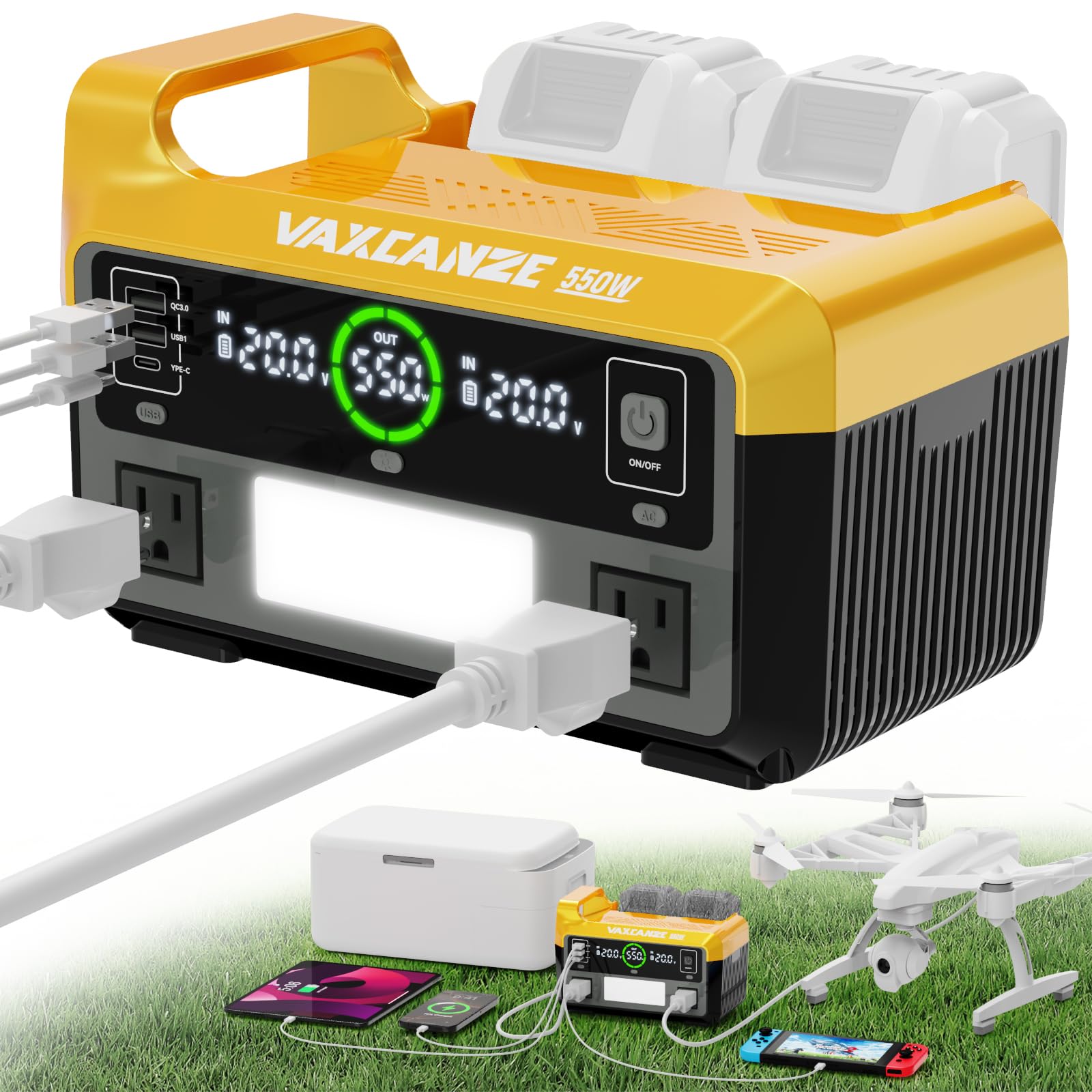
Features and Specifications
- Product type: DC-to-AC power inverter and battery adapter
- Input: DeWalt-style DC 20V battery packs (battery not included)
- Output: AC 110V, pure sine wave
- Rated power: 550W
- Outlets: 1 AC outlet, 2 USB ports, 1 Type-C fast-charging port
- Extras: Built-in LED, battery adapter housing
- ASIN: B0F4Y4NRFT
The headline is the power rating. 550W is enough to run a laptop, a small TV, a fan, a string of lights, a camera battery charger or a small kitchen appliance, and it is not enough to run anything with a compressor or a heating element that demands a big startup surge.
The second headline is the input. This is not a self-contained power station with its own cells; it is an adapter that borrows a 20V DeWalt pack. That is the whole design philosophy of the product, and it changes every other decision a buyer makes.
Trade-off: The battery is sold separately and is the real cost of ownership — a buyer with no DeWalt 20V packs on the shelf is buying into a battery platform, not just an inverter.
Build and Design
The housing is a compact adapter-style body that mounts a DeWalt 20V slide pack and exposes the outlets and ports on the front face. Because the battery does the work, the unit itself is small and light compared with a power station of similar output, and it packs into a toolbox or a backpack without a struggle.
Pure sine wave output is the specification worth pausing on. Modified sine wave inverters are cheaper to build, but they run resistive loads fine while making some electronics unhappy — motors can hum, chargers can run hot, and sensitive audio gear can pick up noise. A pure sine wave design produces a cleaner waveform that behaves much closer to a wall outlet, which is why it matters for laptops, medical devices and anything with a motor or a speaker inside.
The LED is a practical touch on a job site or around a campsite after dark, and the mix of charging ports means phones, tablets and other USB devices do not have to compete with the AC outlet for attention.
Power and Output
The 550W figure sets a clear ceiling. Small entertainment gear, lighting, fans, power tools with modest draw, laptop and camera charging, and a router or modem during an outage all sit comfortably inside that limit. Anything with a motor that kicks on with a surge — a fridge, a full-size circular saw, a space heater — does not.
The three USB ports, including the Type-C fast-charging port, are the part most people will use daily. Modern phones and tablets charge quickly on USB-C, and having two additional USB-A ports means a family or a small crew can top up several devices at once without a hub.
The pure sine wave output is what separates this unit from the bargain inverter bin. For a buyer charging a laptop, running a fan or powering a TV, the cleaner output reduces the risk of odd behavior and heat buildup in the connected device.
The real variable is the battery. Output time depends entirely on which 20V pack is slid onto the adapter and how much charge it holds. A small pack will run a laptop for a while and a larger pack will run it longer, but this is not a whole-house backup and should not be sold to a buyer as one.
Who It Suits
This inverter fits three buyer types well. The first is the DeWalt 20V owner who already has packs and a charger and wants a cheap way to get AC power out of them — the value proposition is strongest for that group by a wide margin.
The second is the camper, tailgater or festival-goer who wants a light, compact way to run a fan, lights, a small TV and charge a pile of phones without hauling a heavy power station.
The third is the tradesperson or homeowner who wants a small AC source on a job site or during a short outage, where a battery pack is already on hand and the loads are modest.
Who it is not for: anyone without DeWalt 20V batteries, anyone who needs to run a fridge, a heater or a large power tool, and anyone who wants a self-contained station that works out of the box. Those buyers should look at a standalone power station with its own cells and a higher output rating.
Maintenance and Everyday Use
The inverter itself has no consumable parts and no battery to degrade, which is the quiet advantage of the adapter design: the part that wears out is the battery pack, and that is a pack the buyer already owns, charges and replaces on the DeWalt platform.
The practical routine is simple. Keep the battery topped up, store the unit dry, and check the vents and ports for dust and debris after job-site use. Because the housing is compact and has no internal cells, there is no long-term storage ritual of partial charges and recharges that a power station demands.
The limitation is the same one that defines the category. The inverter is only as good as the battery on it. A buyer who forgets to charge a pack, or who brings a single small pack for a weekend, will be disappointed — not by the inverter, but by the power budget. Carrying two packs is the simple fix.
FAQ
-
What is a DeWalt 550W power inverter?
It is a battery adapter that converts the DC power from a DeWalt-style 20V battery pack into AC 110V household power, with a pure sine wave output, one AC outlet, two USB ports and a Type-C fast-charging port. The battery is not included. -
Does the DeWalt 550W power inverter come with a battery?
No. The product is the adapter only, and the battery must be purchased separately. Buyers who already own DeWalt 20V packs get the most value from it. -
What can a 550W inverter run?
Laptops, phones, tablets, fans, lights, a small TV, a router, camera chargers and similar modest loads. It is not built for fridges, space heaters, air conditioners or large power tools that draw more than its rating or surge on startup. -
What does pure sine wave mean and why does it matter?
Pure sine wave output produces a smooth, wall-outlet-like AC waveform instead of a stepped approximation. Electronics, motors and chargers generally run cooler and more predictably on it, which is why it is the preferred output type for sensitive devices. -
How long will it run on one battery?
That depends entirely on the capacity and charge level of the 20V pack used, and on the load plugged in. A larger, fully charged pack runs longer; a small or partly drained pack runs shorter. Carrying a spare pack is the practical way to extend runtime. -
Can it charge a phone and run an AC device at the same time?
Yes. The AC outlet and the USB ports are separate outputs, so a phone on USB-C and a laptop on the AC outlet can run together, within the total power budget. -
Is it safe to leave a battery on the adapter?
The adapter should be stored dry and disconnected when not in use, and the battery should be stored according to the battery maker’s guidance. As with any inverter, the unit should not be run in a sealed space or near water. -
Can it be used indoors?
It can power indoor devices, but like any inverter it should not be operated in an enclosed space without ventilation, and it should be kept away from moisture and flammable materials. -
Does it work with other brands of 20V batteries?
The product is built as a DeWalt 20V battery adapter, so it is designed around that battery platform. Buyers with other brands should not expect a fit. -
Is the DeWalt 550W power inverter worth it?
For a DeWalt 20V owner who wants a compact, light way to get AC and USB power from packs already on the shelf, it is a sensible and inexpensive route. For a buyer starting from zero, a self-contained power station is usually the better first purchase.
Bottom Line
The DeWalt 550W Power Inverter is a smart, compact solution for one specific buyer: the person who already owns DeWalt 20V batteries and wants household AC, USB and USB-C power without buying a sealed power station. Pure sine wave output, a light adapter housing and a sensible port mix make it a genuinely useful camping, tailgating and job-site tool. Buyers with no 20V packs, or with loads beyond 550W, should look elsewhere — but for the DeWalt owner, it is an easy call.
