Why there are Amazon links here: Brave Review is paid a commission for qualifying Amazon purchases made through the links below. Your price does not change, and using our links is entirely optional. How this works
AFERIY P210 vs EcoFlow Delta 3 Max Plus: Which 2048Wh Power Station Fits
The AFERIY P210 and the EcoFlow Delta 3 Max Plus are both 2048Wh portable power stations, and that shared capacity is where the similarity mostly ends. One is a budget-leaning home backup unit with a fast-charging battery and a 2400W inverter; the other is a premium station with a higher continuous output, a much faster recharge window and a bigger price tag. This comparison separates them dimension by dimension so a buyer can decide quickly, and the short version is that the AFERIY suits budget-conscious backup and camping, while the EcoFlow suits households that want more headroom and faster turnaround.
AFERIY P210

Battery: LiFePO4, 3500+ cycles
Capacity: 2048Wh
AC Output: 2400W continuous, 4800W peak
Recharge: AC fast charging
DC Output: 12V/25A XT60
UPS Switchover: 10ms
Intended Use: Home backup, camping, solar optional
The P210 is built around a LiFePO4 battery rated for 3500+ cycles, which is the chemistry most buyers now want in a station meant to sit charged for years between outages. Its 2400W inverter with a 4800W peak handles resistive loads and most motor-start surges, and the 10ms UPS switchover means it can sit between a wall outlet and sensitive equipment without a visible gap in power. The 12V/25A XT60 DC output is a deliberate inclusion for RV and off-grid users who run DC appliances or charge from a DC source rather than AC.
Charging is handled through AC fast charging, with solar listed as an optional add-on rather than a bundled panel. That keeps the box price down, but it also means a buyer planning to rely on solar needs to budget for panels separately. The station is aimed at a household that wants a mid-size backup unit plus a camping battery in one purchase, and at that price tier it trades the last word in fit and finish for capacity per dollar.
Trade-off: The lower price tier shows up in the details — this is a heavier, plainer unit than premium rivals, and solar charging requires buying panels on top.
Check the current price on Amazon
EcoFlow Delta 3 Max Plus
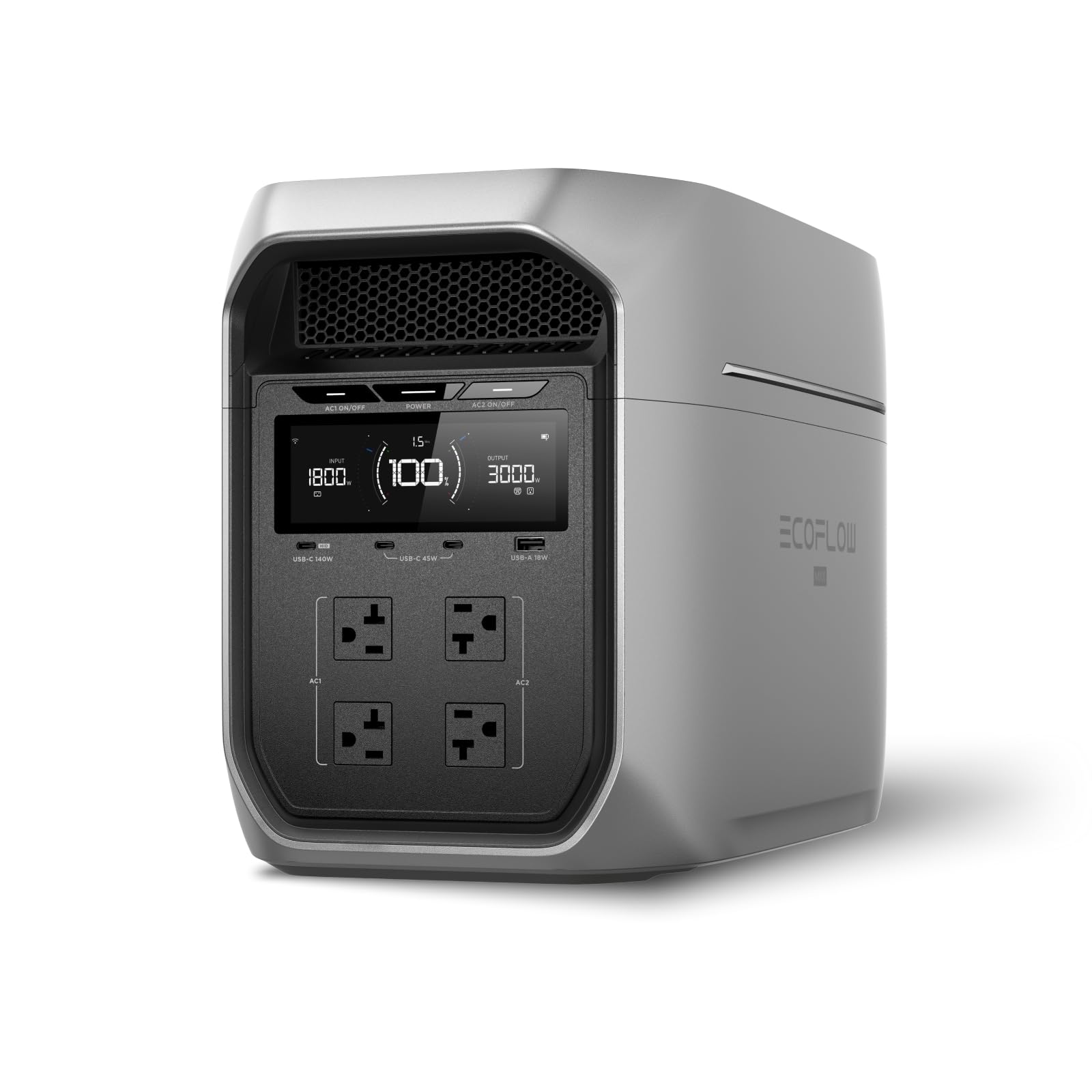
Capacity: 2048Wh
AC Output: 3000W continuous
X-Boost Output: 3800W
Recharge: 0–80% in 64 minutes
Intended Use: Home backup, RV, camping
Solar: Panel optional
The Delta 3 Max Plus pairs the same 2048Wh capacity with a 3000W continuous inverter, and its X-Boost mode extends usable output to 3800W for appliances that would otherwise trip a smaller station. That headroom matters for buyers running a fridge, a microwave or a space heater alongside smaller loads, because it keeps more of the home’s circuits inside the station’s comfort zone. Recharging is the headline: a 0–80% top-up in 64 minutes is fast enough that an outage-adjacent household can refill between events rather than planning a full day around it.
This is a premium-tier station, and the price reflects both the inverter headroom and the charging architecture. Solar is again optional rather than included, so the total cost of a solar-ready setup sits above the sticker. Build and app-side management are the areas where this class of unit typically earns its premium, and buyers paying this much should expect a more polished ownership experience than a budget unit delivers.
Trade-off: The premium price is the real barrier — buyers who only need occasional camping power are paying for output and recharge speed they may rarely use.
Check the current price on Amazon
Side-by-Side Comparison
| Specification | AFERIY P210 | EcoFlow Delta 3 Max Plus |
|---|---|---|
| Capacity | 2048Wh | 2048Wh |
| Battery Chemistry | LiFePO4, 3500+ cycles | Not stated in name |
| Continuous AC Output | 2400W | 3000W |
| Peak / Boost Output | 4800W peak | 3800W X-Boost |
| Recharge Speed | AC fast charging | 0–80% in 64 minutes |
| DC Output | 12V/25A XT60 | Not stated in name |
| UPS Switchover | 10ms | Not stated in name |
| Solar | Optional | Optional |
| Price Tier | Budget | Premium |
| Best Use | Budget home backup, camping | High-draw home backup, RV |
Read across the table and the pattern is clear. Capacity is identical, so the decision never comes down to watt-hours — it comes down to how much power the buyer needs at once and how fast the station has to be ready again. The AFERIY wins on peak surge (4800W against 3800W X-Boost) and adds a dedicated 12V/25A XT60 DC output plus a stated 10ms UPS switchover, which are practical advantages for RV owners and anyone backing up sensitive electronics.
The EcoFlow wins on continuous output, 3000W against 2400W, and on recharge speed by a wide margin. A buyer running a sustained high draw — a heater, a large fridge cycle, power tools — gets more usable headroom from the EcoFlow before the inverter complains. The 64-minute 0–80% recharge is the kind of difference that changes behavior: it makes the station practical to refill during a short grid gap rather than only between outages.
Price tier is the third dimension and it cuts the other way. The AFERIY sits at roughly half the cost of the EcoFlow, and for a buyer whose loads fit inside 2400W continuous, that gap buys a lot of panels or a second smaller station. The EcoFlow’s premium is justified by output and charging speed, not by capacity, so anyone shopping purely on watt-hours per dollar should look hard at the AFERIY.
Which Should You Buy?
Choose the AFERIY P210 if the budget is the deciding factor and the loads fit inside 2400W continuous. It suits campers, RV owners who will use the 12V/25A XT60 output, and households that want a UPS-style backup with a stated 10ms switchover without paying premium prices. The 4800W peak also gives motor-start surges more room than the EcoFlow’s boost rating.
Choose the EcoFlow Delta 3 Max Plus if sustained output and recharge speed matter more than price. A household running high-draw appliances through an outage, or a buyer who wants the station back to 80% within about an hour, gets real value from the 3000W inverter and the fast recharge. It is the better fit for buyers who will actually use that headroom.
Neither is the right call for someone who only needs to top up a phone and a laptop during a weekend trip — both are heavier and more expensive than that job requires.
FAQ
-
Is the AFERIY P210 or the EcoFlow Delta 3 Max Plus bigger?
Both are 2048Wh stations, so capacity is a tie. The difference is output: the EcoFlow delivers 3000W continuous, the AFERIY 2400W continuous with a 4800W peak. -
Which one recharges faster?
The EcoFlow Delta 3 Max Plus, which reaches 0–80% in 64 minutes. The AFERIY P210 uses AC fast charging but does not state an equivalent window in its product name. -
Can either run on solar?
Yes, both list solar as optional. Neither includes panels, so a solar setup adds to the total cost on either unit. -
Which is better for an RV?
The AFERIY P210 has an edge for DC-heavy RV use thanks to its 12V/25A XT60 output. The EcoFlow is the stronger pick if the RV draws high AC loads. -
Does the AFERIY P210 work as a UPS?
Its name states a 10ms UPS switchover for power outages, which is fast enough for most home electronics. The EcoFlow’s name does not state a switchover time. -
Which one costs less?
The AFERIY P210 sits in the budget tier at roughly half the price of the EcoFlow Delta 3 Max Plus, which is a premium-tier unit. -
Who should skip both?
Buyers who only charge small devices on occasional trips. A smaller, lighter station covers that job for far less money.
Bottom Line
The EcoFlow Delta 3 Max Plus is the stronger station on paper — 3000W continuous and a 64-minute run to 80% are genuine advantages — but the AFERIY P210 is the better buy for most households, because it matches the capacity, adds a 12V/25A XT60 output and a 10ms UPS switchover, and costs about half as much. Buyers whose loads genuinely exceed 2400W continuous should pay the premium for the EcoFlow; everyone else gets more value from the AFERIY.
