Why there are Amazon links here: Brave Review is paid a commission for qualifying Amazon purchases made through the links below. Your price does not change, and using our links is entirely optional. How this works
Best Angle Adjustment Bracket for a Camera: 5 Mounts That Hold Any Angle
An angle adjustment bracket for a camera solves one problem: keeping a camera pointed exactly where it needs to be, and keeping it there. The five picks below cover the three buyer profiles that matter here — the homeowner or installer aiming a security camera, the photographer who needs fast vertical-to-horizontal switching, and the video shooter building a monitor or transmitter rig. The overview table below shows each pick’s key spec, best use, and price tier so a decision can happen in under a minute.
Overview Of The Picks
| Product | Key Spec | Best Use | Price Tier |
|---|---|---|---|
| Universal Joint Mount (3-Axis) | 3-axis adjustable solid metal base | Flexible CCTV aiming indoors and out | Budget |
| Universal Security Camera Mount Bracket | Heavy duty metal adapter, wall/ceiling/pole | PTZ and dome camera installation | Budget |
| ARKON Camera Wall Mount | Robust aluminum construction | Long-term outdoor CCTV and camcorders | Premium |
| DSLR Camera L Bracket | Vertical/horizontal switching quick release plate | Tripods, monopods, and gimbals | Mid-range |
| SmallRig Foldable Mini L-Shaped Plate | Supports up to 2.6 lbs, 1/4"-20 screw | Transmitters and monitors on small rigs | Mid-range |
1. Universal Joint Mount For Security Camera, 3-Axis Bracket Adjustable Solid Metal Base

Type: Universal joint security camera mount
Adjustment: 3-axis
Material: Solid metal base
Intended use: CCTV camera installation
Environment: Indoor and outdoor
Price tier: Budget
This is the most flexible aimer in the group. A three-axis joint means pan, tilt, and rotation can each be set independently, which matters when a camera has to clear a soffit, a gutter, or an awkward corner. The solid metal base suggests a mount built to hold position under its own load rather than drift after a season of wind.
It suits homeowners and small installers who need one bracket to solve several awkward mounting spots. The trade-off is that a joint with this much freedom rewards careful tightening — a loose collar on a multi-axis mount is exactly where sag starts, so buyers should expect to check tension after the first week.
Check the current price on Amazon
Trade-off: The extra articulation is only as good as the tightening, and a budget joint can creep out of aim if it is not re-checked after installation.
2. Universal Security Camera Mount Bracket, Heavy Duty Metal Adapter

Type: Security camera mount bracket
Build: Heavy duty metal adapter
Compatibility: PTZ and dome surveillance cameras
Mounting: Wall, ceiling, and pole
Environment: Indoor and outdoor
Price tier: Budget
This bracket is the practical answer for heavier camera bodies. PTZ and dome units carry more weight and more leverage than a small bullet camera, so the heavy duty metal adapter and the three mounting routes — wall, ceiling, and pole — cover the installations most people actually face. It is the cheapest pick here and the most installation-focused.
It suits buyers replacing a flimsy plastic mount or adding a camera to an existing pole. The caution is that a heavy duty adapter is not a precision aiming head: buyers who need fine, repeatable angle control should look at the three-axis joint above instead.
Check the current price on Amazon
Trade-off: Built for holding a camera securely rather than for fine adjustment, so precise aiming is coarser than a dedicated joint mount allows.
3. ARKON Mounts Camera Wall Mount, Robust Aluminum Construction

Type: Camera wall mount
Material: Robust aluminum
Adjustment: Precision adjustment to capture any angle
Compatibility: CCTV cameras and camcorders
Installation: Easy installation
Price tier: Premium
Aluminum is the reason this one costs what it does. It resists corrosion better than painted steel in wet conditions and stays lighter on the wall, which matters for a mount that may sit outside for years. The precision adjustment claim points to a head designed for set-and-forget aiming rather than constant repositioning.
It suits buyers who mount once and want to forget it — a permanent CCTV position, a camcorder pointed at a fixed scene, or a location exposed to weather. The trade-off is straightforward: at the premium end of this list, buyers paying for a single fixed angle get durability rather than versatility.
Check the current price on Amazon
Trade-off: Premium pricing buys material quality and stability, not extra mounting options, so it is poor value for anyone who needs to reposition the camera often.
4. DSLR Camera L Bracket Vertical Horizontal Switching Tripod Quick Release Plate

Type: L bracket with quick release plate
Function: Vertical and horizontal switching
Compatibility: Canon, Nikon, Sony cameras; DJI Osmo, Ronin, Zhiyun stabilizers
Mounting: Tripod and monopod
Price tier: Mid-range
This is the photographer’s angle adjustment bracket. An L bracket lets a camera swing between landscape and portrait without remounting, and the quick release plate means the switch happens on the head rather than in the field with a screwdriver. The compatibility list covers the major camera brands plus the common gimbal systems.
It suits shooters who alternate orientations during a session and want that change to take seconds. The trade-off is fit: an L bracket is shaped around a camera body, and a plate that is not matched to the body can block a battery door or a port cover, so buyers should confirm the fit for their specific camera before committing.
Check the current price on Amazon
Trade-off: Generic L brackets can obstruct battery compartments and side ports on some bodies, so exact camera fit matters more than the spec list suggests.
5. SmallRig Foldable Mini L-Shaped Plate With 1/4"-20 Screw
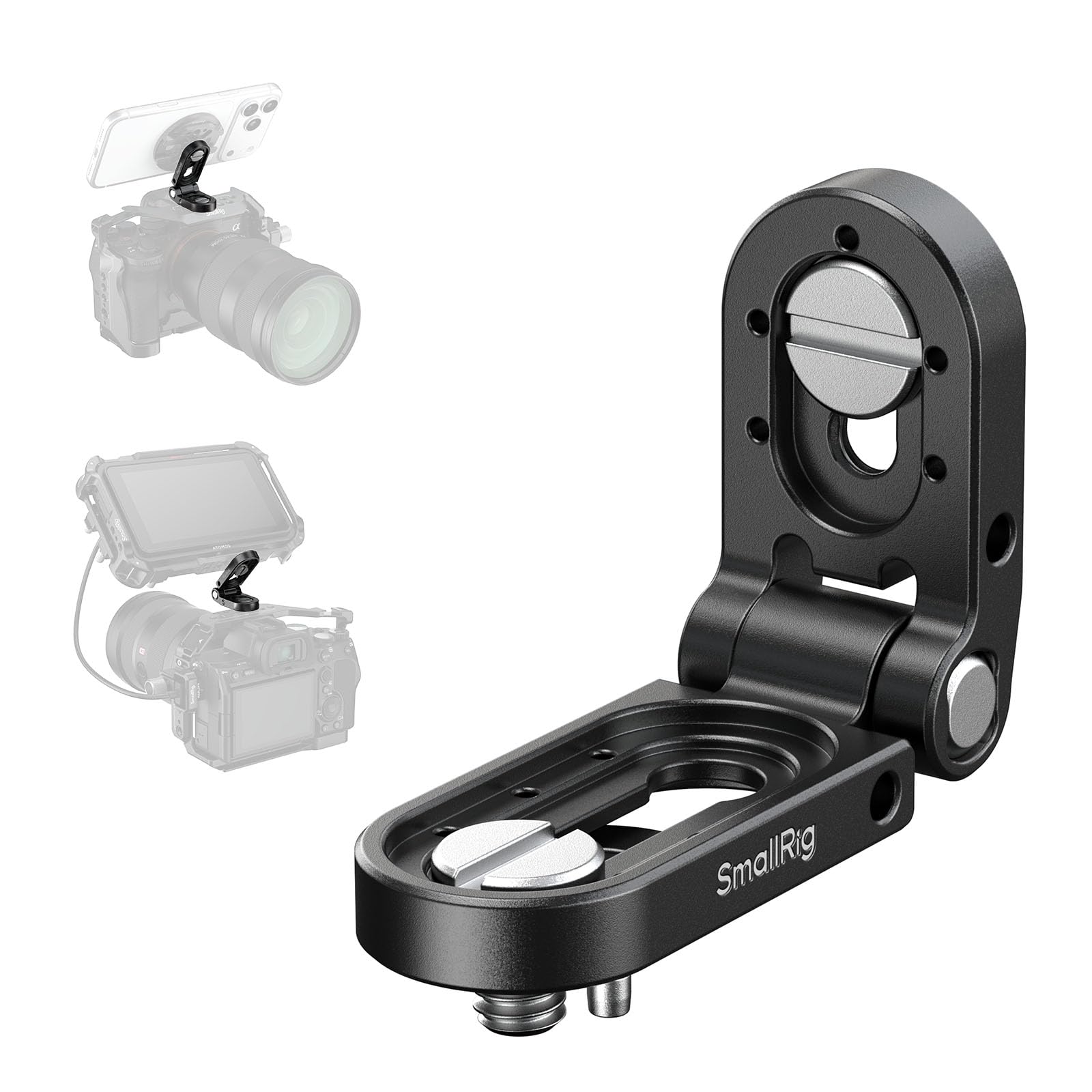
Type: Foldable mini L-shaped plate
Load capacity: Up to 2.6 lbs
Mounting: 1/4"-20 screw with removable pin
Intended use: Transmitters and monitors
Price tier: Mid-range
This is the rig builder’s option. The foldable design means the plate stows flat and takes up little space in a bag, while the 1/4"-20 screw and removable pin handle the standard mounting points on transmitters and on-camera monitors. The 2.6 lb ceiling is the number to read first.
It suits video shooters who need an adjustable arm for a small monitor or wireless transmitter rather than for the camera itself. The trade-off is capacity: 2.6 lbs is generous for a monitor but rules out heavier accessories, and anyone mounting a full camera body should choose a different bracket entirely.
Check the current price on Amazon
Trade-off: The 2.6 lb limit is a hard ceiling for small accessories only, so it cannot substitute for a camera mount.
Before You Buy
- Material: Aluminum resists corrosion and stays light; steel is stronger for heavy cameras but heavier on the wall. Plastic mounts are best avoided outdoors.
- Load capacity: Match the bracket to the camera, not the other way around. A PTZ or dome body needs a heavier duty adapter than a small bullet camera.
- Mounting surface: Confirm whether the bracket attaches to a wall, ceiling, or pole, and whether the hardware suits the surface — masonry, siding, and drywall each need different fasteners.
- Adjustment type: A multi-axis joint gives the most aiming freedom but needs re-tightening; a fixed precision head is more stable but less flexible.
- Camera fit: For DSLR and mirrorless L brackets, check that the plate clears the battery door and side ports on the specific body.
- Environment: Outdoor installations need corrosion-resistant metal and hardware rated for weather, not just a bracket described as suitable for outdoor use.
- Included accessories: Confirm whether mounting screws and the camera-side fastener are part of the package, since a bracket without them stalls the install.
Frequently Asked Questions
-
What is an angle adjustment bracket for a camera used for?
It holds a camera in a set position and lets the user change that position — tilt, pan, or rotation — without remounting the whole assembly. Security cameras, tripod setups, and monitor rigs all use some version of it. -
Can one bracket work for both a security camera and a DSLR?
Rarely well. Security mounts use different threads and load ratings than tripod plates, so a bracket built for CCTV is a poor fit for a camera body and vice versa. -
How much weight can a typical camera bracket hold?
Capacity varies widely by design, from small plates rated in the low single pounds to heavy duty adapters built for PTZ bodies. The bracket’s stated limit should always exceed the camera plus lens or accessory weight. -
Does a three-axis mount stay in position over time?
It does if the joints are tightened properly and checked after installation. Multi-axis mounts have more points that can loosen than a single fixed head, so a quick tension check after the first week is worthwhile. -
Is aluminum better than steel for an outdoor camera mount?
Aluminum resists corrosion better in wet conditions and is lighter, while steel offers more strength for heavier cameras. For most residential outdoor installations, aluminum is the easier long-term choice. -
Do L brackets work with gimbals?
Many do, and the models here list stabilizer compatibility. The plate still has to match the gimbal’s mounting standard and clear the camera body, so fit should be checked before purchase.
Bottom Line
For most buyers, the Universal Joint Mount is the best angle adjustment bracket for a camera because its three-axis joint handles awkward security camera angles at a budget price. Buyers mounting a heavier PTZ or dome body should take the heavy duty adapter instead, and photographers who switch orientation mid-shoot will get more daily use from the DSLR L bracket.
