Why there are Amazon links here: Brave Review is paid a commission for qualifying Amazon purchases made through the links below. Your price does not change, and using our links is entirely optional. How this works
Anker 521 vs Anker SOLIX C1000 Gen 2: Which Portable Power Station Fits Your Backup Plan
The Anker 521 and the Anker SOLIX C1000 Gen 2 sit at opposite ends of the portable power station market, and the choice between them comes down to one question: how much power does the job actually need? The 521 is a compact 256Wh unit built for tailgates, camping trips and small-device backup. The SOLIX C1000 Gen 2 is a 1,024Wh powerhouse aimed at home backup and heavier outdoor use.
This comparison covers capacity, output, ports, battery chemistry and price tier, then names the buyer each unit suits. Readers who already know their wattage needs can jump to the side-by-side table; everyone else should start with the overview.
The Picks at a Glance
| Product | Key Spec | Best Use | Price Tier |
|---|---|---|---|
| Anker 521 | 256Wh LiFePO4, 300W (600W peak), 6 ports | Camping, tailgating, phone and laptop backup | Budget |
| Anker SOLIX C1000 Gen 2 | 1,024Wh LiFePO4, 2,000W (3,000W output), car charging cable included | Home backup, emergency power, heavy outdoor use | Premium |
The 521 is the budget pick and the easier one to carry and store. The SOLIX C1000 Gen 2 costs several times more but delivers roughly four times the capacity and enough output to run appliances the 521 cannot touch. Neither is a compromise pick — they simply serve different jobs.
Anker 521 Portable Power Station

Battery Capacity: 256Wh
Battery Type: LiFePO4
AC Output: 300W continuous, 600W peak
Outlets: 2 AC outlets
USB-C Output: 60W PD
Total Ports: 6
The 521 is a small-format power station with a lithium iron phosphate battery, a chemistry chosen for longevity and thermal stability rather than raw energy density. Its 300W continuous AC output covers laptops, fans, lights, a small TV and similar low-draw devices, while the 600W peak rating handles brief startup surges from items like a mini fridge. The 60W USB-C PD port charges modern phones and tablets at full speed without an adapter.
Six ports in a body this size make the 521 a practical hub for a campsite or a car trunk. The two AC outlets are the headline feature, but the mix of USB-A and USB-C covers the devices most people actually carry. The unit accepts solar input, and the solar panel is sold separately, so buyers who want off-grid recharging should budget for that accessory.
Trade-off: The 256Wh capacity and 300W output rule out anything with a heating element or a large motor, so buyers planning to run a space heater, microwave or full-size fridge need to look elsewhere.
Check the current price on Amazon
Anker SOLIX C1000 Gen 2 Portable Power Station
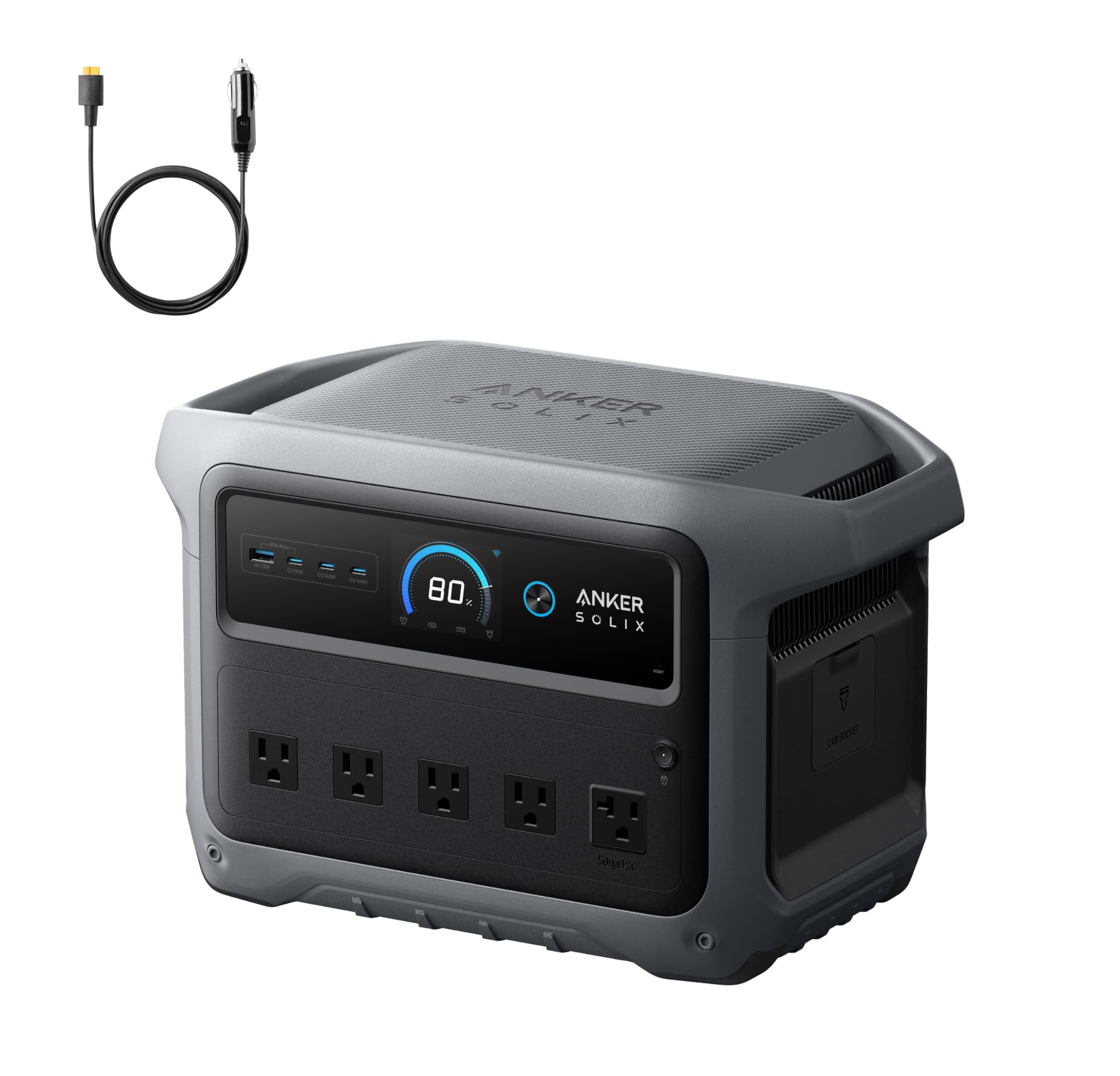
Battery Capacity: 1,024Wh
Battery Type: LiFePO4
AC Output: 2,000W
Peak Output: Up to 3,000W
Intended Use: Home, outdoor and emergency backup
Included Accessory: Car charging cable
The SOLIX C1000 Gen 2 is a full-size solar generator built around a 1,024Wh LiFePO4 battery. Its 2,000W continuous output and up to 3,000W peak rating put it in the class of units that can run a refrigerator, a microwave or a space heater for a useful stretch — the appliances the 521 cannot start at all. The included car charging cable means the unit can top up from a vehicle’s 12V outlet on the road, which matters for road trips and for anyone whose backup plan involves driving to a charge source.
The LiFePO4 chemistry matches the 521’s, so the same long-cycle-life and safety advantages apply at a larger scale. The trade-off is weight and footprint: a battery this size is a two-hand lift, and it takes up real floor or shelf space. Buyers should plan a permanent spot for it rather than treating it as a grab-and-go item.
Trade-off: The 1,024Wh capacity and 2,000W output come with a premium price and a bulky, heavy body, so buyers who only need to charge phones and laptops are paying for power they will never use.
Check the current price on Amazon
Side-by-Side Comparison
| Specification | Anker 521 | Anker SOLIX C1000 Gen 2 |
|---|---|---|
| Battery capacity | 256Wh | 1,024Wh |
| Battery chemistry | LiFePO4 | LiFePO4 |
| AC output (continuous) | 300W | 2,000W |
| Peak output | 600W | Up to 3,000W |
| AC outlets | 2 | Not stated in name |
| USB-C PD output | 60W | Not stated in name |
| Total ports | 6 | Not stated in name |
| Solar input | Yes (panel optional) | Yes (solar generator) |
| Included accessory | None listed | Car charging cable |
| Intended use | Outdoor, camping, small devices | Home, outdoor, emergency |
| Price tier | Budget | Premium |
Where the Two Diverge
Capacity and runtime. The 1,024Wh battery in the SOLIX C1000 Gen 2 holds roughly four times the energy of the 521’s 256Wh pack. In practice that means the larger unit can run a device for four times as long, or run a device with four times the draw for the same period. For a phone or laptop, the 521 is plenty. For a fridge or a heater, only the C1000 Gen 2 is in the conversation.
Output and appliance compatibility. The 521’s 300W continuous output sets a hard ceiling: devices that draw more than that will not run, and its 600W peak only briefly absorbs startup surges. The SOLIX C1000 Gen 2’s 2,000W continuous and up-to-3,000W peak output open up microwaves, kettles, power tools and full-size appliances. This is the single dimension that most often settles the decision.
Portability and storage. The 521’s compact 256Wh body is a one-hand carry and fits in a closet or a car trunk without ceremony. The SOLIX C1000 Gen 2 is a different category of object — a 1,024Wh battery is heavy, and the unit needs a dedicated shelf or floor spot. Buyers who value portability over capability lean toward the 521.
Recharging options. Both units accept solar input, and the 521’s panel is optional. The SOLIX C1000 Gen 2 ships with a car charging cable, which gives it a vehicle-based recharge path the 521 does not advertise. For road trips and emergency scenarios where wall power is unavailable, that accessory is a meaningful difference.
Battery chemistry. Both use LiFePO4, so the choice between them is not about chemistry. Buyers get the same long-cycle-life and thermal-stability profile at either size; the difference is purely how much of it they are buying.
Price tier. The 521 is a budget purchase and the SOLIX C1000 Gen 2 is a premium one, with a price gap that reflects the capacity and output gap. Buyers should match the spend to the job: paying premium prices for a device that only needs to charge a phone is wasted money, and buying a budget unit for whole-home backup is a plan that will fail on the first outage.
Which Should You Buy?
Choose the Anker 521 if the job is camping, tailgating, road trips or small-device backup. It charges phones, laptops, lights, fans and a small TV, fits in a car trunk, and costs a fraction of the larger unit. Buyers who want a grab-and-go battery for weekends and minor outages will not miss the capacity they are not using.
Choose the Anker SOLIX C1000 Gen 2 if the plan involves home backup, emergency power or running real appliances. Its 2,000W output and 1,024Wh capacity can carry a fridge, a microwave or a space heater through an outage, and the included car charging cable adds a recharge path for road use. Buyers who have ever been caught without power during a storm are the target audience.
Skip the 521 if the buyer needs to run anything with a heating element or a large motor. Skip the SOLIX C1000 Gen 2 if the buyer only needs to top up phones and laptops, or if storage space and weight are real constraints.
FAQ
-
What is the main difference between the Anker 521 and the Anker SOLIX C1000 Gen 2?
Capacity and output. The 521 is a 256Wh, 300W unit for small devices; the SOLIX C1000 Gen 2 is a 1,024Wh, 2,000W unit for home backup and large appliances. -
Can the Anker 521 run a refrigerator?
No. Its 300W continuous output is below what a full-size fridge draws, and its 600W peak only covers brief surges. The SOLIX C1000 Gen 2’s 2,000W output is the one built for that job. -
Do both units use LiFePO4 batteries?
Yes. Both the 521 and the SOLIX C1000 Gen 2 use lithium iron phosphate chemistry, so the difference between them is capacity and output, not battery type. -
Can both be charged with solar panels?
Yes. The 521 supports solar input with an optional panel sold separately, and the SOLIX C1000 Gen 2 is marketed as a solar generator. Buyers should confirm panel compatibility before purchasing. -
Does the SOLIX C1000 Gen 2 include a car charging cable?
Yes. The C1000 Gen 2 ships with a car charging cable, which allows recharging from a vehicle’s 12V outlet. The 521 does not list one in its product name. -
Which unit is better for camping?
The 521. Its smaller size and lighter weight make it the easier carry, and its 300W output covers the devices most campers bring. The C1000 Gen 2 is better suited to basecamp or RV use where weight matters less. -
Which unit is better for home emergency backup?
The SOLIX C1000 Gen 2. Its 1,024Wh capacity and 2,000W output can run essential appliances during an outage, while the 521 is limited to lights, phones and small electronics. -
Is the Anker 521 enough for a laptop and phone?
Yes. The 60W USB-C PD output charges modern laptops and phones at full speed, and the 256Wh capacity covers multiple charges before needing a recharge.
Bottom Line
The Anker SOLIX C1000 Gen 2 is the better pick for anyone whose plan involves home backup, emergency power or real appliances — its 1,024Wh capacity and 2,000W output do jobs the 521 simply cannot. The Anker 521 remains the right choice for camping, tailgating and small-device backup, where its compact body and budget price tier are the point rather than a limitation.
Check the current price of the Anker SOLIX C1000 Gen 2 on Amazon
