Why there are Amazon links here: Brave Review is paid a commission for qualifying Amazon purchases made through the links below. Your price does not change, and using our links is entirely optional. How this works
Aosu Solar vs Arcctv Solar: One Camera Kit or One Panel?
Aosu Solar and Arcctv Solar are not two versions of the same thing. The Aosu listing is a complete solar-powered security camera with its own lens, night vision, and storage. The Arcctv listing is a solar panel and cable built to keep an existing Ring camera charged.
That means the choice comes down to what is already on the wall. A buyer starting from nothing needs the Aosu kit. A buyer who already owns a Ring Spotlight Cam or Stick Up Cam needs the Arcctv panel and nothing more. The sections below break down the differences, then a short verdict points each type of buyer to the right pick.
Aosu Solar Camera: The Complete Kit

Type: Solar-powered wireless security camera
Resolution: 2K (3 MP)
Night Vision: Color
Coverage: 360° with smart tracking
Audio: Two-way talk
Storage: microSD or cloud
Connectivity: 2.4GHz WiFi only
Power: Fixed solar panel
The Aosu unit is a self-contained surveillance camera. It carries its own image sensor, its own night vision, its own speaker and microphone, and its own storage slot, so nothing else has to be bought to start recording. The fixed solar panel on top keeps the internal battery topped up, which is what makes a wire-free mount practical on a fence, shed, or garage wall.
Its 360° coverage and smart tracking are the features that separate it from a fixed-angle camera. The head can follow motion across a yard rather than staring at one spot, and color night vision keeps some detail in low light instead of dropping straight to black and white. Two-way talk turns it into a doorbell-style intercom for deliveries or visitors.
Setup is aimed at households rather than installers. The camera pairs over 2.4GHz WiFi, so it will not join a 5GHz-only network, and that is worth checking before ordering. Storage runs either to a microSD card bought separately or to a cloud plan, and the cloud route carries an ongoing cost that the card does not.
Trade-off: The fixed panel cannot be angled independently of the camera, so a shaded mounting spot limits how much sun the battery receives and how often the camera needs charging.
Check the current price on Amazon
Arcctv Solar Panel: The Charger for Ring Cameras
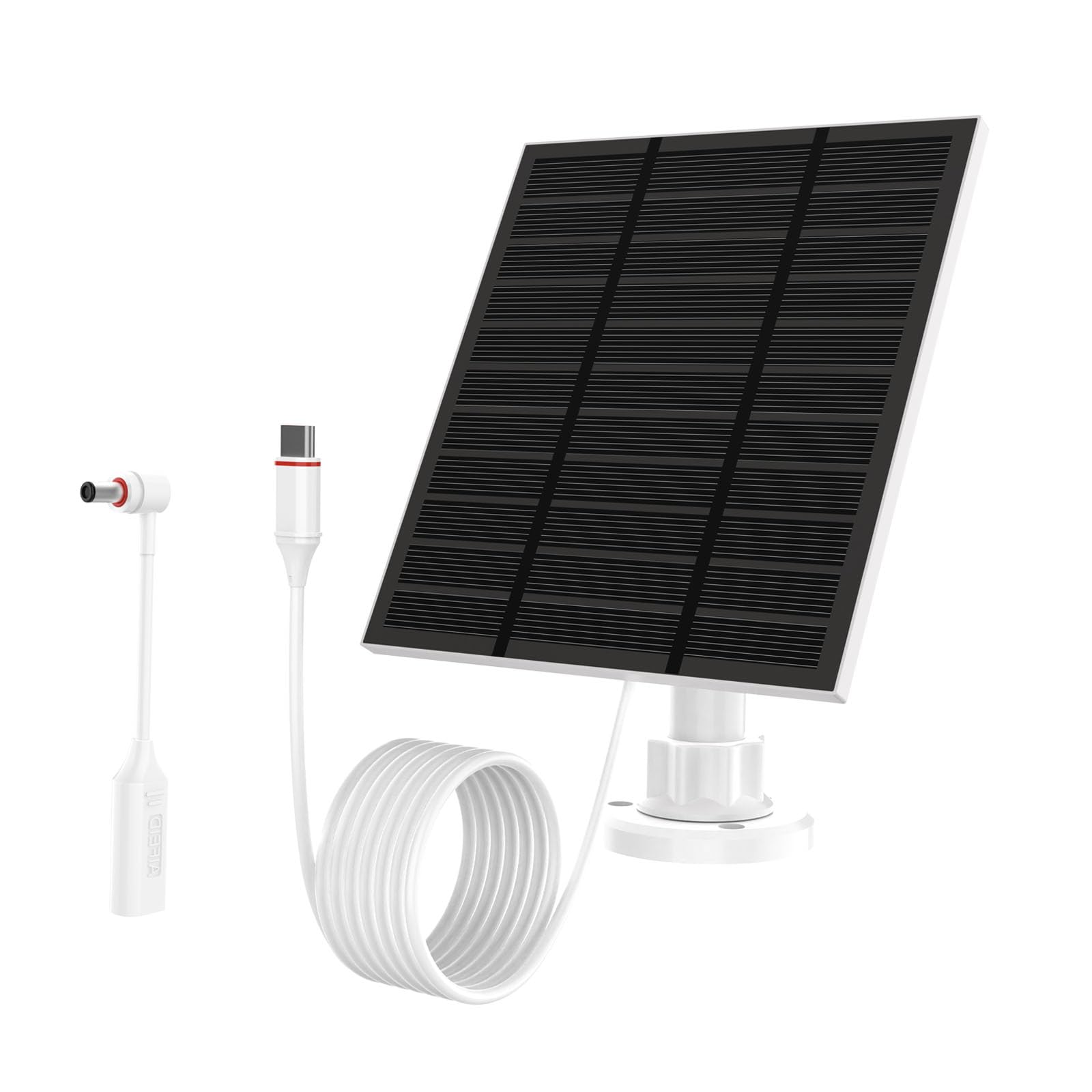
Type: Solar charger for Ring cameras
Output: 5W, 5V
Cable Length: 10FT
Compatibility: Spotlight Cam Plus and Stick Up Cam Pro
Adapters: USB-C and DC
Weather Rating: IP68 waterproof
Mount: 360° adjustable
Low-Light: Works on cloudy and rainy days
The Arcctv panel does not take pictures. It exists to feed power to a Ring camera that is already installed, replacing the chore of pulling the battery for a recharge every few weeks. The 10FT cable gives enough slack to put the panel where the sun actually lands while the camera stays where the view is best.
Two details matter more than the rest. The 360° adjustable mount lets the panel be tilted toward the sun independently of the camera, which is the opposite of the Aosu’s fixed arrangement. The IP68 rating means rain and hose spray are not a concern, and the panel is rated to keep working through cloudy and rainy stretches rather than only in direct sun.
The adapter set covers both USB-C and DC connections, matching the Spotlight Cam Plus and Stick Up Cam Pro. Buyers with an older Ring model or a different brand should confirm the connector before ordering, because this panel is built around those two camera families and is not a universal charger.
Trade-off: The panel only makes sense for someone who already owns a compatible Ring camera, and it adds nothing to image quality, storage, or alerts because those all live in the camera it charges.
Check the current price on Amazon
Side-by-Side Comparison
| Feature | Aosu Solar Camera | Arcctv Solar Panel |
|---|---|---|
| Type | Complete security camera | Solar charger only |
| Power | Fixed solar panel on camera | 5W, 5V panel with 10FT cable |
| Resolution | 2K (3 MP) | N/A — camera provides it |
| Night Vision | Color | N/A |
| Coverage | 360° with smart tracking | N/A |
| Audio | Two-way talk | N/A |
| Storage | microSD or cloud | N/A |
| Connectivity | 2.4GHz WiFi only | N/A |
| Weather Rating | Outdoor wireless | IP68 waterproof |
| Compatibility | Standalone | Ring Spotlight Cam Plus, Stick Up Cam Pro |
| Price Tier | Budget camera kit | Budget accessory |
How the Two Differ
The largest difference is scope. The Aosu is a whole system in one box: lens, night vision, speaker, storage, and power. Nothing else is required to record and review footage. The Arcctv is one component in a system the buyer already owns, and its only job is to keep a Ring camera’s battery from dying.
Coverage and tracking follow from that. The Aosu moves its head to follow motion across a wide arc, which suits a driveway or a side yard where activity arrives from several directions. The Arcctv has no view at all; the camera it charges keeps whatever fixed field of view Ring gave it, so a buyer wanting wider coverage would need to reposition the camera itself.
Panel mounting is where the Arcctv wins a narrow point. Its 360° adjustable bracket and long cable let the panel chase the sun independently of the camera. The Aosu’s panel is fixed to the camera body, so the camera’s best viewing angle and the panel’s best solar angle have to be the same spot. In a shaded corner, that is a real constraint.
Cost structure also splits. The Aosu is a one-time purchase, with an optional microSD card or cloud subscription on top. The Arcctv is a small add-on that cuts the labor of recharging an existing camera, but it does nothing for a household with no Ring hardware. Buyers with a mixed setup should check which cameras the adapters actually fit before committing.
Which Should You Buy?
Choose Aosu if the property has no camera yet and the goal is a single wire-free unit that records, talks, and tracks motion without extra hardware. It suits renters and homeowners who want one mount, one app, and one power source, and who have a 2.4GHz network available.
Choose Arcctv if a Ring Spotlight Cam Plus or Stick Up Cam Pro is already mounted and the recurring battery pull is the annoyance. It suits buyers who like their existing camera and just want it to stay charged through sun, cloud, and rain.
Neither product replaces the other. They solve different problems at different points in a security setup, and buying the wrong one leaves a gap the other cannot fill.
FAQ
-
Can the Arcctv panel power the Aosu camera?
No. The Arcctv panel is built for Ring Spotlight Cam Plus and Stick Up Cam Pro connections, and the Aosu camera has its own fixed panel already attached. -
Does the Aosu camera need a subscription?
Not necessarily. It supports microSD storage, so local recording works without a plan, while cloud storage is an optional extra. -
Will the Aosu camera work on a 5GHz network?
No. It connects over 2.4GHz WiFi only, so a router broadcasting only 5GHz will need a 2.4GHz band enabled. -
How much cable does the Arcctv panel include?
The panel ships with a 10FT cable, which gives room to place it away from the camera for better sun exposure. -
Does the Arcctv panel work in bad weather?
Yes. It carries an IP68 waterproof rating and is rated to keep charging through cloudy and rainy conditions. -
Which Ring cameras does the Arcctv panel fit?
The listing names Spotlight Cam Plus and Stick Up Cam Pro, using the included USB-C and DC adapters. -
Is the Aosu camera wired?
No. It runs on a solar panel and internal battery, with no power cable to run to an outlet.
Bottom Line
For a buyer with no camera installed, the Aosu Solar Camera is the pick: it delivers the lens, night vision, tracking, audio, and storage in one solar-powered unit. The Arcctv Solar Panel is the better buy only for households already running a compatible Ring camera, where it removes the recharge routine for a fraction of the cost. Start with the Aosu Solar Camera unless a Ring camera is already on the wall.
