Why there are Amazon links here: Brave Review is paid a commission for qualifying Amazon purchases made through the links below. Your price does not change, and using our links is entirely optional. How this works
Best Automation for a Home Cinema for One-Remote Control
The best automation for a home cinema is not one gadget but the right hub for the room a buyer already owns. This roundup suits three types: the tinkerer building a local, privacy-first setup; the household that just wants projector, TV, AC and receiver on one voice command; and the installer who wants control on the wall, not in an app.
Each pick below is judged on what it automates, how it connects and where it falls short. The overview table points to the right pick in seconds; the full reviews explain the trade-offs.
Overview of the Picks
| Product | Key Spec | Best Use | Price Tier |
|---|---|---|---|
| Home Assistant Green | Official Home Assistant hub, advanced automation | Local control of a mixed-brand cinema | Mid |
| Tapo Smart IR & IoT Hub H110 | Matter-certified, 8,000+ IR brands, built-in chime | Broad IR coverage with voice and app control | Budget |
| Broadlink RM4 Mini Smart Remote IR Hub | 38KHz IR blaster, 2.4G Wi-Fi | Simple phone-based IR automation | Budget |
| BroadLink RM4 Mini IR Universal Remote Control | 2.4 GHz Wi-Fi IR blaster, Alexa/Google/IFTTT | Alexa and IFTTT routines on a budget | Budget |
| Shelly Wall Display XL Black | 10.1-inch touchscreen, 4 buttons, built-in 5A relay | Wall-mounted control panel for the cinema room | Premium |
1. Home Assistant Green — Best Overall for Local Control

Type: Smart home hub
Platform: Official Home Assistant hardware
Automation: Advanced, local
Best for: Mixed-brand cinema rooms
Home Assistant Green | Smart Home hub with Advanced Automation | Official Home Assistant Hardware
Check price on Amazon: See the current price for Home Assistant Green
Home Assistant Green is the official hardware for the Home Assistant platform, a small hub built to run automations on the device rather than in a cloud. That matters in a cinema room, where a projector, receiver, media player, lights and blinds rarely share a brand. The hub ties them together and keeps scenes running even when the internet drops, which is the whole point of local automation.
It is the pick for buyers who want one "movie night" trigger to dim the lights, drop the screen and switch the receiver input, and who do not mind a learning curve to get there. The platform is deep and the community is large, so the ceiling is high.
Trade-off: The setup is not plug-and-play — a buyer who wants a working scene in ten minutes will find the learning curve steep, and some devices need extra integrations before they appear.
2. Tapo Smart IR & IoT Hub H110 — Best for Broad Device Coverage
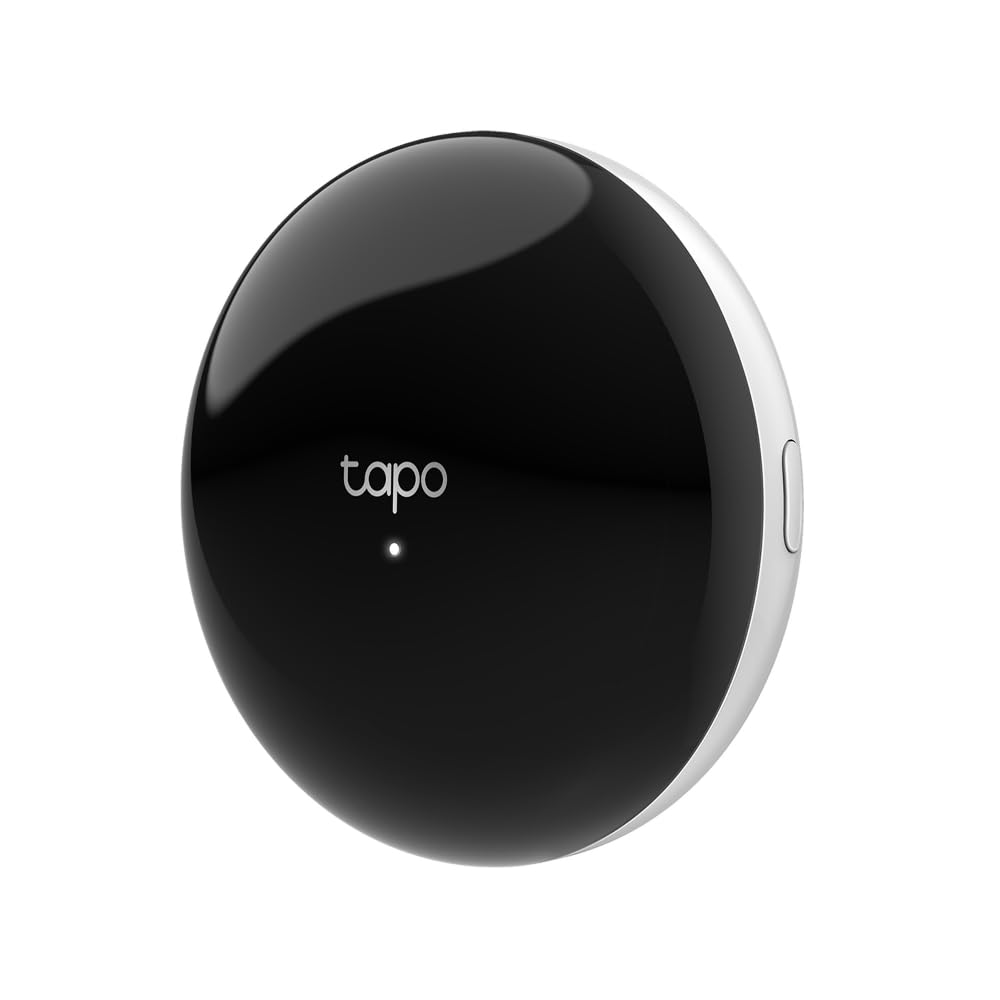
Type: IR and IoT hub with chime
Coverage: 8,000+ infrared brands, 18+ device types
Certification: Matter
Control: Voice and app, custom schedules
Check price on Amazon: See the current price for the Tapo H110 hub
The Tapo H110 is the widest-net option here: an IR blaster that also acts as an IoT hub, with a library covering thousands of infrared brands across TVs, air conditioners and more than eighteen device types. Matter certification means it slots into the newer smart-home standard instead of locking buyers into one app ecosystem. The built-in chime is a small bonus that suits a doorbell or a "film starting" alert.
It fits a household that wants projector, TV and AC controlled by voice and schedule without building a server. The custom schedules and automations cover the everyday movie-night sequence well.
Trade-off: IR is line-of-sight technology, so the hub needs a clear view of every device it controls — a cabinet door or an awkward angle can leave one device out of reach.
3. Broadlink RM4 Mini Smart Remote IR Hub — Best Simple IR Blaster

Type: IR blaster and smart hub
Frequency: 38KHz infrared
Network: 2.4 GHz Wi-Fi only
Control: Voice, app, smart timer
Check price on Amazon: See the current price for the Broadlink RM4 Mini
This Broadlink unit is a compact IR blaster that replaces a pile of remotes with phone and voice control. The 38KHz infrared output is the common standard for consumer AV gear, so it talks to most TVs, projectors and air conditioners, and the smart timer handles "turn everything off at midnight" without any scripting.
It is aimed at the buyer who wants a cheap, single-purpose bridge between a phone and the cinema’s IR devices. Voice control through Alexa or Google covers the basic commands hands-free.
Trade-off: The 2.4 GHz-only Wi-Fi is the real limit — it will not join a 5 GHz-only network, and the app-driven setup is more manual than a Matter hub’s.
4. BroadLink RM4 Mini IR Universal Remote Control — Best for Alexa and IFTTT Routines

Type: Wi-Fi IR blaster
Network: 2.4 GHz Wi-Fi only
Devices: TV, AC, set-top box, audio
Ecosystems: Alexa, Google Home, IFTTT
Check price on Amazon: See the current price for the BroadLink RM4 Mini IR
This is the BroadLink RM4 Mini in its universal-remote form, marketed squarely at TV, air conditioner, set-top box and audio gear. The distinguishing feature is IFTTT support, which lets a buyer chain the blaster into wider routines — a "movie time" trigger can fire the projector, the AC and the lights together. Alexa and Google Home handle the voice side.
It suits the household already living inside Alexa or IFTTT and wanting the cinema to join those routines cheaply. The form factor is small enough to sit on a shelf near the equipment.
Trade-off: IFTTT adds a cloud dependency and occasional latency, and the 2.4 GHz-only radio rules out modern mesh networks set to 5 GHz.
5. Shelly Wall Display XL Black — Best Wall-Mounted Control Panel
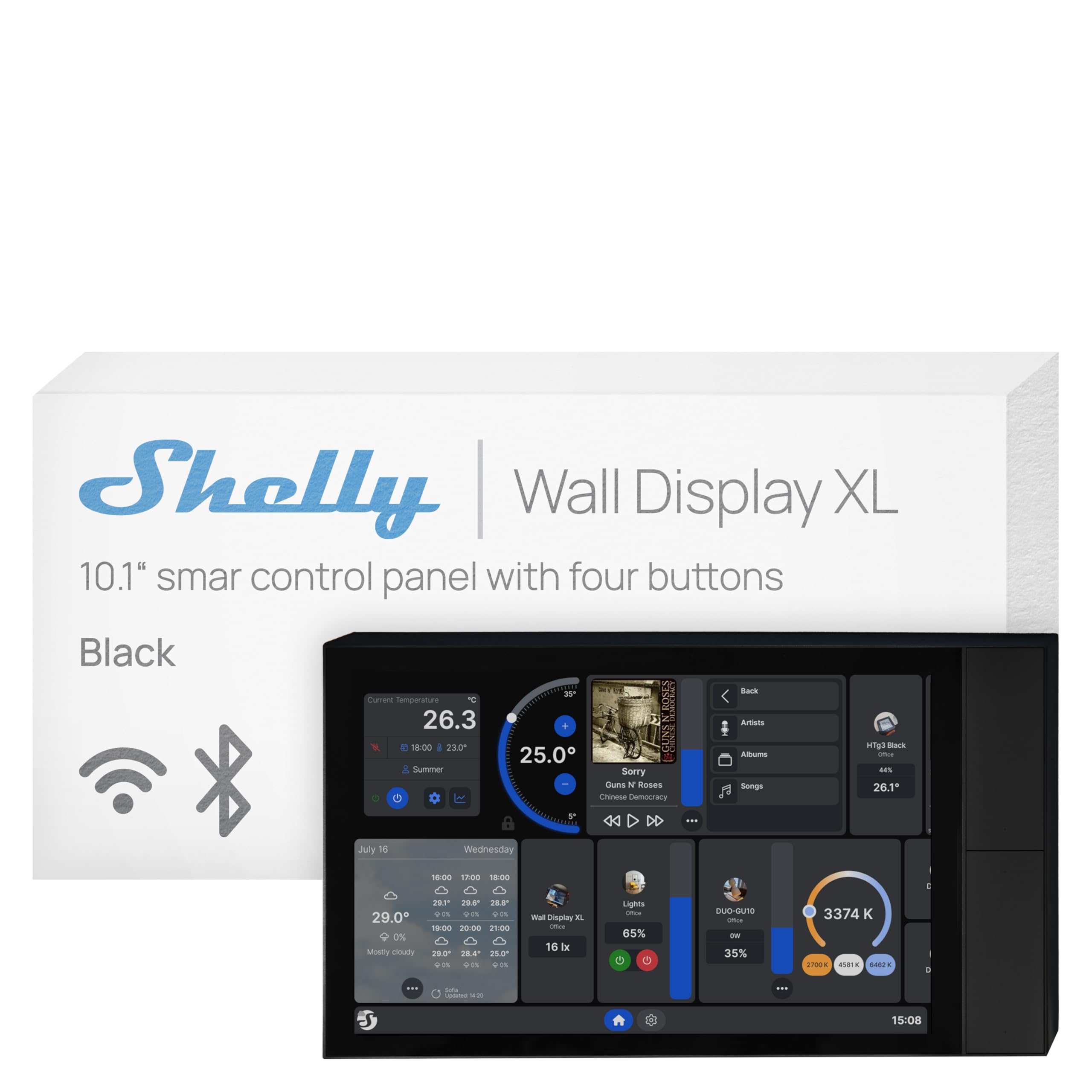
Type: Wall-mounted smart control panel
Display: 10.1-inch touchscreen
Controls: 4 physical buttons, lux sensor
Ecosystems: Alexa, Google, HomeKit, Home Assistant
Check price on Amazon: See the current price for the Shelly Wall Display XL
The Shelly Wall Display XL is the premium pick: a 10.1-inch touchscreen that mounts on the wall as a permanent control surface for the cinema room. Four physical buttons cover the commands used most — lights, scene, volume — while the touchscreen handles everything else. A lux sensor lets scenes react to room brightness, and the built-in 5A relay can switch a circuit directly.
It is for the buyer who wants control on the wall instead of hunting for a phone, and it works across Alexa, Google, HomeKit and Home Assistant. The large screen makes it a natural fit for a dedicated media room.
Trade-off: It requires a neutral wire at the mounting point, which rules out many older switch boxes, and the premium price puts it well above a simple IR blaster.
Before You Buy
- Compatibility: Check whether the cinema’s devices are IR-controlled, Wi-Fi, or both — an IR blaster cannot reach a device that only speaks Wi-Fi, and a hub cannot reach one that only speaks IR without a blaster.
- Line of Sight: IR hubs need a clear path to each device’s sensor; plan placement before buying.
- Network: Several IR blasters are 2.4 GHz-only, so a 5 GHz-only router or mesh setup needs a 2.4 GHz band enabled.
- Wiring: A wall panel like the Shelly needs a neutral wire at the mounting point; confirm it exists before ordering.
- Ecosystem: Match the hub to the household’s voice assistant and app — Matter and HomeKit support widen the options, while IFTTT adds cloud routines.
- Room Size: A single IR blaster covers one room; a larger cinema with gear in a cabinet may need more than one.
Frequently Asked Questions
-
What is the best automation for a home cinema overall?
Home Assistant Green offers the deepest local automation for mixed-brand gear, while the Tapo H110 is the easiest broad-coverage IR option. -
Do IR blasters work with projectors?
Yes, if the projector responds to infrared and the blaster has a clear line of sight to its sensor. -
Can one hub control lights, screen and receiver together?
Yes — a hub that supports scenes can group IR devices and smart lights into one "movie night" trigger. -
Is a wall panel better than an app?
A wall panel keeps control in the room and works without a phone, but it costs more and needs a neutral wire. -
Do these hubs need the cloud?
Home Assistant Green runs locally; IR blasters generally rely on an app and, with IFTTT, the cloud. -
What if the router is 5 GHz only?
Enable the 2.4 GHz band or choose a hub that supports 5 GHz before buying an IR blaster.
Bottom Line
For most buyers, the best automation for a home cinema starts with Home Assistant Green, which keeps scenes running locally across mixed-brand gear. Buyers who want the simplest broad IR coverage should look at the Tapo H110 instead, and the Shelly Wall Display XL is the pick when control belongs on the wall.