Why there are Amazon links here: Brave Review is paid a commission for qualifying Amazon purchases made through the links below. Your price does not change, and using our links is entirely optional. How this works
Best Automation Trigger for a Leak Alert: 5 Smart Water Sensors Compared
A leak alert is only as useful as the automation behind it: the sensor has to trip, the hub or app has to fire, and the message has to reach a phone before the puddle becomes a repair bill. The five picks below cover that whole chain, from long-range LoRa kits to hub-free Wi-Fi units. Budget-minded renters, whole-house owners and smart-home tinkerers will each find a fit. The overview table below sorts them fast; the reviews explain the trade-offs.
Overview of the Picks
| Product | Key Spec | Best Use | Price Tier |
|---|---|---|---|
| YoLink Water Leak Sensor 1 Kit (4-Pack + Hub) | LoRa range up to 2034 ft, 5-year battery | Whole-house coverage on a budget | Mid |
| YoLink Water Leak Sensor 4 Kit (6-Pack + Hub) | 105 dB alarm, IP67, 5-year battery | Loud local alarm plus app alerts | Premium |
| SwitchBot WiFi Water Leak Detector | No hub, 100 dB alarm, IP67 | Simple single-room setup | Budget |
| Tapo Smart Water Leak Detector T300 | Rapid dripping detection, 90 dB alarm | Alexa and Google Home households | Budget |
| GoveeLife Upgraded Smart Water Leak Detector (4-Pack) | 1804 ft range, SMS/email/app push | Large homes needing SMS alerts | Mid |
1. YoLink Water Leak Sensor 1 Kit: 4-Pack + Hub

Type: Water leak sensor kit with hub
Alert Methods: Mobile app, email, SMS
Battery Life: Up to 5 years
Range: Up to 2034 feet (LoRa)
Automation: Works with IFTTT
Pack Size: 4 sensors plus hub
This is the value play for anyone who wants several rooms covered at once. The LoRa protocol is the standout: it pushes signal through walls and across outbuildings far beyond what Wi-Fi reaches, so a basement sensor and a shed sensor can share one hub. The five-year battery claim matters because these units sit idle for years, and a leak sensor that dies quietly is worse than none. The kit includes the hub, so there is no separate bridge to buy.
It suits owners of larger properties, rentals with utility rooms far from the router, and anyone building IFTTT automations that trigger lights or shutoffs. The trade-off is that LoRa gear only talks to its own ecosystem, so this kit commits the buyer to YoLink rather than mixing with an existing Zigbee or Wi-Fi setup.
2. YoLink Water Leak Sensor 4 Kit: 6-Pack + Hub

Type: Water leak and freeze sensor kit with hub
Alert Methods: Mobile app, plus 105 dB local alarm
Battery Life: Up to 5 years
Rating: IP67
Range: Up to 2034 feet (LoRa)
Pack Size: 6 sensors plus hub
The Sensor 4 kit takes the same long-range LoRa backbone and adds two things: freeze alerts and a 105 dB siren on each unit. That combination covers the two most expensive water disasters in a home — a burst pipe and a frozen one — and the local alarm means anyone on-site hears it even if the phone is on silent. IP67 sealing allows placement under sinks and near appliances where splashes are routine.
This is the pick for whole-house coverage: six sensors spread across a basement, laundry, kitchen, bathrooms and water heater, all on one hub. It costs more than the four-pack, and that is the caution — buyers with a small apartment will pay for sensors they never place, so the smaller kit is the smarter spend unless every room genuinely needs coverage.
3. SwitchBot WiFi Water Leak Detector

Type: Wi-Fi water leak detector
Hub Required: No
Alert Methods: App and email, plus 100 dB alarm
Rating: IP67
Battery Life: 2 years
Cable: 1 m sensor cable
The SwitchBot unit is the easiest entry point because it joins a 2.4GHz Wi-Fi network directly — no hub, no bridge, no extra purchase. The one-metre cable lets the sensor head sit exactly where water would pool while the body stays dry, which is useful behind a washing machine or under a dishwasher. It detects drips and water levels as well as full leaks, so a slow seep gets caught before it spreads.
It fits renters and single-room setups: one sensor, one app, done. The trade-off is battery life — two years is respectable but well short of the five-year LoRa units, so buyers covering many rooms should expect to swap cells more often. Wi-Fi range also limits placement to within reach of the router.
4. Tapo Smart Water Leak Detector T300

Type: Wi-Fi water leak sensor
Hub Required: Yes, Tapo Hub
Alert Methods: App alerts, 90 dB adjustable alarm
Detection: Rapid dripping detection
Voice Control: Works with Alexa and Google Home
Model: T300
For households already running Alexa or Google Home, the T300 slots into routines that announce leaks aloud or flash lights. Rapid dripping detection is the differentiator: it catches the fast drip from a failing supply line, not just standing water, and the 90 dB alarm is adjustable so it can be loud under a sink without being unbearable in a bedroom. The Tapo app handles alerting and history.
This pick suits smart-home users who want leak events woven into existing automations. The caution is the hub requirement — buyers without a Tapo Hub must factor in that extra purchase, and the sensor is useless on its own. Anyone starting from zero should weigh that against the hub-free options above.
5. GoveeLife Upgraded Smart Water Leak Detector, 4-Pack
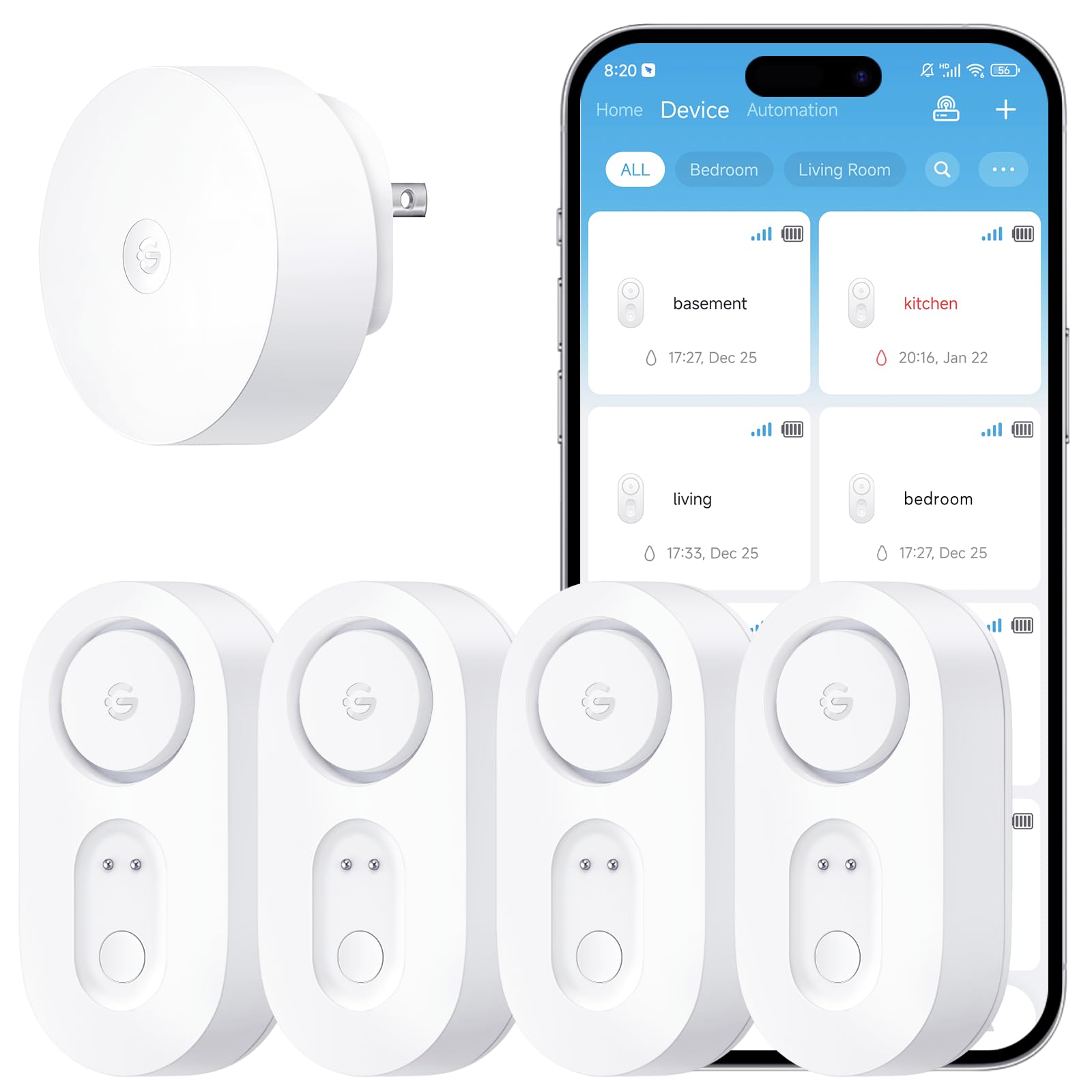
Type: Wi-Fi water leak sensor, 4-pack
Alert Methods: SMS, email, app push
Range: Up to 1804 feet
Battery Life: 5 years
Rating: IP67
Alarm: High-output local alarm
This pack stands out for three reasons: SMS alerts, a claimed 1804-foot range and five-year batteries. SMS is the most reliable alert channel for anyone who mutes app notifications overnight, and the long range means sensors can reach a detached garage or a far basement corner. Four IP67 units cover the usual hot spots, and the high alarm gives on-site warning.
It is the right buy for large homes and for owners who travel and want text messages rather than app badges. The trade-off is that long-range Wi-Fi performance depends heavily on the home’s router and layout, so buyers in thick-walled or multi-building properties should test placement before committing to all four sensors.
Before You Buy
- Hub or no hub: Hub-free Wi-Fi sensors are simplest, but hub-based systems like YoLink and Tapo offer longer range and tighter automation.
- Alert channels: App push is standard; email adds a paper trail, and SMS is the most dependable for overnight alerts.
- Battery life: Two years means regular cell swaps; five-year units suit hard-to-reach spots like crawlspaces.
- Range and protocol: LoRa reaches far beyond Wi-Fi, which matters for basements, garages and outbuildings.
- Waterproofing: An IP67 rating allows placement under sinks and near appliances where splashes are expected.
- Local alarm: A built-in siren warns anyone at home even when phones are silenced.
- Ecosystem fit: Check that the sensor works with existing Alexa, Google Home or IFTTT automations before buying a multi-pack.
Frequently Asked Questions
-
What is the best automation trigger for a leak alert?
The trigger is the sensor’s own detection event: water bridging its contacts fires the alert. From there, the hub or app sends push, email or SMS notifications, and IFTTT or voice-assistant routines can chain further actions. -
Do leak sensors need a hub?
Not all of them. The SwitchBot and GoveeLife units connect directly to Wi-Fi. The YoLink kits include a hub, and the Tapo T300 requires a separate Tapo Hub. -
How long do leak sensor batteries last?
It varies by model: the SwitchBot unit is rated for two years, while the YoLink and GoveeLife sensors claim up to five. Long battery life matters most for sensors in crawlspaces and vacation homes. -
Can a leak sensor send a text message?
Yes. The YoLink kits and the GoveeLife pack list SMS among their alert channels, which is useful when app notifications are muted. -
Where should leak sensors be placed?
Under sinks, behind washing machines, beside water heaters, near dishwashers and in basements. Sensors with cables, like the SwitchBot unit, can put the detection point exactly where water pools. -
Will a leak sensor work without internet?
Local alarms still sound, but app, email and SMS alerts need a working internet connection through Wi-Fi or the hub.
Bottom Line
For most buyers, the YoLink Water Leak Sensor 1 Kit is the best automation trigger for a leak alert: four sensors, a hub in the box, long LoRa range and five-year batteries at a mid-tier price. Households that want freeze protection and a loud local siren should step up to the Sensor 4 six-pack, while renters and single-room setups can start with the hub-free SwitchBot unit.