Why there are Amazon links here: Brave Review is paid a commission for qualifying Amazon purchases made through the links below. Your price does not change, and using our links is entirely optional. How this works
Best Backup Power for a Home Office for Every Budget
A home office needs backup power that keeps the router, computer, and monitor alive through short outages and brownouts, not a generator that can run the whole house. This guide covers five picks that fit different desks and budgets: a compact UPS for a router and modem, a mid-size unit for a full workstation, and portable power stations for longer outages or mixed home-and-outdoor use. The overview table below shows each option at a glance, and the reviews that follow explain who each one suits.
Overview of the Picks
| Product | Key Spec | Best Use | Price Tier |
|---|---|---|---|
| CyberPower CP1500PFCLCD | 1500VA / 1000W, 12 outlets, AVR | Full desktop workstation with PFC power supply | Mid-range |
| Jackery HomePower 3600 Plus | 3584Wh, 3600W, expandable | Long outages and whole-desk backup | Premium |
| Anker SOLIX S2000 | 2010Wh LiFePO4, 1500W | All-day office backup with solar top-up | Upper mid-range |
| BLUETTI Elite 100 V2 | 1024Wh, 1800W, 10ms UPS | Desk-size backup with fast recharge | Mid-range |
| APC BE600M1 | 600VA / 330W, 490 J surge | Router, modem, and NAS only | Budget |
CyberPower CP1500PFCLCD PFC Sinewave UPS
Type: Mini tower UPS battery backup
Capacity: 1500VA / 1000W
Outlets: 12
Power conditioning: AVR
Certification: UL Certified
Form factor: Mini tower

The CP1500PFCLCD is a mini-tower UPS built for a full desktop setup, with a sinewave output that suits modern power-factor-corrected computer supplies. Automatic voltage regulation smooths brownouts without draining the battery, and the twelve outlets give room for a tower, monitors, router, and peripherals on one unit. It is the pick for a desk that already has a tower PC and wants protection without buying a power station.
This unit earns its place for buyers who want set-and-forget protection under the desk. The trade-off is that it is a battery backup, not a generator: it rides out short outages, and it will not carry a workstation through a multi-hour blackout the way a large power station can.
Trade-off: Runtime is limited to short outages, so a desk that needs hours of uptime should look at a power station instead.
Jackery HomePower 3600 Plus Power Station
Type: Solar generator / home backup power station
Capacity: 3584Wh
AC output: 3600W
Battery: LFP (lithium iron phosphate)
Expandable: Up to 21kWh
Solar: Panel optional

The HomePower 3600 Plus is the heavy hitter here: a 3584Wh LFP power station with 3600W of AC output and an expandable design that can grow to 21kWh with add-on batteries. LFP chemistry is the durable choice for a unit that sits plugged in as home backup, and the expandable architecture means one base unit can scale from office backup to whole-home essentials. It suits a home office that cannot afford downtime or a buyer who wants one system for the office, emergencies, and RV trips.
This is the premium pick, and it is the right one for anyone planning multi-hour or multi-day outages. The trade-off is price and footprint: this is a large, costly unit, and a simple router-and-laptop desk does not need this much capacity.
Trade-off: The cost and physical size are high for a buyer who only needs to bridge short outages.
Anker SOLIX S2000 Portable Power Station
Type: Portable power station
Capacity: 2010Wh
Battery: LiFePO4
Output: 1500W
Included: Power strip
Use: Home backup, outdoor, emergency
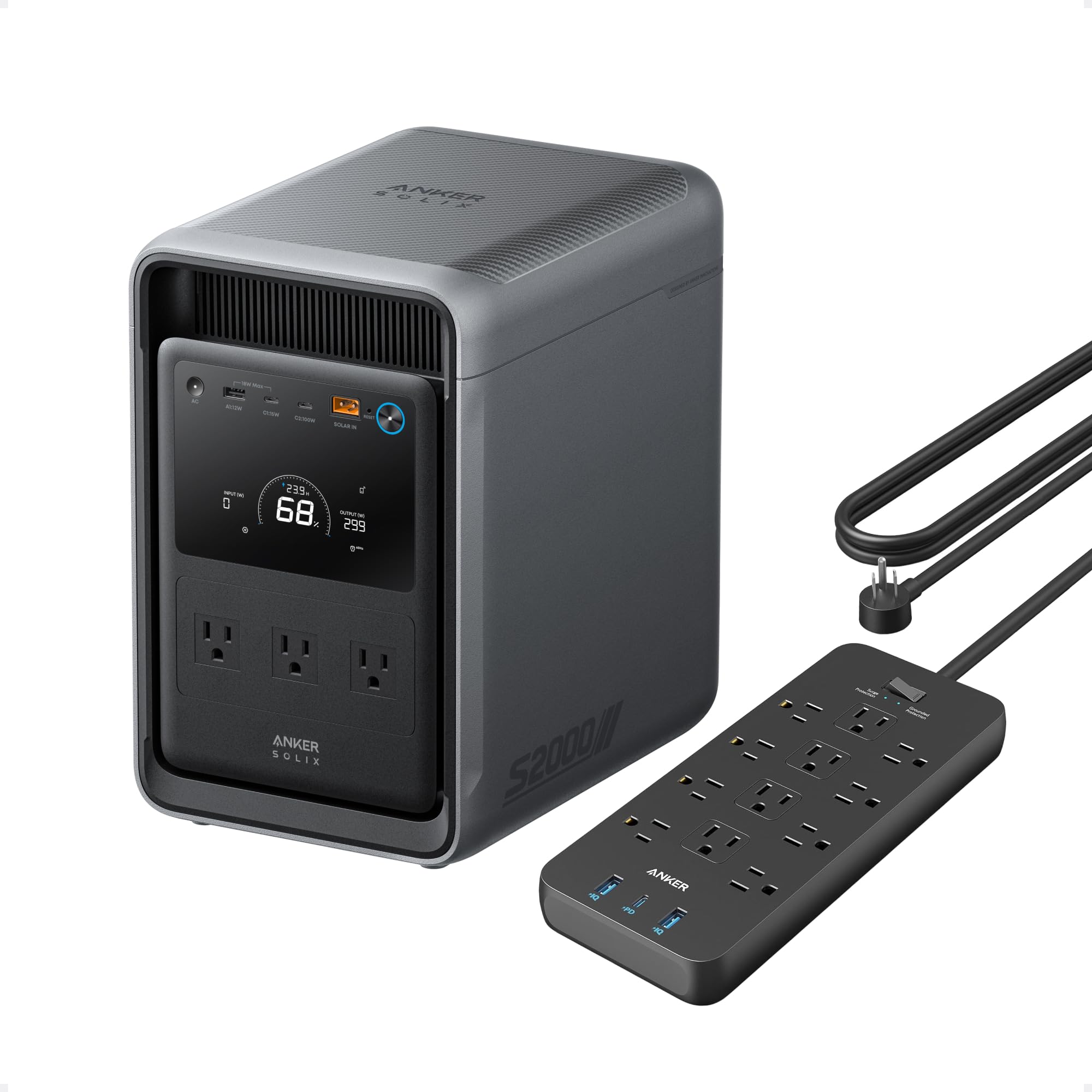
The SOLIX S2000 pairs a 2010Wh LiFePO4 battery with 1500W of output and ships with a power strip, which makes it easy to plug a whole desk into one place. LiFePO4 gives it the cycle life expected from a unit meant to sit ready for years, and the capacity sits in a practical middle ground between a UPS and a full home-backup system. It suits a home office that wants enough reserve for a full workday and the option to top up with solar.
This pick is the balanced choice for a desk that needs hours rather than minutes of runtime. The trade-off is that 1500W of output limits high-draw equipment, so a desk with a large gaming rig or space heater on the same circuit would need to manage loads carefully.
Trade-off: The 1500W output ceiling means high-draw office equipment has to be rationed or left off backup.
BLUETTI Elite 100 V2 Portable Power Station
Type: Portable power station with UPS mode
Capacity: 1024Wh
Output: 1800W
Surge: 3600W
Battery: LiFePO4
UPS switchover: 10ms
Recharge: 0–80% in 45 min
Footprint: 35% smaller
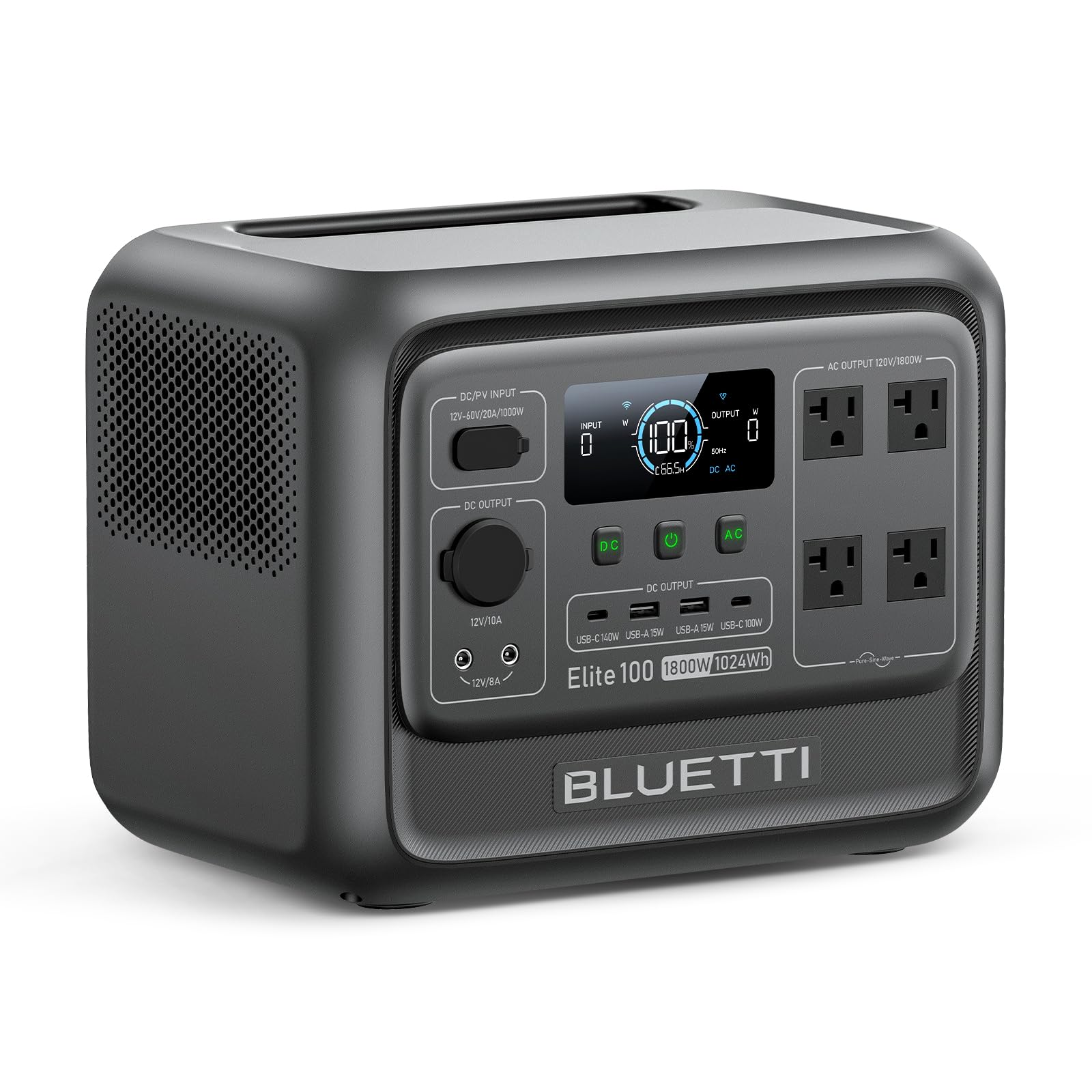
The Elite 100 V2 is built for desk-side duty, with a 10ms UPS switchover that keeps a computer from rebooting when the grid drops. The 1024Wh LiFePO4 battery, 1800W continuous output, and 3600W surge cover a desktop, monitor, and network gear, while the 35%-smaller footprint and 45-minute fast recharge to 80% make it easy to live with. It suits a home office that wants UPS-grade switching plus real runtime in one compact unit.
This is the pick for a desk that wants both instant failover and enough capacity to keep working through an outage. The trade-off is capacity: 1024Wh is generous for a desk but modest for a household, so it is not the unit for running appliances or a whole room.
Trade-off: The 1024Wh capacity is desk-sized, so it will not carry larger household loads through a long outage.
APC BE600M1 UPS Battery Backup & Surge Protector
Type: Compact UPS battery backup
Capacity: 600VA / 330W
Surge protection: 490 J
USB charging: Yes
Runtime: 23 minutes at 100W
Use: Computer, router, NAS

The BE600M1 is the budget pick and the classic choice for keeping a router, modem, and NAS alive through short outages. It delivers 600VA/330W of backup, 490 joules of surge protection, and a USB charging port, with a stated runtime of 23 minutes at 100W. It suits a small home office or a network closet where the goal is to keep connectivity up and shut down cleanly, not to run a workstation.
This unit earns its place on price and simplicity, and it is the right first purchase for a buyer new to backup power. The trade-off is output: 330W will not carry a desktop tower under load, so it is a network-and-accessory unit rather than a whole-desk solution.
Trade-off: The 330W output limits it to routers, modems, and small devices, not a full desktop.
Before You Buy
- Capacity and load: Add up the wattage of everything that must stay on, then match it to the unit’s continuous output, not its surge rating.
- Runtime: Decide whether the goal is a few minutes to save work and shut down, or hours of continued work; that single question separates a UPS from a power station.
- Battery chemistry: LiFePO4 units cost more up front but suit a device that stays plugged in and ready for years.
- Switchover speed: A UPS-grade transfer keeps a computer from rebooting; check the stated switchover time if the desk must stay live.
- Outlets and form factor: Count the plugs needed and measure the space under or beside the desk before choosing a tower or a portable unit.
- Expandability: A unit that accepts add-on batteries can grow with the office instead of being replaced.
- Solar and recharge: For long outages, a unit that accepts solar panels or recharges quickly keeps the desk running between events.
Frequently Asked Questions
-
What size backup power does a home office need?
A router-and-laptop desk can run on a compact 600VA UPS, while a full desktop with monitors needs a 1500VA-class UPS or a power station with matching output. -
Is a UPS or a power station better for a home office?
A UPS is best for instant switchover and short outages; a power station is best when the office must keep working for hours. -
Can a backup unit run a desktop computer?
Yes, if its continuous wattage exceeds the computer’s draw; check the output rating rather than the surge rating. -
How long will backup power last during an outage?
Runtime depends on the load and the battery capacity, so estimate it from the unit’s stated runtime at a given wattage. -
Do these units protect against surges as well as outages?
The UPS models include surge protection alongside battery backup; power stations focus on backup and should be paired with surge protection where needed. -
Can solar panels recharge a home office power station?
The larger power stations here accept optional solar panels, which extends runtime during long outages.
Bottom Line
For most home offices, the CyberPower CP1500PFCLCD is the best backup power for a home office: it protects a full desktop with sinewave output and automatic voltage regulation at a mid-range price. Buyers who need hours of runtime should step up to the BLUETTI Elite 100 V2 for its UPS-grade switchover, or the Jackery HomePower 3600 Plus for whole-desk, multi-day coverage.
