Why there are Amazon links here: Brave Review is paid a commission for qualifying Amazon purchases made through the links below. Your price does not change, and using our links is entirely optional. How this works
Best Backup Power for a Security System: 5 Reliable Picks
A security system is only as reliable as the power feeding it, and a brief outage can leave cameras, hubs, and alarm panels dark. The five picks below cover the range of real setups: a full desktop security station, a modem-and-router combo, a compact wall unit, and a budget option for small loads. Buyers who run a whole-home camera system, homeowners protecting a single entry point, and renters who need something small and tidy will each find a match. The overview table below puts every pick side by side, so the right unit can be chosen in under a minute.
The Picks at a Glance
| Product | Key Spec | Best Use | Price Tier |
|---|---|---|---|
| CyberPower CP1500PFCLCD | 1500VA/1000W, PFC sinewave | Whole-system security PC and NVR | Premium |
| CyberPower CP1500AVRLCD3 | 1500VA/900W, AVR, LCD | DVR, router, and panel combo | Mid |
| GOLDENMATE 1000VA/800W | 230Wh LiFePO4, 8 outlets | Long runtime for modem and cameras | Mid |
| GOLDENMATE 1500VA/1000W | 230Wh LiFePO4, wall-mount | Wall-mounted hub and router | Premium |
| CyberPower EC850LCD | 850VA/510W, ECO mode | Small alarm panel and single camera | Budget |
1. CyberPower CP1500PFCLCD PFC Sinewave UPS

Capacity: 1500VA / 1000W
Outlets: 12
Power Type: PFC sinewave
Regulation: AVR
Form Factor: Mini tower
Certification: UL certified
Pros: The PFC sinewave output is the standout feature, and it matters for security gear. Active power-factor-corrected supplies are common in modern NVRs and small servers, and a stepped or simulated wave can stress them. This unit feeds clean sinewave power, so a recording server shuts down gracefully instead of crashing mid-write.
Cons: It is the priciest pick here and the heaviest of the CyberPower group. Buyers with only a router and one camera will be paying for headroom they never touch.
The CP1500PFCLCD is built as a mini tower with a dozen outlets, which is enough to cover a security PC, a monitor, an NVR, and the network gear feeding the cameras. Automatic voltage regulation smooths brownouts without draining the battery, so brief sags do not trigger a switchover. The PFC sinewave design is the reason it earns the top slot for anyone running a recording server.
This is the pick for a buyer treating the security setup as a small data center: a dedicated PC, an NVR, and a switch that all need to stay up. It is not for the homeowner who just wants the router alive during a storm. The trade-off is price and bulk — this unit costs more and takes up more floor space than the smaller options.
Trade-off: The premium price and tower footprint are only justified when the load includes a recording PC or server that needs clean sinewave power.
2. CyberPower CP1500AVRLCD3 Intelligent LCD UPS

Capacity: 1500VA / 900W
Outlets: 12 plus 2 USB
Regulation: AVR
Display: Intelligent LCD
Form Factor: Mini tower
Certification: UL certified
Pros: The intelligent LCD reports load level, battery status, and estimated runtime at a glance, which is genuinely useful when sizing a security load. Two USB ports charge a phone or a small camera accessory without an adapter. Automatic voltage regulation keeps gear on stable power through dips.
Cons: The output is a stepped approximation rather than a true sinewave, so a sensitive PFC power supply may complain. It also costs nearly as much as the sinewave model while offering less clean power.
This unit sits just below the sinewave model in the lineup, trading clean output for a friendlier price and a smarter display. The twelve outlets cover a DVR, router, switch, and a couple of cameras, and the LCD makes it easy to see how much runtime is left. Automatic voltage regulation handles the everyday sags that would otherwise chatter a relay.
It suits a buyer running a DVR-based system with a router and switch, where the load is modest and the display is a real convenience. It is not the right call for a rack of power-factor-corrected servers. The trade-off is the stepped wave — fine for most consumer gear, less ideal for picky supplies.
Trade-off: The stepped output and near-premium price mean buyers with sensitive PFC equipment should step up to the sinewave model instead.
3. GOLDENMATE 1000VA/800W Lithium UPS

Capacity: 1000VA / 800W
Battery: 230Wh LiFePO4
Outlets: 8
Power Type: Pure sinewave
Display: Color LCD
Color: Gray
Pros: Lithium iron phosphate chemistry is the headline — it holds up to repeated deep discharges far better than lead-acid and does not need the same care. Pure sinewave output protects sensitive gear, and the color LCD shows runtime and load clearly. Eight outlets are plenty for a modem, router, and a few cameras.
Cons: The 230Wh pack limits total runtime under a heavy load, and lithium units cost more per watt-hour than lead-acid. It is also heavier than a plain surge strip, so placement needs a little thought.
GOLDENMATE builds this around a LiFePO4 pack, which is the chemistry to want if the unit will be cycled often or left in a hot garage. Pure sinewave output and a color LCD round out a package aimed at the home office and internet gear. Eight outlets cover the typical modem-router-camera cluster with room to spare.
It suits a buyer who wants long, repeatable runtime for networking and cameras and does not mind paying for lithium. It is not for someone who needs to power a full desktop plus monitor for hours. The trade-off is capacity per dollar — the pack is modest, so heavy loads drain it quickly.
Trade-off: The 230Wh battery delivers long runtime only for light loads, and the lithium premium makes it a poor value for high-draw equipment.
4. GOLDENMATE 1500VA/1000W Wall-Mount Lithium UPS
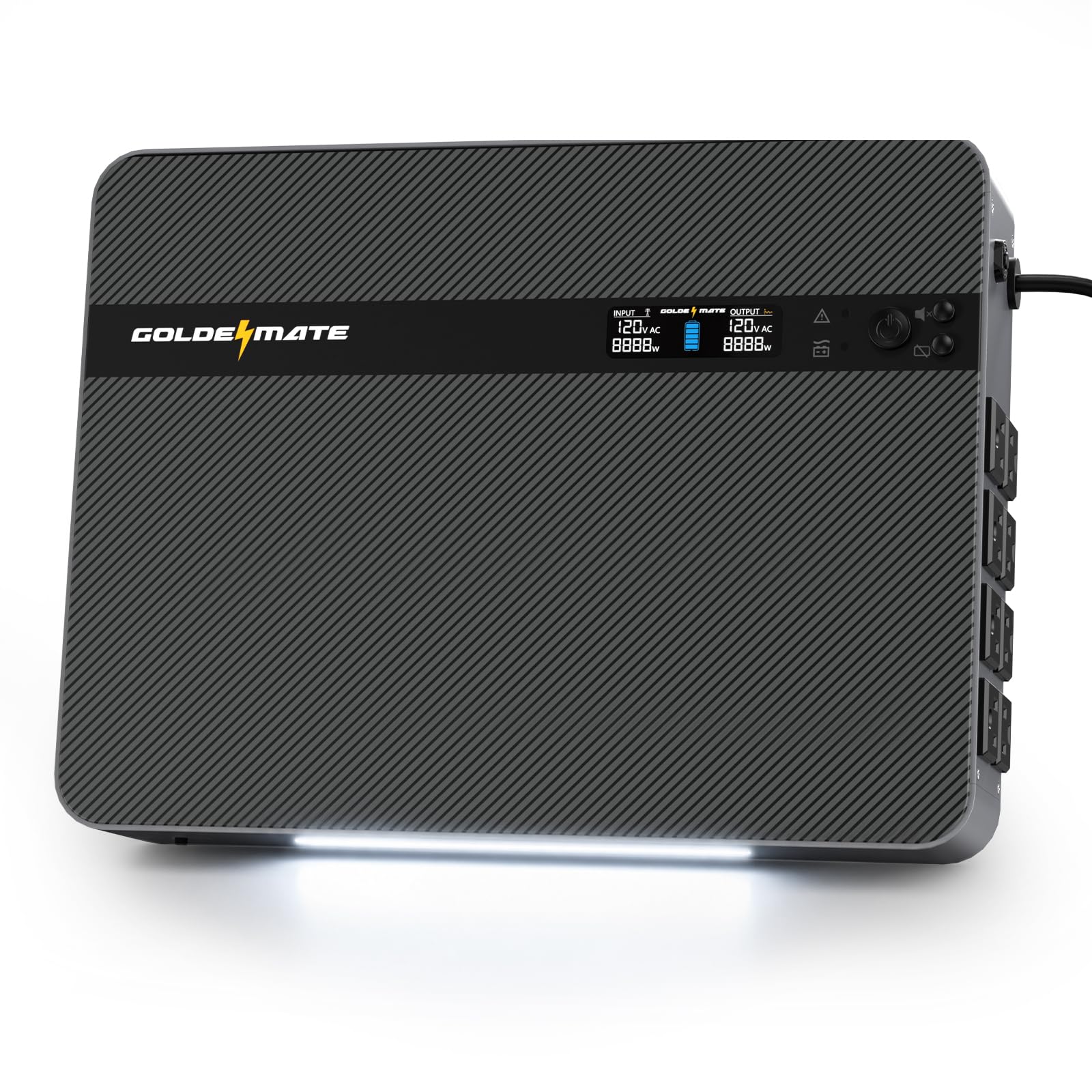
Capacity: 1500VA / 1000W
Battery: 230Wh LiFePO4
Outlets: 8 plus 2 USB
Mounting: Wall-mount
Power Type: Pure sinewave
Extras: LCD display, emergency light
Pros: The wall-mount design is the differentiator — it gets the unit off the floor and out of the way in a closet or utility room. Pure sinewave output and a LiFePO4 pack keep sensitive gear happy, and the built-in emergency light is a practical touch during an outage. Two USB ports add charging without an adapter.
Cons: The higher VA rating does not come with a bigger battery, so runtime under load is similar to the smaller GOLDENMATE. Wall mounting also limits placement to a stud or solid surface, and the price is the steepest here.
This is the same lithium platform as the previous pick, rehoused for wall mounting and rated higher on paper. The 1500VA/1000W figure speaks to surge handling rather than stored energy, and the 230Wh pack sets the real runtime. Eight outlets plus two USB ports cover a hub, router, and camera cluster, and the LCD keeps status visible.
It suits a buyer who wants a tidy, off-the-floor install in a utility closet or garage. It is not for anyone who needs maximum runtime for a heavy load or who cannot mount to a wall. The trade-off is that the higher rating buys surge headroom, not more minutes.
Trade-off: The premium price buys wall-mount convenience and surge headroom, not extra battery capacity — runtime stays close to the smaller model.
5. CyberPower EC850LCD Ecologic UPS

Capacity: 850VA / 510W
Outlets: 12
Mode: ECO mode
Form Factor: Compact
Certification: UL certified
Pros: Twelve outlets in a compact body is a lot of connectivity for the money, and ECO mode cuts wasted standby draw. It is the cheapest way to keep an alarm panel, a router, and a single camera alive through a short outage. UL certification and a familiar brand round out a sensible budget pick.
Cons: The 510W rating is the lowest here, so it will not carry a desktop or a large NVR. Output is a stepped wave rather than pure sinewave, and runtime on a meaningful load is short.
The EC850LCD is the budget entry in the lineup, built compact and priced to move. Twelve outlets let a buyer plug in the alarm panel, router, and a camera without hunting for a strip, and ECO mode trims standby waste. Automatic voltage regulation is not part of this model’s name, so buyers should treat it as a basic battery backup rather than a line conditioner.
It suits a renter or a homeowner protecting a small, low-draw security setup on a tight budget. It is not for a system with a recording PC or a large NVR. The trade-off is capacity and output quality — this unit keeps small loads alive briefly, not big ones for long.
Trade-off: The low wattage and stepped output cap this unit to small, short outages — it cannot carry a desktop or a large recorder.
Before You Buy
- Capacity: Match the VA/W rating to the real load — a router and camera need far less than a recording PC, and oversizing wastes money.
- Battery chemistry: LiFePO4 handles repeated deep cycles better than lead-acid, which matters if outages are frequent or the unit lives in a hot space.
- Output type: Pure sinewave protects power-factor-corrected supplies and sensitive gear; stepped output is fine for basic networking equipment.
- Outlet count and type: Count every plug the security setup needs, including the modem, router, switch, and camera power supplies, and check for USB if accessories need charging.
- Placement: A mini tower sits on the floor or a shelf, while a wall-mount unit needs a stud or solid surface — measure the space before ordering.
- Runtime expectations: Stored energy, not the VA rating, sets how many minutes the gear stays up, so size the battery to the outage length that matters.
Frequently Asked Questions
-
How long will a UPS keep a security system running?
Runtime depends on the load and the battery’s stored energy, not the VA rating. A router and a few cameras may run for a while on a lithium unit, while a recording PC drains the same pack far faster. -
Is pure sinewave necessary for security equipment?
Not always, but it is safer for modern power-factor-corrected supplies found in NVRs and small servers. Basic routers and cameras generally tolerate stepped output. -
Can a UPS power cameras that use PoE?
Yes, if the PoE switch or injector is plugged into the UPS. The UPS backs up whatever is connected to it, so the switch feeding the cameras must be on battery too. -
Lithium or lead-acid for backup power?
Lithium iron phosphate lasts through more deep discharges and needs less maintenance, while lead-acid costs less upfront. Frequent outages favor lithium. -
Does a wall-mount UPS save space?
It gets the unit off the floor and into a closet or utility room, but it requires a stud or solid mounting surface. Buyers without wall space should choose a tower or compact model. -
What size UPS is needed for an alarm panel and router?
A compact budget unit in the 850VA class covers a low-draw panel and router for short outages. Larger systems with a recorder need more capacity.
Bottom Line
The best backup power for a security system depends on the load, and the CyberPower CP1500PFCLCD is the safest all-round choice for anyone running a recording PC or NVR thanks to its PFC sinewave output. Buyers with lighter loads can save with the GOLDENMATE lithium units for long runtime or the compact CyberPower EC850LCD for a small panel and router. Match capacity to the real load, confirm the output type suits the gear, and the right pick is straightforward.
