Why there are Amazon links here: Brave Review is paid a commission for qualifying Amazon purchases made through the links below. Your price does not change, and using our links is entirely optional. How this works
Best Draught Proofing for a Period Property: 5 Picks That Seal Old Doors and Windows
Old houses leak heat through gaps that modern homes never had to deal with. The best draught proofing for a period property needs to work with uneven frames, wide floor gaps and heritage timber, not against them. This short roundup covers five affordable seals: two self-adhesive foam strips for narrow gaps, a larger two-pack for a whole house, a flexible flap seal for badly warped doors, and a sliding under-door blocker. The overview table below lets a reader match a product to a gap in under a minute.
The Picks at a Glance
| Product | Key Spec | Best Use | Price Tier |
|---|---|---|---|
| 33 Ft Gray Self-Adhesive Weather Stripping | 0.35" wide x 0.2" thick, 33 ft roll | Narrow window and door reveals | Budget |
| Strong Self-Adhesive Draft Blocker (2 Pack) | 0.35" wide x 0.2" thick, 65 ft total | Whole-house coverage | Budget |
| Alien Draft Seal Set | 49 ft adhesive and flexible flap | Warped or uneven doors | Mid |
| V Shape Thin Foam Weather Stripping | 19.7 ft, V-shape foam, brown | Front door frames | Budget |
| Holikme Under Door Draft Stopper | 36 inch adjustable sliding blocker | Bottom-of-door gaps | Budget |
1. 33 Ft Gray Self-Adhesive Soundproofing Weather Stripping
Type: Self-adhesive foam weather strip
Width: 0.35 inches
Thickness: 0.2 inches
Length: 33 feet
Color: Gray
Intended use: Doors and windows

33 Ft Gray Self-Adhesive Soundproofing Weather Stripping for Doors and Windows
This is a straightforward closed-cell foam strip with a peel-and-stick backing, cut narrow enough to sit inside a window reveal without fouling the sash. The 33 ft roll is generous for a single room and the gray tone disappears against painted timber better than white or black. It compresses under a closing door or window, which is what makes it usable on frames that are not perfectly square. The foam is soft, so it seals small irregularities rather than bridging a deep gap.
The pick suits owners of older properties who need to treat a handful of windows and one back door. It earns its place because the narrow profile works where a thicker strip would stop a sash from closing. The catch is that a 0.2 inch thickness cannot fill a gap wider than that, and soft foam flattens over time in high-traffic doorways.
Trade-off: Thin foam is a poor match for badly warped frames or gaps wider than a quarter inch, where it will not bridge the space.
2. Strong Self-Adhesive Draft Blocker, 2 Pack
Type: Self-adhesive foam weather strip, two-pack
Width: 0.35 inches
Thickness: 0.2 inches
Total length: 65 feet
Color: Gray
Intended use: Doors and windows, winter sealing
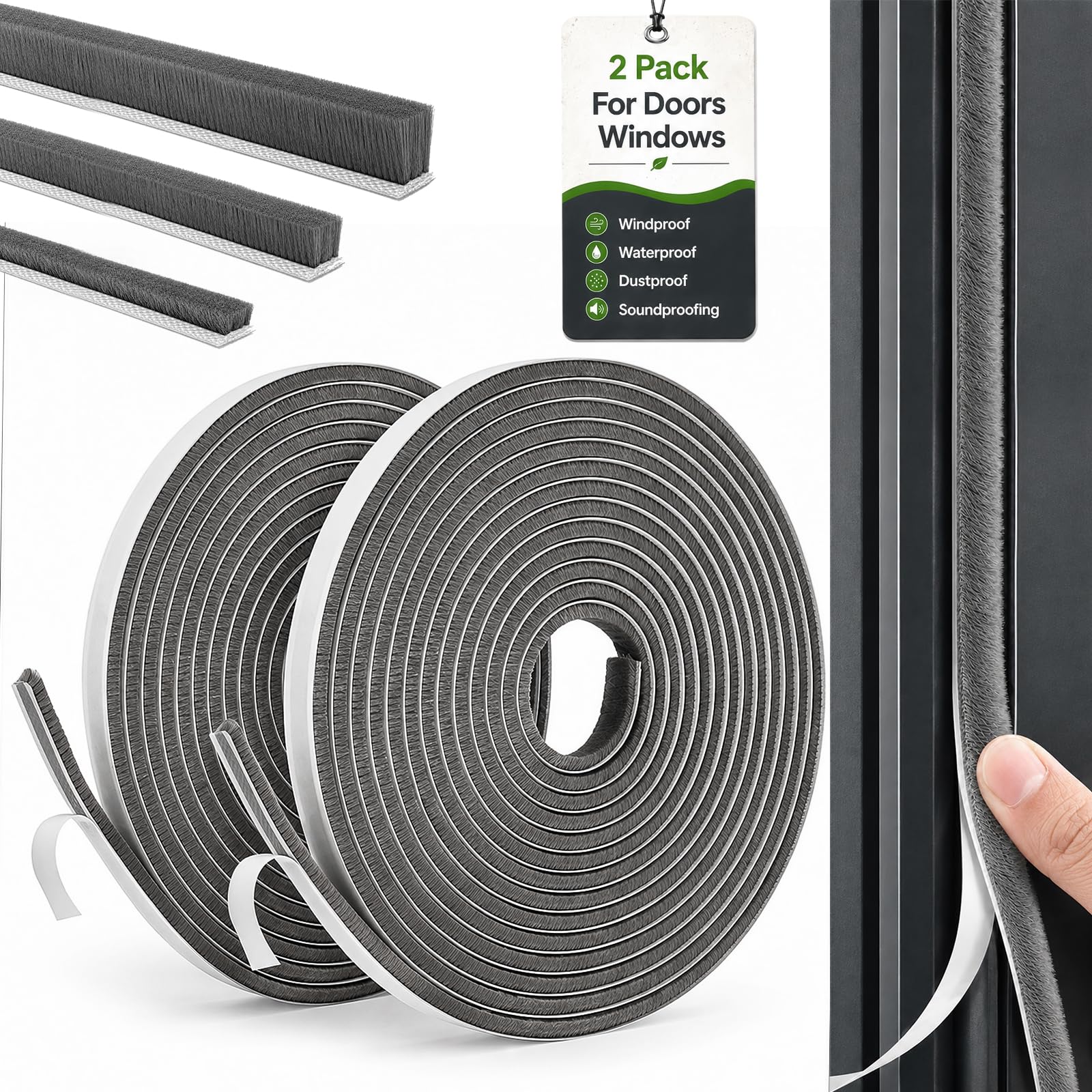
Two rolls of the same narrow foam profile, giving 65 ft in total, which is enough to work around a whole floor of sash windows. The dimensions match the single roll above, so the foam seats into slim reveals and compresses under a latch. The two-pack format means one roll can be kept for touch-ups after the first winter. It is the cheapest way to buy this much strip.
This is the pick for a period property with many identical windows, where buying one roll at a time becomes expensive. It earns its place on volume and price rather than any difference in the foam itself. The limitation is the same as any thin adhesive strip: the bond relies on a clean, dry, dust-free surface, and old chalky paint will need sanding before the backing will hold.
Trade-off: The adhesive is only as good as the surface under it, so flaking paint or dusty timber will shorten the life of the seal.
3. Alien Draft Seal Set, 49 Feet
Type: Adhesive strip plus flexible flap seal
Length: 49 feet total
Application: Self-adhesive
Intended use: Gaps around doors and windows
Color: As supplied

This set pairs an adhesive strip with a flexible flap, so the seal bends to follow a frame that has moved out of true rather than relying on foam compression alone. That makes it the most forgiving option here for a period front door that no longer sits flush. The 49 ft total covers a door and several windows, and the flap design tolerates a gap that varies along its length. It is the only pick in this roundup built specifically for uneven openings.
It suits owners of older properties whose doors have dropped or warped and who have already failed with rigid foam. It earns its place because the flexible flap keeps contact across a gap that changes width. The caution is that a flap seal is more visible than a foam strip and adds thickness to the frame edge, which can matter on a listed interior where appearance is scrutinised.
Trade-off: The flap is bulkier and more noticeable than plain foam, and it can interfere with a tight-fitting door that already binds on its frame.
4. V Shape Thin Foam Weather Stripping, 19.7 Ft, Brown
Type: Self-adhesive V-shape foam strip
Length: 19.7 feet
Profile: V-shape, thin foam
Color: Brown
Intended use: Exterior front door and side frame sealing

The V-shaped profile is designed to fold into the corner where a door meets its frame, which is exactly where period front doors tend to leak. Brown foam blends with stained or dark-painted timber far better than gray or white, a real consideration on a visible entrance. At 19.7 ft it is sized for one door and its side frames rather than a whole house. The thin foam collapses into the V when the door closes, so it adds little resistance.
This suits owners who want the entrance to stay presentable while still cutting the draught that arrives under and around a front door. It earns its place on colour and profile rather than length. The drawback is coverage: one roll will not stretch to a back door and several windows, so it is a targeted fix rather than a whole-property solution.
Trade-off: The short length limits it to a single doorway, and brown foam is hard to match on painted frames in any other colour.
5. Holikme Under Door Draft Stopper, 36 Inch
Type: Adjustable sliding under-door blocker
Width: 36 inches
Color: Gray
Intended use: Bottom-of-door gap sealing
Function: Blocks light, air and dust

This is a sliding blocker that sits against the base of a door and adjusts to the width of the opening, sealing the gap underneath rather than around the frame. Old properties often have a generous gap below the door to clear a thick carpet or an uneven floor, and no adhesive strip will close that. The 36 inch width suits a standard internal door, and the gray fabric-covered body is unobtrusive. It moves with the door rather than being fixed to it.
It suits owners dealing with a cold hallway or a draught running along the floor from a front door. It earns its place because it solves a gap the other four products cannot reach. The limitation is friction: a blocker that slides on the floor can catch on rugs or thick pile, and it needs to be lifted clear when the door is opened fully.
Trade-off: A floor-sliding blocker can snag on carpet and rugs, and it does nothing for gaps around the sides or top of a door.
Before You Buy
- Gap size: Measure the widest point of the gap before choosing. Foam strips suit narrow, even gaps; a flexible flap or under-door blocker suits gaps that vary or run along the floor.
- Material and surface: Adhesive seals need a clean, dry, sound surface. Sand chalky paint and wipe away dust, or the strip will peel within weeks.
- Frame condition: Period frames are rarely square. A flexible flap tolerates movement that rigid foam cannot.
- Compatibility: Check that a seal will not stop a sash, latch or door from closing. Thicker profiles can bind on tight-fitting heritage joinery.
- Appearance: Brown and gray strips are less visible on timber. On a listed interior, a bulky flap may be unacceptable.
- Care: Foam strips compress and flatten over time. Expect to replace high-traffic door seals periodically.
- Coverage: Add up the linear feet needed for every window and door before ordering, so a single roll is not exhausted halfway through the job.
Frequently Asked Questions
-
What is the best draught proofing for a period property with uneven doors?
A flexible flap seal, such as the Alien Draft Seal, copes best with frames that have warped or dropped, because it bends to follow the gap instead of relying on even compression. -
Can draught proofing damage old windows or doors?
Not if it is sized correctly. The risk is choosing a strip thick enough to stop a sash or door from closing, which stresses the frame. A narrow foam profile is the safer choice for tight heritage joinery. -
How much strip is needed for a typical period house?
Measure each opening and add the totals. A single door can use 15 to 20 ft once both sides and the top are counted, so a multi-window property usually needs the larger two-pack. -
Does draught proofing help with noise as well as heat?
Foam and flap seals reduce the air path that carries sound, so they cut some noise alongside the draught. They are not a substitute for proper acoustic glazing. -
What about the gap under an old door?
An under-door blocker is the practical answer. Adhesive strips around the frame will not close a gap that runs along the floor. -
When should draught proofing be replaced?
When the foam no longer springs back or the adhesive lifts at the edges. High-traffic door seals typically need attention sooner than window strips.
Bottom Line
For most period properties, the Alien Draft Seal Set is the strongest single purchase, because its flexible flap handles the warped, uneven openings that defeat plain foam. Pair it with the Holikme Under Door Draft Stopper for the floor gap and the two-pack foam strip for the windows, and the whole house is covered for very little outlay.
