Why there are Amazon links here: Brave Review is paid a commission for qualifying Amazon purchases made through the links below. Your price does not change, and using our links is entirely optional. How this works
Best Gas Leak Detector for a Kitchen for Fast, Reliable Gas Alerts
Natural gas and propane leaks rarely announce themselves, so a dedicated detector belongs in every kitchen that runs on gas. This guide covers five models that fit different needs: a plug-in alarm for round-the-clock coverage, a handheld sniffer for tracking down a suspected leak, and a long-life battery unit for spots without an outlet. Buyers who want set-and-forget protection, buyers who want to hunt the source of a smell, and renters who cannot rewire anything will each find a match below. The overview table comes first, followed by the individual picks.
The Picks at a Glance
| Product | Key Spec | Best Use | Price Tier |
|---|---|---|---|
| Kidde Carbon Monoxide + Explosive Gas Alarm | Plug-in with 9V backup, digital display | Whole-kitchen coverage plus CO | Mid |
| PT520A Natural Gas Detector | 17-inch gooseneck probe | Pinpointing a leak source | Budget |
| Plug in Natural-Gas-Detector for Home | LED display, low-power sensor | Small kitchens and apartments | Budget |
| Protect My Home Natural Gas Detector | 10-year built-in battery, ETL-certified | Outlet-free walls and pipes | Premium |
| PT199 Natural Gas Leak Detector | Audible and visual alarm, handheld | Quick spot checks around appliances | Budget |
1. Kidde Carbon Monoxide + Explosive Gas, Natural Gas & Propane Alarm

Type: Plug-in alarm with battery backup
Target gases: Carbon monoxide, natural gas, propane
Power source: AC outlet with 9V battery backup
Alarm: 85 dB with LED status indicators
Display: Digital readout
Edition: 3rd Edition
Kidde Carbon Monoxide + Explosive Gas, Natural Gas & Propane Alarm
This is the pick for a kitchen that wants one device handling two risks. The unit plugs into a standard outlet and adds a 9V battery backup, so it keeps watching during a power cut — a real concern, since a gas appliance can be left running when the power trips. The digital display gives a running readout instead of a silent box on the wall, and the 85 dB alarm is loud enough to carry through a closed kitchen door. LED indicators show status at a glance, so a quick look confirms the unit is live.
It earned its place as the all-rounder because it covers both explosive gas and carbon monoxide, which many single-purpose detectors ignore. Buyers with a gas range, a gas water heater nearby, or an attached garage will get more value from one plug-in point than from two separate boxes. The trade-off: it needs a free outlet in the right spot, and the plug-in form factor means the unit is only as good as the socket it occupies — a kitchen with no counter-level outlet will need an extension or a different pick.
Check the current price on Amazon
2. PT520A Natural Gas Detector with 17-Inch Gooseneck

Type: Handheld gas leak detector
Probe: 17-inch gooseneck
Target gases: Propane, methane, butane
Power source: Batteries (three included)
Best for: Locating a leak source
Color: Orange
PT520A Natural Gas Detector, Gas Leak Detector with 17-Inch Gooseneck
The long gooseneck is the whole point of this tool. It lets the sensor reach behind a stove, under a hob, and along the gas line to a water heater without the buyer crouching into the gap with a flashlight. The unit reacts to propane, methane, and butane, covering the common kitchen fuels, and it ships with three batteries so it works out of the box. This is a diagnostic tool, not a wall alarm — it is for finding the source once a smell has been noticed.
It suits buyers who already have an alarm and want a way to trace a suspected leak before calling a technician, and it is a sensible companion for RV owners with onboard propane. The trade-off: a handheld sniffer only protects when someone is actively using it, so it cannot replace a fixed alarm for round-the-clock coverage, and the gooseneck is a flexible part that deserves care when stored.
Check the current price on Amazon
3. Plug in Natural-Gas-Detector for Home with LED Display

Type: Plug-in gas alarm
Target gases: Natural gas, propane
Display: LED
Sensor: Low-power sensor
Best for: Kitchen, apartment, RV
Power source: AC outlet
Plug in Natural-Gas-Detector for Home, Propane-Leak-Detector with LED Display
This is the budget entry for a small kitchen or apartment where a single plug-in point covers the whole cooking area. The low-power sensor is built for continuous operation, and the LED display gives a visible status readout rather than a bare indicator light. It handles both natural gas and propane, so it works whether the building runs on mains gas or a cylinder. The compact body suits an RV or a tight counter run where a larger alarm would crowd the outlet.
It earned a spot as the value pick for renters and small-space owners who want a fixed alarm without spending much. The trade-off: at this price tier the build is basic and the unit depends entirely on mains power, so a power cut silences it — buyers who want backup should look at the Kidde or the battery model below.
Check the current price on Amazon
4. Protect My Home Natural Gas Detector with 10-Year Built-in Battery
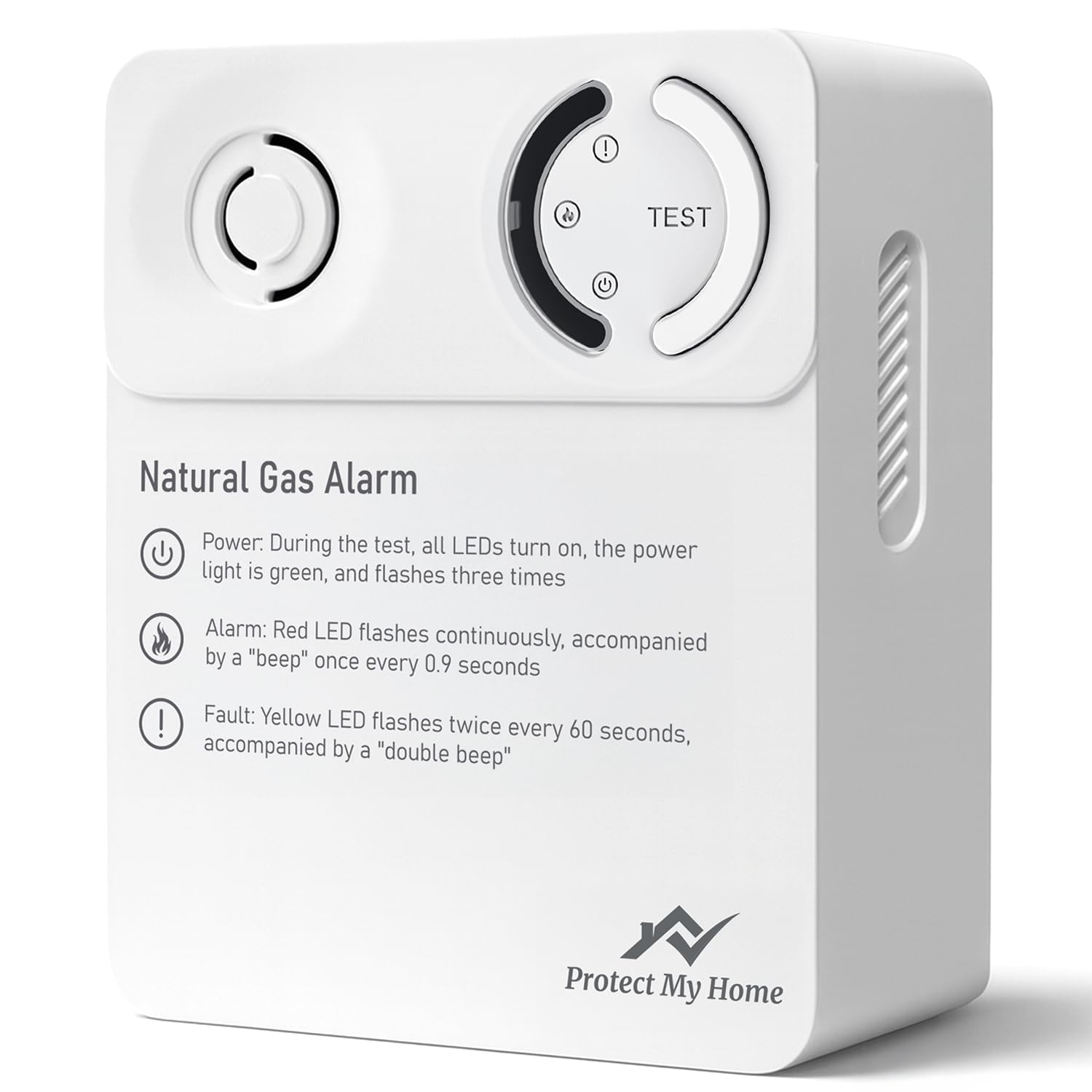
Type: Battery-powered gas alarm
Battery: 10-year built-in
Mounting: Wall or pipe mounted
Alerts: LED indicators and speaker
Certification: ETL-certified
Power source: No plug-in needed
Protect My Home Natural Gas Detector with 10-Year Built-in Battery
This is the pick for a kitchen wall with no free outlet. The built-in battery is rated to last ten years, which covers the typical service life of a gas alarm, and the unit mounts to a wall or clips onto a pipe — useful above a gas line or beside a water heater. Speaker alerts and LED indicators give both audible and visual warning, and the ETL certification is a meaningful third-party safety mark at this price. No plug means no cord to route and no socket to sacrifice.
It suits buyers who want set-and-forget protection in an awkward spot, and RV owners who need a detector that does not compete for a 12V socket. The trade-off: the battery is built in, so the whole unit is replaced at end of life rather than the cell being swapped, and the premium price reflects the long-life design — a buyer on a tight budget can get basic coverage for less.
Check the current price on Amazon
5. PT199 Natural Gas Leak Detector with Audible & Visual Alarm

Type: Handheld gas sniffer
Alerts: Audible and visual alarm
Target gases: Methane, propane
Power source: Batteries (two included)
Best for: Locating combustible sources at home
Color: Orange
PT199 Natural Gas Leak Detector with Audible & Visual Alarm
The PT199 is the compact spot-checker of the group. It is small enough to keep in a kitchen drawer and simple enough to hand to anyone in the household: switch it on, move it along the gas line, and the audible and visual alarm both fire near a leak. It runs on two included batteries, so there is no charging routine to remember, and it covers methane and propane for both mains gas and cylinder setups. The orange body is easy to find in a drawer or toolbox.
It earned its place as the low-cost second detector — the tool for a quick check after fitting a new appliance or when a faint smell appears near the hob. The trade-off: it is a handheld sniffer with no continuous monitoring, so it only protects while someone is using it, and the small housing means the sensor sits close to the surface being checked rather than sampling a whole room.
Check the current price on Amazon
Before You Buy
- Coverage type: A fixed alarm watches a room continuously; a handheld sniffer only works while in hand. Most kitchens benefit from one fixed alarm plus a sniffer for diagnosis.
- Power source: Plug-in units need a free outlet and stop working in a power cut unless they carry a battery backup. Battery models go anywhere but are replaced at end of life.
- Target gases: Confirm the unit reacts to the fuel actually in use — natural gas for mains supply, propane for cylinders and RVs. Some models cover both, some cover only one.
- Mounting: Wall and pipe mounts suit a detector placed near a gas line or above a hob. Plug-in units need counter-level or low-wall socket space.
- Certification: A recognized safety mark such as ETL is worth checking on any alarm that will sit unattended for years.
- Placement: Fit the alarm where gas would gather — near the appliance, not across the room — and keep it clear of grease and steam from daily cooking.
- Maintenance: Fixed alarms need periodic testing and eventual replacement; handheld sniffers need fresh batteries and careful storage of any flexible probe.
Frequently Asked Questions
-
Where should a gas leak detector go in a kitchen?
Place it near the gas appliance and any gas line, at a height where it will not be splashed or steamed. Natural gas rises, so a point above the hob or beside the supply pipe is a sensible starting spot. -
Is a plug-in or battery detector better for a kitchen?
A plug-in unit gives continuous protection with no battery to change, but it dies in a power cut. A battery model works anywhere and keeps watching during an outage, at a higher upfront cost. -
Can a handheld sniffer replace a fixed alarm?
No. A handheld tool is for finding a suspected leak source while it is in use. Round-the-clock protection needs a fixed alarm that runs unattended. -
Does one detector cover both natural gas and propane?
Some models do, and those are listed above. Buyers should confirm the unit names the fuel in use before relying on it, since a single-gas model will miss the other. -
How long does a gas detector last?
Fixed alarms have a service life, and long-life battery models are rated to match it. A unit with a built-in battery is replaced as a whole at end of life rather than having the cell swapped. -
Should a detector also watch for carbon monoxide?
A combined unit is worth considering where a gas range or water heater shares space with the kitchen. It covers two risks from one outlet and simplifies placement.
Bottom Line
For most kitchens the Kidde Carbon Monoxide + Explosive Gas Alarm is the pick: it watches for both explosive gas and carbon monoxide, keeps running on its 9V backup during a power cut, and shows status on a digital display. Buyers with no free outlet should step up to the Protect My Home battery model, and anyone who wants to trace a smell should add the PT520A gooseneck sniffer alongside a fixed alarm.
