Why there are Amazon links here: Brave Review is paid a commission for qualifying Amazon purchases made through the links below. Your price does not change, and using our links is entirely optional. How this works
Best Heat Alarm for a Kitchen with a Tumble Dryer: 5 Picks That Cut False Alarms
A tumble dryer fills a kitchen with warm, humid air, and an ordinary smoke alarm in that room will chirp at laundry steam rather than at a real fire. The answer is a heat alarm: it watches temperature instead of smoke, so lint and damp air stay quiet while a genuine flare-up still trips it. This guide covers five hardwired heat alarms suited to a kitchen-and-utility setup, from a budget-friendly garage-style unit to a mechanical detector built for tough rooms. Buyers who want the simplest swap, buyers who need interconnect with existing alarms, and buyers wiring a new circuit each have a clear pick below. The overview table comes first so a decision can be made in under a minute.
Overview of the Picks
| Product | Key Spec | Best Use | Price Tier |
|---|---|---|---|
| Kidde Heat Detector, Hardwired with Battery Backup | Hardwired, battery backup, interconnect | Whole-home interconnect on a budget | Budget |
| First Alert BRK HD6135FB Hardwired Heat Alarm | 9V battery backup | Straight replacement in an existing BRK setup | Mid |
| First Alert Heat Alarm Hard Wired 120 V | Thermistor sensor, 50 ft detection | Large kitchen-diner coverage | Mid |
| Kidde Hardwire Interconnectable 135-Degree Heat Alarm HD135F | 135-degree fixed temperature, interconnect | New-build kitchen wiring | Mid |
| System Sensor 5601P Mechanical Heat Detector | Fixed temperature plus rate-of-rise, plain housing | Harsh utility rooms and outbuildings | Premium |
1. Kidde Heat Detector, Hardwired with Battery Backup

Type: Hardwired heat detector
Power Source: Mains with battery backup
Indicators: Two LEDs
Interconnect: Compatible with matching units
Intended Use: Garages and utility spaces
This Kidde unit is a hardwired heat detector with a battery backup, so it keeps working through a power cut. The two LEDs give a visible status read at a glance, and the interconnect capability lets it join a chain of matching alarms so one trip sets off the rest. Kidde positions it for garages, and that same logic fits a laundry corner: heat rises, smoke does not, and a dryer that overheats gets caught without steam causing nuisance trips. The housing is a conventional ceiling-mount design that suits standard junction boxes.
It earns its place as the budget pick because it covers the essentials — mains power, backup battery, interconnect — without extra circuitry. Buyers wiring a first heat alarm alongside existing Kidde smoke alarms are the natural audience. The caution is coverage: a single unit protects one room-sized zone, so a kitchen that opens into a long utility corridor likely needs a second alarm on the same interconnect loop. Buyers who want app alerts or voice prompts should look elsewhere in the range.
Trade-off: The plain LED-and-horn design gives no smart-home or voice notification, so remote monitoring is not part of the package.
2. First Alert BRK HD6135FB Hardwired Heat Alarm with Battery Backup

Type: Hardwired heat alarm
Power Source: Mains with 9V battery backup
Model: HD6135FB
Brand Line: First Alert BRK
Intended Use: Kitchens and utility rooms
The HD6135FB is a hardwired heat alarm from the First Alert BRK line, running on mains power with a 9V battery as backup. The 9V format is the common one, which makes replacement batteries easy to source at any hardware store. It is built as a straight swap for an existing BRK hardwired fitting, so the wiring harness and mounting plate usually line up with what is already on the ceiling. That matters in a kitchen where a smoke alarm is being pulled out and a heat alarm dropped in its place.
The pick suits buyers who already have BRK alarms upstairs and want the kitchen unit to match. It is a mid-tier choice: more than the budget Kidde, less than a commercial detector. The drawback is that the 9V backup needs a yearly battery check, and a heat alarm mounted over a tumble dryer sits in a warm spot that shortens battery life in practice. Buyers who dislike battery swaps should weigh a sealed-backup model instead.
Trade-off: The 9V backup is user-replaceable rather than sealed, so it adds a yearly maintenance task in a hot, lint-heavy room.
3. First Alert Heat Alarm Hard Wired 120 V
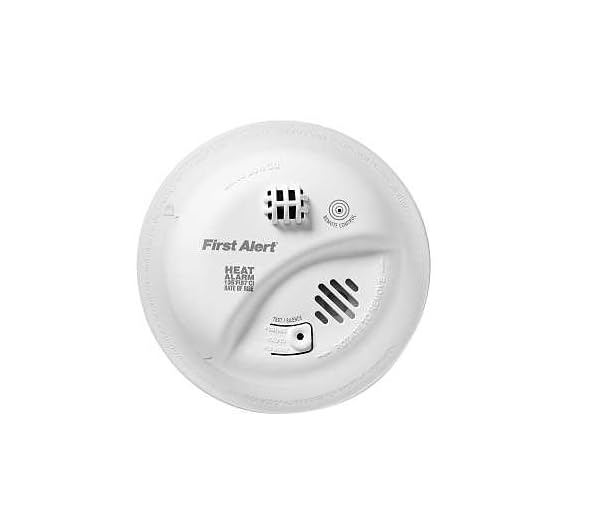
Type: Hardwired heat alarm
Power Source: 120 V mains with battery backup
Sensor: Thermistor
Coverage: 50 ft detection
Alarm Output: 85 dB
Brand: First Alert
This First Alert unit uses a thermistor sensor rather than a bimetallic strip, which is the more responsive design of the two. The listed 50 ft detection range makes it the pick for a kitchen that runs long, or for an open-plan kitchen-diner where one ceiling point has to cover a lot of floor. The 85 dB horn is loud enough to carry through a closed utility door, and the 120 V hardwiring matches standard US household circuits with a battery backup behind it.
It suits buyers with a larger room or an open plan where a smaller-coverage alarm would leave a blind spot. The trade-off is that a wider detection radius also means the unit is more exposed to ambient heat from ovens and radiators, so placement matters more than with a tight-coverage unit. Buyers in a compact galley kitchen are paying for range they will not use.
Trade-off: The 50 ft coverage rewards a big room but demands careful siting, since a wide radius near an oven can shorten the time before a trip.
4. Kidde Hardwire Interconnectable 135-Degree Heat Alarm HD135F

Type: Hardwired heat alarm
Power Source: Mains hardwired
Trip Point: 135 degrees
Interconnect: Interconnectable with matching alarms
Model: HD135F
Intended Use: Kitchens and utility rooms
The Kidde HD135F is a hardwired heat alarm with a fixed 135-degree trip point and interconnect capability. That trip temperature is the standard choice for a kitchen: high enough that cooking and dryer exhaust do not set it off, low enough that a real fire is caught early. Interconnect means it can share a loop with matching Kidde alarms, so a trip in the kitchen sounds the whole house. The unit is designed for permanent mains wiring rather than a plug-in adapter.
It is the pick for a new-build or a rewire, where an electrician is running the circuit anyway. The build is conventional ceiling-mount hardware and the install is a job for someone comfortable at a breaker panel. The caution: hardwired-only means no battery-only fallback if the mains circuit is down, and buyers in an older home without a spare circuit will face more installation work than a battery-backed model demands.
Trade-off: No battery-only operation means the alarm is silent during a mains outage unless the circuit is backed up.
5. System Sensor 5601P Mechanical Heat Detector

Type: Mechanical heat detector
Trip Point: 135 degrees fixed temperature
Sensor Logic: Fixed temperature plus rate-of-rise
Circuit: Single-circuit
Housing: Plain
Intended Use: Commercial and utility spaces
The System Sensor 5601P is a mechanical heat detector, not a consumer alarm, and it combines fixed-temperature tripping at 135 degrees with rate-of-rise logic. Rate-of-rise catches a fast temperature spike before the fixed point is reached, which is exactly the profile of a dryer fire starting in a lint trap. The plain housing is built for surface mounting in commercial and utility settings where appearance is secondary to durability.
This is the premium pick and the one for a hard-to-reach utility room, a workshop, or a laundry outbuilding where a domestic alarm would be knocked about. It is a single-circuit device, so it ties into a conventional alarm panel rather than standing alone with its own sounder. The caution is real: it is a component, not a plug-and-play alarm, and buyers without a panel or a wiring plan will find it the wrong tool. It also lacks the battery backup and built-in horn the other picks carry.
Trade-off: The detector needs an existing alarm panel and sounder to be useful, so it is not a standalone replacement for a kitchen smoke alarm.
Before You Buy
- Sensor type: A thermistor or rate-of-rise detector reacts faster than a plain fixed-temperature strip; match the sensor to how quickly a dryer fire is likely to build.
- Coverage: A 50 ft detection radius suits an open-plan kitchen-diner, while a compact galley kitchen is well served by a tighter single-room unit.
- Interconnect: A heat alarm that joins the house loop sounds every alarm at once; check it matches the brand and wiring of existing units.
- Power: Mains with battery backup keeps protection through an outage; hardwired-only models depend on the circuit staying live.
- Placement: Mount on the ceiling away from the dryer vent, oven door and direct sunlight, since local heat shortens the time before a trip.
- Installation: Hardwired units need a circuit and a breaker; a mechanical detector needs an alarm panel. Budget for an electrician where needed.
- Maintenance: Battery-backed models need a yearly battery check, and a hot laundry room is harder on batteries than a hallway.
Frequently Asked Questions
-
Why use a heat alarm instead of a smoke alarm in a kitchen with a tumble dryer?
A dryer throws off steam and lint that trip smoke alarms, while a heat alarm ignores both and responds only to a genuine temperature rise. -
Will a heat alarm still catch a dryer fire?
Yes. A lint fire raises the temperature fast, and a 135-degree fixed point or rate-of-rise logic will trip well before the room fills with smoke. -
Does the heat alarm need to interconnect with the rest of the house?
It should. Interconnect means a kitchen trip sounds every linked alarm, which matters when the dryer runs overnight or the kitchen door is closed. -
How far should the alarm sit from the tumble dryer?
Keep it off the ceiling directly above the dryer vent and out of the hot plume; the wider the detection radius, the more placement matters. -
Can a mechanical detector replace a household heat alarm?
Only with an alarm panel behind it. The System Sensor unit is a component, not a standalone alarm with its own sounder and backup. -
Is a battery-only heat alarm a good option?
The picks here are hardwired for reliability, but a battery-only unit suits a room with no circuit; the trade-off is a yearly battery change.
Bottom Line
For most kitchens with a tumble dryer, the Kidde Heat Detector with battery backup and interconnect is the top pick: mains power, backup battery, two status LEDs and the ability to join a house-wide loop, all at the budget end of the range. Buyers with a large or open-plan kitchen should step up to the 50 ft thermistor First Alert, and buyers wiring a new circuit should choose the interconnectable Kidde HD135F. The System Sensor mechanical unit is the right answer only where a panel already exists.
