Why there are Amazon links here: Brave Review is paid a commission for qualifying Amazon purchases made through the links below. Your price does not change, and using our links is entirely optional. How this works
Best Heat Alarm for a Kitchen: 5 Hardwired Picks That Skip the Steam
A kitchen is the one room where a standard smoke alarm earns its false alarms honestly — toast, searing, a kettle at full boil. The best heat alarm for a kitchen fixes that by watching temperature instead of airborne particles, so steam and cooking smoke stay quiet while a real fire still trips the unit. This roundup covers five hardwired heat alarms: three for typical residential kitchens, one budget fixed-temperature unit, and one premium interconnectable model. Renters and anyone without existing alarm wiring should look elsewhere first, because every pick here expects a 120 V circuit.
The Picks at a Glance
| Product | Key Spec | Best Use | Price Tier |
|---|---|---|---|
| Kidde Heat Detector, Hardwired with Battery Backup & 2 LEDs | Battery backup, interconnect capable | Garages and utility rooms | Mid |
| First Alert BRK HD6135FB | 9V battery backup | Straightforward kitchen swap | Budget |
| Thermistor Sensor Hardwired Heat Alarm | Thermistor sensor, 50 ft detection | Large open kitchens | Mid |
| System Sensor 5600 | 135°F fixed temp plus rate-of-rise | Alarm-panel systems | Budget |
| Kidde HD135F | 135°F rating, interconnectable | Multi-unit whole-home setups | Premium |
1. Kidde Heat Detector, Hardwired with Battery Backup & 2 LEDs

Type: Hardwired heat detector
Power Source: 120 V with battery backup
Indicators: Two LEDs
Interconnect: Compatible with other interconnected units
Intended Use: Garages and similar spaces
Check the current price on Amazon
Kidde builds this unit around a hardwired base with a battery backup cell, so it keeps watching the room through a power cut. The twin LEDs give a quick visual read on status from across a room, and the interconnect line lets it join a wider alarm circuit so one trip sounds the rest. The housing is the usual molded plastic of the category, sized to sit flush against a box. It is aimed at garages in Kidde’s own naming, but the same temperature-based logic suits a kitchen where smoke alarms keep crying wolf.
This is the pick for a household that already has hardwired alarms and wants the kitchen to stop being the weak link. It earns its place on the backup battery and the interconnect option, both of which matter more in a kitchen than a fancy sensor. The trade-off is that a garage-first unit is not tuned for tight residential spaces, so buyers in a small galley kitchen may find a dedicated kitchen model more predictable.
2. First Alert BRK HD6135FB Hardwired Heat Alarm

Type: Hardwired heat alarm
Power Source: 120 V with 9V battery backup
Backup: 9V battery
Model: HD6135FB
Intended Use: Residential kitchens and utility areas
Check the current price on Amazon
First Alert’s BRK line is the default name in most US alarm aisles, and this model follows the familiar formula: a hardwired chassis, a 9V backup cell, and a simple twist-on mount. The 9V backup is the practical detail here, since that battery is on every hardware store shelf and swaps without tools. The unit reads temperature rather than smoke, which is exactly what a kitchen wants. It is a plain, functional device with no display and no smart features.
Buyers replacing an aging kitchen alarm on the same wiring will find this the least disruptive option, and the price tier keeps a whole-floor retrofit affordable. It suits landlords and DIY installers who want a known brand without a premium. The trade-off is that a budget-first unit gives up niceties — expect a basic test button and no frills, and confirm the interconnect behavior before buying if the house runs a linked system.
3. Thermistor Sensor Hardwired Heat Alarm
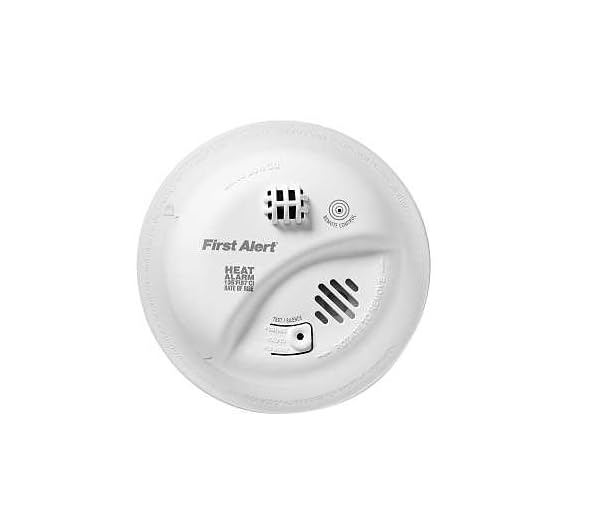
Type: Hardwired heat alarm
Sensor: Thermistor
Detection: 50 ft coverage
Alarm: 85 dB
Power Source: 120 V with battery backup
Check the current price on Amazon
This unit leans on a thermistor sensor, a solid-state part with no moving pieces to stick, and rates its coverage at 50 ft with an 85 dB horn. That combination points at larger rooms — an open-plan kitchen that runs into a dining area is the obvious fit. The hardwired base carries a battery backup so the unit stays live when the circuit drops. Build is standard consumer alarm plastic with a ceiling-mount footprint.
Buyers with a big kitchen, or a kitchen that opens onto a hallway, get the most from the coverage rating here. It also suits anyone who prefers a sensor with no mechanical contacts to wear out over years of cooking heat. The trade-off is that a broad coverage claim is not the same as a tuned kitchen response, so a very small room may be better served by a tighter, simpler unit.
4. System Sensor 5600 Fixed Temperature Rate-of-Rise Heat Detector

Type: Mechanical heat detector
Rating: 135°F fixed temperature plus rate-of-rise
Circuit: Single-circuit
Housing: Plain
Intended Use: Alarm-panel and low-voltage systems
Check the current price on Amazon
The System Sensor 5600 is a different animal from the consumer alarms above: a mechanical detector with a plain housing, built to trip on a 135°F fixed temperature or a fast rate of rise, wired as a single circuit. There is no battery, no horn and no standalone operation — it reports to a panel. The mechanical element is the appeal, since it needs no power to sense heat. This is commercial-grade hardware in a no-nonsense shell.
It belongs in a kitchen that is already backed by an alarm panel or a low-voltage system, and it suits owners who want a detector that keeps working when the mains are down. Anyone building a monitored setup will find the plain housing easy to blend into a ceiling. The trade-off is stark: a buyer expecting a beeping stand-alone alarm gets nothing here, and installation assumes panel knowledge and low-voltage wiring.
5. Kidde HD135F Hardwire Interconnectable 135-Degree Heat Alarm

Type: Hardwired heat alarm
Rating: 135°F
Interconnect: Links with compatible units
Model: HD135F
Power Source: 120 V hardwired
Check the current price on Amazon
Kidde’s HD135F is the premium pick of the group: a 135°F heat alarm on a hardwired base with interconnect capability, so it can join a house-wide network of compatible Kidde units. The 135°F trip point is the standard ceiling for this class of device, high enough that normal cooking heat stays below it. The chassis is the familiar Kidde ceiling mount, and the interconnect line is the headline feature. It is built for whole-home consistency rather than one-room duty.
This is the choice for a house that already runs Kidde alarms and wants the kitchen on the same circuit, sounding everywhere at once. It earns the premium tier on integration, not on extra sensors. The trade-off is that the interconnect benefit only pays off inside a matching system — a buyer replacing a single standalone alarm pays for a feature that does nothing on its own.
Before You Buy
- Power source: Every pick here expects a 120 V hardwired circuit. A house without alarm wiring needs a battery-only heat alarm instead, not an adapter workaround.
- Sensor type: Thermistor and mechanical detectors both ignore smoke and steam; a fixed-temperature plus rate-of-rise unit adds a second trigger for fast-growing fires.
- Interconnect compatibility: Linking only works within a matching brand family. Confirm the existing alarms before paying for an interconnectable model.
- Coverage and room size: A 50 ft detection rating suits open-plan kitchens; a compact galley may be better served by a tighter unit.
- Trip temperature: A 135°F rating is the common residential figure and sits above normal cooking heat, but check local code before choosing.
- Panel vs. stand-alone: The System Sensor unit reports to an alarm panel and has no built-in horn. Buyers wanting a self-contained alarm should skip it.
- Mounting and ceiling height: Heat rises, so ceiling placement matters more than wall placement, and a high ceiling in a vaulted kitchen can delay response.
Frequently Asked Questions
-
Why use a heat alarm instead of a smoke alarm in a kitchen?
Heat alarms respond to temperature rather than smoke particles, so steam from a kettle, a sizzling pan or an open oven door will not set them off. A smoke alarm in the same spot will. -
Can a heat alarm replace a smoke alarm in a kitchen?
In most homes the heat alarm is the kitchen-specific device, with smoke alarms covering bedrooms and hallways. Local code decides the exact mix, so check it before removing anything. -
Do these heat alarms work during a power outage?
The Kidde and First Alert models here carry battery backup, so they stay live when the circuit drops. The System Sensor 5600 is a mechanical detector wired to a panel and has no battery of its own. -
What does 135°F mean on a heat alarm?
It is the fixed temperature at which the unit trips. The figure sits above normal cooking heat, which is why a kitchen can run hot without tripping the alarm. -
Can a heat alarm be interconnected with smoke alarms?
Only within a compatible brand family. Kidde’s interconnectable models link to other Kidde units, and mixing brands generally breaks the link. -
Where should a heat alarm be mounted in a kitchen?
On the ceiling, away from the immediate zone above a stove and clear of dead-air corners. Heat rises, so the ceiling gives the sensor the earliest read.
Bottom Line
For most kitchens, the Kidde Heat Detector with battery backup is the safest all-round call: it keeps working through a power cut, shows status at a glance, and can join a wider alarm circuit. Buyers on a tighter budget should take the First Alert BRK HD6135FB, while anyone with an alarm panel should go straight to the System Sensor 5600. Whichever fits the wiring in the house, the next step is the same — check the current price on Amazon and confirm compatibility before ordering.