Why there are Amazon links here: Brave Review is paid a commission for qualifying Amazon purchases made through the links below. Your price does not change, and using our links is entirely optional. How this works
Best Heat Alarm for a Shed Used as an Office
A shed office needs a heat alarm, not a smoke alarm: dust, sawdust, and workshop fumes set off smoke detectors constantly, while heat detectors stay quiet until temperature actually rises. This guide covers five heat alarms for hardwired and low-voltage setups, from budget first-timers to interconnecting units for a full outbuilding circuit. The picks suit three buyer profiles: the shed-office owner wiring a single alarm, the tinkerer who wants battery backup, and the installer building a linked system. The overview table below shows every pick at a glance.
Overview of the Picks
| Product | Key Spec | Best Use | Price Tier |
|---|---|---|---|
| First Alert BRK HD6135FB | Hardwired, 9V battery backup | Simple shed-office install | Budget |
| Kidde Heat Detector | Hardwired, battery backup, interconnect | Linked garage/shed circuit | Mid-range |
| First Alert Heat Alarm (B0C8Z4DTTH) | Thermistor sensor, 50 ft detection, 85 dB | Large shed coverage | Mid-range |
| System Sensor 5600 | 135°F fixed temp + rate-of-rise, mechanical | Alarm-panel installations | Budget |
| System Sensor 5601P | 135°F fixed temp + rate-of-rise, mechanical | Panel installs on a tight budget | Budget |
First Alert BRK HD6135FB Hardwired Heat Alarm

Type: Hardwired heat alarm
Power source: 120V with 9V battery backup
Sensor: Heat detection (not smoke)
Best use: Single shed office
Price tier: Budget
First Alert BRK HD6135FB Hardwired Heat Alarm
This is the straightforward entry point for a shed office. It runs on mains power and keeps a 9V battery as backup, so a tripped breaker or a cut feed doesn’t leave the shed unprotected. The heat-sensing element ignores the dust and fumes that plague smoke alarms in outbuildings. Installation needs a live 120V feed at the ceiling, which most sheds wired for an office already have.
The pick suits the shed-office owner who wants one reliable alarm with minimal fuss and no panel. It earns its place on price and simplicity. The trade-off: a single hardwired unit covers one room, so a long or divided shed needs a second alarm or an interconnecting model instead.
Kidde Heat Detector Hardwired with Battery Backup

Type: Hardwired heat detector
Power source: 120V with battery backup
Features: Two LEDs, interconnect capability
Best use: Linked shed and garage circuit
Price tier: Mid-range
Kidde Heat Detector Hardwired with Battery Backup
The Kidde unit adds interconnect capability, which is the feature that matters when a shed office sits near a garage or a second outbuilding. Wired into a shared circuit, one alarm sounding triggers the others, so a heat event in the shed is heard at the house. Two LEDs give a visible status check from the floor. The housing is built for garage-grade conditions — dust, temperature swings, and the occasional cobweb.
This suits buyers who already run Kidde alarms or plan to link several outbuildings into one warning system. The trade-off: interconnect wiring only pays off if the other alarms on the circuit are compatible, so a mixed-brand setup may not link cleanly.
First Alert Heat Alarm, Thermistor Sensor, 50 ft Detection
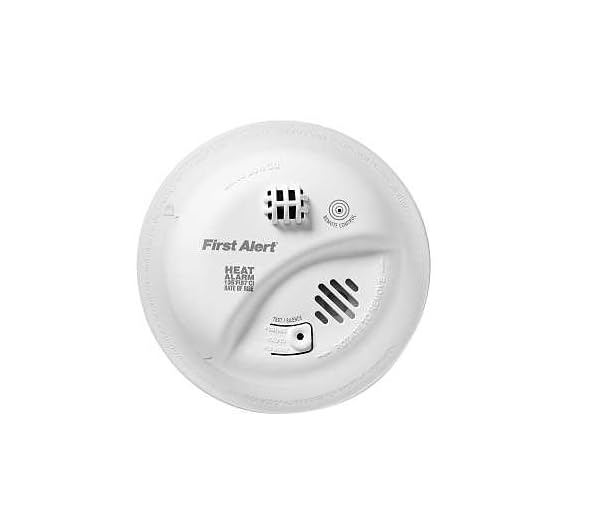
Type: Hardwired heat alarm
Power source: 120V with battery backup
Sensor: Thermistor
Detection range: 50 ft
Alarm volume: 85 dB
Best use: Larger or open-plan shed offices
Price tier: Mid-range
First Alert Heat Alarm with Thermistor Sensor
The thermistor sensor and stated 50 ft detection range make this the pick for a bigger shed or an open-plan workshop-office. An 85 dB alarm is loud enough to carry across a garden to the house on a quiet day. The thermistor design responds to temperature rise rather than smoke, so dust from tools and insulation stays a non-issue. Battery backup keeps it live through power cuts.
It suits the buyer with a shed larger than a single small room, or one who wants audible warning beyond the building. The trade-off: a wider detection footprint means the unit is less suited to tight, cluttered spaces where a more localized sensor would trip sooner.
System Sensor 5600 Mechanical Heat Detector

Type: Mechanical heat detector
Sensor: 135°F fixed temperature plus rate-of-rise
Circuit: Single-circuit
Housing: Plain
Best use: Wired into an alarm panel
Price tier: Budget
System Sensor 5600 Mechanical Heat Detector
This is a detector head, not a standalone alarm: it wires into a conventional fire alarm panel and reports back to it. The 135°F fixed threshold plus rate-of-rise sensing covers both slow heat build-up and a fast flare, which suits a shed with heaters, chargers, or power tools. The mechanical design needs no battery and no separate power feed at the device. Plain housing keeps the look unobtrusive on a shed ceiling.
It suits the buyer who already has, or plans, a small alarm panel covering the outbuilding. The trade-off: without a panel this unit does nothing on its own — no sounder, no backup, no standalone protection.
System Sensor 5601P Mechanical Heat Detector

Type: Mechanical heat detector
Sensor: 135°F fixed temperature plus rate-of-rise
Circuit: Single-circuit
Housing: Plain
Best use: Budget panel-based shed protection
Price tier: Budget
System Sensor 5601P Mechanical Heat Detector
The 5601P is the lower-cost sibling of the 5600, built on the same fixed-temperature and rate-of-rise principle for panel-based systems. It shares the mechanical, battery-free operation and the plain housing. For a shed office tied into an existing panel, it’s the cheapest way to add heat coverage on that circuit. The same 135°F threshold applies.
It suits budget-conscious buyers assembling a multi-device panel system where per-head cost adds up. The trade-off: like the 5600, it relies entirely on the panel for power, sound, and backup, so it is not a fit for a shed with no alarm wiring.
Before You Buy
- Power source: A shed office with a live 120V circuit can take a hardwired alarm; a shed without mains needs a battery-only unit or a panel.
- Interconnect: If the shed shares a wall or circuit with a garage or house, choose an interconnecting model so one alarm triggers the rest.
- Sensor type: Heat detectors ignore dust and fumes; smoke alarms in a shed office will nuisance-trip. Stick with heat sensing.
- Panel compatibility: The System Sensor units are detector heads only — confirm the shed has a conventional alarm panel before buying.
- Coverage: One alarm per room; a long or divided shed needs two units or a wider-detection model.
- Mounting height: Heat rises, so ceiling mounting near the highest point gives the fastest response.
- Backup: Battery backup matters in a shed where power is switched off at the breaker between visits.
Frequently Asked Questions
-
Why use a heat alarm instead of a smoke alarm in a shed office?
Dust, sawdust, and workshop fumes trigger smoke alarms constantly. Heat alarms only respond to temperature rise, so they stay quiet during normal shed work. -
Can a heat alarm work without mains power in a shed?
The hardwired units here need a 120V feed, with battery only as backup. A shed with no mains needs a battery-only alarm or a panel-based system. -
Do the System Sensor units make a sound on their own?
No. They are detector heads that report to an alarm panel. The sounder and backup come from the panel, not the device. -
What does rate-of-rise mean?
It means the detector responds to a fast temperature increase as well as a fixed high temperature, catching a rapid flare as well as slow heat build-up. -
How many heat alarms does a shed office need?
One per enclosed room. An open-plan shed typically needs a single unit, while a divided shed needs one per section or an interconnecting setup. -
Can a heat alarm be linked to alarms in the house?
Only if the models are interconnect-compatible and wired on the same circuit. Mixed-brand systems may not link, so check compatibility first.
Bottom Line
For most shed offices, the First Alert BRK HD6135FB is the top pick: hardwired, battery-backed, heat-sensing, and simple to install in a single room. Buyers linking the shed to a garage or house should step up to the interconnect-capable Kidde, while panel-based setups get the best value from the System Sensor heads.
