Why there are Amazon links here: Brave Review is paid a commission for qualifying Amazon purchases made through the links below. Your price does not change, and using our links is entirely optional. How this works
Best Heat Alarm for a Workshop: 5 Picks That Beat Smoke Detectors
A workshop is the wrong room for a smoke alarm. Dust, sawdust and welding fumes set them off constantly, so people disable them — and that is exactly when a fire starts. A heat alarm ignores smoke and triggers on temperature rise, which makes it the correct device for a garage, shop or utility building.
This guide covers five heat alarms for three buyer types: the homeowner wiring a permanent 120 V circuit, the renter or shed owner who wants a battery backup, and the DIY installer building a low-voltage or mechanical system. The overview table below sorts all five by key spec and price tier.
Overview of the Picks
| Product | Key Spec | Best Use | Price Tier |
|---|---|---|---|
| Kidde Heat Detector | Hardwired with battery backup, 2 LEDs, interconnect capable | Whole-home or multi-room garage wiring | Mid |
| First Alert BRK HD6135FB | 9V battery backup, hardwired | Straight replacement in an existing hardwired circuit | Budget |
| 85 dB Hardwired Heat Alarm | Thermistor sensor, 50 ft detection, 120 V | Large open shop floors | Mid |
| System Sensor 5600 | 135°F fixed temp plus rate-of-rise, single circuit | Alarm-panel systems | Budget |
| System Sensor 5601P | 135°F fixed temp plus rate-of-rise, plain housing | Panel systems on a tight budget | Budget |
Kidde Heat Detector, Hardwired with Battery Backup

Type: Heat detector
Power Source: Hardwired with battery backup
Indicators: 2 LEDs
Interconnect: Capable
Intended Use: Garages and workshops
The Kidde unit is the most versatile pick here because of the interconnect feature. Wired into a circuit with other compatible alarms, one heat event sets off every connected device — useful when the shop sits away from the house and a single alarm would go unheard. The two LEDs give a clear local status read, and the battery backup keeps it live through a power cut.
That interconnect capability is what earns it the top spot for anyone with an attached garage or a shop on the same circuit as living space. It suits the buyer who wants one system, not two. The trade-off is that the extra wiring work and the interconnect dependency mean it is a poor fit for a detached shed with no existing circuit — a standalone battery unit makes more sense there.
First Alert BRK HD6135FB Hardwired Heat Alarm

Type: Hardwired heat alarm
Power Source: Hardwired with 9V battery backup
Battery: 9V
Intended Use: Workshop and garage ceilings
The First Alert BRK is the cheapest hardwired option in this group, and it keeps the essentials: mains power with a 9V backup so the alarm still works when the breaker trips. The 9V format is the easiest backup battery to find on a shelf, which matters for a building that may sit unattended for months.
It suits the buyer replacing an old hardwired alarm on an existing ceiling box, or anyone wiring a single workshop room on a budget. The straightforward design keeps installation simple. The trade-off is the lack of interconnect: this alarm sounds alone, so a loud workshop or a closed door between rooms can hide it.
85 dB Hardwired Heat Alarm with Thermistor Sensor
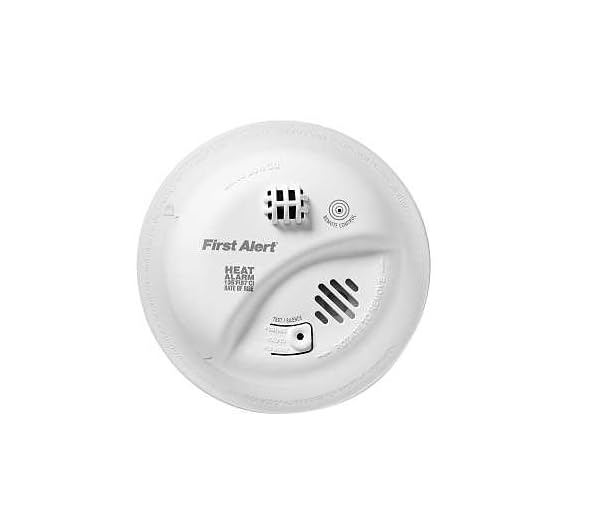
Type: Hardwired heat alarm
Sensor: Thermistor
Detection Range: 50 ft
Loudness: 85 dB
Power Source: 120 V with battery backup
The thermistor sensor is the technical headline here. A thermistor responds to temperature change quickly and without moving parts, which is the right approach for a dusty shop where mechanical parts can gum up over years. The rated 50 ft detection reach and the 85 dB sounder are both aimed at open, high-ceiling spaces.
This is the pick for a large shop floor or a barn where one device needs to cover real distance and still be heard over machinery. It suits the buyer who is already running 120 V wiring and wants coverage per device rather than a network. The trade-off is that a single wide-coverage unit leaves no redundancy — in a big or partitioned building, two smaller alarms beat one long-reach model.
System Sensor 5600 135 Degree Heat Detector

Type: Mechanical heat detector
Trigger: 135°F fixed temperature plus rate-of-rise
Circuit: Single-circuit
Housing: Plain
The System Sensor 5600 is a different animal from the consumer alarms above. It is a mechanical detector built for a low-voltage alarm panel, and it triggers on two conditions: a fixed 135°F ceiling and a rapid rate of rise. The dual trigger catches a fast-moving fire before the room reaches the fixed threshold, which is why panel systems use these.
It suits the buyer with an existing security or fire panel in the shop, or someone building a monitored system where the detector reports back to a central point. The plain housing keeps it unobtrusive on a ceiling. The trade-off is stark: it has no sounder of its own, so without a panel and horn it protects nothing audible.
System Sensor 5601P 135 Degree Heat Detector

Type: Mechanical heat detector
Trigger: 135°F fixed temperature plus rate-of-rise
Circuit: Single-circuit
Housing: Plain
The 5601P carries the same 135°F fixed-temperature and rate-of-rise logic as the 5600, in the lowest-cost package of the group. It is the volume choice: the detector to buy when a panel system needs several heads across a large shop and budget per device matters.
It suits the installer fitting out a multi-zone panel system, or the buyer adding a spare head to an existing mechanical loop. The single-circuit design keeps wiring simple and predictable. The trade-off is identical to the 5600 — no built-in alarm, no battery, no standalone function — and the small price gap between the two means the cheaper one is only worth it in quantity.
Before You Buy
- Power source: A hardwired 120 V alarm needs an existing circuit and a ceiling box. A mechanical detector needs a panel. Match the device to the wiring already in the building before anything else.
- Interconnect: If the shop is attached to a house or has more than one room, buy an interconnect-capable alarm so one event sounds everywhere.
- Coverage: Wide detection reach suits open floors. Partitioned shops need more devices, not a longer reach.
- Audibility: A mechanical detector has no sounder. Budget for a panel, horn or separate alarm if the device is a sensor only.
- Environment: Heat alarms are the right call for dusty, fume-heavy or unheated buildings where smoke alarms nuisance-trip.
- Mounting: Ceiling placement matters more than the model. Keep detectors clear of dead-air corners and directly above heat sources.
Frequently Asked Questions
-
Why use a heat alarm instead of a smoke alarm in a workshop?
Smoke alarms react to dust, sawdust and welding fumes and go off constantly. Heat alarms ignore smoke and trigger on temperature, so they stay quiet until there is a real problem. -
Can a heat alarm replace a smoke alarm in a garage?
In a garage or shop, yes — that is the intended use. Inside living space, smoke alarms remain the standard because they detect smoldering fires earlier. -
Do these alarms need a battery?
The hardwired models carry a battery backup so they keep working during a power cut. The mechanical System Sensor units run off the panel circuit and have no battery of their own. -
What does rate-of-rise mean?
It means the detector triggers when the temperature climbs quickly, not only when it hits a fixed ceiling. That catches a fast fire sooner than a fixed-temperature-only device. -
How many heat alarms does a workshop need?
One per enclosed room is a reasonable baseline. Large open floors may need two for redundancy even if one device’s reach covers the area.
Bottom Line
For most workshop owners, the Kidde Heat Detector is the best heat alarm for a workshop: hardwired power, battery backup and interconnect capability cover the common cases without a panel. Buyers on an existing hardwired circuit who want the lowest cost should take the First Alert BRK, and anyone with an alarm panel should go straight to the System Sensor 5600.
