Why there are Amazon links here: Brave Review is paid a commission for qualifying Amazon purchases made through the links below. Your price does not change, and using our links is entirely optional. How this works
Best Heating Control for a Converted Barn with Thick Stone Walls
Thick stone walls hold cold and release it slowly, so a converted barn rarely heats like a modern house: rooms come up to temperature unevenly and lose it again the moment the heat stops. The five picks below cover the two jobs that matter — putting heat into the room fast and controlling it precisely — and each one suits a different buyer, from the owner of a single cold living room to someone running a large workshop conversion. The overview table gives the short answer; the reviews explain the fit.
Overview of the Picks
| Product | Key Spec | Best Use | Price Tier |
|---|---|---|---|
| GiveBest Smart Wall Heater | 1500W, WiFi and remote, 3 modes | Small rooms and quick top-up heat | Budget |
| 5000W Garage Heater | 5000W, 240V, wall or ceiling mount | Large converted spaces needing raw output | Mid-range |
| Tekmar 521 Programmable Thermostat | Two-stage heat or heat-cool control | Precise control of an existing system | Mid-range |
| ROVSUN 10000W Garage Heater | 10000W, 240V, app and remote | Big workshops and open-plan barn rooms | Premium |
| 180W Infrared Heater | 180W, 3–6㎡ coverage, TÜV certified | Gentle background warmth in a small nook | Budget |
GiveBest Smart Wall Heater
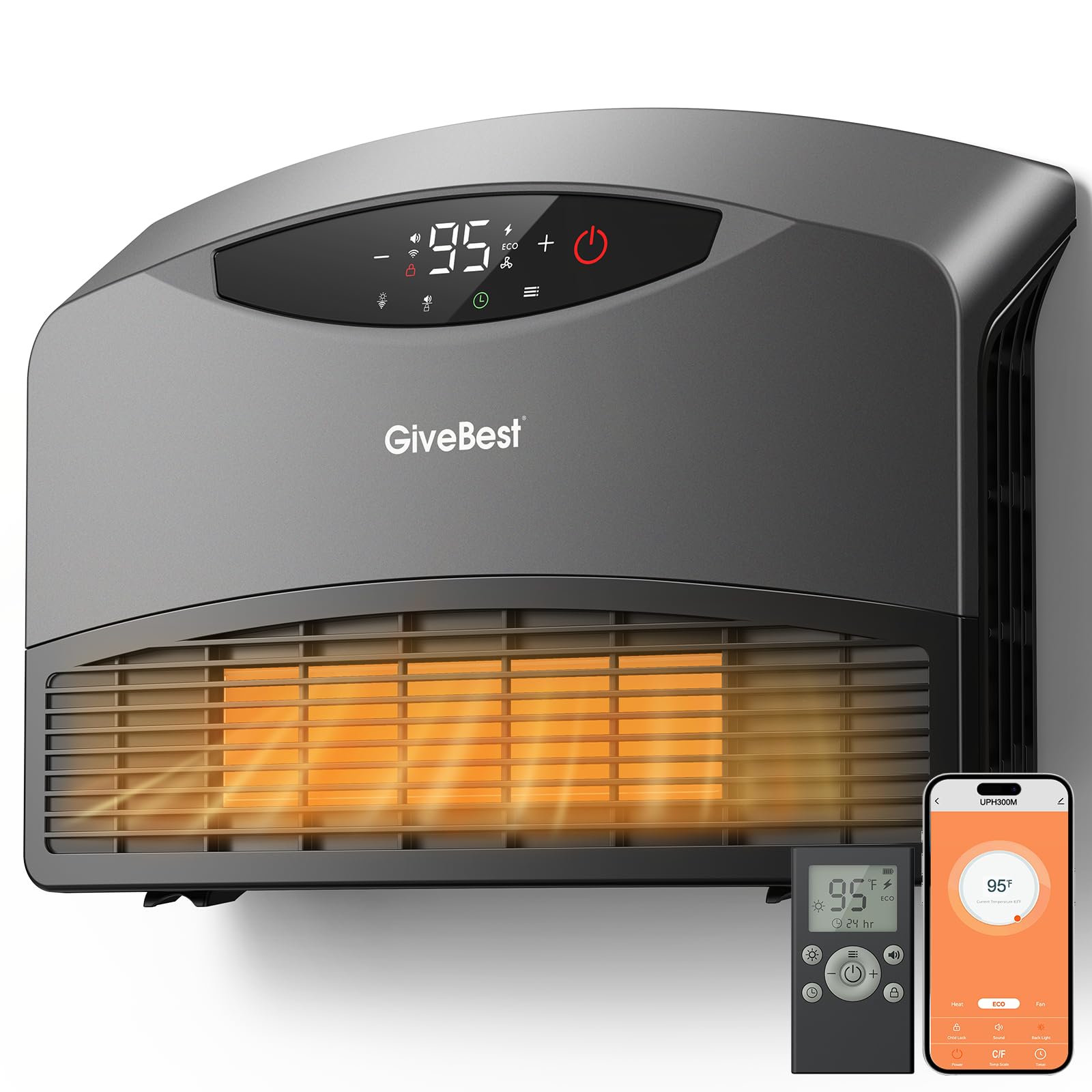
Power: 1500W
Control: WiFi, remote, thermostat
Heating Modes: 3
Timer: 24 hours
Mounting: Wall-mounted
GiveBest Smart Wall Heater, 1500W Portable Heaters for Indoor Use
This is a plug-in wall panel rather than a whole-building solution: 1500W is standard household circuit territory, so it installs without an electrician and runs from an ordinary socket. The three heating modes and 24-hour timer let it switch itself on before the room is needed, which matters in a stone-walled space that takes a while to feel warm. WiFi and remote control mean the settings can be changed without crossing a cold floor. It suits a bedroom, study or small sitting room carved out of a larger barn conversion.
It earns its place as the low-cost starting point for anyone who wants app control and a timer without touching the wiring. Buyers with a single chilly room and a normal socket nearby get the most from it. The caution is capacity: 1500W will not lift a large open-plan barn room, and the fan-assisted output is best treated as local warmth rather than a substitute for a proper heat source.
Trade-off: The output is modest, so it warms the space around it rather than the whole room in a big conversion.
5000W Garage Heater
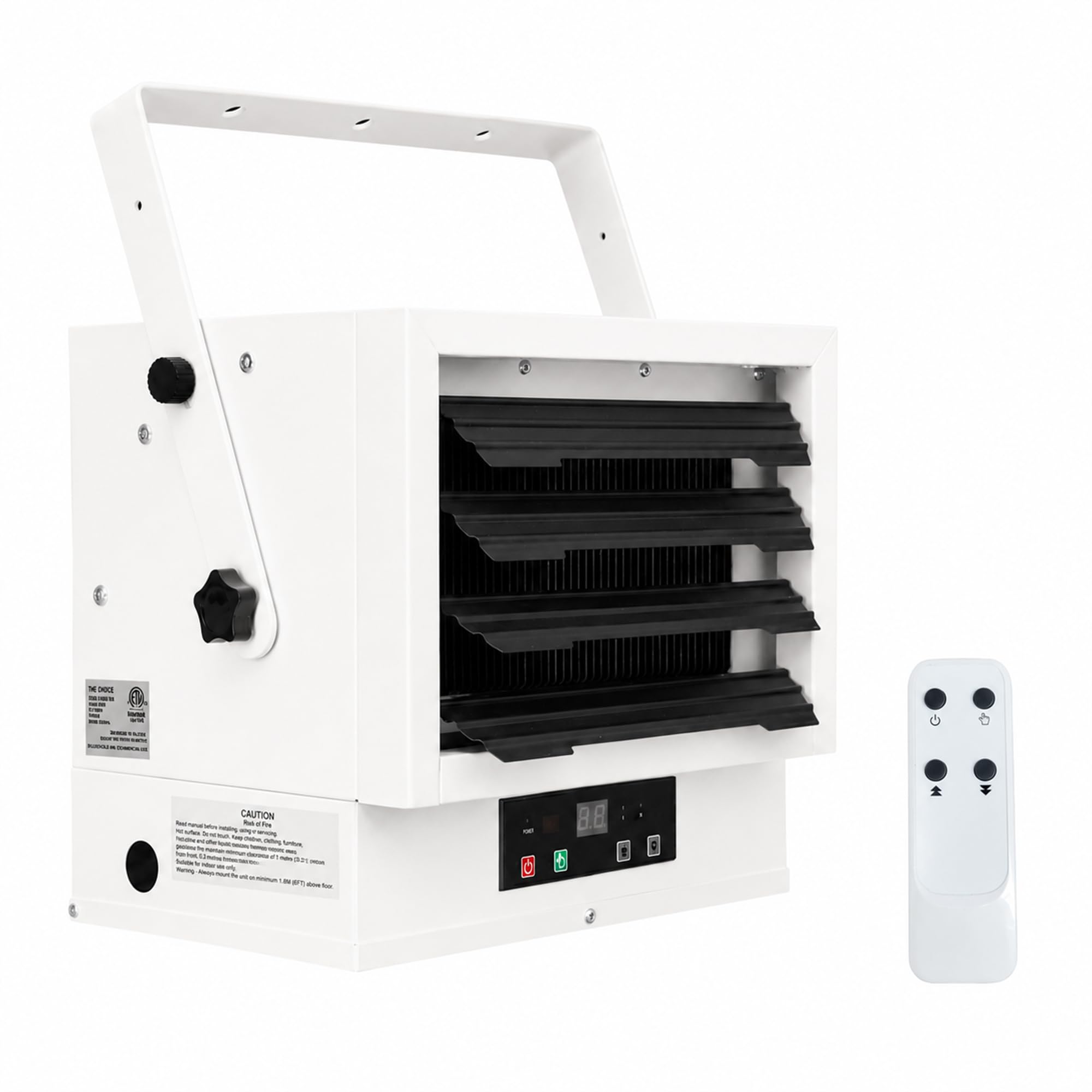
Power: 5000W
Voltage: 240V
Mounting: Wall or ceiling
Timer: 1–9 hours
Protection: Overheat protection
Certification: ETL Listed
5000W Garage Heater, 240V, Wall/Ceiling Mount, with Remote Control
This is a fan-forced unit built for hard-working spaces: 5000W at 240V puts out serious heat, and the wall or ceiling mount keeps it off the floor where a barn conversion usually loses space. Overheat protection and an ETL listing address the safety side that matters in a timber-and-stone building. The 1–9 hour timer and remote make it practical for a workshop or utility end of the conversion that is only used part of the day.
It suits buyers with a large, poorly insulated room — a garage end, a studio, a workshop — where a domestic panel heater is simply outmatched. The 240V supply is the sticking point: this needs a dedicated circuit installed by an electrician, which adds to the real cost. It is not a fit for anyone hoping to plug it into a ring main.
Trade-off: The 240V requirement means professional wiring, so the installed cost runs well above the sticker price.
Tekmar 521 Programmable Thermostat

Type: Programmable thermostat
Modes: Two-stage heat or heat-cool
Function: Scheduling and setpoint control
Mounting: Wall
Tekmar 521 Programmable Thermostat with Two Stage Heat or Heat-Cool Modes
This is the control half of the problem rather than the heat half. Two-stage operation lets a system run at a lower output to hold temperature and bring in the second stage only when the room is far from setpoint — a sensible match for stone walls that respond slowly and overshoot easily. It can also be configured for heat-cool operation, so the same unit manages a summer cooling source if one is fitted. Programming sets different temperatures across the day, which is where most of the running-cost saving in a barn conversion comes from.
It suits owners who already have a heating system — a boiler, a heat pump or a zoned electric setup — and want tighter control over it. Buyers starting from scratch with plug-in heaters should look elsewhere. The caution is compatibility: this is a control unit that depends on the system it is wired to, and it is not a DIY-friendly swap for a basic room thermostat.
Trade-off: It only pays off with a compatible multi-stage system behind it, and installation is a job for a heating engineer.
ROVSUN 10000W Electric Garage Heater

Power: 10000W
Voltage: 240V
Control: Remote and app
Timer: 12 hours
Mounting: Ceiling
Protection: Overheat protection
ROVSUN 10000W Electric Garage Heater with Remote & APP Control, 240V
The largest unit here, this fan-forced ceiling heater is aimed at spaces where heat loss is brutal and recovery speed matters. At 10000W on 240V it is in a different class from a domestic panel, and the ceiling mount suits a tall barn interior where floor space is precious. App and remote control plus a 12-hour timer mean a cold workshop can be brought up to temperature before anyone steps into it. Overheat protection covers the safety basics for an unattended unit.
It fits large open-plan conversions, workshops, gyms and agricultural buildings where the volume of air to heat is the whole problem. The caution is the supply: 10000W demands a substantial dedicated circuit and a professional install, and the running cost is proportional to the output. It is the wrong choice for a small room, where it would cycle hard and waste energy.
Trade-off: Power draw of this size needs heavy-duty wiring and a serious electrical budget to run.
180W Infrared Heater

Power: 180W
Coverage: 3–6㎡
Heat-Up: 3 seconds
Certification: TÜV certified
Control: Thermostat, remote, app
Mounting: Wall-mounted
Low-Power Infrared Heater with Thermostat, Wall Mounted, Remote and App Control
Infrared works differently from the fan heaters above: it warms surfaces and people directly rather than the air, which is why 180W can feel effective in a small zone. The 3-second heat-up and silent operation make it a good fit for a reading corner, a boot room or a bathroom nook where instant, quiet warmth beats a slow warm-up. Thermostat, remote and app control put it in the same smart-home bracket as the GiveBest, and the TÜV certification speaks to build quality.
It suits buyers who want spot warmth without heating an entire cold room, and it is the cheapest way to take the chill off a small area. The caution is coverage: 3–6㎡ is a genuinely small footprint, and in a stone-walled barn it will not raise the temperature of the room as a whole. Buyers expecting it to heat a living space will be disappointed.
Trade-off: Coverage is limited to a small zone, so it supplements a main heat source rather than replacing one.
Before You Buy
- Power supply: Any heater above 1500W typically needs a 240V circuit; confirm what the barn’s consumer unit can support before ordering.
- Room volume: Match output to cubic space, not floor area — barn conversions often have high ceilings that multiply the air to be heated.
- Insulation first: Stone walls lose heat fast; draught-proofing and loft insulation reduce the size of heater needed.
- Control compatibility: A thermostat like the Tekmar 521 only works with a system it is designed for — check the existing boiler or heat pump first.
- Mounting: Wall and ceiling units need solid fixing points; stone and timber-framed walls vary, so plan the bracket before installation.
- Running cost: Electric resistance heat is expensive per kWh; a timer and thermostat pay for themselves faster than a bigger heater.
Frequently Asked Questions
- Can a plug-in heater warm a converted barn? Only small rooms or local zones. Large open-plan spaces need a 240V unit or a central system.
- Is a thermostat or a heater the better first purchase? A thermostat if a heating system already exists; a heater if the room has no heat source at all.
- Why do stone walls make heating harder? They absorb and release cold slowly, so rooms take longer to warm and lose heat quickly once the source stops.
- Does infrared work in a cold barn? It warms people and surfaces in a small area well, but it will not raise the air temperature of a large room.
- Do these heaters need an electrician? The 1500W and 180W models run from a standard socket; the 5000W and 10000W units need a dedicated 240V circuit installed professionally.
- Can app control reduce running costs? Scheduling heat only for occupied hours is the single biggest saving, and app control makes that easier to stick to.
Bottom Line
For most barn conversions, the practical answer is two-part: the GiveBest Smart Wall Heater for fast, app-controlled warmth in a single room, paired with a proper thermostat once a central system is in place. Owners of a large workshop or open-plan space should step up to the 5000W or 10000W fan-forced units and budget for the wiring.
