Why there are Amazon links here: Brave Review is paid a commission for qualifying Amazon purchases made through the links below. Your price does not change, and using our links is entirely optional. How this works
Best Heating Control for a Static Caravan: 5 Thermostats That Fit the Job
Static caravans lose heat fast and run on odd wiring, so the right heating control matters more than the thermostat’s spec sheet suggests. This guide covers five controls that suit the three most common caravan setups: electric baseboard panels, underfloor heating mats, and older millivolt gas or LPG systems. A renter or part-time owner who wants something simple lands in a different place than a full-season resident who wants a schedule. The overview table below shows every pick side by side; the reviews explain who each one is for.
The Picks at a Glance
| Product | Key Spec | Best Use | Price Tier |
|---|---|---|---|
| Honeywell Home CT33A1009/E1 Economy Millivolt Thermostat | Non-programmable, millivolt system | Basic on/off control of older gas and LPG heaters | Budget |
| White-Rodgers 70 Series 1E78-140 Classic Thermostat | Non-programmable, classic 70 Series | Straightforward replacement in a simple caravan circuit | Budget |
| Honeywell Home RLV4305A1000 5-2 Day Programmable Thermostat | 5-2 day programming, electric baseboard | Scheduled heating for electric panel heaters | Mid-range |
| Honeywell Home RLV3120A1005 Digital Thermostat | Digital, non-programmable, electric heat only | Precise manual control of electric heaters | Mid-range |
| Programmable Thermostat for Radiant Underfloor Heating | Dual sensing (air and floor), built-in GFCI, 3600W | Underfloor heating mats in a caravan or annex | Premium |
1. Honeywell Home CT33A1009/E1 Economy Millivolt Non-Programmable Thermostat

Type: Millivolt, non-programmable
Heat source: Millivolt gas and LPG systems
Control: Manual dial
Color: White
Price Tier: Budget
Honeywell Home CT33A1009/E1 Economy Millivolt Non-Programmable Thermostat — a two-wire control built for the low-voltage millivolt circuits found on many older caravan gas and LPG heaters. The white housing is plain and compact, and the thermostat runs on the tiny current the millivolt system itself produces, so there is no battery to change and no mains wiring to run behind the wall. A simple dial sets the temperature and the heater switches on and off at that point. It is a fit-and-forget part rather than a smart device, and that is exactly the appeal for a caravan that sits unused for weeks at a time.
This is the pick for a part-time owner with an older LPG or gas heater who wants reliable on/off control and nothing more. The trade-off is that a millivolt dial is a blunt instrument: it holds a rough temperature band with no schedule, no setback and no display, so a caravan left cold all week will not warm itself before arrival.
Check the current price on Amazon
2. White-Rodgers 70 Series Classic, Non-Programmable, Thermostat, 1E78-140
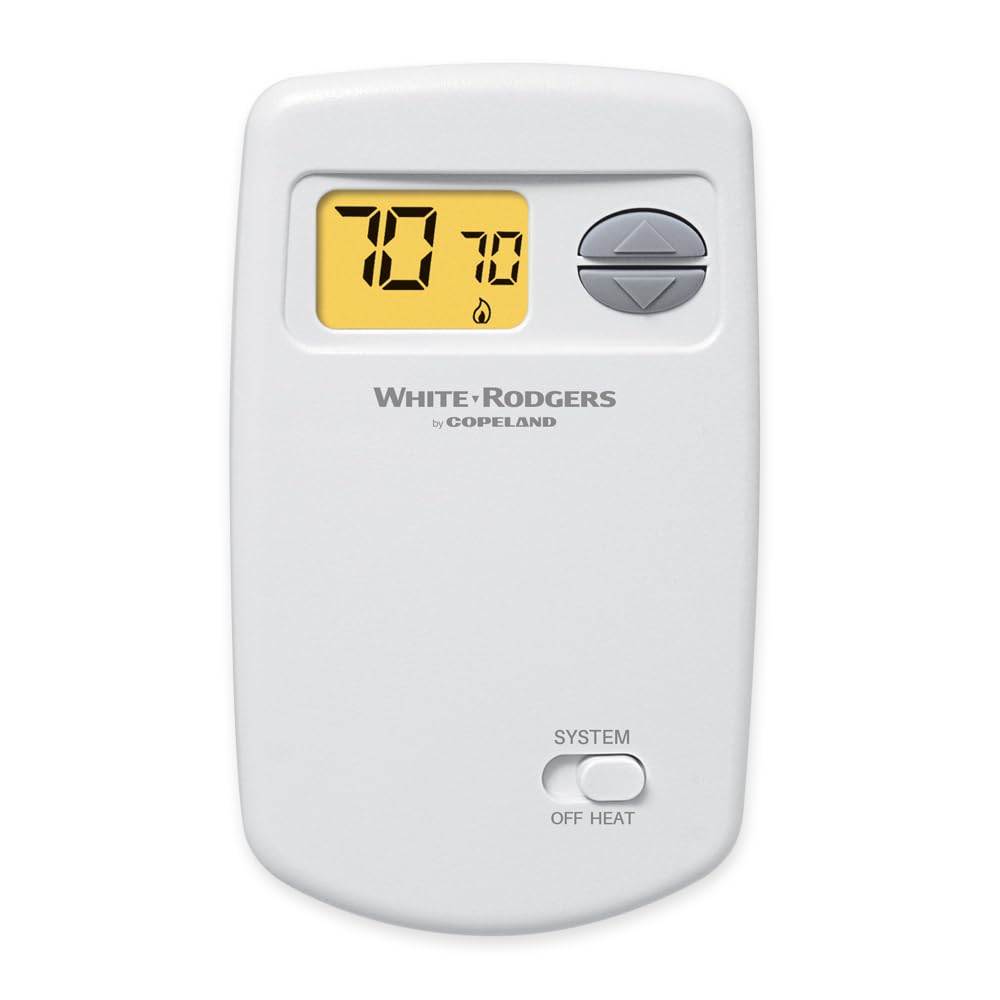
Type: Non-programmable
Series: 70 Series Classic
Control: Manual
Price Tier: Budget
White-Rodgers 70 Series Classic, Non-Programmable, Thermostat, 1E78-140 — a classic mechanical thermostat that has been the standard replacement part in simple heating circuits for decades. The 70 Series design uses a straightforward bimetal-style control with a small temperature dial, and the unit is built to drop into an existing wall plate with minimal fuss. There is no programming, no digital display and no battery to think about. For a caravan with a basic heater circuit, that simplicity is a genuine advantage.
This pick suits the owner replacing a failed thermostat in an older caravan where the wiring is simple and the goal is a working heater before the weekend. The trade-off is accuracy: a classic mechanical stat swings a few degrees either side of the set point, so the caravan will run slightly warm, then slightly cool, rather than holding a tight band.
Check the current price on Amazon
3. Honeywell Home RLV4305A1000 5-2 Day Programmable Thermostat

Type: Programmable, 5-2 day
Application: Electric baseboard heaters
Control: Digital with schedule
Price Tier: Mid-range
Honeywell Home RLV4305A1000 5-2 Day Programmable Thermostat Electric Baseboard Heaters — a digital programmable stat made for electric baseboard heating, which is the most common heating setup in static caravans. The 5-2 day format lets the owner set one schedule for weekdays and another for the weekend, so the caravan can be warm on arrival and cooler while empty. A digital display shows the set temperature and the schedule, and the unit is designed to mount where the old baseboard stat sat.
This is the pick for a full-season resident or a regular weekend user on electric panel heaters who wants a schedule rather than a dial. The trade-off is the 5-2 format itself: it cannot give every day its own program, so a household with an irregular week will find the schedule only partly useful, and the digital interface takes a few minutes to learn.
Check the current price on Amazon
4. Honeywell Home RLV3120A1005 Digital Non-Programmable Thermostat

Type: Digital, non-programmable
Application: Electric heat only
Control: Digital with buttons
Price Tier: Mid-range
Honeywell Home RLV3120A1005 Digital Non-Programmable Thermostat for Electric Heat Only — a digital stat for electric heating only, which means it is built for the resistive loads of baseboard panels and similar electric heaters rather than gas systems. The digital control holds a set temperature more tightly than a mechanical dial and shows the reading on a small display, while the button interface is simple enough to set once and leave. It mounts in place of an existing wall stat and needs no schedule to operate.
This pick suits the owner who wants better temperature control than a dial gives but does not want to program a schedule, and it is a sensible midpoint between the budget mechanical stats and the programmable model. The trade-off is that it is electric-heat only: a caravan with a gas or LPG heater cannot use it, and there is no setback or timer, so the heater runs to the same set point whether the caravan is occupied or empty.
Check the current price on Amazon
5. Programmable Thermostat for Radiant Underfloor Heating

Type: Programmable, dual sensing
Application: Radiant underfloor heating mats
Sensing: Air and floor sensor
Voltage: 120/240V AC
Safety: Built-in Class A GFCI
Power: 3600W
Price Tier: Premium
Programmable Thermostat for House Radiant Underfloor Heating, Home Heat Floor Mat Controller self-Adaption AC(120/240V) Voltage, Dual Sensing(Air&Floor Sensor) Built-in Class A GFCI, Power 3600W — the specialist pick for a caravan or annex with electric underfloor heating mats. It reads both air temperature and floor temperature through a dual sensor, so the floor warms to a set level without the air overheating, and the self-adaption function learns how quickly the floor responds. The built-in Class A GFCI adds ground-fault protection at the stat, and the 120/240V AC input with 3600W capacity covers a typical caravan floor mat circuit. A programmable schedule rounds it out.
This is the pick for an owner who has fitted, or is fitting, underfloor heating in a caravan and needs a controller that understands a floor sensor rather than just air temperature. The trade-off is complexity and cost: it is the most expensive control here, it needs the floor sensor wired in correctly, and it is the wrong choice for a caravan with baseboard panels or a gas heater.
Check the current price on Amazon
Before You Buy
- Heat source: Match the control to the heater — millivolt stats for gas and LPG, electric-only stats for baseboard panels, and a floor-sensing stat for underfloor mats. The wrong pairing will not work, however good the thermostat.
- Wiring: Check how many wires the existing stat uses and whether the circuit is mains or millivolt before ordering, because a two-wire millivolt stat and a mains electric stat are not interchangeable.
- Programming: Decide whether a schedule is wanted. A 5-2 day model suits a regular weekly pattern; a non-programmable digital stat suits an owner who sets a temperature and leaves it.
- Sensor type: For underfloor heating, confirm the controller reads a floor sensor as well as air, otherwise the floor can overheat while the air stays cold.
- Safety: A built-in GFCI is worth having on any electric floor heating circuit in a caravan, where damp and movement are constant factors.
- Mounting: Measure the old wall plate and confirm the replacement covers it, since caravan walls are thin and patching is awkward.
Frequently Asked Questions
-
What is the best heating control for a static caravan?
For most caravans with electric baseboard heating, the Honeywell Home RLV4305A1000 is the best all-round choice because it adds a 5-2 day schedule to a standard baseboard circuit. Owners with gas or LPG heaters should look at the millivolt CT33A1009/E1 instead. -
Can a home thermostat be used in a static caravan?
Often yes, provided it matches the heat source and voltage. The key is compatibility: an electric-only stat will not run a millivolt gas heater, and a millivolt stat will not switch a mains electric baseboard circuit. -
Is a programmable thermostat worth it in a caravan?
It is worth it for regular weekend users and full-season residents, because a schedule warms the caravan before arrival and saves energy while it is empty. Occasional users who visit unpredictably get less from one. -
What does dual sensing mean on an underfloor thermostat?
Dual sensing means the thermostat reads both the air temperature and the floor temperature through separate sensors. That lets it cap the floor temperature while still heating the room, which is safer and more comfortable than air-only control. -
Do caravan thermostats need a battery?
Some do and some do not. Millivolt models typically draw power from the heater circuit and need no battery, while many digital and programmable models use batteries to hold the schedule and display. Check the model before buying. -
What size thermostat is needed for underfloor heating?
The power rating matters more than physical size. The underfloor controller here is rated to 3600W, which covers a typical caravan floor mat circuit, but the mat’s total load should be checked against the stat’s rating before installation.
Bottom Line
For most static caravan owners on electric baseboard heating, the Honeywell Home RLV4305A1000 is the best heating control for a static caravan: it brings a weekday and weekend schedule to the most common caravan heating setup at a mid-range price. Owners with older gas or LPG heaters should take the millivolt CT33A1009/E1, and anyone running underfloor mats should go straight to the dual-sensing floor controller.
