Why there are Amazon links here: Brave Review is paid a commission for qualifying Amazon purchases made through the links below. Your price does not change, and using our links is entirely optional. How this works
Best Humidity Sensor for Mould Prevention: 5 Picks That Catch Damp Early
Mould needs sustained high humidity to take hold, so the best humidity sensor for mould prevention is one that alerts before a room stays damp for days. This roundup covers five options, from a cheap standalone gauge to a Wi-Fi system and a controller that actually switches a dehumidifier on. It suits renters watching a single bedroom, homeowners protecting a basement or cellar, and growers running a greenhouse or mushroom setup. The overview table below shows each pick’s key spec, best use and price tier at a glance.
The Picks at a Glance
| Product | Key Spec | Best Use | Price Tier |
|---|---|---|---|
| TempPro TP50 Digital Hygrometer | Standalone display unit | Low-cost spot checks in any room | Budget |
| Govee H5075 Bluetooth Hygrometer | Bluetooth app, 164ft range | Bedroom and wine cellar tracking | Budget |
| Govee H5074 Mini Humidity Sensor | 262ft range, portable | Greenhouse and incubator monitoring | Budget |
| GoveeLife 2.0 WiFi Hygrometer 3-Pack | Wi-Fi with gateway, 3 sensors | Whole-home and basement coverage | Premium |
| Inkbird IHC200 Humidity Controller | Pre-wired dual-stage outlets | Automating a humidifier or dehumidifier | Mid-range |
1. TempPro TP50 Digital Hygrometer — Best Simple Sensor for Any Room
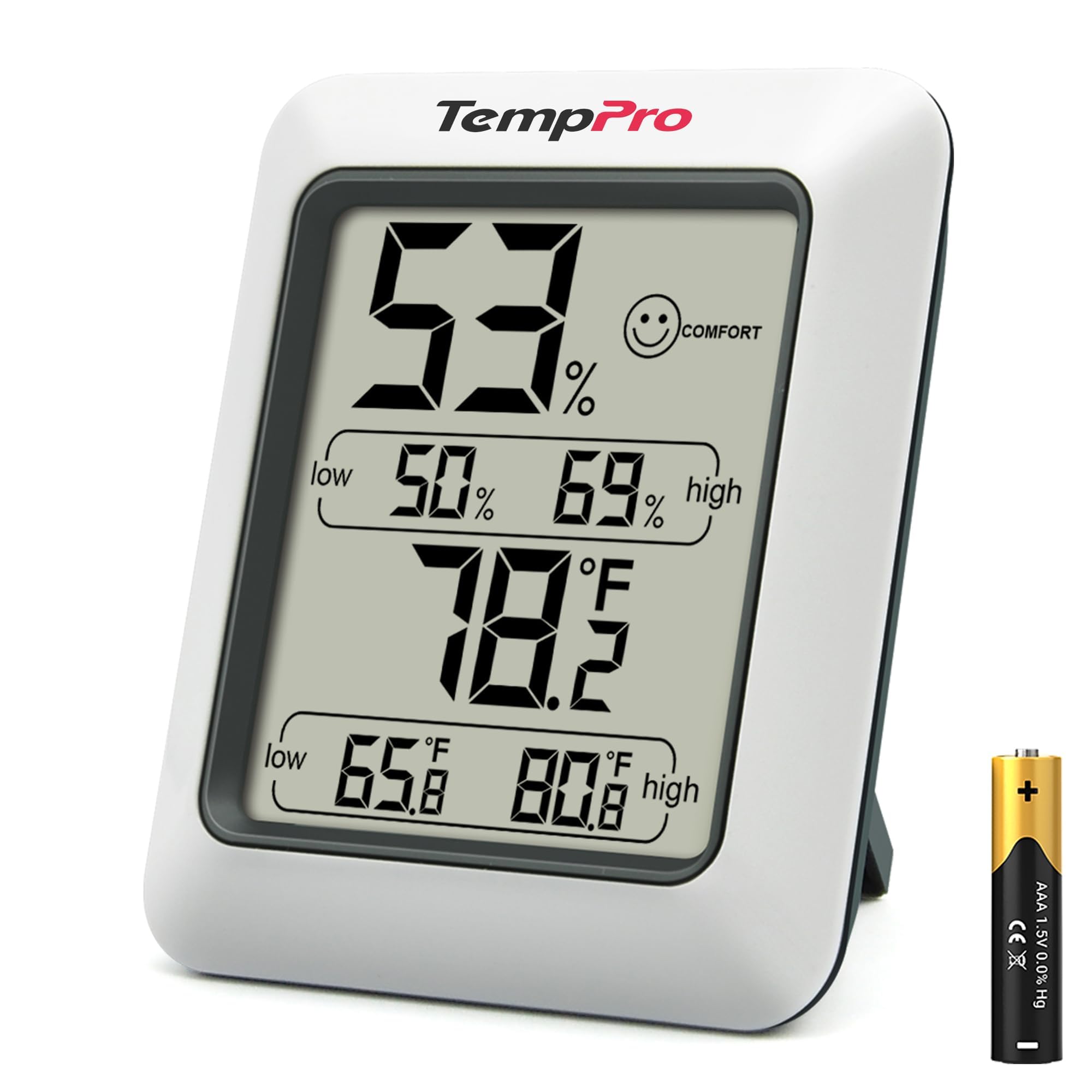
Type: Digital indoor hygrometer and thermometer
Display: LCD readout
Mounting: Freestanding or wall-friendly design
Intended use: House, office, cellar, kitchen, greenhouse, RV
Power source: Battery
Price tier: Budget
This is the simplest tool in the roundup: a small digital unit that shows temperature and humidity on an LCD screen with no app, no pairing and no account. The build is lightweight plastic, the sort of thing that sits on a shelf or counter and gets checked in passing. It covers a wide list of rooms in its name, which tells the story — it is a general-purpose gauge, not a specialist instrument.
It earns its place as the entry point for anyone who has never monitored a room before. A homeowner who suspects a bedroom feels clammy can put this down, read it daily and get a rough picture within a week. Buyers who want alerts pushed to a phone, or a log of how humidity moved overnight, will find it too passive.
Trade-off: A budget display unit gives a reading at the moment it is checked, so it cannot warn about a damp spell that builds while nobody is in the room.
Check the current price on Amazon
2. Govee H5075 Bluetooth Hygrometer — Best for Bedroom and Cellar Tracking

Type: Bluetooth hygrometer and thermometer
Connectivity: Bluetooth app control
Range: 164ft remote monitoring
Data: 2 years of storage with export
Alerts: Smart alerts
Intended use: Bedroom, wine cellar
Price tier: Budget
The H5075 adds a phone app to the basic gauge formula, and that changes what it can do for mould prevention. Readings land on a screen in the app rather than only on the device, the 164ft range means a sensor in a bedroom or cellar can be checked from elsewhere in the house, and the stored history can be exported for a longer view. Smart alerts mean the app can flag conditions rather than waiting for someone to look.
This is the pick for a buyer who wants a record rather than a glance. A cellar owner can see whether humidity climbs after rain, and a bedroom user can check whether a damp patch correlates with overnight readings. It is a single-sensor device, so it monitors one location, and the app connection is Bluetooth rather than Wi-Fi — checks happen when in range, not from anywhere.
Trade-off: Bluetooth-only coverage means alerts depend on being within range of the sensor, so it is a poor fit for monitoring a remote property.
Check the current price on Amazon
3. Govee H5074 Mini Humidity Sensor — Best Portable Sensor for Greenhouse and Incubator

Type: Bluetooth thermometer and hygrometer
Range: 262ft
Data: 2-year export
Sensor: Precision sensor
Portability: Mini, portable design
Alerts: Temperature and humidity alerts
Intended use: Greenhouse, incubators
Price tier: Budget
The H5074 is the compact sibling of the H5075, built around a mini body that can be dropped into a tray, hung near a seedling bench or tucked beside an incubator. Its longer 262ft range suits a greenhouse at the end of a garden better than a short-range unit would, and the precision sensor is aimed at growers who care about tight swings rather than rough averages.
It fits the buyer running a small growing setup where humidity drives mould on leaves, trays or walls. The portable format means one sensor can move between a greenhouse in summer and a propagator in spring. Buyers who want permanent whole-home coverage will find a single mini sensor too limited, and the app is again Bluetooth-based.
Trade-off: The mini format is built for portability rather than permanence, so it is easy to misplace and offers no mounting hardware beyond what the small body allows.
Check the current price on Amazon
4. GoveeLife 2.0 WiFi Hygrometer with Gateway — Best Whole-Home System
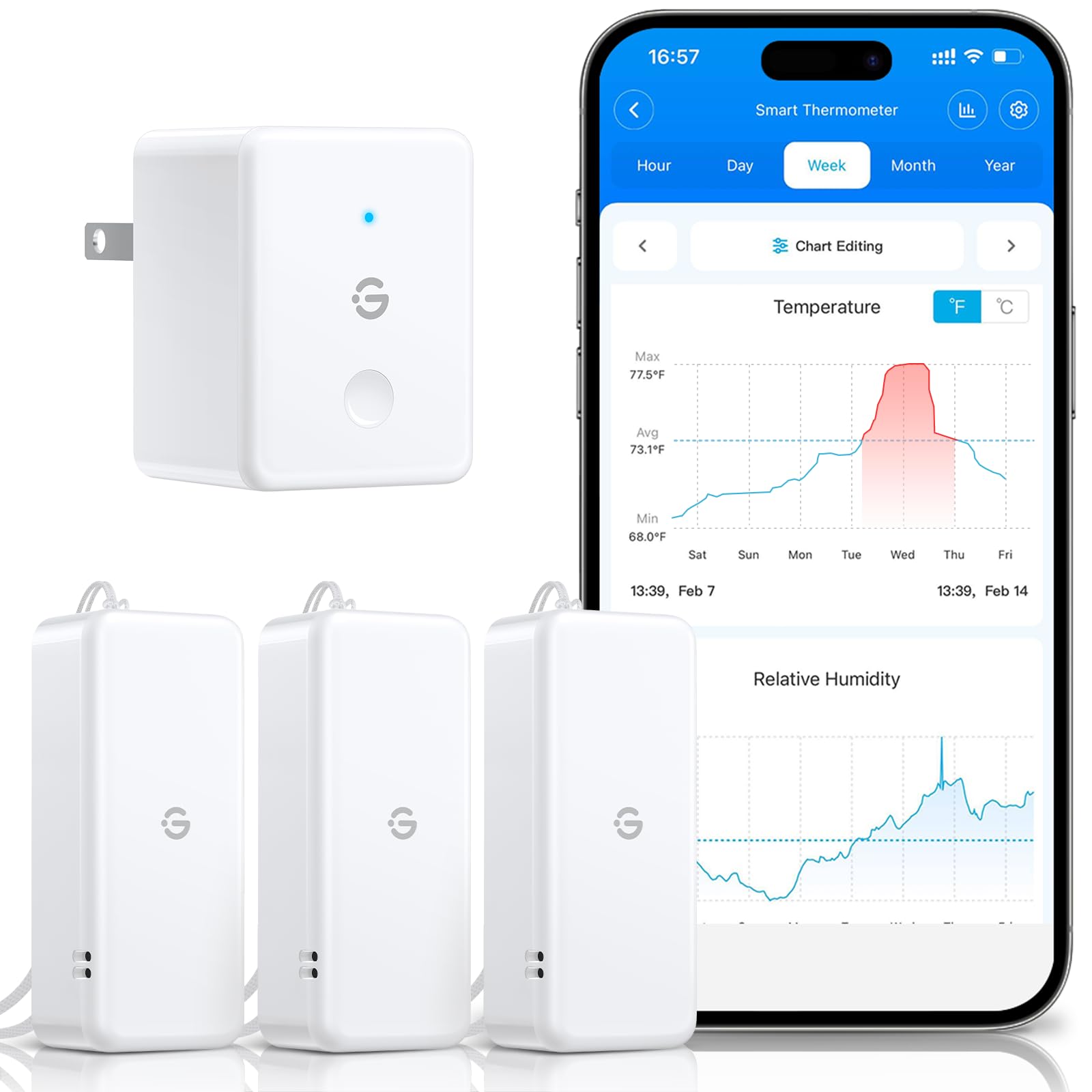
Type: Wi-Fi hygrometer and thermometer system
Connectivity: 2.4G Wi-Fi with included gateway
Sensors: 3 mini sensors
Data: 2-year data storage
Power: Battery
Alerts: App alerts
Intended use: Wine cellar, bedroom, basement
Price tier: Premium
This is the only pick here that connects over Wi-Fi, and the gateway is what makes it work: the sensors talk to the gateway, and the gateway puts readings on the home network so alerts arrive wherever the phone is. Three mini sensors ship in the box, which is the real argument — a basement, a bedroom and a cellar can all be watched from one app instead of moving a single unit around.
It suits the homeowner who wants coverage rather than a single data point, especially where a damp basement is the main worry and the phone is often away from home. The Wi-Fi requirement is 2.4G only, which matters for anyone on a mesh or 5GHz-first network, and the three-sensor bundle costs more than the budget options by a wide margin.
Trade-off: The system depends on a 2.4G Wi-Fi network and the gateway staying powered, so setup is more involved than a standalone gauge and the price reflects the multi-room bundle.
Check the current price on Amazon
5. Inkbird IHC200 Humidity Controller — Best for Automating a Dehumidifier

Type: Pre-wired humidity controller (humidistat)
Outlets: Dual stage, pre-wired
Devices controlled: Humidifier and dehumidifier
Intended use: Mushroom growing, greenhouse
Price tier: Mid-range
The IHC200 is a different class of device: instead of only reporting humidity, it switches equipment on and off to hold a target. The pre-wired dual-stage outlets accept a humidifier and a dehumidifier, so the controller can push humidity up or pull it down without anyone touching a dial. That makes it the strongest mould-prevention pick for a space where damp is a recurring problem rather than an occasional one.
It suits growers and greenhouse owners who already run humidifiers or dehumidifiers and want them to respond to conditions automatically. A homeowner fighting basement damp could pair it with a dehumidifier and let the controller do the switching. It is not a monitoring tool — there is no app, no history and no remote alert — so buyers who want to see a trend should look at the Wi-Fi pick instead.
Trade-off: This is a controller, not a monitor, so it offers no data logging or phone alerts and requires compatible plug-in equipment to do anything useful.
Check the current price on Amazon
Before You Buy
- Alerting: A display-only gauge requires someone to check it; app alerts and Wi-Fi systems flag rising humidity without a visit.
- Connectivity: Bluetooth sensors work in range of a phone, while Wi-Fi systems need a 2.4G network and a gateway.
- Coverage: One sensor watches one room, so a basement plus bedroom plus cellar needs a multi-sensor pack.
- Automation: A controller can run a dehumidifier automatically, but only if the buyer already owns compatible equipment.
- Data history: Exportable logs help spot patterns over weeks, which matters more for mould prevention than a single reading.
- Placement: Sensors need to sit where air moves freely, away from direct sun and radiators, or readings drift.
Frequently Asked Questions
-
What humidity level should a sensor show to prevent mould?
Mould struggles to establish when indoor humidity stays below roughly 60 percent, so a sensor that flags sustained higher readings in a room is doing its job. -
Is a cheap gauge enough for mould prevention?
A budget gauge is enough to spot a problem room, but it cannot alert when nobody is present, which is when damp spells often build unnoticed. -
Do these sensors need Wi-Fi?
Only the GoveeLife 3-pack uses Wi-Fi. The TempPro is standalone, and the two Govee mini sensors use Bluetooth with a phone in range. -
Can a humidity sensor turn on a dehumidifier?
A sensor alone cannot, but the Inkbird IHC200 controller switches a plugged-in dehumidifier or humidifier automatically to hold a target level. -
Where should a sensor be placed in a damp room?
Mid-room at sitting height, away from windows, radiators and direct sunlight, gives the most representative reading of the air that walls and furniture actually sit in. -
How many sensors does a house need?
One per problem area is the practical rule — a basement, a bedroom and a cellar each behave differently, which is why the three-sensor pack suits whole-home coverage.
Bottom Line
For most buyers, the GoveeLife 2.0 WiFi Hygrometer with Gateway is the best humidity sensor for mould prevention because three sensors and Wi-Fi alerts cover the rooms where damp actually starts. Buyers on a tight budget who only need one room should start with the TempPro TP50, and anyone ready to automate a dehumidifier should go straight to the Inkbird IHC200.
