Why there are Amazon links here: Brave Review is paid a commission for qualifying Amazon purchases made through the links below. Your price does not change, and using our links is entirely optional. How this works
Best Leak Sensor for a Downstairs Toilet With No Socket
A downstairs toilet usually has no spare outlet, no easy wiring route, and no one watching it for hours at a time. That makes battery-powered, self-contained leak alarms the practical answer, and this article covers five of them. The picks suit three kinds of buyer: the renter who wants a cheap set-and-forget puddle alarm, the homeowner who wants a phone alert from another floor, and the multi-bathroom household that needs several sensors at once. The overview below puts the key differences side by side so a choice can be made in under a minute.
Overview of the Picks
| Product | Key Spec | Best Use | Price Tier |
|---|---|---|---|
| 6000 Toilet Leak Detector | Toilet-specific, no tools required | Running and leaking toilets | Mid |
| Flood Buzz 12-Pack | 12 reusable alarms, no setup | Whole-house coverage on a budget | Mid |
| Zircon Leak Alert | 90 dB alarm, no setup | Single spot near a fixture | Budget |
| YoLink Water Leak Sensor 1 | App, email and SMS alerts, hub required | Remote monitoring | Budget (plus hub) |
| 5 Pack Water Leak Detectors | 100 dB alarm, 5-pack | Bathroom, kitchen and laundry | Budget |
6000 Toilet Leak Detector

Type: Toilet-mounted leak and running-toilet detector
Power source: Battery, no socket required
Installation: Seconds, no tools required
Alerts: Visual and audible
Coverage: Leaks, running toilets and other high-water-bill problems
This is the only pick designed around the toilet itself rather than around the floor. It watches for the two failures that drive most downstairs water bills: a slow leak around the base and a flapper that never quite seats, so the cistern refills all night. Installation needs no tools and no outlet, which is exactly what a downstairs cloakroom with a single light circuit can offer. The alerts are both visual and audible, so a glance on the way past is enough for most days. It suits a household with one problem toilet and no appetite for apps.
Trade-off: It is a single-fixture device at a mid-tier price, so covering a second bathroom means buying a second unit, and the audible alert only helps when someone is home to hear it.
Flood Buzz Water Leak Alarms, Small Model, 12-Pack

Type: Standalone battery water alarm
Pack size: 12 alarms
Setup: None required, patented design
Placement: Under sink, toilet, basement, RV, water heater, dishwasher
Reusability: Reusable after drying
Twelve independent alarms in one box is the simplest way to blanket a house that has several risk points and no wiring anywhere near them. Each unit is a small standalone puck that needs no setup, no hub and no app, so one can sit behind the downstairs toilet and the rest can go under the kitchen sink, beside the water heater and in the basement. The reusable design means a unit that gets splashed during a mop can be dried out and put back to work. It suits landlords, large families and anyone who would rather buy coverage in bulk than think about placement twice.
Trade-off: A twelve-pack is overkill for a single downstairs toilet, and standalone alarms only shout — nobody gets a phone notification while out of the house.
Zircon Leak Alert Water Leak Detector
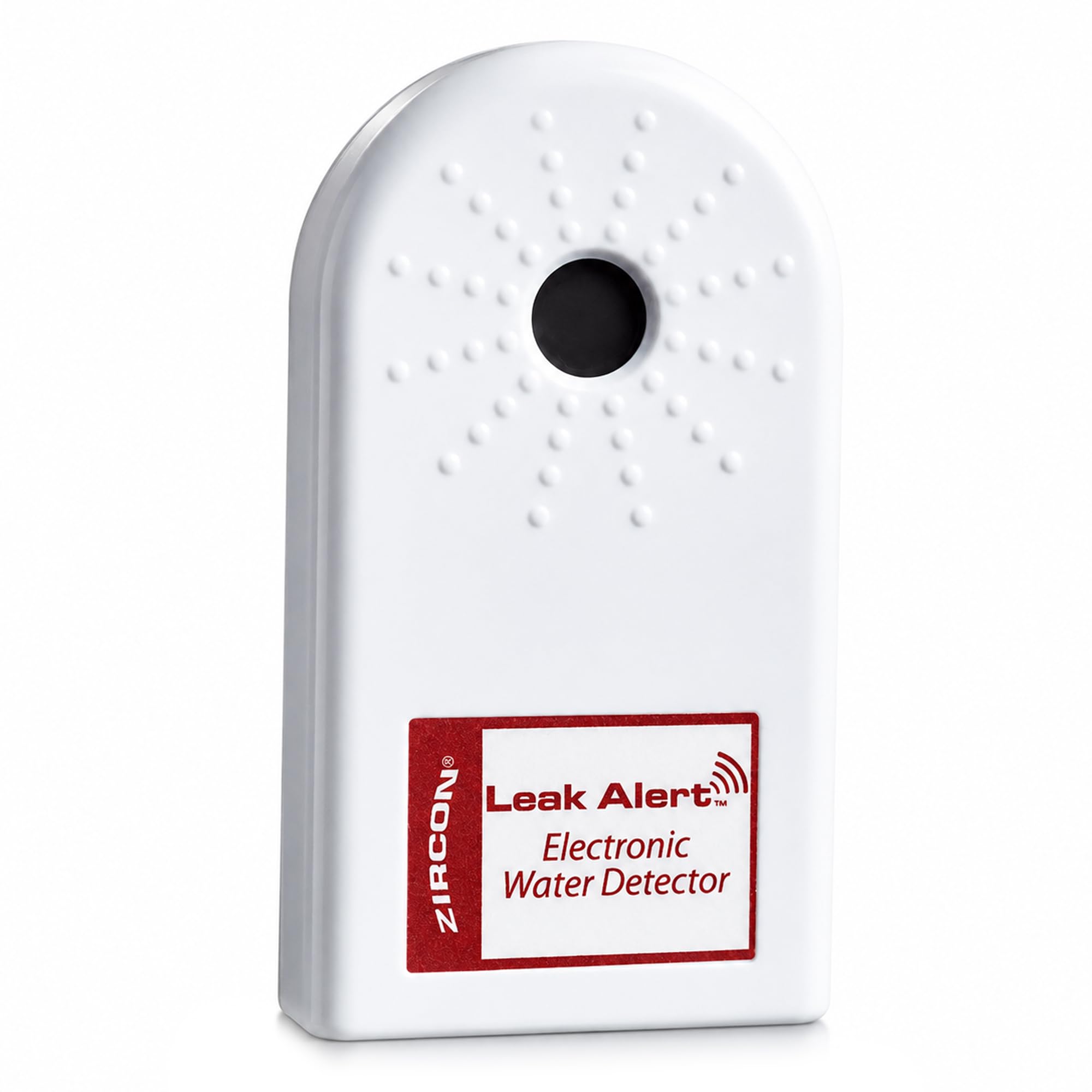
Type: Standalone water leak detector
Alarm: 90 dB
Setup: None required
Placement: Water heaters, appliances, plumbing fixtures
Power source: Battery, no socket required
The Leak Alert is the budget single-spot option: one small detector, one loud 90 dB alarm, no setup and no wiring. It is built for exactly the placement a downstairs toilet needs — on the floor beside the pan or under the supply valve, where a slow drip will eventually pool. The 90 dB rating is loud enough to carry through a hallway and up a stairwell in a typical house. It suits a buyer who wants one reliable alarm at one known risk point and does not want to pay for a connected system.
Trade-off: It covers one small area, so a leak that runs along a joist or pools at the far end of the room may never reach the contacts, and there is no remote notification of any kind.
YoLink Water Leak Sensor 1, YS7903

Type: Smart water leak sensor
Alerts: Mobile app, email and SMS
Battery life: Up to 5 years
Protocol: LoRa YoLink, range up to 2034 feet
Hub: Required
This is the pick for a downstairs toilet in a house where nobody is home during the day. Alerts arrive by app, email and SMS, so a burst supply line announces itself instead of quietly soaking the ceiling below. The LoRa protocol is built for long range and penetration through floors and walls, which is what makes a basement or ground-floor cloakroom reachable from a hub upstairs. Battery life is rated at up to five years, so the lack of a socket genuinely does not matter. It suits owners who already run a smart home or are willing to add a hub for peace of mind.
Trade-off: The hub is sold separately and is mandatory, so the true entry cost is higher than the sensor alone, and a Wi-Fi outage or dead hub silences the remote alerts that justify the price.
5 Pack Water Leak Detectors for Home

Type: Standalone water sensor alarm
Pack size: 5 detectors
Alarm: 100 dB
Placement: Pipe, drain, sink, faucet, bathroom, kitchen, toilet, laundry room, basement
Power source: Battery, no socket required
Five 100 dB alarms for roughly the price of two premium singles makes this the value pick for a household with several wet rooms. The set covers the downstairs toilet, the upstairs bathroom, the kitchen sink cabinet, the washing machine and the basement corner without any wiring, hub or app. At 100 dB the alarm is loud enough to be heard from another floor in most homes. It suits a first-time buyer who wants broad coverage quickly and does not need remote alerts.
Trade-off: These are dumb alarms with no app and no differentiation between units, so a triggered alarm tells someone water is somewhere but not which of the five rooms to check first.
Before You Buy
- Power source: Confirm the sensor runs on batteries and needs no outlet, since a downstairs toilet rarely has a spare socket.
- Alert type: Decide between a local audible alarm and app, email or SMS alerts; the second type needs a hub and home Wi-Fi.
- Coverage area: A single sensor protects one small pool of floor, so measure how far water could travel before choosing a count.
- Placement surface: Flat tile or vinyl lets water pool and reach the contacts; a sloping or heavily grouted floor can channel it away.
- Hub compatibility: Smart sensors require the manufacturer’s own hub, which is a separate purchase and a separate power point.
- Reusability: Sensors that can be dried and reused suit homes prone to mopping and minor spills.
- Pack size: Buying a multi-pack is cheaper per unit but only makes sense if there are enough risk points to place them all.
Frequently Asked Questions
-
Do leak sensors need a socket?
No. Every pick here runs on batteries, which is why they suit a downstairs toilet with no outlet. The only extra power draw is the hub on the YoLink option, and that can live anywhere with a free socket. -
Will a leak alarm work through a closed door?
A loud alarm in the 90 to 100 dB range usually carries through a standard internal door and up a stairwell. A closed, solid door plus background noise such as a washing machine can mask it, which is where app alerts help. -
Is a smart sensor worth it without a hub?
No. The YoLink sensor needs its hub to send app, email and SMS alerts, so the hub is part of the purchase decision, not an optional extra. -
How many sensors does one downstairs toilet need?
One is usually enough if it sits in the lowest point near the pan and supply valve. Two make sense where the room is large or the pipework runs along a wall away from the toilet. -
Can these alarms be reused after they get wet?
Standalone puck-style alarms generally can be dried out and returned to service. A sensor that has been submerged in dirty floodwater should be inspected before being trusted again. -
Where exactly should the sensor sit?
On the floor, close to the toilet base and the supply valve, on a flat patch where water would naturally collect. Avoid spots directly under a drip where splashes from cleaning will set it off falsely.
Bottom Line
For a downstairs toilet with no socket, the 6000 Toilet Leak Detector is the strongest single choice: it needs no tools, no wiring and no hub, and it watches the toilet itself rather than just the floor around it. Buyers who want alerts on their phone should step up to the YoLink sensor and budget for the hub, while anyone covering several rooms gets better value from a multi-pack.
