Why there are Amazon links here: Brave Review is paid a commission for qualifying Amazon purchases made through the links below. Your price does not change, and using our links is entirely optional. How this works
Best Leak Sensor for a Static Caravan: 5 Smart and Simple Picks
A static caravan spends long stretches empty, often through freezing weather, and a slow drip under the sink or a burst pipe behind the paneling can do serious damage before anyone notices. The right leak sensor depends on how the van is used: owners who leave it unattended for weeks want remote alerts to a phone, while seasonal residents and site owners often prefer a loud local alarm that works without Wi-Fi. This shortlist covers both approaches, plus a cable model for awkward spaces. The overview below lines up all five so a reader can pick in under a minute.
Overview of the Picks
| Product | Key Spec | Best Use | Price Tier |
|---|---|---|---|
| GoveeLife 5-Pack Ultra-Long Range | 1804 ft range, IP67, 5-year battery | Whole-van coverage with phone alerts | Mid |
| YoLink 4-Pack + Hub | LoRa up to 2034 ft, 5-year battery, IFTTT | Remote monitoring on large or spread-out sites | Premium |
| 120dB Flood Alarm 3-Pack | 120 dB, 37.8 in cable, battery operated | Loud local warning, no app needed | Budget |
| GoveeLife 1-Pack with Cable | Wi-Fi, IP66, 4.92 ft cable | One tight spot such as under a sink | Mid |
| 100dB Water Sensor Alarm 5-Pack | 100 dB, 5-pack, battery operated | Cheap coverage of several drip points | Budget |
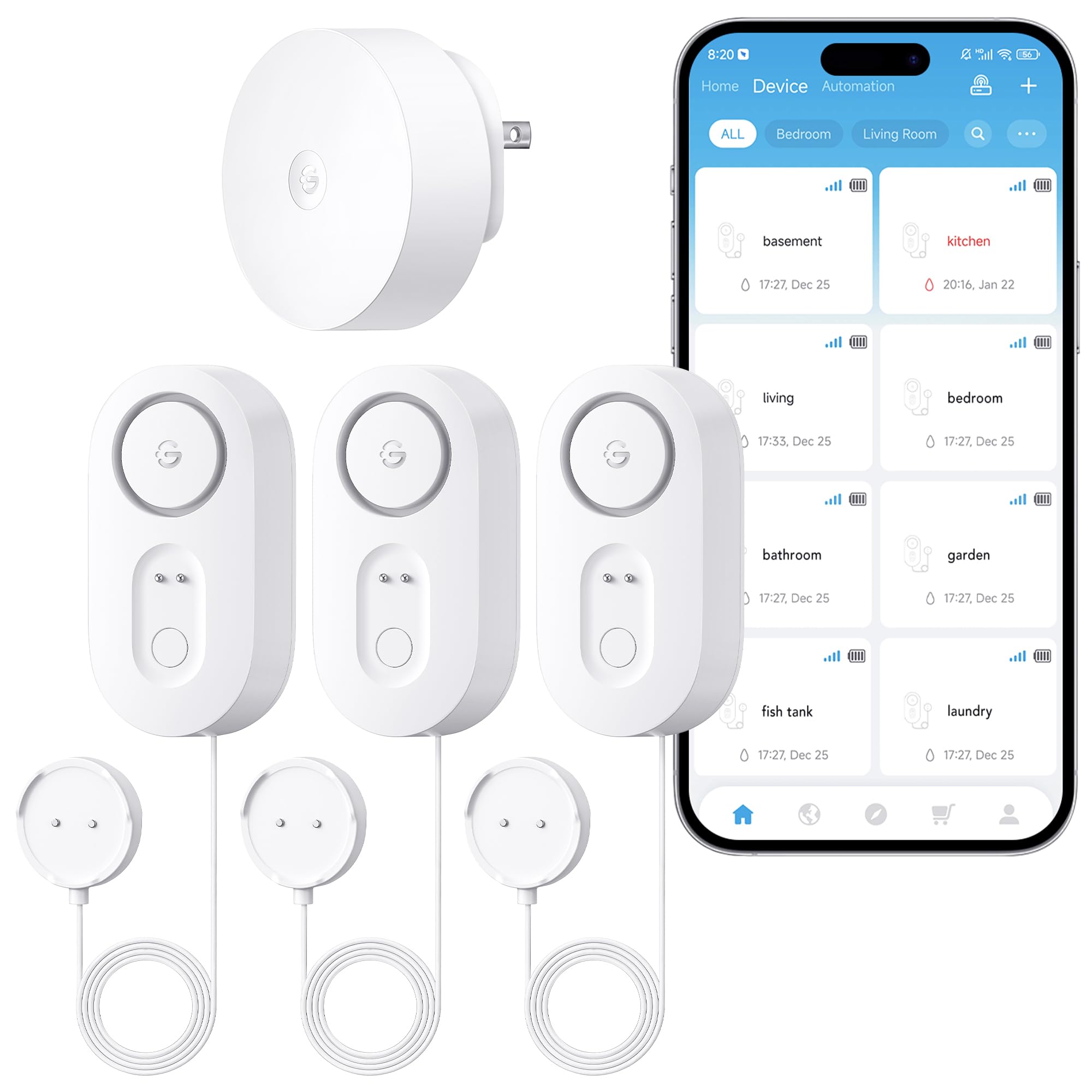
GoveeLife Upgraded Smart Water Leak Detector 5-Pack

Type: Wi-Fi water leak detector, 5-pack
Range: Up to 1804 ft
Battery Life: Up to 5 years
Rating: IP67
Alerts: SMS, email, app push, sound alarm
Best For: Whole-van coverage with remote alerts
This five-pack is built for covering a whole van at once: one sensor under the kitchen sink, one by the water heater, one in the bathroom, and two spare for pipe runs or a storage locker. The IP67 rating means each unit tolerates splashes and damp, which suits a caravan bathroom or a leaky compartment. The long wireless range matters on a static site where the router may sit at the far end of the van, and the five-year battery keeps maintenance to a minimum between seasons. Alerts arrive by app push, SMS and email, so an owner can be hundreds of miles away and still know a pipe has let go.
The trade-off is that this system leans on a Wi-Fi connection and a phone, so it is not the pick for a van with no router or for an owner who wants nothing to do with apps.
YoLink Water Leak Sensor 1 Kit: 4-Pack + Hub

Type: LoRa water leak sensor kit with hub, 4-pack
Protocol: LoRa (YoLink)
Range: Up to 2034 ft
Battery Life: Up to 5 years
Alerts: Mobile app, email, SMS, IFTTT
Best For: Remote monitoring on large or spread-out sites
This kit pairs four sensors with its own hub, and the LoRa radio is the reason it earns a place here. LoRa pushes a signal much further than ordinary Wi-Fi and copes better with the metal cladding and thick walls of a caravan, so sensors reach the hub even from a detached awning or a shed on the same pitch. The five-year battery keeps each unit running for several seasons, and the hub handles the connection so individual sensors stay small and simple. IFTTT support lets an owner tie alerts into other routines, such as a smart plug or a second notification channel.
The trade-off is the hub: it adds a device to power and set up, and it makes this the most expensive route on the list for a buyer who only needs one or two sensors.
120dB Flood Alarm 3-Pack with Cable

Type: Battery-operated flood alarm, 3-pack
Alarm: 120 dB
Cable: 37.8 inches
Power: Battery operated
Best For: Loud local warning without an app
This is the straightforward option: a battery-powered alarm that shrieks at 120 dB the moment water bridges its contacts. No hub, no router, no account — which makes it the natural fit for a van on a site with poor Wi-Fi or for an owner who wants the alarm to work during a power cut. The 37.8-inch cable lets the sensor pad sit right where water would pool while the alarm body stays up on a shelf or bracket, and the three-pack covers the usual suspects: under-sink, water heater and bathroom. It suits seasonal residents who are in the van when a leak starts.
The trade-off is silence when nobody is there: with no remote notification, a leak in an empty van goes unheard until the next visit, so this works best alongside a neighbor or site warden who can respond.
GoveeLife Upgraded Smart Water Leak Detector 1-Pack with Cable
Type: Wi-Fi water leak detector, single unit
Cable: 4.92 ft
Battery Life: Up to 5 years
Rating: IP66
Alerts: SMS, email, app push, sound alarm
Best For: One awkward spot such as under a sink or behind a panel
A single smart sensor makes sense when a van has one known weak point — typically the cupboard under the kitchen sink or the space around the water heater — and no need for a full kit. The 4.92-foot cable is the useful part: the sensor probe can be dropped into a tight corner or behind a panel while the body stays somewhere with a clearer signal. IP66 sealing and a five-year battery mean it can be tucked away and largely forgotten, and the name pairs phone alerts with a local sound alarm so the van itself also makes noise. It suits owners who want app alerts without buying five sensors they will never place.
The trade-off is coverage: one unit protects one spot, so a buyer with several risk areas will spend more buying extras than a multi-pack would have cost.
100dB Water Sensor Alarm 5-Pack

Type: Battery-operated water sensor alarm, 5-pack
Alarm: 100 dB
Quantity: 5 detectors
Best For: Cheap coverage of several drip points
Five simple alarms for roughly the price of one smart sensor is the appeal here. Each unit stands on its own, sounds at 100 dB when water reaches it, and needs no hub or network, so a van can be dotted with them at every pipe joint, drain and tap. The name lists the classic drip points — pipe, drain, sink, faucet, bathroom, kitchen, toilet and laundry — which is exactly the checklist a caravan owner should work through. For a buyer who wants basic early warning on a tight budget, this covers more ground per pound than anything else on the list.
The trade-off is that these are dumb alarms: no phone alerts and a quieter siren than the 120 dB model, so they only help when someone is close enough to hear them.
Before You Buy
- Power source: Battery models suit vans with no permanent mains hook-up and keep working in a power cut; Wi-Fi models need constant power to the router.
- Connectivity: A remote-alert sensor needs a router that stays on when the van is empty; without one, a local alarm is the honest choice.
- Range: Static caravans have thick walls and metal cladding, so check the stated wireless range against the distance from router or hub to the furthest sensor.
- Cable length: A cabled probe reaches under sinks and behind panels where a stand-alone puck will not fit; measure the gap before choosing.
- Water resistance: Damp bathrooms and compartments call for a sealed rating such as IP66 or IP67 rather than a bare indoor unit.
- Number of sensors: Count the risk points first — kitchen sink, water heater, bathroom, shower tray, pipe runs — and buy a pack sized to that list.
- Alarm volume: A 100 dB alarm is audible through a van; 120 dB carries further across a pitch and is the better bet for a large or spread-out layout.
Frequently Asked Questions
-
Do leak sensors work in a caravan with no Wi-Fi?
Yes, if they are the local alarm type. Battery-powered models sound a siren on their own and need no network, while smart sensors that push alerts to a phone require a router that stays powered on. -
Where should sensors go in a static caravan?
The usual spots are under the kitchen sink, beside the water heater, in the bathroom and shower area, and along visible pipe runs. Cabled probes help in cupboards too tight for a stand-alone unit. -
Will a leak sensor survive a freezing winter in an empty van?
A sealed, battery-operated sensor generally copes with cold better than a mains-powered smart unit, but batteries weaken in low temperatures. The bigger protection is catching the leak early, which is exactly what these devices do. -
How long do the batteries last?
The smart models here state up to five years, and the local alarms run on standard batteries that are easy to swap at the start of each season. Check and replace them as part of the annual pre-season routine. -
Is a five-pack overkill for one caravan?
Not necessarily. A van has several risk points, and spare sensors can cover a storage locker or awning. A single smart sensor with a cable is the better fit when there is only one known weak spot. -
Can these sensors be used in a touring caravan too?
Yes. The battery-operated alarms travel well and need no setup, while the smart kits work anywhere with a stable Wi-Fi connection and a powered hub.
Bottom Line
For most static caravan owners the GoveeLife 5-Pack Ultra-Long Range is the best leak sensor for a static caravan: five sealed sensors cover every likely leak point, the long range copes with thick caravan walls, and phone alerts reach an owner wherever they are. Buyers on a large site with a detached awning should look at the YoLink kit for its LoRa reach, and anyone without Wi-Fi is best served by the 120 dB local alarm.
