Why there are Amazon links here: Brave Review is paid a commission for qualifying Amazon purchases made through the links below. Your price does not change, and using our links is entirely optional. How this works
Best Lighting Automation for a Morning Routine for a Gentle, Automatic Wake-Up
Waking up to a dark room is one of the most common reasons a morning routine falls apart. The best lighting automation for a morning routine fixes that by turning lights on before the alarm, fading them up gradually, or syncing them to sunrise so the body gets a light cue instead of a jolt. This roundup covers five picks for three kinds of buyers: renters who want a cheap plug-and-play fix, smart-home tinkerers building a full system, and anyone who wants a dedicated bedside device that handles light and sound together. The overview table below shows each pick at a glance, and every product block explains who it suits and where it falls short.
The 5 Best Lighting Automation Picks Compared
| Product | Key Spec | Best Use | Price Tier |
|---|---|---|---|
| Philips Hue Bridge | Smart lighting hub, Matter-compatible | Whole-home automation backbone | Mid |
| Philips Hue Essential Starter Kit | Bridge + 4 E26 smart bulbs | Full color wake-up system in one box | Mid |
| GHome Smart Plug Timer | 2.4GHz WiFi, no hub required | Budget lamp automation for renters | Budget |
| WiZ Connected LED Smart Bulb | Sunset-to-sunrise automation, Matter | Single-room gradual wake-up | Budget |
| Hatch Restore 3 | Sunrise light + 80+ sleep sounds | Screen-free bedside routine | Premium |
The table splits neatly into two approaches. The Hue picks build a lighting system that can run the whole house, while the GHome plug, the WiZ bulb and the Hatch each solve the morning problem with a single device. Price tier matters less than fit here: a budget plug can wake a bedroom lamp just as reliably as a hub-driven system, it just cannot do as much afterward.
Philips Hue Bridge

Type: Smart lighting hub
Compatibility: Voice assistants and Matter
Core function: Multi-room control, zones, automations
Out-of-home control: Yes
Price Tier: Mid
This is the brain rather than the light. The Hue Bridge is a small mains-powered hub that connects Hue bulbs and lamps to the network, and it is what unlocks multi-room control, zones and scheduled automations that run without a phone in the room. A morning routine can be built as a scene that fades specific rooms up at specific times, and out-of-home control means the schedule still runs when nobody is home to trigger it. It suits buyers who already own or plan to buy Hue bulbs and want the automation layer underneath them.
The catch is that the Bridge on its own produces no light at all. Buyers who pick this up expecting a working morning setup will find they still need bulbs or lamps to go with it, which pushes the real cost higher than the sticker suggests.
Trade-off: It is a hub with no lights included, so it only makes sense for buyers committed to the Hue ecosystem.
Check the Philips Hue Bridge on Amazon
Philips Hue Essential Starter Kit
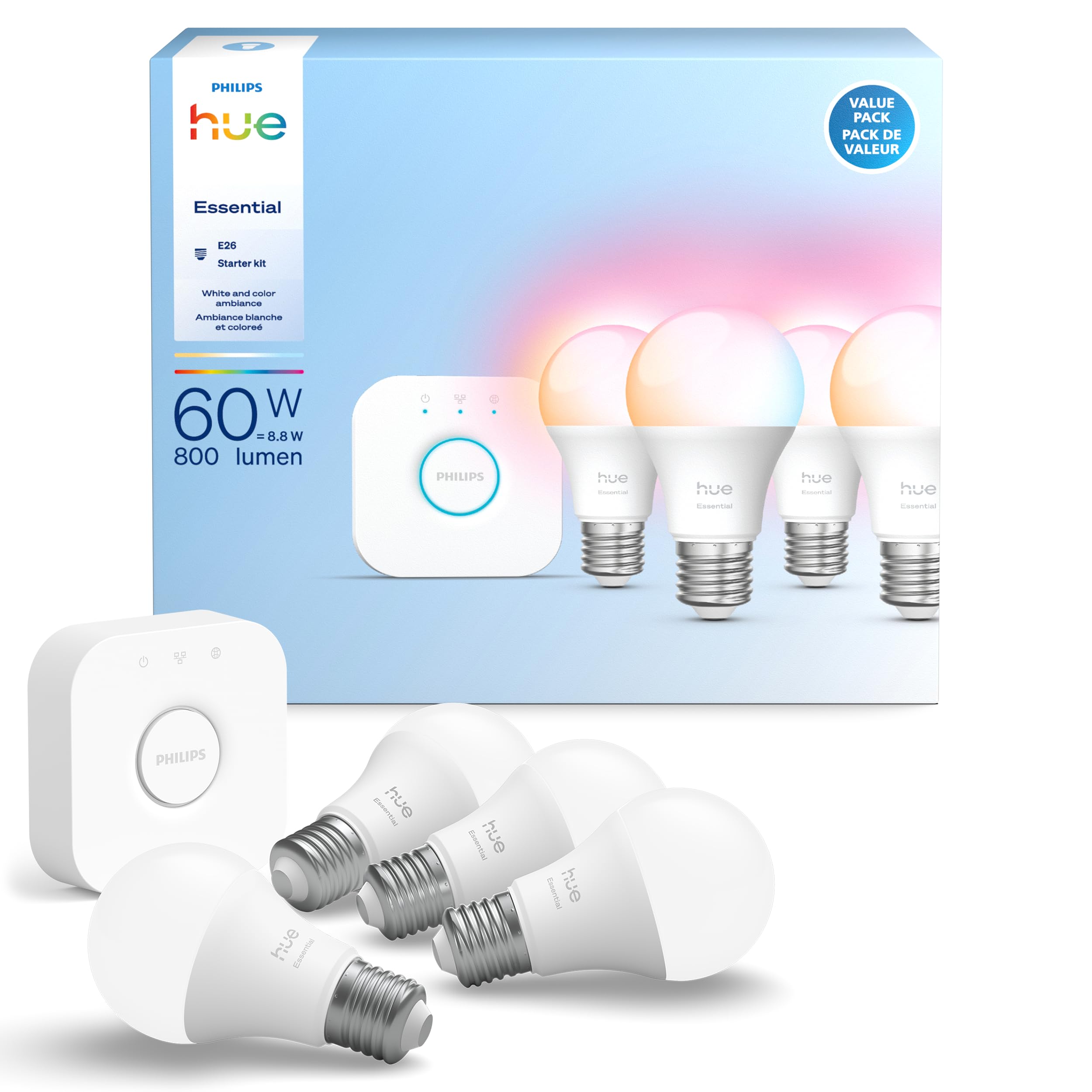
Type: Starter kit (hub + bulbs)
Bulb count: 4
Fitting: E26
Color range: White and color ambiance, 2200K–6500K
Dimmable: Yes
Works with: Alexa, Google, Samsung SmartThings, Apple Home
Price Tier: Mid
This kit bundles the Bridge with four E26 smart bulbs, which makes it the shortcut for anyone who wants a complete Hue morning system in one purchase. The bulbs cover the full white range from warm 2200K to daylight 6500K plus full color, and dimming means a wake-up scene can start almost imperceptibly low and climb. Because the Bridge is included, multi-room schedules and zones work out of the box, and the four bulbs are enough to cover a bedroom plus a hallway or kitchen.
It is the pick for buyers who want the ecosystem without assembling it piece by piece. The limitation is scale: four bulbs cover a small apartment well and a whole house poorly, and expanding later means buying more bulbs at Hue prices.
Trade-off: Four bulbs is a modest starting count for the money, and a larger home will need additional Hue bulbs to finish the job.
Check the Philips Hue Essential Starter Kit on Amazon
GHome Smart Plug Timer

Type: WiFi smart plug with timer
Network: 2.4GHz WiFi only
Hub required: No
Works with: Alexa, Google Home
Certification: ETL, FCC listed
Price Tier: Budget
The simplest route to an automated morning is to automate the lamp already on the nightstand. This GHome plug sits between the outlet and any ordinary lamp, then switches it on and off on a schedule set in the app, with remote control and voice commands as backup. No hub is needed and setup is a matter of pairing it to a 2.4GHz network, which makes it the obvious entry point for renters or anyone unwilling to replace existing fixtures.
The trade-off is granularity. A plug is either on or off, so the wake-up is a lamp clicking on rather than a gradual fade, and the lamp itself has to be a plain switched one rather than a dimmable smart fixture.
Trade-off: It cannot dim or fade, so the morning transition is abrupt compared with a bulb or sunrise device.
Check the GHome Smart Plug Timer on Amazon
WiZ Connected LED Smart Bulb

Type: Smart LED bulb
Fitting: E26, A19
Output: 60W equivalent, 800LM
Color: Full color
Automation: Sunset to sunrise, motion detection
Compatibility: Voice, app, Matter
Price Tier: Budget
One bulb, one socket, one automated morning. The WiZ A19 screws into a standard E26 fixture and brings full color plus built-in sunset-to-sunrise automation, so the light can follow the actual dawn rather than a fixed clock time. Motion detection adds a second layer, and Matter compatibility means it can join a broader smart-home setup later without being locked to one app.
This is the lowest-effort way to test whether light-based waking works before committing to a full system. The honest limitation is coverage: a single 800-lumen bulb is a bedside or small-room solution, and a bedroom that needs several fixtures lit at once will need several of these.
Trade-off: One bulb covers one socket, so a multi-lamp bedroom means buying multiples and grouping them in the app.
Check the WiZ Connected LED Smart Bulb on Amazon
Hatch Restore 3

Type: Sunrise alarm and sound machine
Sound options: 80+ sleep sounds
Lighting: Circadian sunrise light
App: Hatch Sleep App with meditations
Design: Screen-free bedside device
Color: Greige
Price Tier: Premium
The Hatch Restore 3 is the only pick here built for the bedside specifically. It combines a sunrise light that brightens gradually with a library of sleep sounds and guided meditations delivered through the Hatch Sleep App, and the device itself stays screen-free so the morning does not start with a phone. The circadian lighting angle is the point: light rises slowly enough to wake someone gently rather than switching a room from black to bright.
It suits buyers who want one device to own the whole wind-down and wake-up sequence, and who prefer a dedicated appliance over app-controlled bulbs. The cost is the obvious drawback — this sits at the top of the price range, and it does not integrate with a broader lighting system the way the Hue and WiZ picks do.
Trade-off: It is the most expensive pick and works as a self-contained bedside device rather than part of a whole-home lighting setup.
Check the Hatch Restore 3 on Amazon
Before You Buy
- Compatibility: Check which voice assistants and apps a device supports before buying, and confirm whether a hub is required or included.
- Network: Several WiFi devices require a 2.4GHz network specifically, which matters in homes running a single combined network name.
- Bulb fitting: Confirm the socket type — the Hue kit and WiZ bulb use E26, which will not fit bayonet or small Edison fittings.
- Dimming and fading: A smart plug only switches a lamp on and off; gradual wake-ups need a dimmable bulb or a dedicated sunrise device.
- Coverage: Count how many fixtures the morning routine needs lit, since single-bulb and single-plug picks cover one socket each.
- Ecosystem lock-in: Hue bulbs work best with the Hue Bridge, so mixing brands in one schedule adds friction.
- Bedside vs. whole-home: A sunrise alarm owns one room, while a hub-based system scales across the house — pick according to the goal.
Frequently Asked Questions
-
What is the cheapest way to automate morning lights?
A smart plug on an existing lamp is the lowest-cost route, since it requires no new bulbs or hub. The GHome plug covers that job and adds app and voice control. -
Do I need a hub for Hue bulbs?
The Bridge unlocks multi-room control, zones and out-of-home automations. The Essential Starter Kit includes it, while buying the Bridge alone leaves the buyer to source bulbs separately. -
Can smart lights wake someone gradually?
Yes, where the device supports dimming or sunrise simulation. The Hue bulbs dim across their range, the WiZ bulb follows sunset-to-sunrise automation, and the Hatch Restore 3 uses circadian lighting. -
Will a smart plug work with any lamp?
It works with lamps that have a physical on/off switch left in the on position. It cannot dim, so the lamp comes on at full brightness when the schedule fires. -
Is a sunrise alarm better than smart bulbs for a bedroom?
A sunrise alarm keeps everything in one bedside device and avoids phone use first thing. Smart bulbs make more sense when the same system should also light other rooms. -
Does Matter compatibility matter for a morning routine?
It matters for buyers planning to add devices from different brands later. The Hue Bridge and the WiZ bulb both support Matter, which keeps future expansion simpler.
Bottom Line
For most buyers, the Philips Hue Essential Starter Kit is the best lighting automation for a morning routine: it includes the Bridge and four dimmable, full-color bulbs, so a gradual multi-room wake-up works from day one without buying anything else. Renters and budget buyers should start with the GHome smart plug instead, and anyone who wants light and sound handled by one bedside device should go straight to the Hatch Restore 3.
