Why there are Amazon links here: Brave Review is paid a commission for qualifying Amazon purchases made through the links below. Your price does not change, and using our links is entirely optional. How this works
Best Mesh System for a House With Foil Backed Insulation: 5 Picks That Cut Through the Signal Trap
Foil backed insulation is a radiant barrier, and radiant barriers do not care about a router’s feelings. The foil layer reflects heat, and it reflects the radio waves that carry WiFi just as happily — which is why a house wrapped in it can show full bars in one room and nothing two walls over. This roundup covers the best mesh system for a house with foil backed insulation, plus four foil-based products that solve the same problem from the other direction: blocking or redirecting heat and signal where the mesh alone cannot reach. It suits three buyers — the homeowner with a stubborn dead zone, the renovator who wants to fix the thermal side too, and the RV or garage owner dealing with the same foil-lined walls on a smaller scale. The overview below sorts every pick in seconds; the reviews explain the trade-offs.
The Picks at a Glance
| Product | Key Spec | Best Use | Price Tier |
|---|---|---|---|
| NETGEAR Orbi 370 Series WiFi 7 Mesh System, 3 Pack | Up to 5 Gbps, 70 devices, 6,000 sq ft | Whole-home coverage through foil-backed walls | Premium |
| US Energy Products Radiant Barrier Insulation, 1000 sqft | 4 ft wide, perforated, commercial grade | Large attic and roof radiant barrier projects | Mid |
| NASA TECH Perforated Radiant Barrier, 500 sqft | 4 ft x 125 ft roll, perforated | Mid-size attic and house wrap jobs | Mid |
| Double Reflective Bubble Foil Insulation Foam, 23.6 in x 10 FT | Double-sided foil over foam, 23.6 in wide | Windows, garage doors, RV panels | Budget |
| Reflective Window Insulation Foil, 48 in x 10 ft | Double-sided aluminum foil bubble, 48 in wide | Wide window and door coverage | Budget |
1. NETGEAR Orbi 370 Series WiFi 7 Mesh System, 3 Pack

Type: Router plus two satellite extenders
Speed: Up to 5 Gbps
Capacity: 70 devices
Band: Dual-band
Port: 2.5 Gig
Coverage: Up to 6,000 sq ft
Security: Security features included
This is the actual mesh system in a roundup that is otherwise about foil, and it earns the top slot because a foil-backed house is a coverage problem before it is anything else. The Orbi 370 pairs a router with two satellite extenders, and the point of satellites is placement: each one can sit in the room where the signal actually needs to land, past the foil layer that is killing the main router. WiFi 7 and a 2.5 Gig port mean the backhaul between units has headroom, and dual-band operation keeps the whole setup simple to manage through the Orbi app.
The 6,000 sq ft figure assumes open space, and foil-backed walls will eat into it — this is not a magic number, it is a starting estimate. Buyers should plan on one satellite per problem zone rather than trusting the coverage claim as gospel. Setup is app-driven and the security features are baked in rather than sold as an add-on, which matters for a household running 70 devices across phones, TVs, and smart home gear.
Who it suits: Homeowners with a foil-backed house and a dead zone that a single router cannot fix, especially anyone who wants WiFi 7 headroom for the next few years.
Trade-off: The premium price tier buys coverage and speed, but a three-pack is overkill for a small house — and the satellites still need a wired or strong wireless path back to the router to do their job.
Check the current price on Amazon
2. US Energy Products Radiant Barrier Insulation, 1000 sqft

Type: Radiant barrier reflective insulation
Width: 4 ft
Coverage: 1000 sqft
Grade: Commercial grade
Perforation: Perforated, no-tear
Applications: Attic, roof, house wrap, SCIF, RFID
This is the thermal-side answer to the same foil problem. The US Energy Products roll is a commercial-grade radiant barrier with a perforated, no-tear construction — perforation matters because it lets moisture escape rather than trapping condensation against roof decking. At 4 ft wide and 1000 sqft of coverage, it is sized for a real attic or roof project rather than a weekend patch job, and the same material is used in SCIF and RFID shielding contexts, which tells buyers something about how effectively it blocks signal.
For a foil-backed house, the practical use is targeted: lining a garage ceiling, a shed, or an attic space where heat and signal both need managing. It is a barrier, not a mesh replacement, so buyers should not expect it to improve WiFi — it is the thing WiFi has to work around.
Who it suits: Renovators and attic owners who want a large-format radiant barrier and are comfortable cutting and installing a 4 ft roll.
Trade-off: A 1000 sqft commercial roll is a commitment — the upfront cost and storage bulk are real, and a small project will leave most of it unused.
Check the current price on Amazon
3. NASA TECH Perforated Radiant Barrier, 500 sqft

Type: Radiant barrier reflective insulation
Dimensions: 4 ft x 125 ft
Coverage: 500 sqft
Grade: Commercial grade
Perforation: Perforated, no-tear
Applications: Attic, roof, house wrap, SCIF, RFID
The NASA TECH roll is the same category of product as the pick above, at half the coverage and in a long, narrow format. The 4 ft x 125 ft dimensions suit long runs — attic rafters, roof lines, house wrap — better than they suit small square patches, and the perforated no-tear build keeps it breathable and resistant to ripping during install. Commercial grade here means it is built for jobsite handling rather than light craft use.
The 500 sqft coverage is the friendlier entry point for a first radiant barrier project, and the narrower commitment makes it easier to justify for a single attic or a garage. The same caveat applies: it blocks signal, so it belongs on the thermal side of the plan, not as a WiFi fix.
Who it suits: DIYers tackling a mid-size attic or roof project who want commercial-grade material without buying a full 1000 sqft roll.
Trade-off: The long 125 ft format is awkward to manage solo on a ladder, and leftover material from a partial roll is harder to store than a shorter, wider cut.
Check the current price on Amazon
4. Double Reflective Bubble Foil Insulation Foam, 23.6 in x 10 FT
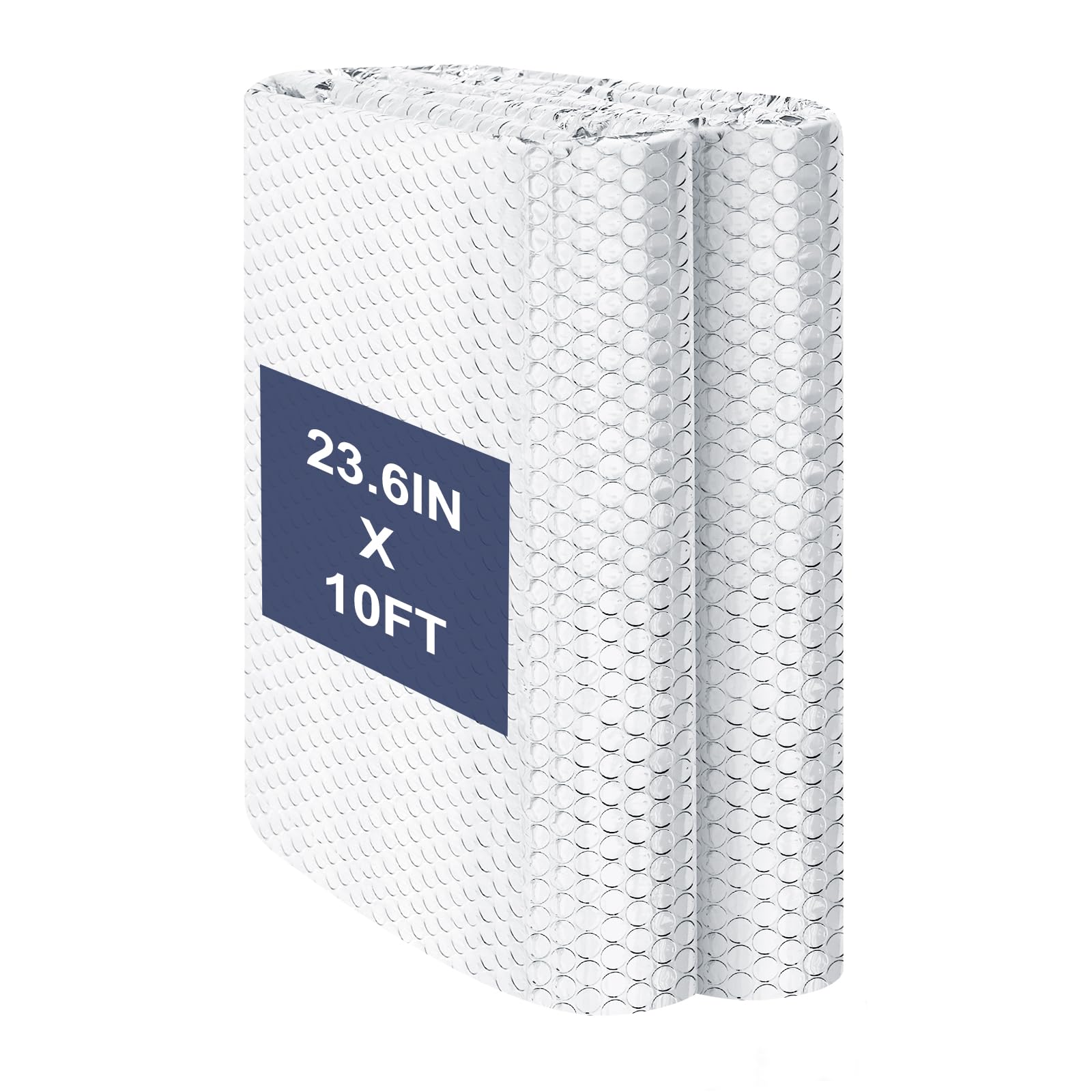
Type: Double reflective bubble foil with foam core
Width: 23.6 in
Length: 10 ft
Construction: Aluminum foil both sides over foam
Applications: Window, garage door, RV, roof
This is the small-format, high-versatility option: double-sided aluminum foil over a foam core, cut to a 23.6 in width and 10 ft length. The foam layer adds a bit of cushion and thickness that plain bubble foil lacks, which helps it sit flatter against a window or garage door panel. It is the pick for spot treatments — a hot window, an RV wall, a garage door that bakes in summer — rather than whole-attic coverage.
For a foil-backed house, this is the product for testing the theory before committing: cut a panel for the worst window or door and see how much heat it knocks down. It also doubles as a signal-blocking experiment, though buyers should expect it to interfere with WiFi near whatever it covers.
Who it suits: Renters and homeowners who want a cheap, cut-to-size thermal barrier for windows, garage doors, or an RV without a full install.
Trade-off: The narrow 23.6 in width means seams on anything wider than a small window, and the foam core makes it bulkier to store than a flat roll.
Check the current price on Amazon
5. Reflective Window Insulation Foil, 48 in x 10 ft

Type: Double-sided aluminum foil bubble insulation
Width: 48 in
Length: 10 ft
Construction: Bubble core, foil both sides
Applications: Windows, RVs, garage doors
The 48 in width is the whole story here: this roll covers a standard window or door panel in a single piece, no seams, no overlap. Double-sided aluminum foil over a bubble core is the classic reflective insulation build — light, flexible, and easy to cut with household scissors. For a house where foil-backed walls are already fighting the router, this is the product for the windows that let heat in and the garage door that radiates it back.
At 10 ft long, the roll is enough for a couple of large windows or a full garage door with careful cutting. It is not structural and not permanent, so it suits seasonal installs and renters who cannot modify the building.
Who it suits: Buyers who need wide, seamless coverage for windows, sliding doors, or a garage door and want a simple cut-and-fit solution.
Trade-off: Bubble foil is fragile compared with a foam-core product — it creases, punctures, and loses some reflectivity where it is crushed, so careful handling matters more than the price suggests.
Check the current price on Amazon
Before You Buy
- Coverage math: Measure the actual dead zone and the attic or window area before ordering — foil-backed houses often need more mesh nodes and less barrier than expected.
- Satellite placement: A mesh satellite only helps if it sits past the foil layer; plan one node per problem room rather than spreading them evenly.
- Perforation: For attic and roof radiant barriers, choose perforated material so moisture can escape; solid foil traps condensation.
- Width and seams: Wider rolls (48 in) mean fewer seams on windows and doors; narrow 23.6 in rolls are better for small panels and RV walls.
- Compatibility: Check that the mesh system’s app and security features match the household’s devices, and that barrier material will not cover vents or block access panels.
- Care and storage: Bubble foil creases and punctures easily; foam-core foil is bulkier but tougher. Store leftover rolls flat, not folded.
- Included accessories: Confirm whether the mesh pack includes all satellites and cabling needed, and whether barrier rolls ship with any cutting or fastening hardware.
Frequently Asked Questions
- Will foil backed insulation really block WiFi? Yes — the aluminum foil layer reflects radio waves the same way it reflects heat, so a foil-backed wall can significantly weaken a signal passing through it.
- Is a mesh system enough, or is a wired backhaul needed? A mesh system with satellites placed past the foil layer often works, but a wired backhaul between nodes is the most reliable fix when walls are heavily shielded.
- Where should mesh satellites go in a foil-backed house? In the rooms with the dead zone, not next to the router — the goal is to get a node on the far side of the barrier.
- Can radiant barrier and a mesh system be used together? Yes, and they solve different problems: the barrier manages heat, the mesh manages coverage. Plan both rather than expecting one to fix the other.
- Does perforated radiant barrier block signal differently than solid foil? Perforation is about moisture, not signal — the foil layer still reflects radio waves, so treat perforated and solid foil the same for WiFi planning.
- What size barrier roll is right for a first project? A 500 sqft roll suits a single attic or garage; 1000 sqft is for larger roof and house wrap jobs, and small bubble foil rolls are for windows and doors.
Bottom Line
For a foil-backed house, the coverage problem comes first, and the NETGEAR Orbi 370 Series three-pack is the pick that solves it — satellites that can be placed past the barrier, WiFi 7 headroom, and capacity for a busy household. The foil products in this roundup handle the thermal side and the spot fixes; they are complements, not substitutes. Start with the mesh system, then add barrier material where heat and signal both need managing.
