Why there are Amazon links here: Brave Review is paid a commission for qualifying Amazon purchases made through the links below. Your price does not change, and using our links is entirely optional. How this works
Best Mesh System for a House with Solid Brick Walls
Solid brick walls are the enemy of Wi-Fi: they soak up signal, so a single router often leaves far rooms dead. The five systems below are the strongest candidates for that kind of house, ranging from a budget starter kit to a tri-band Wi-Fi 7 powerhouse. Budget buyers should look at the Deco S4, most households are best served by the Deco X55 or Orbi 370, and large or demanding homes should head straight for the Wi-Fi 7 picks. The overview table below narrows the field in under a minute.
Overview of the Picks
| Product | Key Spec | Best Use | Price Tier |
|---|---|---|---|
| TP-Link Deco S4 (3-Pack) | AC1900 dual-band, up to 5,500 sq ft | Tight budgets, small brick homes | Budget |
| TP-Link Deco X55 AX3000 (3-Pack) | Wi-Fi 6, up to 6,500 sq ft, Ethernet backhaul | Most brick houses, best value | Mid-range |
| NETGEAR Orbi 370 Series (3-Pack) | Wi-Fi 7 dual-band, up to 6,000 sq ft, 2.5 Gig port | Households wanting Wi-Fi 7 without the flagship price | Upper mid-range |
| TP-Link Deco 7 Pro BE10000 (3-Pack) | Wi-Fi 7 tri-band, up to 7,600 sq ft, 4 x 2.5G ports | Large homes, wired backhaul, heavy device loads | Premium |
| NETGEAR Orbi 770 Series (3-Pack) | Wi-Fi 7 tri-band, up to 8,000 sq ft, up to 11 Gbps | Very large homes, top-tier throughput | Flagship |
TP-Link Deco S4 Mesh AC1900 WiFi System, Deco S4(3-Pack)

TP-Link Deco S4 Mesh AC1900 WiFi System, Deco S4(3-Pack)
Standard: AC1900 dual-band Wi-Fi 5
Coverage: Up to 5,500 sq ft
Ports: Gigabit Ethernet ports
Units: Three-pack
Voice Control: Works with Alexa
Role: Replaces WiFi router and extender
This is the entry point into mesh networking, and it is built for the job: three compact nodes that replace a router and extender with one roaming network. AC1900 dual-band hardware is a generation behind Wi-Fi 6, but the gigabit ports and Alexa compatibility keep it usable for streaming and everyday browsing. The low price tier is the whole point here, and it makes the S4 the obvious first mesh kit for a smaller brick house on a strict budget. Buyers who mostly stream in a few rooms will not feel the missing Wi-Fi 6 features.
The S4 earns its place as the value pick, but brick walls blunt its reach: Wi-Fi 5 signal is weaker through masonry than newer radios, so the quoted coverage is optimistic in a solid-wall home. Expect to place nodes closer together than the box suggests. It suits renters and budget buyers; it is not for anyone with multi-gig internet or a house full of Wi-Fi 7 devices.
Trade-off: Wi-Fi 5 radios and gigabit-only ports mean this kit will feel dated first as faster internet and devices arrive.
TP-Link Deco X55 AX3000 WiFi 6 Mesh System, Deco X55(3-Pack)

TP-Link Deco X55 AX3000 WiFi 6 Mesh System, Deco X55(3-Pack)
Standard: AX3000 Wi-Fi 6
Coverage: Up to 6,500 sq ft
Ports: 3 Gigabit ports per unit
Backhaul: Supports Ethernet backhaul
Role: Replaces wireless router and extender
Units: Three-pack
The X55 is the middle of the road in the best possible way: AX3000 Wi-Fi 6 radios, three gigabit ports on every unit, and support for Ethernet backhaul. That last feature matters most in a brick house, because a wired link between nodes bypasses the walls entirely and keeps speed high at the far end. Three ports per unit also mean a node can sit near a TV or console and still serve wired devices. It is the pick most buyers should start with.
For the money, this is the best mesh system for a house with solid brick walls where a wired backbone is possible, and even on pure wireless it handles a family’s streaming and work-from-home load. It is not for buyers chasing multi-gig speeds or the newest Wi-Fi 7 standard, and the plastic nodes are plain rather than premium.
Trade-off: Gigabit ports cap wired backhaul and LAN speeds, so multi-gig internet plans go to waste.
NETGEAR Orbi 370 Series WiFi 7 Mesh System, 3 Pack
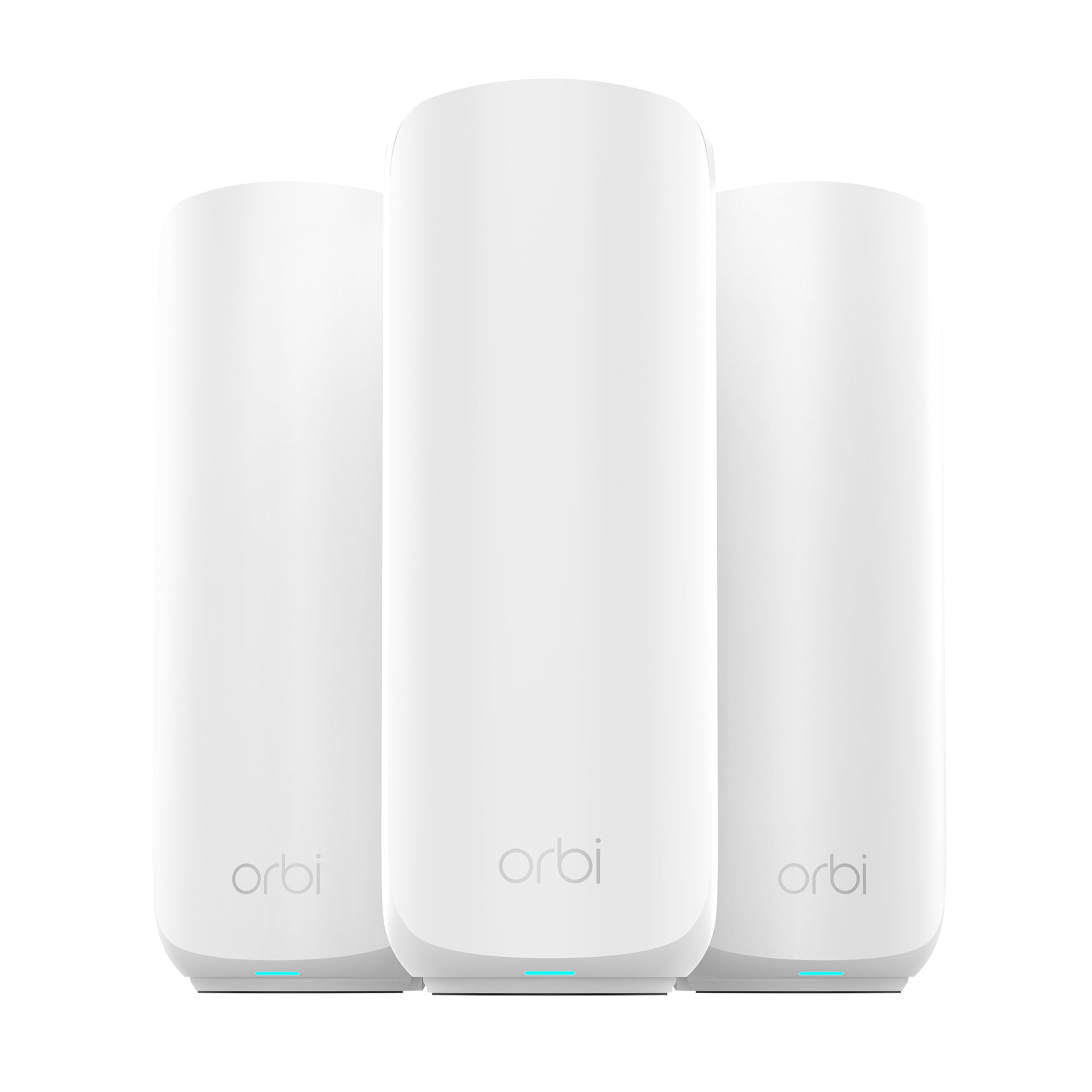
NETGEAR Orbi 370 Series WiFi 7 Mesh System, 3 Pack
Standard: Dual-band Wi-Fi 7
Speed: Up to 5 Gbps
Coverage: Up to 6,000 sq ft
Capacity: 70 devices
Ports: 2.5 Gig port
Setup: Easy set up, router plus two satellite extenders
The Orbi 370 brings Wi-Fi 7 to a mid-range budget, with a dual-band design, a 2.5 Gig port and room for 70 devices. The router-plus-two-satellites layout is the classic Orbi shape, and the 2.5 Gig port gives wired backhaul real headroom over the Deco X55. Security features and easy setup round out a package aimed at households that want current-generation hardware without flagship pricing. It is a sensible step up for a brick home with several heavy users.
It suits buyers who want Wi-Fi 7 future-proofing and a fast wired port at a moderate price. It is not for very large homes, where the 6,000 sq ft claim will not survive solid masonry, and dual-band Wi-Fi 7 is less impressive than the tri-band flagships.
Trade-off: Dual-band Wi-Fi 7 delivers less real-world throughput than tri-band systems at the top of the range.
TP-Link Deco 7 Pro Tri-Band WiFi 7 BE10000 Whole Home Mesh System (3-Pack)
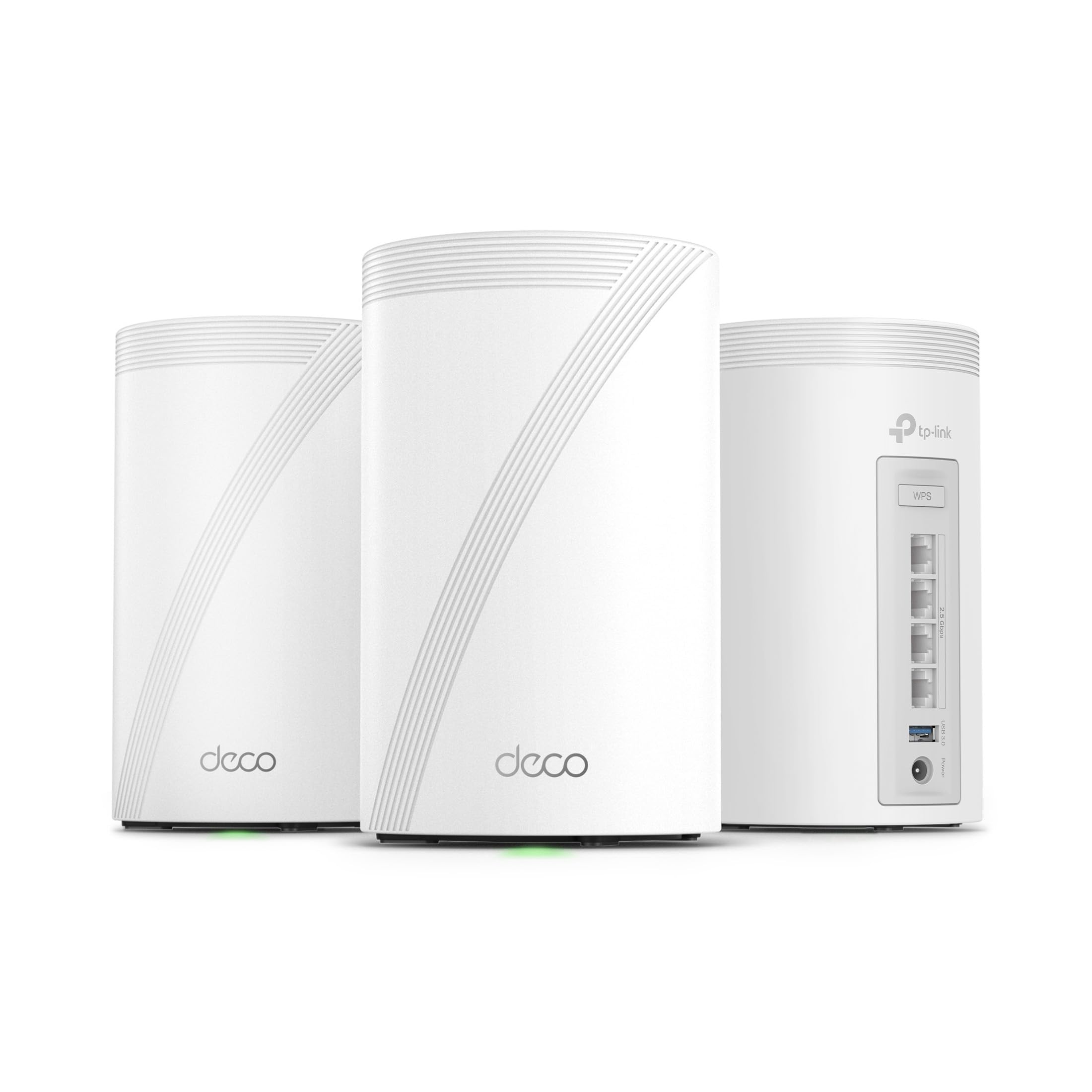
TP-Link Deco 7 Pro Tri-Band WiFi 7 BE10000 Whole Home Mesh System (3-Pack)
Standard: Tri-band Wi-Fi 7, BE10000
Streams: 6-stream, 10 Gbps
Ports: 4 x 2.5G ports with wired backhaul
Coverage: Up to 7,600 sq ft
Antennas: 4 x smart internal antennas
Features: VPN, HomeShield, AI-Roaming
Units: Three-pack
This is the serious pick: tri-band BE10000 Wi-Fi 7, four 2.5G ports per unit, and wired backhaul support across the board. In a brick house, that combination is close to ideal, since each node can be linked by cable and the tri-band radios keep a dedicated lane free for traffic. HomeShield, VPN support and AI-Roaming add management polish, and six streams handle a busy household without strain. It is the best choice for large homes that can run Ethernet.
The Deco 7 Pro suits buyers with big floor plans, lots of devices and multi-gig internet. It is not for anyone on a tight budget, and the compact nodes will not fill a very large brick home wirelessly without a wired backbone.
Trade-off: The high price tier only pays off with fast internet and wired backhaul; wireless-only buyers get less for the money.
NETGEAR Orbi 770 Series WiFi 7 Mesh System, 3 Pack

NETGEAR Orbi 770 Series WiFi 7 Mesh System, 3 Pack
Standard: Tri-band Wi-Fi 7
Speed: Up to 11 Gbps
Coverage: Up to 8,000 sq ft
Capacity: 100 devices
Ports: 2.5 Gig port
Setup: Easy set up, router plus two satellite extenders
The Orbi 770 is the flagship of this group, with tri-band Wi-Fi 7, speeds quoted up to 11 Gbps, coverage up to 8,000 sq ft and capacity for 100 devices. The router-plus-two-satellite design is built for sprawling homes, and the 2.5 Gig port supports fast wired backhaul where cable can be run. Security features and easy setup keep the package friendly despite the power underneath. For a very large brick house, it is the maximum-coverage option here.
It suits buyers with big properties, many devices and the budget for top-tier hardware. It is not for smaller homes or anyone who will not use its throughput, and the flagship price tier is hard to justify on wireless backhaul alone through masonry.
Trade-off: The highest price tier here, and the quoted coverage assumes open space rather than solid brick between nodes.
Before You Buy
- Wall construction: Solid brick and masonry cut signal hard, so plan on more nodes than the coverage figure suggests, or run cable between them.
- Ethernet backhaul: A wired link between nodes is the single biggest upgrade for a brick house; check that each unit has enough ports.
- Wi-Fi standard: Wi-Fi 6 is the sensible minimum today; Wi-Fi 7 buys headroom for newer devices and faster wired ports.
- Port speed: Gigabit ports cap wired backhaul, so multi-gig internet needs 2.5G ports to be worth it.
- Coverage claims: Treat quoted square footage as a best case in open space and size down for thick walls and floors.
- Device count: Count phones, laptops, TVs, consoles and smart-home gear before choosing capacity.
- Placement: Nodes need power and a clear path; in brick homes, doorways and hallways often beat interior walls.
Frequently Asked Questions
-
Will a mesh system work through solid brick walls?
Yes, but expect reduced range per node. Placing units in doorways or using Ethernet backhaul keeps speeds high where masonry blocks the wireless signal. -
How many mesh units does a brick house need?
More than the box suggests. A three-pack suits most average homes, while larger or heavily walled houses may need a fourth node or a wired backbone. -
Is Wi-Fi 7 worth it for a brick house?
It helps with congested homes and fast internet, but the bigger gain in a brick house comes from wired backhaul. Wi-Fi 6 remains a solid value choice. -
Does Ethernet backhaul really make a difference?
It does. A cable between nodes bypasses the walls entirely, so the far end of the house gets near-full speed instead of a weakened signal. -
Can a mesh system replace a router and extender?
Yes. Kits like the Deco S4 and X55 are designed to replace both with one roaming network, which is simpler to manage than mixed gear. -
What internet speed justifies a 2.5G port?
Plans above gigabit. On slower connections, a gigabit port is not the bottleneck, so the cheaper systems remain sensible.
Bottom Line
For most brick houses, the TP-Link Deco X55 is the best mesh system for a house with solid brick walls: Wi-Fi 6, three ports per unit and Ethernet backhaul support at a mid-range price make it the value winner. Buyers with larger homes and multi-gig internet should step up to the TP-Link Deco 7 Pro, while tight budgets can still start with the Deco S4.
