Why there are Amazon links here: Brave Review is paid a commission for qualifying Amazon purchases made through the links below. Your price does not change, and using our links is entirely optional. How this works
Best Mesh System for a House with Thick Walls
Thick masonry, plaster-over-lath and concrete floors eat Wi-Fi signal, and a single router rarely reaches the far end of the house. The five systems below are the strongest candidates for that layout, and they split into three buyer profiles: value-focused households that need solid coverage on a budget, heavy-device homes that want the newest Wi-Fi standard, and large properties that need raw range above all. The overview table below puts every pick side by side so a decision can be made in under a minute; detailed reviews follow.
Overview of the Picks
| Product | Key Spec | Best Use | Price Tier |
|---|---|---|---|
| TP-Link Deco X55 (3-Pack) | AX3000, 6,500 sq ft, Ethernet backhaul | Budget coverage for a mid-size thick-walled home | Budget |
| TP-Link Deco 7 Pro BE63 (3-Pack) | BE10000, 4 x 2.5G ports, 7,600 sq ft | High-device homes wanting Wi-Fi 7 and wired backhaul | Premium |
| NETGEAR Orbi 770 (3-Pack) | Up to 11 Gbps, 8,000 sq ft, 2.5G port | Large homes needing maximum range | Premium |
| NETGEAR Orbi 360 (3-Pack) | Up to 5 Gbps, 6,000 sq ft, 2.5G port | Entry-level Wi-Fi 7 for smaller footprints | Mid-range |
| NETGEAR Orbi 370 (3-Pack) | Up to 5 Gbps, 6,000 sq ft, 2.5G port | Wi-Fi 7 with Orbi styling and setup at a lower tier | Mid-range |
TP-Link Deco X55 AX3000 WiFi 6 Mesh System (3-Pack)

Standard: AX3000 Wi-Fi 6
Coverage: Up to 6,500 sq ft
Ports: 3 Gigabit ports per unit
Backhaul: Supports Ethernet backhaul
Pack Size: 3 units
Role: Replaces an existing router and extender
TP-Link Deco X55 AX3000 WiFi 6 Mesh System, Deco X55(3-Pack) — CHECK PRICE ON AMAZON
The Deco X55 is the value play here, and it earns its place by doing the one thing thick-walled houses need most: wired backhaul. Each unit carries three Gigabit ports, so a house with existing coax or Ethernet runs can link the nodes by cable and sidestep the walls entirely. Wi-Fi 6 hardware keeps the cost down while still handling modern phone and laptop traffic, and the three-pack covers a footprint most mid-size homes can work with. It suits households that want dependable coverage without paying for the newest standard.
This pick is for budget-conscious buyers in a house up to roughly the advertised coverage area, especially anyone willing to run a cable between nodes. It is not for a household with dozens of always-on smart devices or multi-gig internet, since the Gigabit ports cap wired throughput.
Trade-off: The older Wi-Fi 6 standard and Gigabit-only ports leave little headroom for future multi-gig plans.
TP-Link Deco 7 Pro BE63 Tri-Band WiFi 7 BE10000 Whole Home Mesh System (3-Pack)
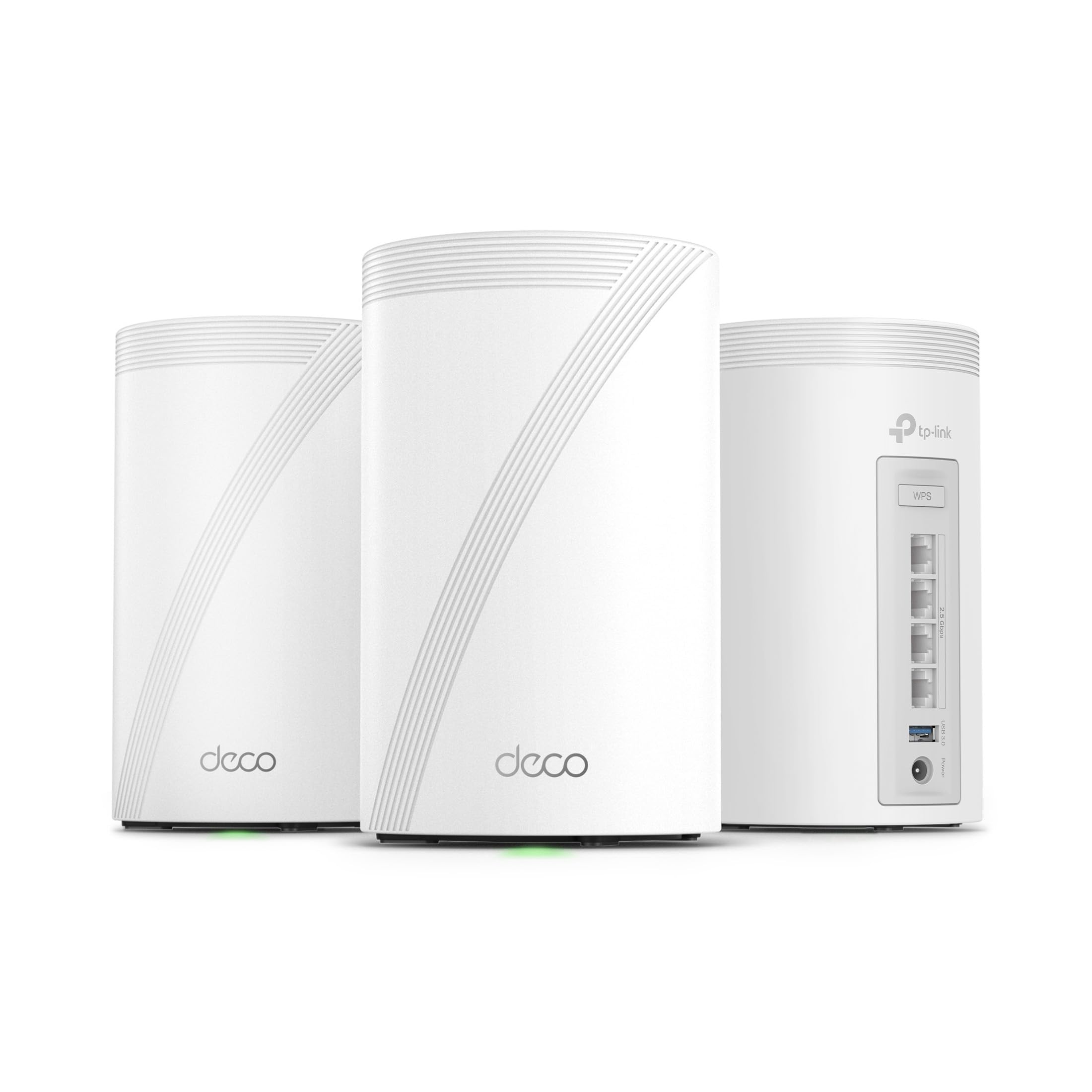
Standard: BE10000 Wi-Fi 7, tri-band
Streams: 6-stream
Ports: 4 x 2.5G ports with wired backhaul
Antennas: 4 smart internal antennas
Coverage: Up to 7,600 sq ft
Features: VPN, HomeShield, AI-Roaming
Pack Size: 3 units
Deco 7 Pro Tri-Band WiFi 7 BE10000 Whole Home Mesh System, BE63 (3-Pack) — CHECK PRICE ON AMAZON
The Deco 7 Pro BE63 is the most capable system in this group on paper. Four 2.5G ports per unit make wired backhaul genuinely fast, which matters in a thick-walled house where a cable between nodes beats any wireless hop. Four internal smart antennas and AI-roaming handle device handoff, while the tri-band design spreads traffic across more channels than a dual-band system can. HomeShield and VPN support round out the package for buyers who care about network controls.
This is the pick for heavy-device households — gaming, streaming, work-from-home — that also have multi-gig internet or plan to. It is not for buyers on a tight budget, since the Wi-Fi 7 premium is real and the extra bandwidth is wasted on a standard cable connection.
Trade-off: The price tier is the highest here, and the full benefit only shows up with a fast internet plan and wired backhaul.
NETGEAR Orbi 770 Series WiFi 7 Mesh System (3-Pack)

Standard: Wi-Fi 7, tri-band
Speed: Up to 11 Gbps
Coverage: Up to 8,000 sq ft
Devices: 100 devices
Ports: 2.5 Gig port
Security: Security features included
Pack Size: Router + 2 satellite extenders
NETGEAR Orbi 770 Series WiFi 7 Mesh System, RBE773 (3-Pack) — CHECK PRICE ON AMAZON
The Orbi 770 is the range leader, rated for up to 8,000 square feet and up to 100 devices. Its tri-band Wi-Fi 7 design and dedicated satellite extenders are built for exactly the problem thick walls create: signal that has to travel a long way and still arrive usable. A 2.5 Gig port on the router keeps the wired side from becoming the bottleneck, and the Orbi lineup is known for a straightforward app-led setup. Security features are included rather than sold separately.
This pick suits large homes — sprawling layouts, multi-floor properties, brick or stone construction — where coverage distance is the top priority. It is not for a compact house, where a three-pack of this size is overkill and the premium goes unused.
Trade-off: The single 2.5 Gig port per unit limits wired flexibility compared with the four-port Deco, and the price sits at the top of the range.
NETGEAR Orbi 360 Series WiFi 7 Mesh System (3-Pack)

Standard: Wi-Fi 7, dual-band
Speed: Up to 5 Gbps
Coverage: Up to 6,000 sq ft
Devices: 70 devices
Ports: 2.5 Gig port
Security: Security features included
Pack Size: Router + 2 satellite extenders
NETGEAR Orbi 360 Series WiFi 7 Mesh System, RBE363 (3-Pack) — CHECK PRICE ON AMAZON
The Orbi 360 is the entry point into Wi-Fi 7 from NETGEAR, and it trims the spec sheet to keep the price down. Dual-band rather than tri-band means fewer channels to share, but the 2.5 Gig port and the same router-plus-two-satellite layout keep it practical for a mid-size thick-walled home. Coverage is rated to 6,000 square feet with support for 70 devices, which covers most family households comfortably.
This pick is for buyers who want the newer standard and a 2.5 Gig port without the tri-band premium, in a house that is not unusually large. It is not for dense device households or very spread-out layouts, where the dual-band design and lower device count will feel tight.
Trade-off: Dual-band operation means less channel separation in crowded neighborhoods than the tri-band systems offer.
NETGEAR Orbi 370 Series WiFi 7 Mesh System (3-Pack)
Standard: Wi-Fi 7, dual-band
Speed: Up to 5 Gbps
Coverage: Up to 6,000 sq ft
Devices: 70 devices
Ports: 2.5 Gig port
Security: Security features included
Pack Size: Router + 2 satellite extenders
NETGEAR Orbi 370 Series WiFi 7 Mesh System, RBE373 (3-Pack) — CHECK PRICE ON AMAZON
The Orbi 370 shares its headline numbers with the 360 — dual-band Wi-Fi 7, up to 5 Gbps, 6,000 square feet, 70 devices, a 2.5 Gig port — and sits in the same tier. The practical difference for a thick-walled house is the same either way: a router plus two satellites spread signal across a floor plan that a single unit cannot reach. Setup is app-driven, and security features come bundled rather than as an add-on.
This pick suits the same buyer as the 360: a mid-size home that wants Wi-Fi 7 and a fast wired port without tri-band pricing. It is not for anyone who needs maximum range or a large device count, and buyers comparing the two Orbi models should treat them as near-equivalent rather than a clear upgrade.
Trade-off: The spec sheet overlaps heavily with the Orbi 360, so the choice between them comes down to availability and price rather than capability.
Before You Buy
- Backhaul: In a thick-walled house, a wired Ethernet backhaul between nodes outperforms any wireless hop — check whether the system supports it and whether the home has cable runs.
- Ports: Multi-gig ports only matter with a matching internet plan; a Gigabit-only system is fine on a standard connection.
- Standard: Wi-Fi 7 buys headroom for future devices, but Wi-Fi 6 remains adequate for phones, laptops and streaming.
- Coverage rating: Advertised square footage assumes open space; thick walls cut effective range, so lean toward a larger rating than the floor plan suggests.
- Device count: Count phones, laptops, TVs, cameras and smart plugs before choosing; a 70-device rating is generous, a 100-device rating is safer for a connected home.
- Pack size: A three-pack suits most houses, but a long or multi-wing layout may need a fourth node — confirm the system supports adding units.
- Placement: Nodes need line of sight through doorways where possible; a node buried behind a chimney breast or in a cabinet loses much of its advantage.
Frequently Asked Questions
-
Does a mesh system actually work through thick walls?
Mesh helps by placing nodes closer to the far rooms, so signal travels shorter distances through fewer walls. It cannot defeat solid stone entirely, which is why wired backhaul is worth considering. -
Is Wi-Fi 7 worth it for a thick-walled house?
Wi-Fi 7 improves throughput and channel use, but range is still governed by physics. The bigger gains in a masonry home come from node placement and wired backhaul. -
How many units does a thick-walled house need?
A three-pack covers most mid-size homes. Long or multi-floor layouts with dense walls may need a fourth node, so check that the system supports expansion. -
Should the nodes be wired together?
Where cable runs exist, yes — Ethernet backhaul removes the wireless hop between nodes and is the single biggest reliability improvement in a wall-heavy home. -
Can a mesh system replace an existing router and extender?
Yes. Systems like the Deco X55 are designed to replace both, and a mesh network hands devices between nodes more smoothly than a router-plus-extender setup. -
Will thick walls affect which node a device connects to?
Good roaming handles the handoff, which is why AI-roaming and similar features matter in a house where signal drops sharply between rooms.
Bottom Line
For most thick-walled homes, the TP-Link Deco X55 three-pack is the sensible buy: it supports Ethernet backhaul, which is the real fix for masonry walls, at the lowest price tier here. Households with multi-gig internet and a dense device load should step up to the Deco 7 Pro BE63, while very large properties will get the most range from the Orbi 770.
