Why there are Amazon links here: Brave Review is paid a commission for qualifying Amazon purchases made through the links below. Your price does not change, and using our links is entirely optional. How this works
Best Mesh System for a Household With a Lot of Smart Devices
A home full of smart bulbs, plugs, cameras, and thermostats puts a different kind of strain on a router than streaming does: dozens of low-bandwidth devices that all need a stable, always-on connection. The five mesh systems below are the strongest fits for that job, sorted by how many devices each one is built to carry and how much house it covers. Budget-minded buyers with a smaller home should look at the TP-Link Deco X55 or the Google WiFi bundle, while larger homes packed with gadgets are better served by the NETGEAR Orbi 370 and Orbi 770. The overview table sums up the differences; the reviews that follow explain who each pick is for.
Overview of the Picks
| Product | Key Spec | Best Use | Price Tier |
|---|---|---|---|
| NETGEAR Orbi 370 Series (3-Pack) | Up to 5 Gbps, 70 devices, 6,000 sq ft | WiFi 7 future-proofing for mid-size smart homes | Mid-range |
| Amazon eero 6+ (3-Pack) | Up to a Gigabit, 75+ devices, 4,500 sq ft | Simple app-managed smart homes | Mid-range |
| NETGEAR Orbi 770 Series (3-Pack) | Up to 11 Gbps, 100 devices, 8,000 sq ft | Large, device-dense homes | Premium |
| Google WiFi AC1200 Bundle (3-Pack) | AC1200, 4,500 sq ft | Tight budgets and simple setups | Budget |
| TP-Link Deco X55 AX3000 (3-Pack) | AX3000, 6,500 sq ft, Ethernet backhaul | Value coverage for many devices | Budget |
NETGEAR Orbi 370 Series WiFi 7 Mesh System, 3 Pack

Device Capacity: 70 devices
Speed Rating: Up to 5 Gbps
Bands: Dual-band
Coverage: Up to 6,000 sq ft
Ports: 2.5 Gig port
Set Contents: Router + 2 satellite extenders
The Orbi 370 is the entry point into WiFi 7 for a mid-size home, and its 70-device rating leaves headroom for a house that has already filled up on smart plugs and cameras. The dual-band design keeps things simple, and the 2.5 Gig port gives a wired connection room to breathe if the internet plan supports it. Built-in security features run at the network level, which matters when dozens of inexpensive smart devices are online around the clock. Setup is handled through the app with the usual router-plus-satellites routine.
This pick suits buyers with a home in the 4,000–6,000 sq ft range who want current-generation WiFi without jumping to the premium tier. It is not the right call for a very large property or a household pushing well past 70 connected devices. Trade-off: The dual-band design is a step behind tri-band systems, so heavy simultaneous traffic in a crowded home may not feel as smooth as the pricier Orbi 770.
Amazon eero 6+ Mesh WiFi System, 3-Pack
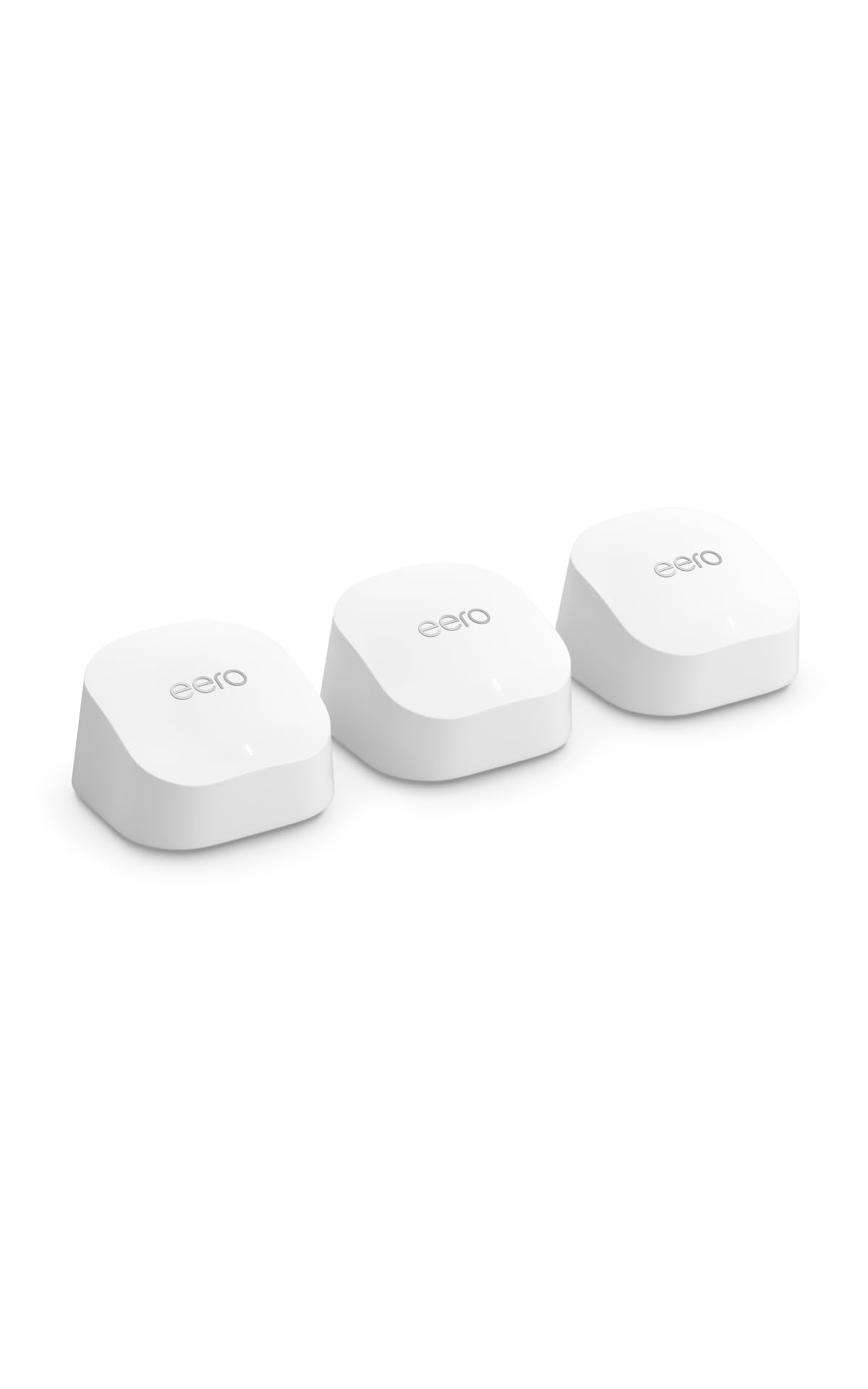
Device Capacity: 75+ devices
Speed Rating: Supports plans up to a Gigabit
Coverage: Up to 4,500 sq ft
Set Contents: 3-pack
Setup: App-managed
The eero 6+ is built around simplicity: three compact units, an app that walks through setup, and a network that manages itself once running. Its 75+ device rating is the highest in this group short of the Orbi 770, which makes it a natural fit for a home where smart devices outnumber people by a wide margin. Coverage reaches up to 4,500 sq ft, enough for a typical two-story house. The system is designed to work with internet plans up to a Gigabit, so it pairs best with mainstream broadband rather than multi-gig service.
This pick suits buyers who want smart-home capacity without fiddling with settings, and who value a clean, low-profile look on a shelf. It is not the best match for a very large home or for anyone on a multi-gig internet plan. Trade-off: The Gigabit ceiling and mid-range coverage mean the eero 6+ will feel constrained in a big house or on a fast fiber plan, where the Orbi models pull ahead.
NETGEAR Orbi 770 Series WiFi 7 Mesh System, 3 Pack

Device Capacity: 100 devices
Speed Rating: Up to 11 Gbps
Bands: Tri-band
Coverage: Up to 8,000 sq ft
Ports: 2.5 Gig port
Set Contents: Router + 2 satellite extenders
The Orbi 770 is the heavyweight of the group: a 100-device rating, up to 8,000 sq ft of coverage, and tri-band WiFi 7 hardware that keeps a dedicated lane free for backhaul traffic. For a home where every room has smart gear and the family streams in 4K at the same time, that extra band is what keeps the network from bottlenecking. The 2.5 Gig port and built-in security features round out a package aimed at buyers who do not want to upgrade again soon. Setup follows the same app-driven process as the rest of the Orbi line.
This pick suits large homes and device-heavy households that want the most capacity and coverage available here. It is not for buyers on a tight budget or anyone with a small apartment, where the extra coverage is wasted. Trade-off: The premium price is the steepest in this roundup, and most budget broadband plans will never come close to using the speed it offers.
Google WiFi AC1200 Mesh Router System Bundle, 3-Pack

Speed Rating: AC1200
Coverage: Up to 4,500 sq ft
Set Contents: 3-pack
Setup: Easy setup, retail packaging
Design: Snow finish
The Google WiFi bundle is the budget route into mesh, and its AC1200 rating is honest about what it is: a system for mainstream broadband and everyday smart-home traffic rather than multi-gig speed. Three units cover up to 4,500 sq ft, and the setup process is designed to be quick for buyers who do not want to think about networking. The snow finish keeps the units unobtrusive on a shelf or side table. It is explicitly pitched at seamless signal for smart home devices, which is exactly the use case here.
This pick suits renters, smaller homes, and buyers who want reliable smart-device coverage at the lowest entry price. It is not the right choice for a large house or a household that streams heavily on several screens at once. Trade-off: The AC1200 rating is the slowest here, so this system is a coverage fix rather than a speed upgrade and will feel dated sooner than the WiFi 6 and WiFi 7 picks.
TP-Link Deco X55 AX3000 WiFi 6 Mesh System, 3-Pack

Speed Rating: AX3000
Coverage: Up to 6,500 sq ft
Ports: 3 Gigabit ports per unit
Backhaul: Supports Ethernet backhaul
Set Contents: 3-pack
Function: Replaces router and extender
The Deco X55 is the value standout: WiFi 6 hardware, up to 6,500 sq ft of coverage, and three Gigabit ports on every unit, all at a budget-tier price. The Ethernet backhaul support is the detail that matters most for a smart-home household, because a wired link between units keeps the wireless bands free for devices instead of backhaul traffic. Three ports per unit also make it easy to hardwire a hub, a console, or a desktop where the signal is weakest. It replaces both an old router and any extenders in one step.
This pick suits buyers who want the most coverage per dollar and are willing to run a cable or two for the best results. It is not the best fit for anyone who needs the fastest possible wireless speeds or the simplest possible app experience. Trade-off: WiFi 6 rather than WiFi 7 means this system trades future-proofing for price, and the Ethernet backhaul that makes it shine requires cables that not every home is set up for.
Before You Buy
- Device capacity: Count smart plugs, bulbs, cameras, speakers, and thermostats, then add phones, laptops, and TVs. A 70-device rating is comfortable for most homes; a 100-device system leaves room to grow.
- Coverage vs. layout: Square footage is a rough guide. Thick walls and multiple floors matter more than the number, so buy for the shape of the home, not just the size.
- WiFi generation: WiFi 6 systems are the value choice today; WiFi 7 systems cost more but stay current longer.
- Ports and backhaul: Ethernet ports on each unit let a buyer hardwire devices and, on systems that support it, link units by cable for a more stable network.
- Internet plan: A system rated for a Gigabit is wasted on a slow plan, and a multi-gig plan is wasted on an AC1200 system.
- Security features: Network-level security is worth having when dozens of inexpensive smart devices are connected around the clock.
- Setup and app: A simple app-managed setup saves time, but check that the app offers the controls the household actually needs.
Frequently Asked Questions
-
How many smart devices can a mesh system handle?
It depends on the model. The picks here range from around 70 devices on the Orbi 370 to 100 on the Orbi 770, with the eero 6+ rated for 75+. -
Is WiFi 7 worth it for a smart-home household?
WiFi 7 costs more but handles crowded networks better and stays current longer. A household with dozens of devices and plans to grow will get more years out of it. -
Will a mesh system fix smart devices that keep dropping offline?
Often, yes. Dropped devices usually point to weak signal or an overloaded router, and a mesh system with higher device capacity addresses both. -
Do smart devices need a separate network?
Not necessarily, but network-level security features and the ability to segment devices are useful when many inexpensive gadgets are connected. -
Does coverage square footage include walls and floors?
It is a rough estimate. Multiple floors and thick walls reduce real-world range, so a larger rating gives more margin. -
Can a mesh system replace an existing router and extender?
Yes. Every pick here is a full router-plus-satellite system, and the Deco X55 is explicitly sold as a replacement for both.
Bottom Line
For a household packed with smart devices, the NETGEAR Orbi 770 Series is the strongest overall pick: its 100-device rating, tri-band WiFi 7 hardware, and up to 8,000 sq ft of coverage handle the densest homes without strain. Buyers who want most of that capacity for less should look at the Orbi 370, and budget-focused households with a smaller footprint will find the Deco X55 hard to beat on coverage per dollar.
