Why there are Amazon links here: Brave Review is paid a commission for qualifying Amazon purchases made through the links below. Your price does not change, and using our links is entirely optional. How this works
Best Mesh System for a Three Storey House: 5 Picks That Kill Dead Zones
A three storey house is the hardest layout a home network has to solve: signal has to climb through two floors of joists, ducts and masonry, and the router usually sits on the middle floor or in a corner. The five mesh systems below cover that job at very different budgets, from a sub-$100 starter kit to a WiFi 7 tri-band flagship. Budget households, remote workers and smart-home owners will each find a different winner, and the overview table below lets most readers pick in under a minute.
The Picks at a Glance
| Product | Key Spec | Best Use | Price Tier |
|---|---|---|---|
| TP-Link Deco S4 (3-Pack) | AC1900, up to 5,500 sq ft | Tight budgets and lighter device loads | Budget |
| TP-Link Deco X55 (3-Pack) | AX3000 WiFi 6, up to 6,500 sq ft | Most three storey homes | Mid-range |
| NETGEAR Orbi 370 Series (3-Pack) | WiFi 7, up to 6,000 sq ft, 70 devices | Fast, simple WiFi 7 upgrade | Mid-range |
| TP-Link Deco 7 Pro BE63 (3-Pack) | WiFi 7 BE10000, 4 x 2.5G ports | Heavy smart homes and wired backhaul | Upper mid-range |
| NETGEAR Orbi 770 Series (3-Pack) | WiFi 7, up to 8,000 sq ft, 100 devices | Large homes and top-tier throughput | Premium |
TP-Link Deco S4 Mesh AC1900 WiFi System, Deco S4 (3-Pack)

Standard: AC1900 dual-band WiFi 5
Coverage: Up to 5,500 sq ft
Units: 3-pack
Ports: Gigabit Ethernet ports
Voice Control: Works with Alexa
Function: Replaces router and extender
TP-Link Deco S4 Mesh AC1900 WiFi System, Deco S4 (3-Pack)
The Deco S4 is the entry point into whole-home mesh, and it is built for buyers who want to stop paying for a router plus a stack of extenders. Each unit is a small, plain tower that plugs into a wall outlet and talks to the others over a dedicated mesh link, so devices hop between floors without the SSID changes that plague range extenders. Setup runs through the Deco app, and the system replaces the existing router outright. It is WiFi 5 hardware, so it suits streaming, browsing and video calls rather than multi-gig file transfers.
This is the pick for a first mesh system in a modest three storey home where the internet plan tops out well below a gigabit. It earns its place on price and simplicity, not on speed.
Trade-off: WiFi 5 hardware and a dual-band design mean throughput drops sharply when many devices stream at once, so heavy 4K or gaming households will outgrow it.
Check the current price on Amazon
TP-Link Deco X55 AX3000 WiFi 6 Mesh System, Deco X55 (3-Pack)

Standard: AX3000 WiFi 6
Coverage: Up to 6,500 sq ft
Units: 3-pack
Ports: 3 Gigabit ports per unit
Backhaul: Supports Ethernet backhaul
Function: Replaces router and extender
TP-Link Deco X55 AX3000 WiFi 6 Mesh System, Deco X55 (3-Pack)
The Deco X55 is the sensible middle of this list: WiFi 6 speeds, three Gigabit ports on every unit, and enough coverage to flood a three storey house with a node on each floor. The extra ports matter on a multi-floor layout, because a wired Ethernet backhaul between floors turns the mesh into a far more stable backbone than a pure wireless link. The Deco app handles naming, guest networks and parental controls, and the units are compact enough to sit on a shelf without drawing attention.
This is the pick for the typical three storey household: remote workers, several streaming devices and a phone or tablet in every room. It is the safest all-round buy here, and the one most buyers should start with.
Trade-off: WiFi 6 rather than WiFi 7 leaves no headroom for future multi-gig plans, and the three-port design fills up fast when a node also feeds a wired device.
Check the current price on Amazon
NETGEAR Orbi 370 Series WiFi 7 Mesh System, RBE373 (3-Pack)

Standard: WiFi 7 dual-band
Speed: Up to 5 Gbps
Coverage: Up to 6,000 sq ft
Device Load: Up to 70 devices
Ports: 2.5 Gig port
Kit: Router + 2 satellite extenders
NETGEAR Orbi 370 Series WiFi 7 Mesh System, RBE373 (3-Pack)
The Orbi 370 is the cheapest way onto WiFi 7 in this lineup, and its 2.5 Gig port means the wired side of the network can keep up with a fast fibre plan. The kit is a router plus two satellites, and the satellite design gives the system a clean look on a landing or in a hallway. NETGEAR’s setup app is straightforward, and the built-in security features cover the basics for a family network without a subscription conversation.
This is the pick for a household that wants modern WiFi 7 radios and one fast wired port without paying flagship money. It suits a three storey home with a normal mix of laptops, TVs and smart speakers.
Trade-off: The dual-band design and 70-device ceiling are modest for the price, so a large smart home or a house full of gamers may hit the limit before the coverage runs out.
Check the current price on Amazon
TP-Link Deco 7 Pro Tri-Band WiFi 7 BE10000 Whole Home Mesh System, BE63 (3-Pack)
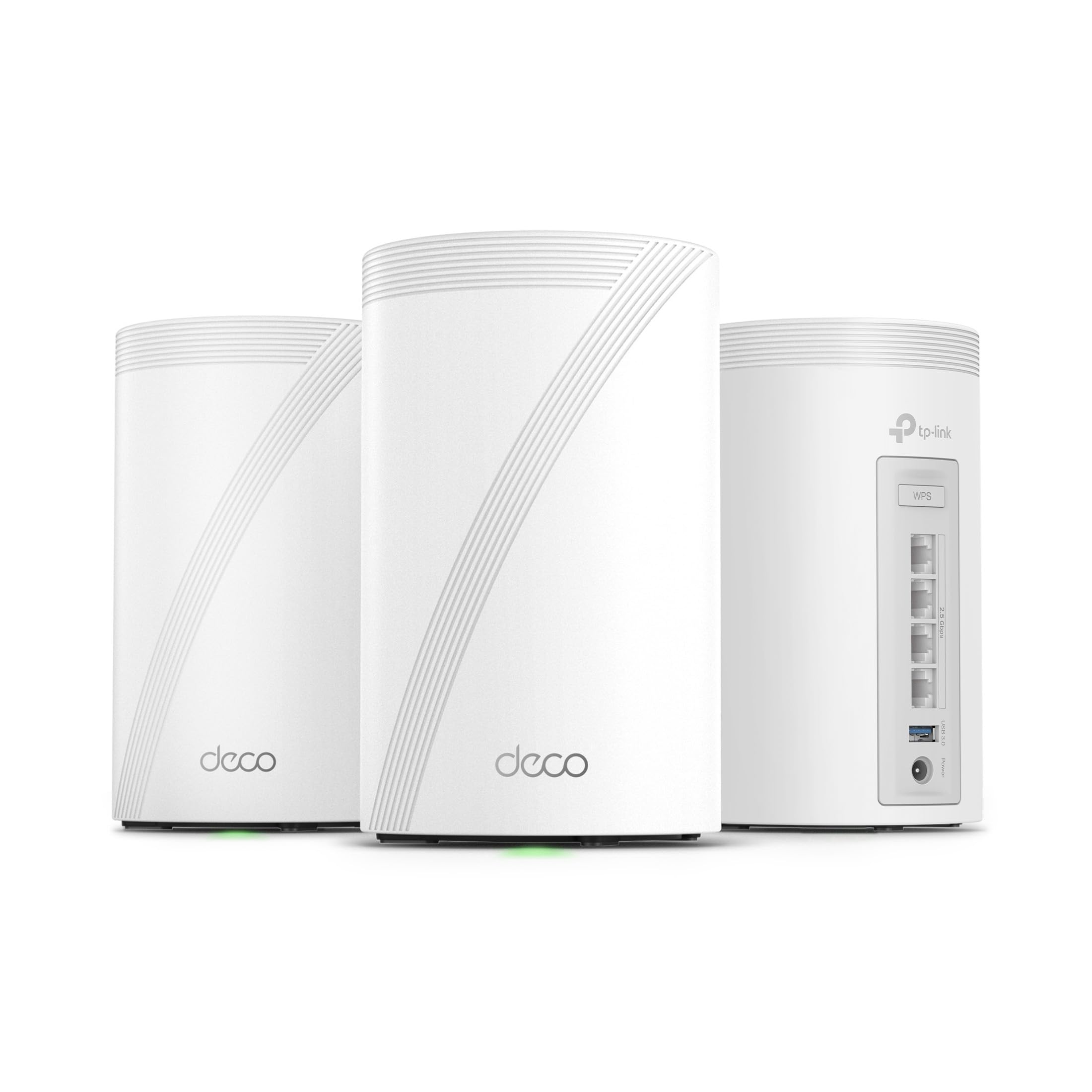
Standard: WiFi 7 tri-band, BE10000
Streams: 6-stream
Ports: 4 x 2.5G ports
Backhaul: Wired backhaul support
Antennas: 4 x smart internal antennas
Features: VPN, HomeShield, AI-Roaming
Coverage: Up to 7,600 sq ft
TP-Link Deco 7 Pro Tri-Band WiFi 7 BE10000 Whole Home Mesh System, BE63 (3-Pack)
The Deco 7 Pro BE63 is the power user’s pick: a tri-band WiFi 7 design with four 2.5G ports per unit, which is more wired capacity than most three storey homes can use. The third radio keeps the mesh backhaul separate from client traffic, so the link between floors does not compete with the devices on them. HomeShield adds network-level filtering, and AI-Roaming nudges devices toward the nearest node as the user moves between floors.
This is the pick for a house with a heavy device count, a fast fibre line and at least some Ethernet cabling between floors. The four 2.5G ports make a wired backhaul realistic without adding a switch on every level.
Trade-off: The BE63 is expensive for a mesh kit, and its full speed is only reachable with WiFi 7 client devices and a multi-gig internet plan, so older hardware will not show the difference.
Check the current price on Amazon
NETGEAR Orbi 770 Series WiFi 7 Mesh System, RBE773 (3-Pack)

Standard: WiFi 7 tri-band
Speed: Up to 11 Gbps
Coverage: Up to 8,000 sq ft
Device Load: Up to 100 devices
Ports: 2.5 Gig port
Kit: Router + 2 satellite extenders
Features: Easy set up, security features
NETGEAR Orbi 770 Series WiFi 7 Mesh System, RBE773 (3-Pack)
The Orbi 770 is the largest system here, rated for up to 8,000 sq ft and 100 devices, which leaves real margin in a three storey house with thick walls or a garage and garden office to cover. The tri-band WiFi 7 radios and 2.5 Gig port put it in flagship territory, and the router-plus-two-satellite kit keeps the familiar Orbi setup process. It is built for buyers who want the network to disappear and stay fast for years.
This is the pick for a big three storey home with a high device count and a fast internet plan, especially where the router cannot sit centrally. It is the premium choice on this list and priced accordingly.
Trade-off: The Orbi 770 costs more than most three storey homes need, and its 2.5 Gig port is the bottleneck for anyone who has already moved to a faster wired backbone.
Check the current price on Amazon
Before You Buy
- Coverage per floor: A three storey house needs one node per floor in most cases, so match the kit’s stated square footage to the whole house, not to a single level.
- Backhaul: Ethernet backhaul between floors is more reliable than wireless, so count the ports on each unit before buying.
- WiFi generation: WiFi 6 is enough for most households; WiFi 7 only pays off with WiFi 7 devices and a fast plan.
- Wired ports: Check whether the kit offers Gigabit or 2.5G ports, since the port speed caps the wired backbone.
- Device load: Compare the stated device count with the number of phones, TVs, laptops and smart-home gadgets in the house.
- Layout: Mesh nodes need to be within reasonable range of each other, so plan placement before committing to a three-pack.
- App and controls: Parental controls, guest networks and security features vary by brand and are managed through each maker’s app.
Frequently Asked Questions
-
How many mesh units does a three storey house need?
A three-pack is the usual starting point: one unit per floor. Larger or unusually thick-walled homes may need a fourth node. -
Is WiFi 6 enough for a three storey house?
For most households, yes. WiFi 6 handles streaming, video calls and a normal device count comfortably; WiFi 7 mainly benefits buyers with fast plans and newer devices. -
Does a mesh system replace the existing router?
Yes. Every kit on this list is a router-and-satellite system that replaces the old router rather than sitting behind it. -
Can mesh units be connected by Ethernet?
Several picks here support Ethernet backhaul, which is the most stable way to link floors when cabling is available. -
Where should the main mesh unit go in a three storey house?
As close to the centre of the middle floor as possible, with the other units one floor above and one below. -
Do these systems work with smart-home devices?
Yes. They broadcast standard WiFi networks that smart plugs, speakers and cameras join like any other device.
Bottom Line
For most three storey homes, the TP-Link Deco X55 is the best mesh system for a three storey house: WiFi 6 speed, three Gigabit ports per unit, Ethernet backhaul support and enough coverage for a node on every floor at a mid-range price. Buyers on a tight budget should take the Deco S4, while the Deco 7 Pro BE63 is the upgrade for heavy device loads and wired backhaul. Check the Deco X55 price on Amazon before the snapshot pricing changes.