Why there are Amazon links here: Brave Review is paid a commission for qualifying Amazon purchases made through the links below. Your price does not change, and using our links is entirely optional. How this works
Best Plug In Doorbell for a Solid Wall: 5 Chime Kits That Skip the Drilling
A solid wall — brick, stone, poured concrete, or a rental where the landlord forbids holes — rules out most wired doorbells before the conversation starts. The best plug in doorbell for a solid wall solves that by putting the receiver in an ordinary wall outlet and the button on the surface with adhesive or a couple of small screws. This roundup covers five kits for three kinds of buyers: renters who want zero damage, homeowners who need a chime heard across a large house, and smart-home users who want phone alerts as well as sound. The overview table below puts every pick side by side.
The Picks at a Glance
| Product | Key Spec | Best Use | Price Tier |
|---|---|---|---|
| LUAMB Wireless Doorbell | 1,000 ft range, 5 volume levels, mute mode | Tight budgets and small apartments | Budget |
| Philips Wireless Doorbell Kit DES2120W/27 | 150 ft range, 2 melodies, plug-in receiver | Simple no-frills setups near the door | Budget |
| TECKNET Plug in Wireless Doorbell | 1,300 ft range, IP66, 60 chimes, RGB lighting | Large homes and covered outdoor mounting | Budget |
| Self-Powered Battery-Free Doorbell | No battery in button, 1,300 ft range, 120 dB | Buyers tired of changing button batteries | Mid-range |
| Ring Chime | Wi-Fi and Bluetooth plug-in chime, real-time alerts | Ring doorbell owners who want audio anywhere | Premium |
1. LUAMB Wireless Doorbell

Range: 1,000 ft
Volume Levels: 5, plus mute mode
Alert Type: Chime and LED flashing
Power Source: Plug-in receiver
Best For: Apartments and small homes
Check the current price on Amazon
The LUAMB is the cheapest way into a working plug-in doorbell, and it does not feel stripped down for the money. The receiver goes straight into a wall socket, the button mounts on the solid wall with the included adhesive or screws, and the pair talks over a wireless link rated for 1,000 feet. Five volume levels plus a mute mode cover everything from a quiet nursery to a noisy front room, and the LED flash gives a silent visual alert for anyone who cannot hear the chime.
This is the pick for renters and apartment dwellers who want a doorbell working in ten minutes with no damage to the wall. The mute mode is also genuinely useful for households with sleeping babies or night-shift workers. The caution is battery dependence: a button at this price runs on a coin cell that will need replacing, and a budget receiver will not match the build quality of premium kits over years of use.
Trade-off: The low price buys a plastic receiver and a button battery that needs periodic replacement, so it suits light-duty use better than a busy main entrance.
2. Philips Wireless Doorbell Kit DES2120W/27

Range: 150 ft
Volume Levels: 4
Melodies: 2
Receiver Type: Plug-in
Best For: Small homes, classrooms, and store counters
Check the current price on Amazon
The Philips kit is the straightforward option: one plug-in receiver, one push button, two melodies, and four volume levels. There is nothing to configure and nothing to pair beyond the factory setup, which makes it the easiest kit here for a buyer who wants a doorbell and not a project. The brand name also carries weight for anyone who has owned Philips small electronics before and trusts the support behind them.
It fits small homes, a classroom door, or a shop counter where the button and the receiver sit within easy reach of each other. The 150-foot range is the shortest in this roundup, though, and that is the limit worth knowing before buying. In a long house or a detached garage setup, the signal may not carry, and two melodies is a thin selection next to the sixty-chime competition.
Trade-off: The short 150-foot range and two-melody limit make it a poor fit for large or multi-story properties, so it belongs near the door it serves.
3. TECKNET Plug in Wireless Doorbell
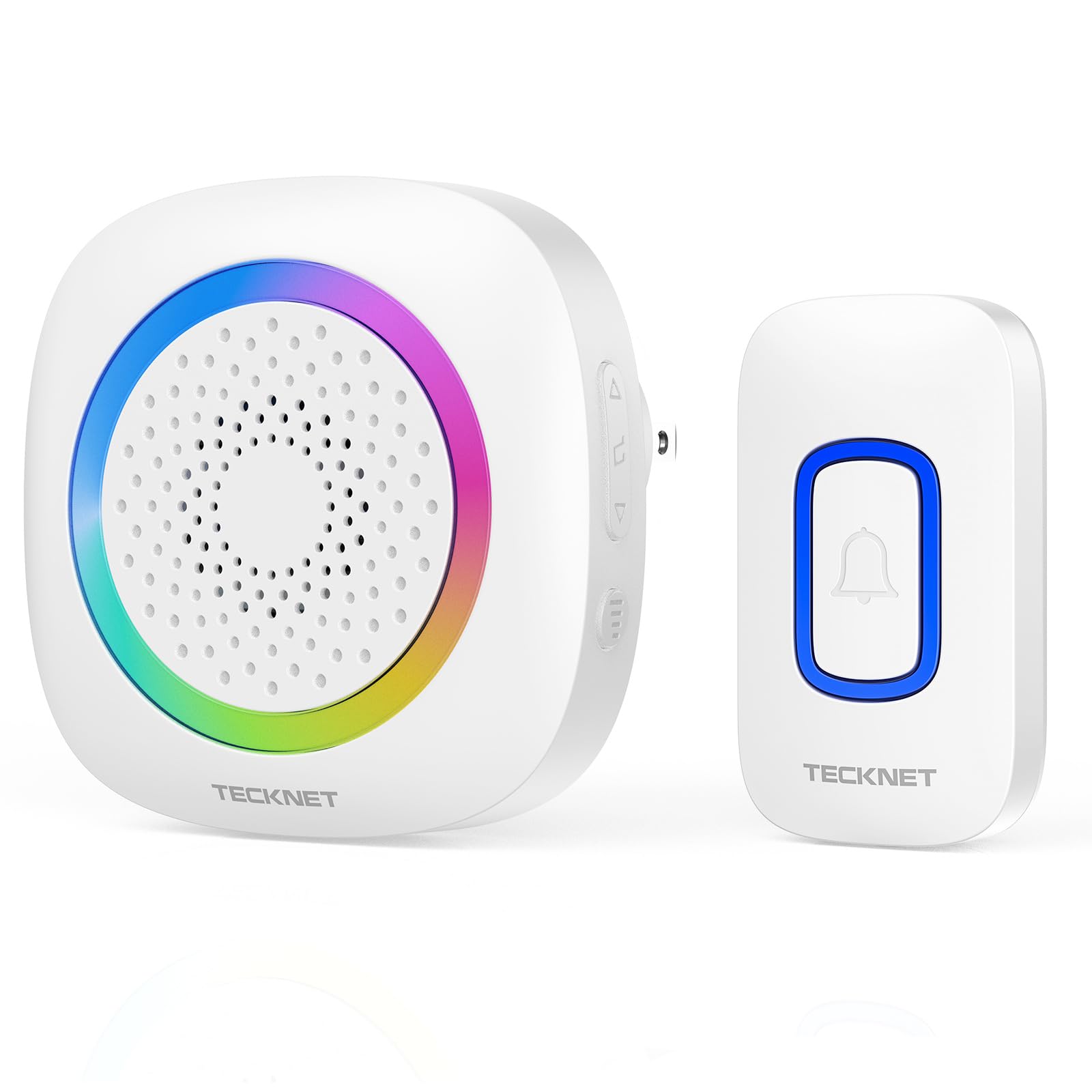
Range: 1,300 ft
Weather Rating: IP66 waterproof button
Chimes: 60
Volume Levels: 5
Battery Life: Up to 4.5 years
Extras: RGB lighting
Check the current price on Amazon
The TECKNET packs the most features per dollar of any pick here. The IP66 rating means the push button survives rain and hose spray, so it can go on an exposed exterior solid wall without a porch roof for cover. The 1,300-foot range covers a large house, a detached garage, or a back garden gate, and sixty chimes plus five volume levels give plenty of room to find a tone the household can live with.
The claimed 4.5-year battery life in the button is the headline for anyone tired of climbing a ladder with a screwdriver. RGB lighting adds a visual alert and a bit of customization. It suits homeowners with big properties and covered or exposed outdoor mounting alike. The caveat is that sixty chimes means a lot of scrolling to find the right one, and the receiver is still a plug-in unit that occupies a socket.
Trade-off: The long feature list comes with a fiddly setup menu for cycling through sixty tones, and the plug-in receiver blocks the outlet it uses.
4. Self-Powered Battery-Free Doorbell

Power Source: Self-powered button, no battery
Range: 1,300 ft
Ringtones: 38
Volume: 120 dB
Receiver: Plug-through design
Weather Resistance: Waterproof button
Check the current price on Amazon
This kit solves the one chore every wireless doorbell owner eventually faces: changing the button battery. The push button generates its own power from the press, so it never needs a cell, never dies at an inconvenient moment, and never strands a homeowner on a ladder. The waterproof button handles outdoor mounting, the 1,300-foot range matches the best here, and the 120 dB chime is loud enough for a large house or a hard-of-hearing resident.
The plug-through receiver is a smart touch — it passes the outlet through so the socket is not lost to the doorbell. Thirty-eight ringtones is a sensible middle ground between two and sixty. This is the pick for anyone who has already replaced a doorbell button battery once and refuses to do it again. The trade-off is that self-powered buttons need a firm, deliberate press, which can be awkward for small hands or visitors unsure how hard to push.
Trade-off: The battery-free button requires a solid press to generate power, so elderly visitors or young children may need to push harder than expected.
5. Ring Chime

Connectivity: Wi-Fi and Bluetooth
Setup: Plug-in
Audio: Enhanced audio for real-time alerts
Design: Sleek white plug-in unit
Compatibility: Ring doorbells and cameras
Best For: Existing Ring households
Check the current price on Amazon
The Ring Chime is not a standalone doorbell — it is the indoor chime for a Ring doorbell or camera, and that distinction matters before buying. For a household already using Ring hardware, it plugs into a wall outlet and extends real-time audio alerts to any room in the house, with Wi-Fi and Bluetooth handling the connection. The sleek white body blends into a hallway outlet better than most chime receivers.
It earns its place here because a solid wall is exactly where a Ring doorbell gets mounted, and the Chime is how that doorbell becomes audible indoors without wiring a mechanical chime. The enhanced audio is noticeably fuller than a basic buzzer. The obvious caution is ecosystem lock-in and price: this is the most expensive pick by a wide margin, and it does nothing at all without a compatible Ring device already in place.
Trade-off: The premium price only makes sense inside the Ring ecosystem, and it adds no doorbell function of its own.
Before You Buy
- Range: Measure the distance from the button to the receiver through walls, not just in open air; solid walls cut signal, so pick a kit rated well above the real distance.
- Power source: Decide between a button battery, a long-life cell, and a self-powered button that never needs changing.
- Mounting: Check whether the kit includes adhesive pads and screws, since solid walls often need both options.
- Weather rating: An exterior button on an exposed wall needs a waterproof rating; a sheltered porch does not.
- Receiver outlet: Confirm the plug-in receiver will not block a socket that is needed for something else; a plug-through design avoids the problem.
- Compatibility: A smart chime such as the Ring only works with matching hardware, so check the ecosystem first.
- Volume and alerts: Households with light sleepers or hearing-impaired residents should look for mute modes and visual LED alerts.
Frequently Asked Questions
-
Will a plug-in doorbell work through a solid brick wall?
Yes, in most cases. Wireless kits are rated for hundreds of feet, and a single solid wall rarely kills the signal — but the rated range assumes open air, so a kit with a longer range gives more margin. -
How do I mount the button without drilling into a solid wall?
Most kits include adhesive pads, and a self-powered or battery button is light enough for strong outdoor tape. Screws and anchors are the more permanent option when drilling is allowed. -
Do plug-in doorbells need Wi-Fi?
Standard wireless kits do not — the button and receiver talk directly. Smart chimes such as the Ring Chime do need Wi-Fi and a compatible doorbell to work. -
What is the loudest option here?
The self-powered model is rated at 120 dB, the highest figure in this roundup, which suits large homes and hard-of-hearing residents. -
Can one button ring more than one receiver?
Many kits support extra receivers, but that depends on the model. Buyers who need coverage on two floors should confirm multi-receiver support before buying. -
How long does the button battery last?
Battery life varies widely; the TECKNET claims up to 4.5 years, while budget buttons typically need a coin cell sooner. A self-powered button avoids the question entirely.
Bottom Line
For most solid-wall installations, the TECKNET Plug in Wireless Doorbell is the best plug in doorbell for a solid wall: the IP66 button survives the weather, the 1,300-foot range reaches across a large house, and the price stays in budget territory. Buyers who never want to touch a button battery should look at the self-powered model instead, and Ring households should go straight to the Chime.