Why there are Amazon links here: Brave Review is paid a commission for qualifying Amazon purchases made through the links below. Your price does not change, and using our links is entirely optional. How this works
Best Programmable Thermostat for Someone Who Works Shifts
Shift workers rarely live on a Monday-to-Friday, nine-to-five rhythm, so a thermostat that only understands weekends and weekdays is close to useless. The best programmable thermostat for someone who works shifts is one that lets every single day run its own schedule — or better, one that can be adjusted from a phone when a shift changes at short notice.
This roundup covers five Honeywell and Sensi models that handle irregular routines well, split between touchscreen programmable units and Wi-Fi smart thermostats. It suits rotating-roster workers, night-shift households, and anyone sharing a home with someone on a different timetable. The overview table below shows the key specification for each pick.
Overview of the Picks
| Product | Key Spec | Best Use | Price Tier |
|---|---|---|---|
| Honeywell Home RTH9585WF1004 | Wi-Fi, 7-day, color touchscreen | Rotating shifts with remote control | Mid |
| Sensi Smart Thermostat ST55 | Wi-Fi, DIY, Alexa | Budget smart control for shift changes | Mid |
| Honeywell Home RTH7600D | 7-day touchscreen | Set-and-forget daily schedules | Budget |
| RTH8560D Honeywell Home | 7-day touchscreen | Simple per-day programming | Budget |
| Honeywell TH4210U2002 T4 Pro | 2H/1C, 1H/1C programmable | Conventional systems on a budget | Budget |
Honeywell Home RTH9585WF1004 Wi-Fi Smart Color Thermostat

Type: Wi-Fi smart thermostat
Programming: 7-day, individual daily schedules
Display: Color touchscreen
Voice Control: Alexa ready
Certification: Energy Star
Finish: Gray
Honeywell Home RTH9585WF1004 Wi-Fi Smart Color Thermostat is the most capable unit in this group. The 7-day programming lets every day of the week carry its own heating and cooling blocks, which is exactly what a rotating roster needs. The color touchscreen is bright and legible, and the gray housing looks more like a small tablet than a utility thermostat.
The Wi-Fi connection is the real advantage for shift work. When a swap lands on the calendar, the schedule can be changed from a phone rather than at the wall. Alexa readiness means voice adjustments are possible too, which helps when someone gets home at an odd hour with cold hands.
Trade-off: The color screen and Wi-Fi radio add cost and complexity, and the unit depends on a stable home network to deliver its remote features.
Check the current price on Amazon
Sensi Smart Thermostat, Wi-Fi, DIY, Alexa, ST55
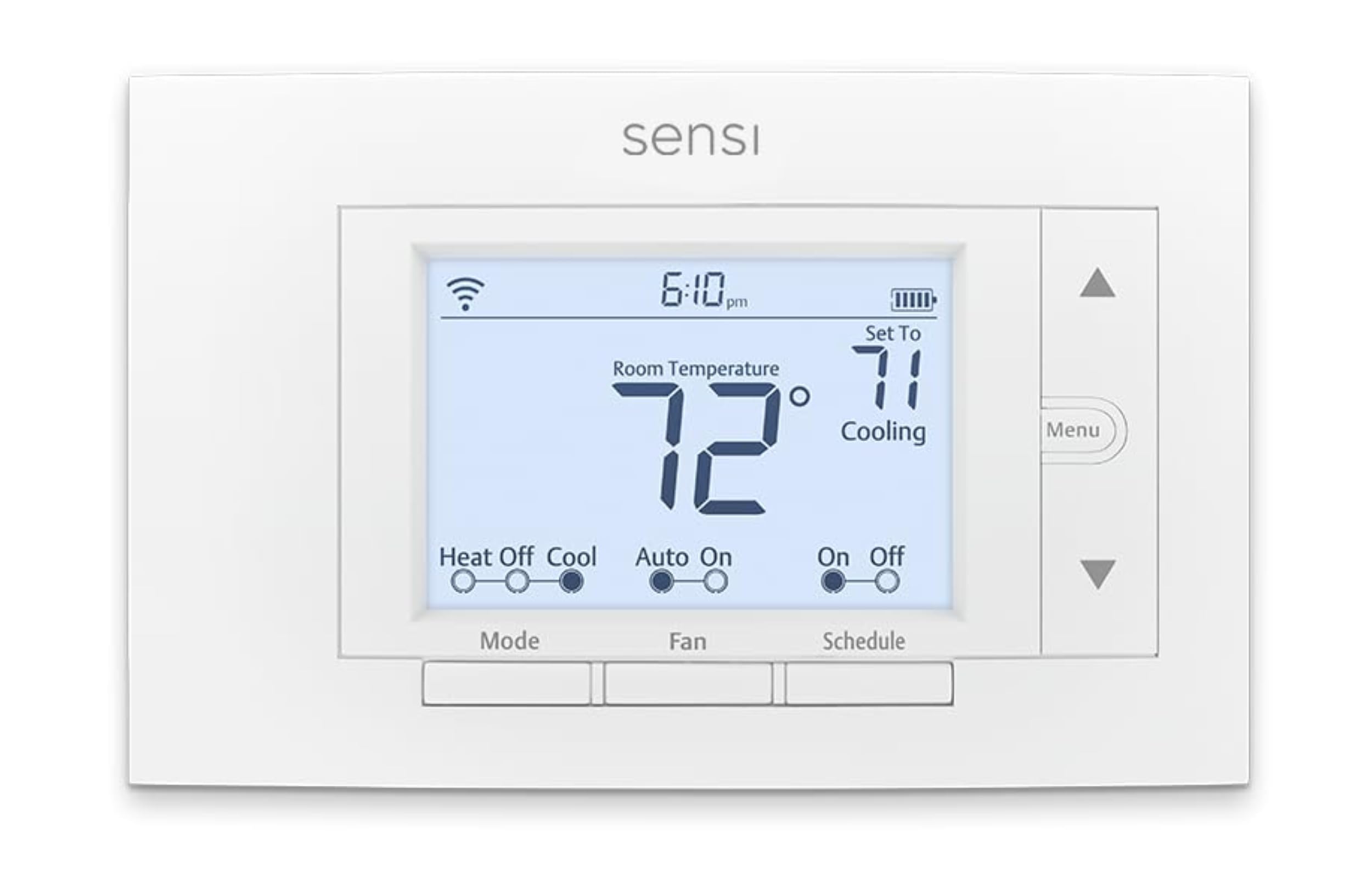
Type: Wi-Fi smart thermostat
Installation: DIY
Voice Control: Alexa
Certification: Energy Star
Programming: Smart scheduling via app
Brand: Sensi
Sensi Smart Thermostat, Wi-Fi, DIY, Alexa, Energy Star Certified, ST55 is the value smart pick. The DIY label means the install is pitched at a homeowner with basic wiring confidence rather than a contractor, and the ST55 has become one of the most popular thermostats in its class for exactly that reason. It carries Energy Star certification, so the efficiency claims are at least third-party checked.
For shift workers, the app-based control is the draw. Schedules can be rebuilt after a roster change without standing in front of the unit, and Alexa adds a hands-free option. The pared-back design keeps the display simple, which suits a hallway or a rental where a big color screen would look out of place.
Trade-off: The feature set is deliberately lean, so buyers wanting detailed runtime charts or multi-zone control should look at a higher tier.
Check the current price on Amazon
Honeywell Home RTH7600D 7-Day Programmable Touchscreen Thermostat

Type: Programmable thermostat
Programming: 7-day
Display: Touchscreen
Connectivity: None
Brand: Honeywell Home
Best For: Fixed weekly routines**
Honeywell Home RTH7600D 7-Day Programmable Touchscreen Thermostat is the classic answer to an irregular week. Each day can be programmed separately, so a worker on a repeating two-week pattern can at least build two distinct schedules and switch between them. The touchscreen is straightforward, with large targets that are easy to hit in a dim hallway.
Because there is no Wi-Fi, this unit never needs an app, an account or a firmware update. That makes it a sensible choice for a rental, a workshop or a home where the network is unreliable. The wiring is conventional and the faceplate is plain enough to blend into most walls.
Trade-off: Without connectivity, any schedule change has to be made at the wall, which is frustrating when a shift swap arrives by text at 10 p.m.
Check the current price on Amazon
RTH8560D Honeywell Home 7 Day Programmable Touchscreen Thermostat

Type: Programmable thermostat
Programming: 7-day
Display: Touchscreen
Connectivity: None
Brand: Honeywell Home
Best For: Straightforward daily scheduling
RTH8560D Honeywell Home 7 Day Programmable Touchscreen Thermostat sits close to the RTH7600D in concept and price, and the choice between them comes down to availability and which interface a buyer prefers. The 7-day structure is the important part: it refuses to force every weekday into one block, so a Monday day shift and a Tuesday night shift can both be programmed.
The touchscreen keeps the number of physical buttons low, which reduces wear and makes cleaning simple. Setup is a manual, on-device job, so the first configuration takes a few minutes of patience. After that the unit runs quietly in the background.
Trade-off: It is a programmable thermostat rather than a smart one, so there is no phone access and no learning behaviour to fall back on when the routine changes.
Check the current price on Amazon
Honeywell TH4210U2002 T4 Pro Programmable Thermostat

Type: Programmable thermostat
System Support: 2H/1C and 1H/1C configurations
Display: Digital
Connectivity: None
Brand: Honeywell
Best For: Standard single-zone systems
Honeywell TH4210U2002 T4 Pro Programmable Thermostat 2H/1C 1H/1C is the budget entry and the one to check first if the existing system is a conventional single-stage setup. The 2H/1C and 1H/1C ratings describe how many heating and cooling stages it can drive, which covers the majority of older forced-air homes. It is a Pro-series unit, so the build is aimed at trade installation rather than a lifestyle gadget.
The interface is plain and the programming is functional rather than clever. For a shift worker on a fixed repeating pattern, that is enough: set the wake, leave, return and sleep blocks per day and let it run. The low price also makes it a reasonable choice for a second property or a garage conversion.
Trade-off: The feature list is short and there is no remote access, so a household that changes plans often will outgrow it quickly.
Check the current price on Amazon
Before You Buy
- Programming flexibility: Confirm the thermostat allows a separate schedule for each day of the week; a 5-2 model cannot follow a rotating roster.
- Connectivity: A Wi-Fi unit is worth the extra spend for anyone whose shifts change at short notice, because schedules can be edited remotely.
- System compatibility: Match the thermostat to the HVAC stages in the home; the T4 Pro’s 2H/1C and 1H/1C ratings are the relevant figures.
- Wiring: Check how many wires the existing thermostat uses and whether a C-wire is present before ordering a smart model.
- Installation appetite: DIY-friendly units suit confident homeowners, while pro-oriented models may warrant an installer.
- Voice assistants: Alexa readiness adds hands-free control, useful for anyone arriving home late and tired.
Frequently Asked Questions
-
Can a 7-day thermostat handle a rotating shift pattern?
Yes — a 7-day model lets each day carry its own schedule, so different shift types can be programmed individually. A 5-2 thermostat cannot do this. -
Is Wi-Fi worth it for shift workers?
For anyone whose roster changes often, yes. Remote editing removes the need to reprogram at the wall every time a swap happens. -
What does 2H/1C mean on the T4 Pro?
It describes support for up to two heating stages and one cooling stage, or one heating and one cooling stage. It covers most conventional single-zone systems. -
Do these thermostats need a C-wire?
Smart Wi-Fi models generally need a constant power connection, while basic programmable units often run on batteries. The wiring should be checked before purchase. -
Can a shift worker still save energy with an irregular schedule?
Yes. Programming the unoccupied blocks accurately, and using remote control to correct them, keeps runtimes down without a fixed routine. -
Which pick suits a renter?
A basic programmable model such as the RTH7600D is the easiest to justify, since it needs no account and can be swapped back at the end of a lease.
Bottom Line
For most shift workers, the Honeywell Home RTH9585WF1004 is the pick that earns its price: a full 7-day schedule plus Wi-Fi control means a roster change takes seconds to absorb. Buyers who want smart control on a tighter budget should look at the Sensi ST55, and anyone with a fixed repeating pattern can save money with the RTH7600D.