Why there are Amazon links here: Brave Review is paid a commission for qualifying Amazon purchases made through the links below. Your price does not change, and using our links is entirely optional. How this works
Best Smart Heating for a House With a Conservatory
A conservatory is the hardest room in the house to heat well: it gains and loses heat faster than the rest of the building, and a single house thermostat rarely knows what is happening out there. This guide covers the best smart heating for a house with a conservatory, mixing room-level panel heaters with whole-home smart thermostats so a buyer can solve the problem from either end. The picks suit three types of buyer: the one who wants the conservatory itself warmed without touching the main system, the one replacing an old thermostat to control the whole house, and the one who wants both linked together. The overview below puts all five side by side; the reviews that follow explain who each one fits.
The Picks at a Glance
| Product | Key Spec | Best Use | Price Tier |
|---|---|---|---|
| Pasapair 1500W Smart Quiet Convection Panel Heater | 1500W, WiFi & Alexa, IP24 | Warming the conservatory directly | Budget |
| ecobee Smart Thermostat Essential | WiFi, Siri/Alexa/Google, Energy Star | Whole-home smart control on a budget | Mid |
| EnviMAX 220v Hardwired Electric Panel Wall Heater | 1000W, hardwired, app control | Permanent wall heat for large rooms | Premium |
| ecobee Smart Thermostat Premium | WiFi, Siri & Alexa built in, smart sensor | Full-featured whole-home control | Premium |
| Honeywell Home RTH9585WF1004 Wi-Fi Smart Color Thermostat | 7-day programmable, touch screen, Energy Star | Familiar thermostat brand with app control | Mid |
Pasapair 1500W Smart Quiet Convection Panel Heater

Type: Freestanding or wall-mounted convection panel heater
Power: 1500W
Control: App, remote, WiFi and Alexa
Temperature Range: 41–95°F
Protection: IP24 splash-proof, overheat and tip-over protection
Timer: 24-hour
Pasapair 1500W Smart Quiet Convection Panel Heater
This is the most direct answer to a cold conservatory: a self-contained convection panel that heats the room it stands in rather than asking the central heating to reach a glazed extension. The 1500W element and three heating modes give a buyer a choice between a quick warm-up and a gentler background heat, and convection design means no fan noise and no glowing bars. The IP24 rating makes it a sensible fit for a conservatory where condensation and damp are part of life, and the overheat and tip-over cut-outs are the safety features that matter in a room used by children or pets. The 24-hour timer and app control mean it can be scheduled to take the chill off before the room is used.
It earned its place as the budget pick because it solves the conservatory problem without touching the boiler, the wiring or the existing thermostat. Buyers who use the conservatory as a home office, a breakfast room or a garden-room extension will find it covers a normal single-room footprint comfortably, and the wall-mount option frees up floor space in a small footprint. It is not for someone heating a large open-plan space, where a single 1500W panel will struggle on the coldest days, and it will not integrate with a whole-home heating schedule the way a smart thermostat does.
Trade-off: A plug-in panel heater of this size warms one room well but adds to electricity use rather than replacing gas central heating, so it is a comfort purchase, not a cost-saving one.
ecobee Smart Thermostat Essential

Type: Programmable WiFi thermostat
Voice Assistants: Siri, Alexa and Google Assistant
Certification: Energy Star
Function: Whole-home heating and cooling control
Installation: Replaces an existing thermostat
ecobee Smart Thermostat Essential
The Essential is the entry point into ecobee’s ecosystem and the sensible choice for a household that wants proper smart control without paying premium money. It is a programmable WiFi thermostat that replaces the existing wall unit and works with all three major voice assistants, so the conservatory question becomes a scheduling question: the house can be warmed before the room is used rather than heated all day. The Energy Star certification signals that the scheduling and setback features are built to cut run time rather than just add an app. For a house where the conservatory is on the same heating circuit as the rest of the ground floor, this is the piece that makes the whole system smarter.
It suits buyers who already have a conventional thermostat and a C-wire-friendly setup, and who want one app for the whole house. It is the wrong pick for a conservatory on its own circuit with no thermostat wiring, and it will not fix a room that loses heat faster than the boiler can replace it — that is a job for a panel heater. Buyers who want remote sensors included should look at the Premium instead, since the Essential is the pared-back model in the range.
Trade-off: The Essential is the stripped-down ecobee, so buyers who want the full sensor package and richer room-by-room control will find it limited compared with the Premium.
EnviMAX 220v Hardwired Electric Panel Wall Heater
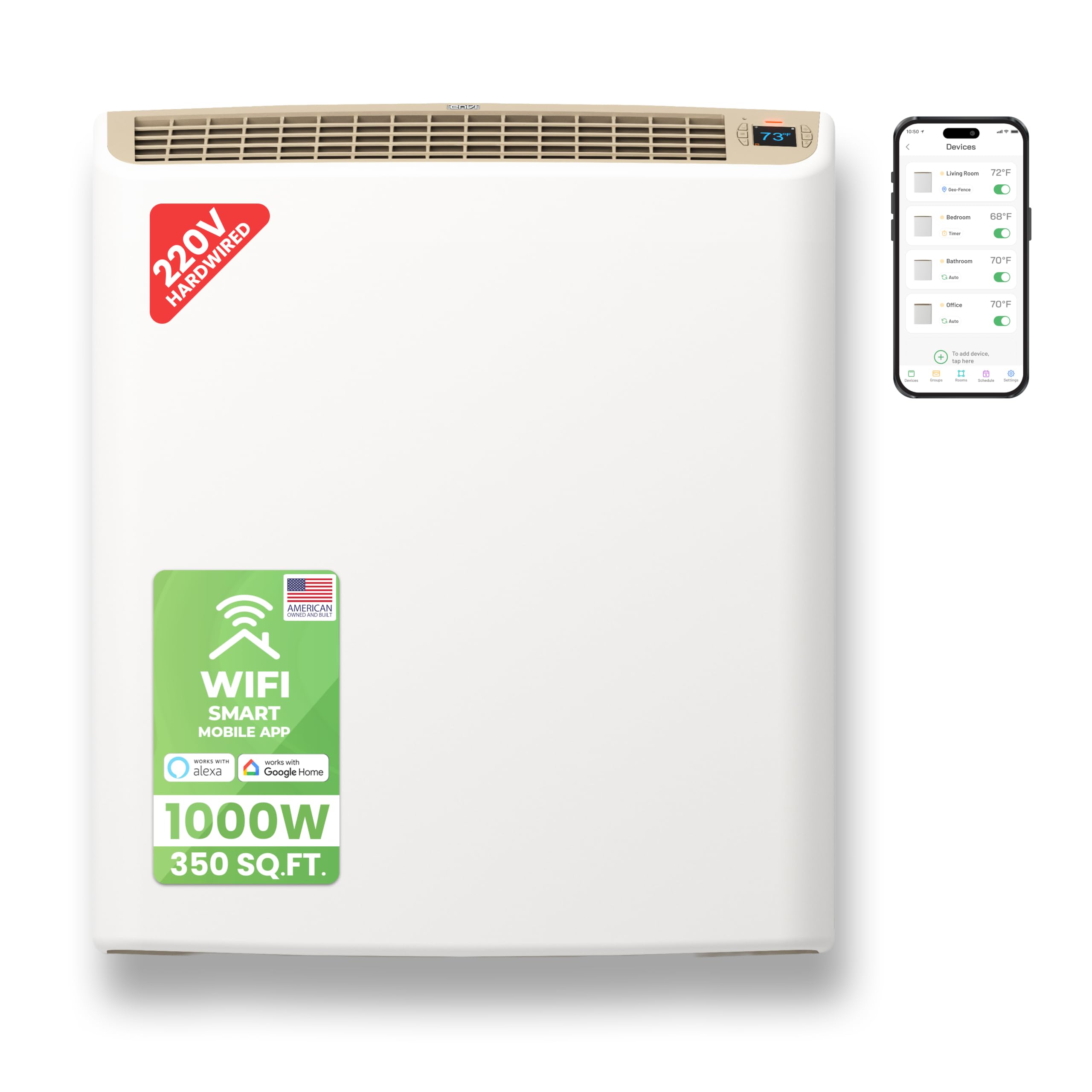
Type: Hardwired electric wall panel heater
Power: 1000W
Voltage: 220V
Control: Smart app, Alexa and Google
Protection: Thermal shut-off
Intended Use: Large rooms
EnviMAX 220v Hardwired Electric Panel Wall Heater
This is the permanent-fixture option: a hardwired 220V wall panel that is installed like a radiator rather than plugged in like an appliance. The 1000W output is lower than the portable Pasapair, but a hardwired panel runs continuously and radiates steadily, which suits a conservatory used through the day rather than in short bursts. The thermal shut-off is the safety backstop, and the app plus Alexa and Google support means it can be scheduled alongside the rest of the smart home. It is designed for large rooms, which is the right framing for a conservatory that is more than a small sunroom.
It earned its place as the premium pick for buyers who want the heater off the floor and permanently wired, with no cable to trip over and no unit to move. The hardwired installation is also the drawback: this is not a DIY swap, and a buyer needs an electrician and a suitable circuit before it can go on the wall. It is not for renters or anyone who wants to take the heater with them, and the 220V requirement rules out a simple plug-in installation in most US homes.
Trade-off: Hardwiring means electrician costs and a permanent commitment, and the 220V supply requirement will rule this out for many buyers before the price even matters.
ecobee Smart Thermostat Premium

Type: WiFi smart thermostat with built-in smart sensor
Voice Assistants: Siri and Alexa built in, Google Home compatible
Function: Whole-home control, air quality monitoring, doorbell live view
Certification: Energy Star
Installation: Replaces an existing thermostat
ecobee Smart Thermostat Premium
The Premium is the top of ecobee’s line and the pick for a household that wants the thermostat to do more than switch the boiler. It has Siri and Alexa built in, so voice control works without a separate speaker, and it doubles as an air quality monitor that reports on the indoor environment — useful in a conservatory where ventilation and damp are recurring concerns. The included smart sensor is the feature that matters most here: placing it in the conservatory lets the thermostat see that room’s temperature and balance the house against it rather than against a hallway. Live view from an ecobee doorbell is a bonus for buyers already in that ecosystem.
It suits buyers who want one hub for heating, air quality and voice, and who are willing to pay for the sensor-driven room balancing that makes a conservatory less of a blind spot. It is not for a tight budget, since the Essential covers basic scheduling for less, and buyers with no interest in air quality or doorbell integration are paying for features they will not use. The conservatory still needs its own heat source on the coldest days; the Premium manages the house, it does not add heat.
Trade-off: The premium price buys sensors and air quality monitoring rather than more heating power, so a buyer who only wants scheduling is overpaying for this model.
Honeywell Home RTH9585WF1004 Wi-Fi Smart Color Thermostat

Type: WiFi smart thermostat with color touch screen
Programming: 7-day programmable
Certification: Energy Star
Voice Control: Alexa ready
Color: Gray
Installation: Replaces an existing thermostat
Honeywell Home RTH9585WF1004 Wi-Fi Smart Color Thermostat
The Honeywell Home is the familiar-brand pick: a 7-day programmable WiFi thermostat with a color touch screen that behaves the way a conventional thermostat user expects, with app control layered on top. The 7-day programming is the practical part for a conservatory household, since weekdays and weekends can be scheduled separately and the room can be warmed before it is used. The color touch screen makes on-wall adjustments obvious to anyone in the house, which matters in a shared home where not everyone wants to use an app. Alexa readiness adds voice control for buyers who already have an Echo.
It earned its place for buyers who want a known thermostat brand and a screen they can read at a glance, rather than an ecosystem hub. It is not the right pick for someone who wants built-in voice assistants or room sensors, since it is a more traditional programmable thermostat with WiFi rather than a sensor-driven platform. Buyers replacing an older Honeywell will find the wiring familiar, which is a real advantage for a straightforward swap.
Trade-off: This is a conventional programmable thermostat with app control rather than a sensor-based smart platform, so it schedules the house but cannot balance a conservatory against the rooms around it.
Before You Buy
- Room vs. whole house: A panel heater warms the conservatory directly; a smart thermostat manages the existing heating system. Most conservatory owners need the first, and many benefit from both.
- Power and wiring: Plug-in panel heaters need only a socket, while hardwired models need a 220V circuit and an electrician. Thermostats need compatible wiring, usually including a C-wire.
- Ecosystem compatibility: Check whether the household uses Alexa, Google or Siri before buying, since support varies by model and built-in assistants cost more.
- Room size: Match heater output to the conservatory’s footprint. A single 1000–1500W panel suits a normal conservatory; larger glazed spaces need more than one source.
- Safety features: Overheat and tip-over protection matter in a room used by children or pets, and splash-proofing is worth having where condensation forms.
- Scheduling: A 24-hour timer or 7-day programming is what turns a heater or thermostat from manual to genuinely smart, so check the timer before buying.
Frequently Asked Questions
-
Can a smart thermostat heat a conservatory on its own?
Only if the conservatory is on the same heating circuit as the rest of the house and the boiler can keep up. A thermostat manages the system; it does not add heat, so a room that loses heat quickly usually needs its own panel heater. -
Is a panel heater or a smart thermostat the better first purchase?
For most conservatory owners, the panel heater. It solves the room directly and works independently of the boiler, while a thermostat is the upgrade once the whole-house schedule needs sorting out. -
Do these heaters work with Alexa and Google?
The Pasapair, EnviMAX, ecobee models and the Honeywell all offer voice control, though the exact assistant varies. The ecobee Premium has Siri and Alexa built in, while the Honeywell is Alexa ready rather than built in. -
How much heater output does a conservatory need?
A 1000–1500W panel is the usual range for a standard conservatory. Larger or poorly insulated glazed rooms may need more than one unit, and hardwired panels are the better choice for all-day heating. -
Can a renter install smart heating for a conservatory?
Yes, with a plug-in panel heater and a thermostat that does not require rewiring. Hardwired panels and thermostat swaps are for owners or need landlord approval. -
Does smart heating save money in a conservatory?
Scheduling and room-level control cut wasted run time, but a conservatory is inherently lossy. The savings come from heating it only when used, not from making the room efficient.
Bottom Line
For most houses with a conservatory, the fastest fix is the Pasapair 1500W Smart Quiet Convection Panel Heater: it heats the room directly, runs quietly, and adds app and voice control without touching the boiler. Pair it with the ecobee Smart Thermostat Essential if the whole-house schedule also needs sorting out, and step up to the Premium only if room sensors and air quality monitoring are worth the extra spend.
