Why there are Amazon links here: Brave Review is paid a commission for qualifying Amazon purchases made through the links below. Your price does not change, and using our links is entirely optional. How this works
Best Smart Thermostat for Underfloor Heating for App Control and Energy Savings
Underfloor heating is slow to warm and expensive to run carelessly, so the thermostat matters more than it does on a radiator system. This guide covers five smart thermostats chosen for electric floor heating, ranging from a budget-friendly wired controller to a Matter-ready single-zone model. It suits DIY installers replacing an old dial stat, renovators wiring a new floor mat, and homeowners who want schedule and app control without a full smart-home rebuild. The overview below puts every pick side by side first.
Overview of the Picks
| Product | Key Spec | Best Use | Price Tier |
|---|---|---|---|
| 6iE Smart WiFi Thermostat | Ultra-thin touchscreen, SmartGeo | Design-led retrofits | Mid |
| SunTouch SunStat CommandPlus 4.3" | 4.3-inch touchscreen, 7-day schedule | Easy DIY replacement | Mid |
| Warmup 7iE Smart Thermostat | Matter technology, single zone | Smart-home integration | Premium |
| SunTouch SunStat CommandPlus GFCI | Built-in GFCI, floor sensor | Electric heat cables | Mid |
| Programmable Radiant Heat Controller | Dual sensing, Class A GFCI | Budget builds | Budget |
1. 6iE Smart WiFi Thermostat for Underfloor Heating

Type: Wired WiFi thermostat
Display: Smartphone-style touchscreen
Design: Ultra-thin profile
Control: App control with SmartGeo
Focus: Energy saving
The 6iE leans on presentation as much as function. Its ultra-thin body and phone-like touchscreen make it the pick for a visible hallway or kitchen wall where a chunky dial stat would look out of place, and the WiFi radio brings app control plus SmartGeo location-based adjustment. That geo feature is the real story for floor heating: it can scale back the schedule when nobody is home, which matters because a warm slab keeps giving off heat long after the system switches off.
It suits design-conscious renovators and anyone replacing a dated thermostat in a room where the wall is on show. Buyers wanting a simple set-and-forget unit may find the touchscreen interface more than they need, and the slim housing leaves little room for error when dressing cables behind the plate.
Trade-off: The thin housing and touchscreen interface put more of the setup burden on careful wiring and app pairing than a plain dial unit would.
2. SunTouch SunStat CommandPlus Wi-Fi Thermostat 4.3" Screen

Type: Wired WiFi floor heating thermostat
Display: 4.3-inch touchscreen
Scheduling: 7-day program
Sensing: Floor and air
Extras: Energy monitor, remote app access
This SunTouch model is the practical all-rounder of the group. The large 4.3-inch screen makes the 7-day schedule readable at a glance, dual floor and air sensing keeps the slab at the target rather than guessing from room temperature, and the energy monitor gives a running picture of what the floor is costing. Remote app access means the schedule can be adjusted without crouching at the wall.
It suits homeowners who want straightforward programming with real feedback, and the easy-install framing makes it a reasonable DIY swap for an existing floor stat. The screen is the largest here, so it needs a wall plate with enough clearance, and the feature set rewards buyers who will actually use the schedule.
Trade-off: The big display and full schedule menu make this a busier wall unit than a minimal dial, and it rewards buyers who will use the programming.
3. Warmup 7iE Smart Thermostat
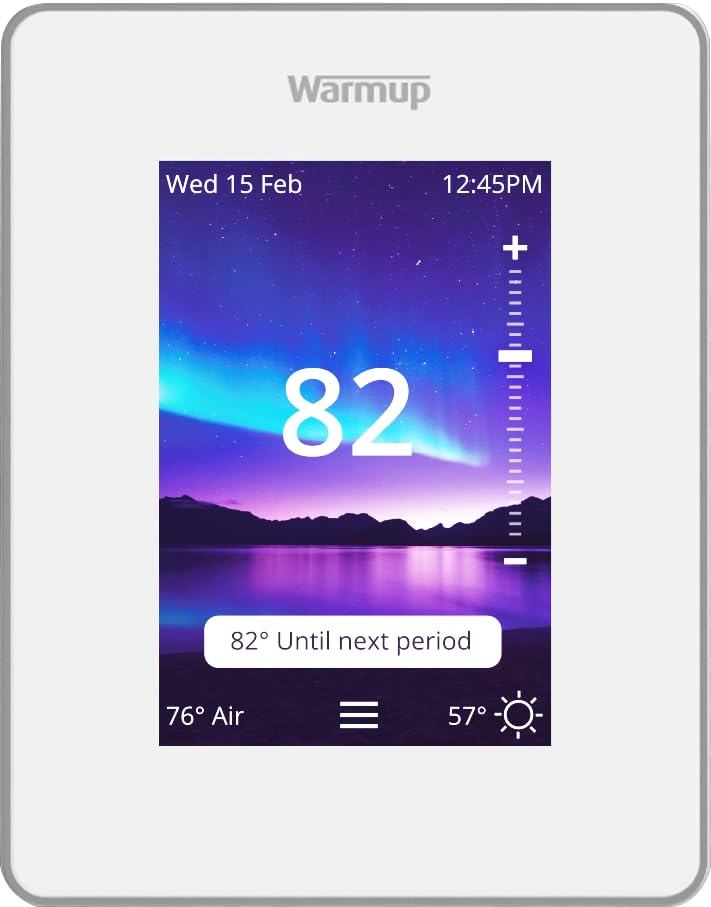
Type: Wired WiFi thermostat
Zones: Single zone
Heating: Underfloor and radiator control
Protocol: Matter technology
Install: DIY
Color: White
The 7iE is the premium pick and the only one here built around Matter. That protocol support means it can join a broader smart-home ecosystem rather than living in a single manufacturer app, and it handles both underfloor and radiator heating from one single-zone controller. Smartcare adds a layer of adaptive control on top of the schedule.
It suits buyers already running a Matter-compatible hub who want the floor heating to sit inside that system, and households with a mixed floor-and-radiator setup in one zone. The single-zone limit is the catch: a multi-room floor installation needs one unit per zone, which pushes the total cost up quickly at this price tier.
Trade-off: Single-zone control at a premium price means multi-room installations need several units, so the total spend climbs fast.
4. SunTouch SunStat CommandPlus Smart WiFi Touchscreen Floor Thermostat
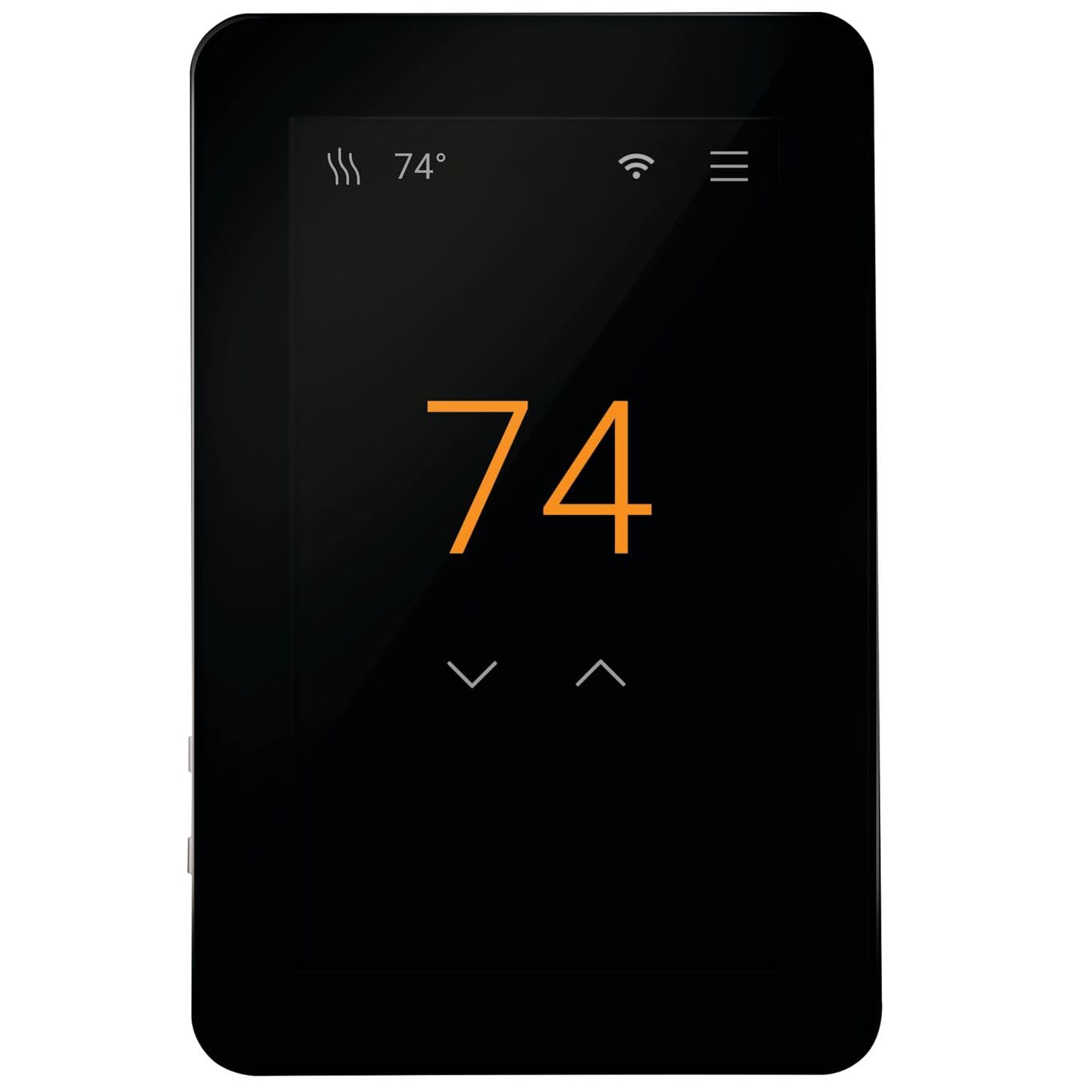
Type: Wired WiFi floor heating thermostat
Display: Touchscreen
Sensor: Floor temperature sensor
Safety: Built-in GFCI
Voltage: 120-240V heat cables
This is the variant built specifically for electric heat cables, and the built-in GFCI is the reason to choose it. Ground-fault protection at the thermostat is a practical requirement for wet-area floor heating, and having it integrated simplifies the install versus adding a separate protective device. The floor temperature sensor keeps the cable system running to slab temperature, and the 120-240V rating covers the common residential cable voltages.
It suits anyone wiring a new electric floor mat or cable run, especially in a bathroom or kitchen where ground-fault protection is non-negotiable. Buyers on a hydraulic or warm-water system should look elsewhere, since this unit is aimed at electric cables rather than a boiler circuit.
Trade-off: This model is aimed at electric cable systems, so it is the wrong choice for a water-based floor loop.
5. Programmable Thermostat for House Radiant Underfloor Heating

Type: Programmable radiant floor controller
Voltage: Self-adapting AC 120/240V
Sensing: Dual air and floor sensor
Safety: Built-in Class A GFCI
Power: 3600W
The budget pick covers the essentials at a fraction of the outlay. Self-adapting AC voltage means the same unit works on either 120V or 240V supply, dual air and floor sensing handles both slab and room temperature, and the built-in Class A GFCI covers the safety requirement for a floor mat circuit. The 3600W power rating is generous for a single residential zone.
It suits cost-conscious DIYers wiring a floor mat in a bathroom, mudroom or small extension, and anyone who wants a reliable controller without app dependency. The obvious trade: there is no WiFi or app control here, so scheduling happens at the wall, and the feature set is functional rather than polished.
Trade-off: No WiFi or app control, so scheduling and adjustments happen at the unit itself rather than from a phone.
Before You Buy
- Heating type: Confirm whether the floor is electric cable or mat versus a water-based loop — most smart stats here are for electric systems, and the Warmup 7iE is the one that also lists radiator control.
- Voltage: Check the supply against the unit’s rating; the budget pick self-adapts between 120V and 240V, while the SunTouch cable model is rated 120-240V.
- GFCI: For electric floor heating, built-in ground-fault protection simplifies the install and is listed on two picks here.
- Sensing: Dual air and floor sensing keeps the slab at target temperature; a floor-only sensor is fine for a single wet room.
- Zones: Count the rooms separately controlled — the Warmup 7iE is single-zone, so a multi-room floor needs one unit per zone.
- Smart-home ecosystem: Matter support on the 7iE matters only if a compatible hub is already in place; otherwise app control on the 6iE or SunTouch is enough.
- Wall clearance: The 4.3-inch SunTouch screen and the ultra-thin 6iE have different mounting footprints, so check the wall plate and cable depth before ordering.
Frequently Asked Questions
-
Can any smart thermostat run underfloor heating?
No. The thermostat must be rated for the floor heating circuit and, on electric systems, matched to the cable or mat voltage. The picks here are all specified for radiant floor heating. -
Is a floor sensor necessary?
A floor sensor reads slab temperature directly, which is more accurate than air temperature alone for slow-response floor heating. Dual-sensing models give the best of both. -
What does built-in GFCI mean for installation?
It means ground-fault protection sits inside the thermostat rather than in a separate device, which simplifies wiring on an electric floor circuit. -
Does the budget pick work on both 120V and 240V?
Yes — the self-adapting AC design covers both voltages, which makes it flexible across different floor mat specifications. -
Which pick works with a smart-home hub?
The Warmup 7iE lists Matter technology, making it the pick for buyers who want floor heating inside a broader ecosystem. -
How many thermostats are needed for a multi-room floor?
One per independently controlled zone. The Warmup 7iE is explicitly single-zone, so a whole-house installation needs several units.
Bottom Line
For most buyers, the SunTouch SunStat CommandPlus with the 4.3-inch screen is the best smart thermostat for underfloor heating: a readable schedule, dual sensing, energy monitoring and app access at a mid-tier price. Buyers wiring electric cables in a wet area should step to the GFCI variant, and anyone building around a Matter hub should pay the premium for the Warmup 7iE.