Why there are Amazon links here: Brave Review is paid a commission for qualifying Amazon purchases made through the links below. Your price does not change, and using our links is entirely optional. How this works
Best Solar Panel Kit for a Shed with No Mains Power
A shed with no mains power can still run lights, a charger, a small fridge or a workshop tool — the trick is buying a kit where the panels, controller, battery and inverter are already matched. This guide covers five complete off-grid solar panel kits for a shed with no mains power, from a compact cabin-sized system to whole-property hardware. It suits three kinds of buyer: the shed owner who wants a few lights and a socket, the hobbyist running real tools, and the property owner who needs serious stored energy. The overview table below shows the field at a glance; each entry is then reviewed in turn.
Overview Of The Picks
| Product | Key Spec | Best Use | Price Tier |
|---|---|---|---|
| ECO WORTHY 10000W Output Complete Off-Grid Solar Panel Kit | 10kW split-phase output, 16.1kWh storage | Whole-property backup | Premium |
| 1280WH Complete Off-Grid Solar Panel Kit | 1280Wh, 1000W inverter | Shed lights and small devices | Budget |
| 4 x 100W Solar Panel Kit with 2000W Inverter | 400W PV, 1.6kWh lithium | Shed workshop with inverter loads | Mid-range |
| Renogy 400Watt Premium Solar Kit | 400W PV, 40A MPPT | Expandable panel-first builds | Mid-range |
| ECO-WORTHY 10KW Output 9.36KWH Off Grid Solar System | 2340W PV, 10.24kWh lithium | Off-grid cabin or large shed | Premium |
ECO WORTHY 10000W Output Complete Off-Grid Solar Panel Kit
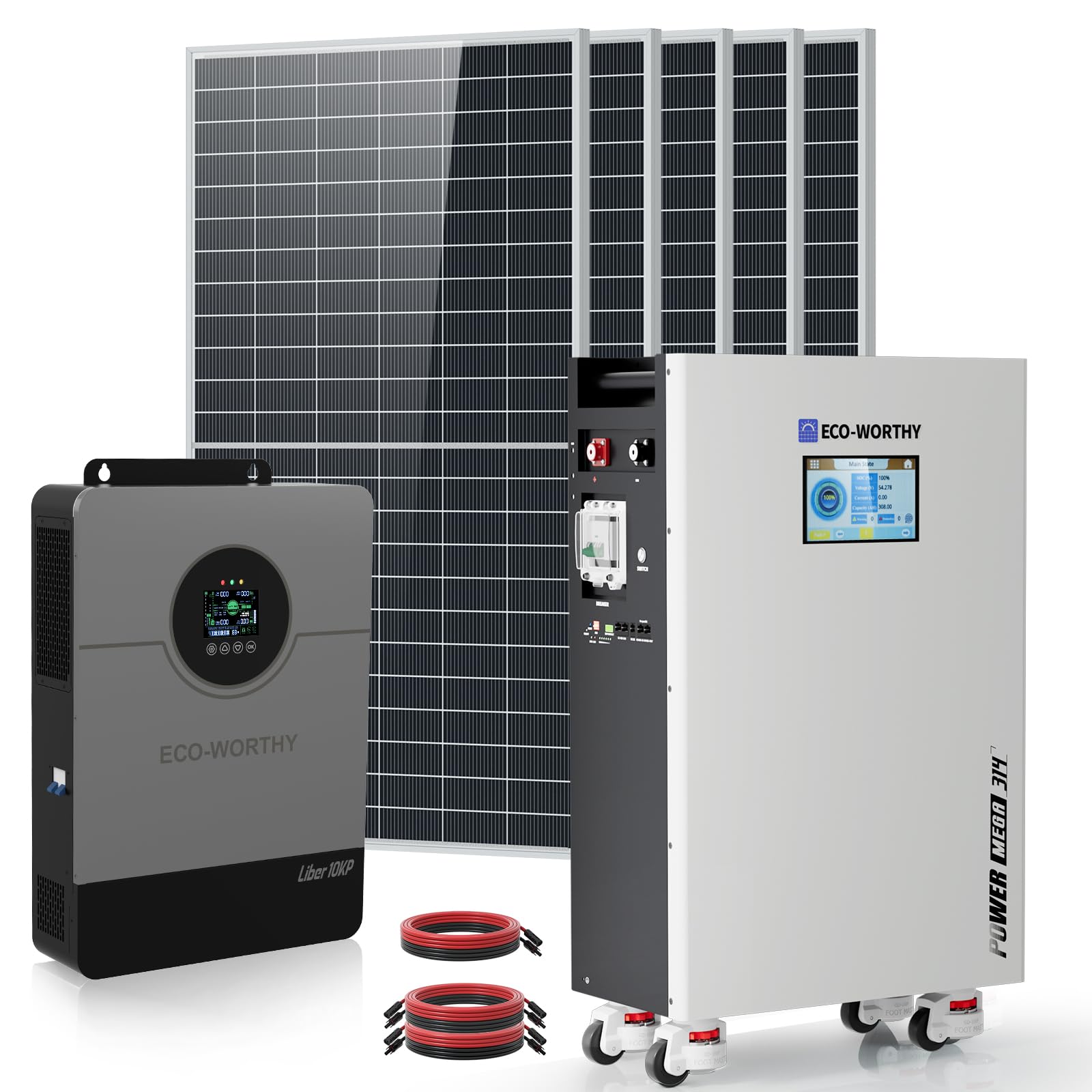
Output: 10000W
Inverter Type: 120V/240V split phase
Battery: 48V 314Ah
Storage Capacity: 16.1kWh
Solar Array: 2950W PV
This is the largest kit in the roundup and the only one built around a split-phase inverter, which is what allows 240V equipment to run alongside ordinary 120V circuits. The 48V battery architecture keeps current low across a very large storage bank, and the 2950W panel array is sized to recharge that bank at a useful rate. Buyers normally pair a system like this with a transfer switch or sub-panel rather than a single outlet.
The kit suits a property owner who wants the shed to carry real load — a workshop, a pump, or backup circuits for the house — and who has the roof or ground space for a full panel array. It is not for a buyer who wants a weekend lighting project; the cost and the installation work are on a different scale entirely. The 48V architecture also means the battery bank is not something to reconfigure casually later.
Trade-off: At this price and power level the kit assumes a qualified installer and a proper mounting structure, and the panel array alone needs far more space than a small shed roof provides.
1280WH Complete Off-Grid Solar Panel Kit
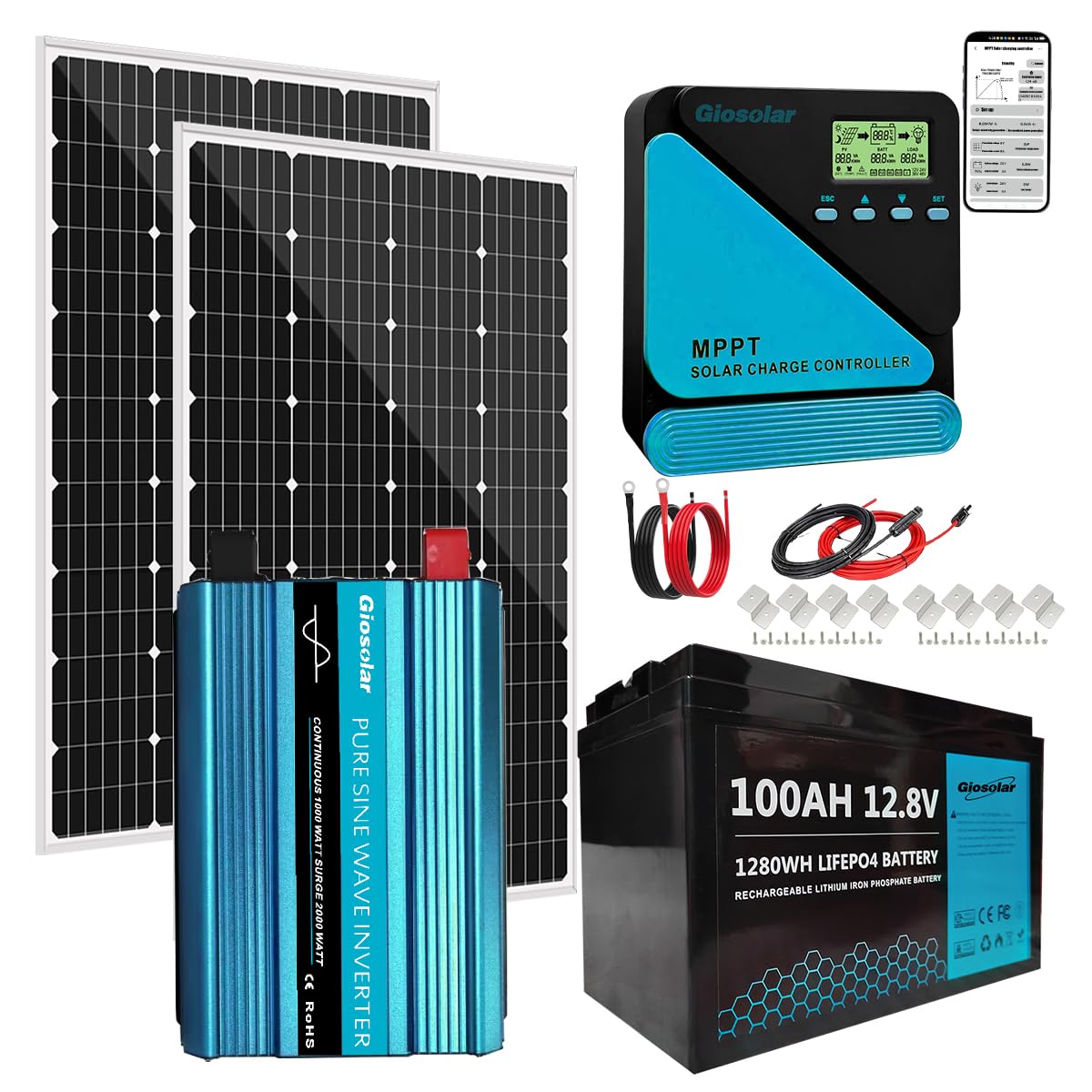
Storage Capacity: 1280Wh
Battery: 100Ah 12.8V LiFePO4
Inverter: 1000W pure sine wave
Controller: 20A MPPT
Solar Panels: 2 x 120W monocrystalline
Intended Use: RV, boat, cabin, shed, home backup
This is the entry point to the roundup and the closest thing to a plug-in-and-go shed system. The 100Ah lithium battery stores 1280Wh, the 1000W pure sine inverter runs sensitive electronics cleanly, and the MPPT controller gets the most out of the two 120W monocrystalline panels. Everything needed to charge and distribute power is in the box.
It suits a shed owner running LED lighting, a Wi-Fi access point, tool chargers, a small fridge or a laptop, and it is the pick for anyone who wants a single purchase with no matching of parts. It is not for a buyer planning to run a table saw, a compressor or a heater — those loads will exhaust 1280Wh quickly. The 20A controller also caps how much extra panel can be added later.
Trade-off: The battery bank and controller are sized for light, steady loads, so the kit leaves little headroom for expansion or for high-draw power tools.
4 x 100W Solar Panel Kit with 2000W Inverter
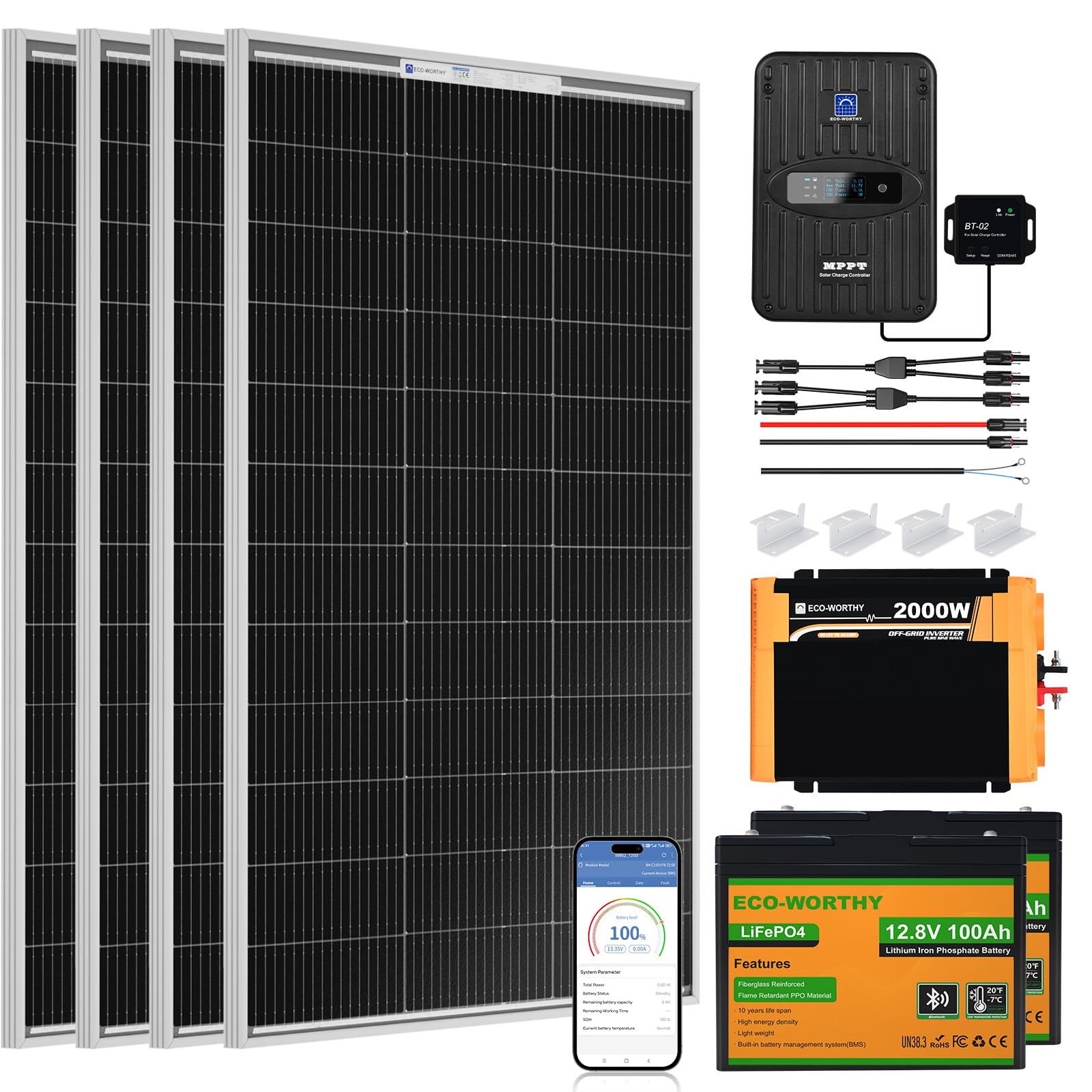
Solar Array: 4 x 100W panels
Controller: 40A MPPT
Battery: 2 x 12V 100Ah lithium
Storage Capacity: 1.6kWh
Inverter: 2000W
Extras: Bluetooth module
System Voltage: 12V
This kit steps up the panel count and the inverter size together, which is the combination a working shed actually needs. Four 100W panels feed a 40A MPPT controller, two 12V 100Ah lithium batteries give 1.6kWh of storage, and the 2000W inverter can start and run larger tools than the budget pick. The included Bluetooth module lets the system be monitored without opening the enclosure.
It suits the hobbyist or small-trades user who wants to run a mitre saw, a shop vac or a battery charger bank from the shed, and who values seeing charge state at a glance. It is not for a buyer who wants the simplest possible install — four panels, two batteries and a separate inverter mean more wiring and more planning. Buyers with a small shed roof should check panel footprint before committing.
Trade-off: The 12V system voltage keeps components familiar and affordable, but it means higher current and thicker cabling once the 2000W inverter is pushed hard.
Renogy 400Watt Premium Solar Kit

Solar Array: 4 x 100W monocrystalline panels
Controller: 40A MPPT
Extras: Bluetooth module, Z-brackets, cables, adaptor kit
Panel Type: Monocrystalline
This is a panel-and-controller kit rather than a full system: four 100W monocrystalline panels, a 40A MPPT charge controller, and the mounting and cabling hardware to tie them together. The Z-brackets and adaptor kit remove the usual scavenger hunt for small parts, and the Bluetooth module gives remote visibility of the controller. There is no battery and no inverter in the box.
It suits the buyer who already has a battery bank and inverter, or who wants to choose those separately to match a specific shed load. It is the strongest panel-first option here for anyone planning a phased build. It is not for a first-time buyer who wants everything in one order — the missing battery and inverter are the two most expensive parts.
Trade-off: Buying panels and controller first means the total project cost only becomes clear once a battery and inverter are added, and those two items can exceed the kit price.
ECO-WORTHY 10KW Output 9.36KWH Off Grid Solar System
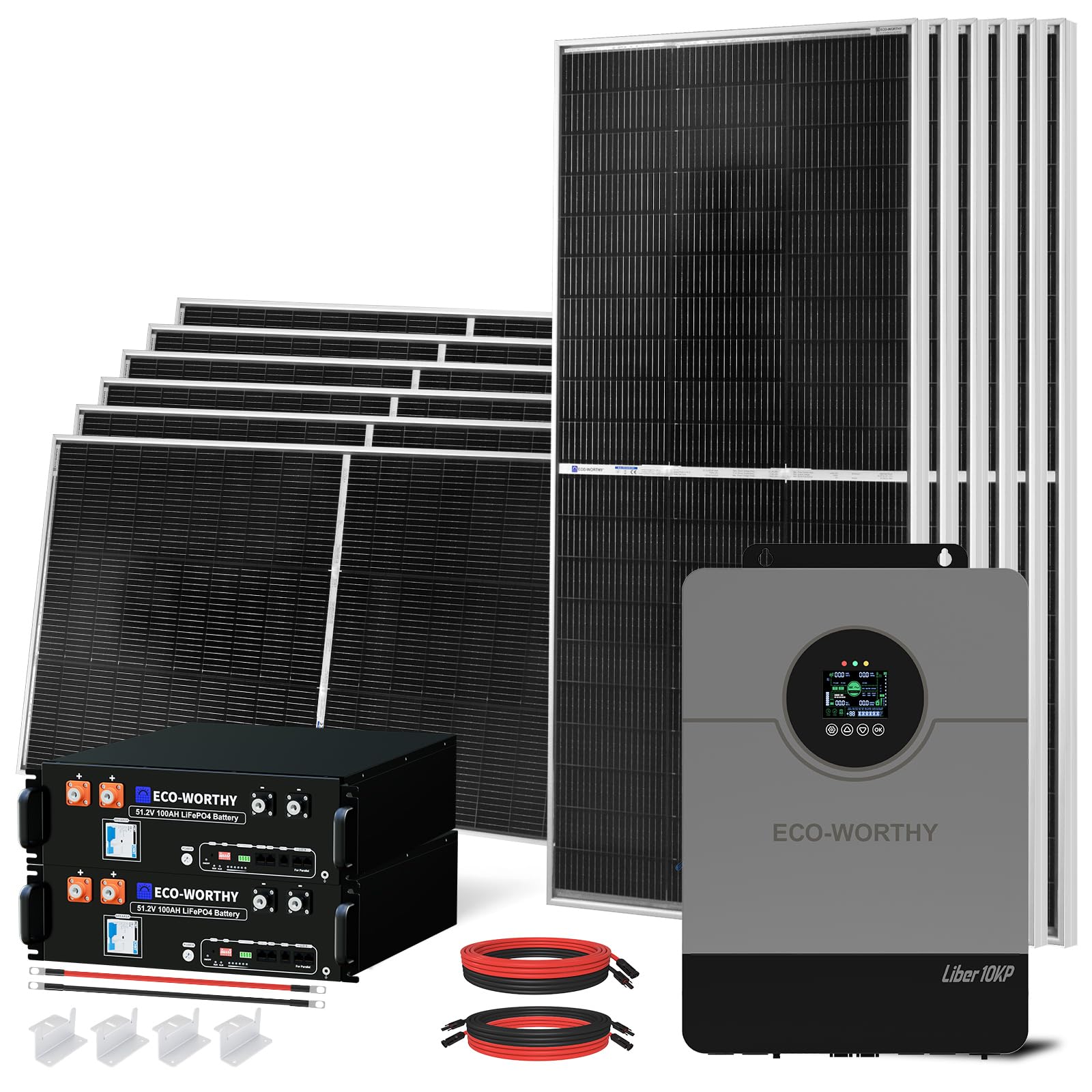
Output: 10000W
Inverter: 120V/240V
Solar Array: 12 x 195W panels (2340W)
Battery: 2 x 48V 100Ah Cubix lithium
Storage Capacity: 10.24kWh
Intended Use: Off-grid home
This kit spreads its panel capacity across twelve separate 195W panels rather than a few large ones, which makes it easier to distribute across multiple roof planes or a ground mount. Two 48V 100Ah lithium batteries provide 10.24kWh of storage, and the 10kW 120V/240V inverter matches the output class of the larger system above. It is a complete off-grid package aimed at property-scale use.
It suits a buyer running a large shed, workshop or off-grid cabin as a genuine power source rather than a convenience, and who wants panel flexibility in how the array is laid out. It is not for a shed owner with modest needs — the array footprint and the installation labour are substantial. The twelve-panel count also means more mounting points and more cable runs to plan.
Trade-off: Twelve separate panels and two 48V batteries make this a multi-day installation project, and the 2340W array needs considerably more mounting area than a single shed roof typically offers.
Before You Buy
- Load first: Add up what the shed will actually run in watts, then size the inverter and battery to that figure rather than to the panel count.
- Battery chemistry: Lithium options here hold usable capacity far better under deep cycling than lead-acid, which matters for a shed that sits idle for days.
- Roof space and orientation: Measure the mounting area before choosing — a 400W array needs meaningfully more room than two 120W panels, and shading on one panel drags the whole string down.
- System voltage: 12V systems are simple and familiar; 48V systems carry the same power at lower current and are the right choice once output climbs into the multi-kilowatt range.
- Included accessories: Kits with Z-brackets, cables and adaptor kits save a second order; kits without them will need mounting hardware and cabling bought separately.
- Expansion headroom: Check the controller’s current rating before planning to add panels later, since a 20A controller fills up quickly.
- Inverter type: A pure sine wave inverter runs electronics and variable-speed tools cleanly; modified sine wave outputs can cause buzzing or faults.
Frequently Asked Questions
-
How much solar power does a shed with no mains power need?
It depends entirely on load. Lighting and device charging are covered by a small kit in the 1kWh class, while power tools and cooling push the requirement into the 1.6kWh-plus range. -
Can a solar kit run power tools in a shed?
Yes, provided the inverter’s continuous rating exceeds the tool’s draw and the battery has enough stored energy for the run time. High-draw tools shorten battery life per charge considerably. -
Is lithium or lead-acid better for a shed solar kit?
Lithium is the better fit for intermittent shed use — it tolerates deep discharge and partial charging far better than lead-acid, and it delivers more usable capacity from the same headline rating. -
Do these kits include everything needed for installation?
Not uniformly. Some include brackets, cables and adaptor kits; others supply only panels and controller. Mounting hardware, fusing and an enclosure are commonly needed as extras. -
Can a shed solar kit be expanded later?
Often, but the controller is the limiting part. Adding panels beyond the controller’s current rating requires a larger controller, and mixing battery ages in one bank shortens overall life. -
What is the difference between the two large ECO-WORTHY kits?
Both deliver 10kW output, but they differ in storage and array layout — one uses a single large 48V bank with fewer, higher-output panels, the other spreads capacity across twelve panels and two batteries.
Bottom Line
For most shed owners with no mains power, the 1280WH Complete Off-Grid Solar Panel Kit is the fastest route to working lights, chargers and a socket — everything needed arrives in one box at the lowest cost in this roundup. Buyers planning to run real tools should step up to the 4 x 100W kit with the 2000W inverter, while property-scale needs point to the larger ECO-WORTHY systems. Start with the load calculation, then check the current price on the 1280WH kit before committing.
