Why there are Amazon links here: Brave Review is paid a commission for qualifying Amazon purchases made through the links below. Your price does not change, and using our links is entirely optional. How this works
Best Thermostat for a Household With Irregular Hours
A household with irregular hours needs a thermostat that adapts to the day, not one that assumes the same schedule every week. The five picks below cover three buyer types: budget-minded households that want a flexible seven-day timer, remote workers who want phone control from anywhere, and renters or small apartments that need a simple swap. The overview table shows the key differences at a glance; each review below explains who the unit fits and where it falls short.
Overview of the Picks
| Product | Key Spec | Best Use | Price Tier |
|---|---|---|---|
| Honeywell Home X2P Programmable Thermostat | 5-2 day schedule, 1 heat/1 cool | Tight budgets, basic systems | Budget |
| ecobee Smart Thermostat Enhanced | Wi-Fi, voice assistants, Energy Star | Learning routines, remote control | Premium |
| Honeywell Home RTH8560D | 7-day touchscreen programming | Flexible weekday/weekend planning | Mid-range |
| Honeywell Home RTH7600D | 7-day touchscreen programming | Households that plan ahead | Mid-range |
| Honeywell Home RTH9585WF1004 | Wi-Fi smart color touchscreen | Phone control plus color display | Upper mid-range |
The two seven-day Honeywell touchscreen models sit closest to the middle of the market, and they are the natural answer for households whose week never looks the same twice. The ecobee costs the most but earns it with Wi-Fi and voice control, which matters when nobody is home to press a button. The X2P is the cheap, no-frills entry point, and the RTH9585WF1004 bridges the gap with a color screen and app access.
Honeywell Home X2P Programmable Thermostat
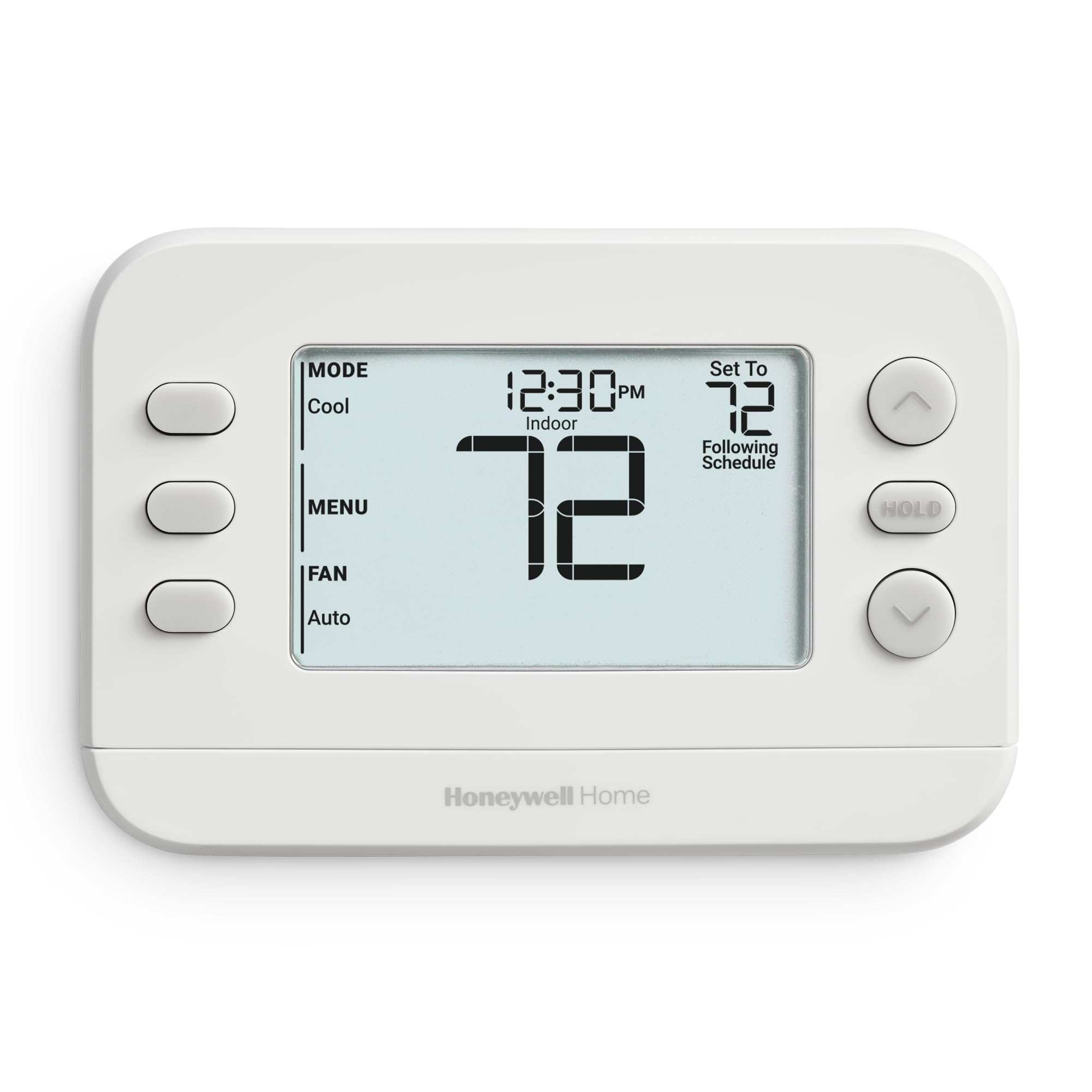
Type: Programmable, non-smart
Schedule: 5-2 day
Compatibility: 1 heat / 1 cool, single-stage
Display: Digital
Color: White
The X2P is a straightforward programmable thermostat built for conventional single-stage heating and cooling systems. Its 5-2 day schedule sets one routine for weekdays and another for the weekend, which suits households whose hours shift mainly between workdays and days off. The white housing and simple button layout make it easy to read at a glance, and installation is the kind of swap a confident DIYer can handle. It is aimed squarely at buyers who want a set-and-forget timer without paying for Wi-Fi or app support.
This is the pick for a tight budget or a second property where smart features would be wasted. It earns its place because the price leaves room for nothing else to go wrong, and the schedule flexibility is real for a household with a predictable weekday pattern. The caution is scope: a 5-2 schedule cannot vary Tuesday from Thursday, and single-stage compatibility rules out multi-stage or heat-pump systems.
Trade-off: The 5-2 schedule and single-stage-only compatibility limit it to simple systems and predictable weekly patterns.
ecobee Smart Thermostat Enhanced

Type: Smart Wi-Fi programmable
Voice assistants: Siri, Alexa, Google Assistant
Certification: Energy Star
Schedule: Programmable
Connectivity: Wi-Fi
The ecobee Enhanced is the smartest unit here and the one built for households whose hours change without warning. Wi-Fi connectivity means the schedule can be adjusted from a phone, and support for Siri, Alexa and Google Assistant lets voice commands override the plan. Energy Star certification signals efficiency credentials, and the learning behavior of this product line is the reason it tops so many shortlists. It suits remote workers, shift workers and anyone who wants the house comfortable on arrival rather than on a fixed clock.
This pick earns its place as the premium option because remote control solves the core problem of an irregular household: nobody has to be home to change the setting. The caution is cost and complexity — it is the most expensive unit in the group, and full value depends on reliable Wi-Fi and a compatible HVAC system.
Trade-off: The highest price here, and the smart features only pay off with dependable Wi-Fi and a compatible system.
Honeywell Home RTH8560D 7 Day Programmable Touchscreen Thermostat

Type: Programmable, non-smart
Schedule: 7-day
Display: Touchscreen
Color: White
Mounting: Wall
The RTH8560D gives every day of the week its own program, which is the single most useful feature for a household with irregular hours. A touchscreen makes setup and adjustment faster than button cycling, and the seven-day structure means a Monday shift pattern does not have to match a Thursday one. It is a non-smart unit, so there is no app, but the programming depth covers most of what an app would do. It fits households that plan their week and want the thermostat to follow it.
This is the mid-range workhorse and the best value for buyers who want flexibility without paying for Wi-Fi. It earns its place because the seven-day schedule directly addresses the keyword’s core problem. The caution is the interface: a touchscreen on a mid-priced thermostat can be slower to navigate than a phone app, and there is no remote access if plans change at the last minute.
Trade-off: No app or remote access, so a schedule change means walking to the wall unit.
Honeywell Home RTH7600D 7-Day Programmable Touchscreen Thermostat

Type: Programmable, non-smart
Schedule: 7-day
Display: Touchscreen
Color: White
Mounting: Wall
The RTH7600D is a long-established seven-day programmable model with a touchscreen and a familiar Honeywell layout. Like the RTH8560D it gives each day its own schedule, which is what an irregular household actually needs from a timer. The build is conventional wall-mounted plastic with a backlit display, and setup follows the standard Honeywell programming flow. It suits buyers who want proven simplicity and do not need smart-home integration.
This pick earns its place as an alternative to the RTH8560D for shoppers who find one model discounted or better stocked. It covers the same core need — a different plan for every day — at a similar price tier. The caution is that it is the older design of the two, so buyers comparing them should expect fewer interface refinements rather than more.
Trade-off: An older design than its stablemate, with no smart features to fall back on when plans change.
Honeywell Home RTH9585WF1004 Wi-Fi Smart Color Thermostat

Type: Smart Wi-Fi programmable
Schedule: 7-day
Display: Color touchscreen
Certification: Energy Star
Voice control: Alexa ready
Color: Gray
The RTH9585WF1004 combines the seven-day scheduling of the mid-range Honeywells with Wi-Fi control and a color touchscreen. Alexa readiness adds voice adjustment, and Energy Star certification covers the efficiency side. The gray finish and color display make it the most visible unit in the group on the wall. It suits households that want app control but prefer a familiar thermostat brand over a learning thermostat.
This pick earns its place as the bridge between the budget timers and the ecobee: seven-day flexibility plus remote access at a lower price than the premium option. The caution is that it is not a learning thermostat, so the schedule still has to be built and maintained by hand, and the color screen adds cost that a buyer who only wants remote access may not need.
Trade-off: No learning behavior, so the seven-day program needs manual upkeep, and the color display pushes the price up.
Before You Buy
- Schedule flexibility: A 5-2 unit only separates weekdays from weekends; a 7-day unit lets every day differ, which is the key spec for irregular hours.
- Compatibility: Check the system type before ordering — single-stage, multi-stage and heat-pump setups need different models.
- Connectivity: Wi-Fi and voice control solve last-minute changes; a non-smart timer relies on the program being right in advance.
- Wiring: Most models here are wall-mounted and need existing thermostat wiring, so a renter should confirm the landlord allows the swap.
- Display: Touchscreens are easier to program than button interfaces but cost more than a basic digital display.
- Certification: Energy Star models signal efficiency, but the schedule and habits still drive most of the savings.
Frequently Asked Questions
-
What is the best thermostat for a household with irregular hours?
A seven-day programmable model or a Wi-Fi smart thermostat. The seven-day Honeywell units let each day differ, while the ecobee adds remote and voice control for changes made on the fly. -
Is a smart thermostat worth it for an irregular schedule?
It can be, because app and voice control remove the need to be home to adjust the setting. The premium is only justified if the home has reliable Wi-Fi and a compatible system. -
Can a 5-2 thermostat handle shift work?
Only partly. It sets one weekday routine and one weekend routine, so a schedule that changes midweek will not be followed accurately. -
Do these thermostats work with heat pumps?
Compatibility varies by model, and the X2P is explicitly single-stage 1 heat/1 cool. Buyers should match the model to their system type before ordering. -
How hard is installation?
These are standard wall-mounted replacements that reuse existing thermostat wiring. A confident DIYer can manage it, and professional installation is the safer route for anyone unsure. -
Which pick is cheapest?
The Honeywell X2P sits at the budget end, with the ecobee at the premium end. Check current prices, since they move.
Bottom Line
For a household with irregular hours, the ecobee Smart Thermostat Enhanced is the top pick: Wi-Fi, voice control and Energy Star certification mean the schedule can change as fast as the week does. Buyers on a tighter budget should take the Honeywell RTH8560D, whose seven-day programming covers the core need without the smart-home premium.