Why there are Amazon links here: Brave Review is paid a commission for qualifying Amazon purchases made through the links below. Your price does not change, and using our links is entirely optional. How this works
Best Whole House Surge Protector for a Home with Solar
A solar array changes what a surge protector has to survive. The inverter, the rapid shutdown hardware, and the array wiring all sit on the same electrical service that a whole house surge protector is guarding, so a single strike or grid switching event can travel two ways at once. This guide covers five Type 1 units that install at the service entrance — where solar backfeed and utility surges meet — and matches each one to a different buyer. The picks suit three groups: budget-conscious owners replacing a failed unit, solar owners who want maximum capacity at the panel, and anyone who needs a weather-rated enclosure for an exterior mount. The overview table below is the fastest route to a decision.
The Picks at a Glance
| Product | Key Spec | Best Use | Price Tier |
|---|---|---|---|
| Bad Wolf SP240V200KA | 200kA, Type 1, NEMA 4X | Budget solar installs, exterior mount | Budget |
| Intermatic IG2240-IMSK Smart Guard | Replaceable modules, UL Listed | Easy future maintenance | Mid |
| Bad Wolf HSD240V | 260kA, ETL Listed, FCC Certified | EMP and lightning coverage | Mid |
| Home EMP & Lightning Protection SP-120-240-RL | Flush-mount concealed design | Clean breaker-box installs | Upper mid |
| Bad Wolf SP240V400KA | 400kA, NEMA 4X, EM protection | Maximum capacity at the panel | Premium |
1. Bad Wolf SP240V200KA Whole House Surge Protector — Best Budget Pick
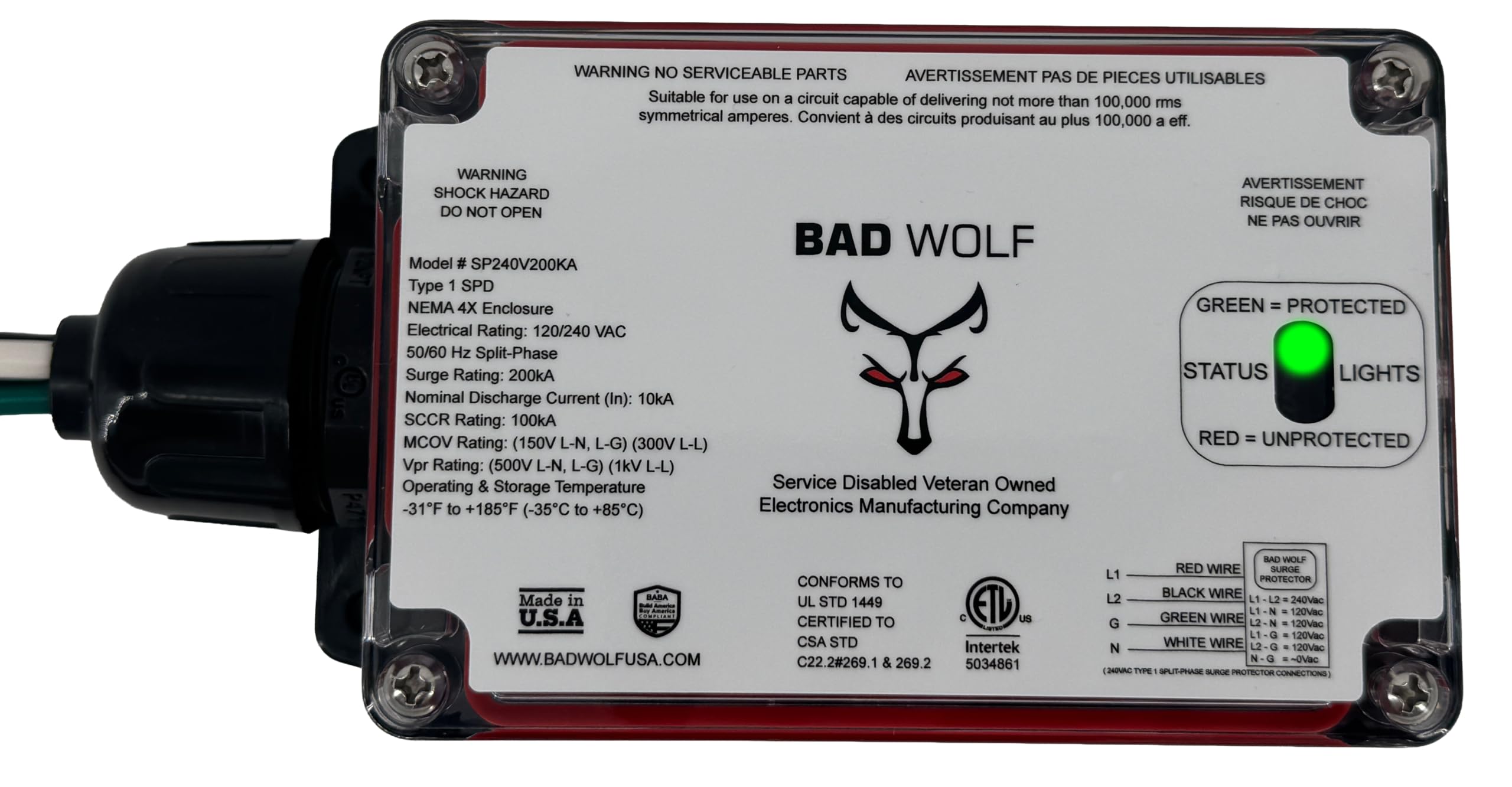
Capacity: 200kA
Type: Type 1 SPD
Voltage: 120/240V Split-Phase
Enclosure: NEMA 4X, IP67
Listings: ETL Listed, UL 1449 5th Ed, CSA C22.2 No. 269.1/269.2
Bad Wolf SP240V200KA Whole House Surge Protector
The SP240V200KA is the entry point into Type 1 protection, and the spec sheet is more complete than the price suggests. The NEMA 4X and IP67 ratings mean the enclosure tolerates rain, dust, and hose-directed washdown, which matters when the only practical mounting spot is beside an exterior meter or disconnect. ETL listing under UL 1449 5th Edition and CSA 269.1/269.2 keeps it compliant for both US and Canadian inspections. A solar service entrance is a busy place, and a sealed enclosure keeps the unit viable there.
Buyers who need a service-entrance SPD on a tight budget, or who want a weather-rated unit for an outdoor panel, get the most from this one. It is not the pick for a large service with heavy inductive loads or a long array run — the lower capacity of the lineup leaves less headroom for repeated events. Buyers sizing for a big shop or a ground-mount array should look further up the list.
Trade-off: The lowest capacity in this group means less margin during repeated strike seasons, so it suits modest services better than large ones.
2. Intermatic IG2240-IMSK Smart Guard — Best for Easy Maintenance
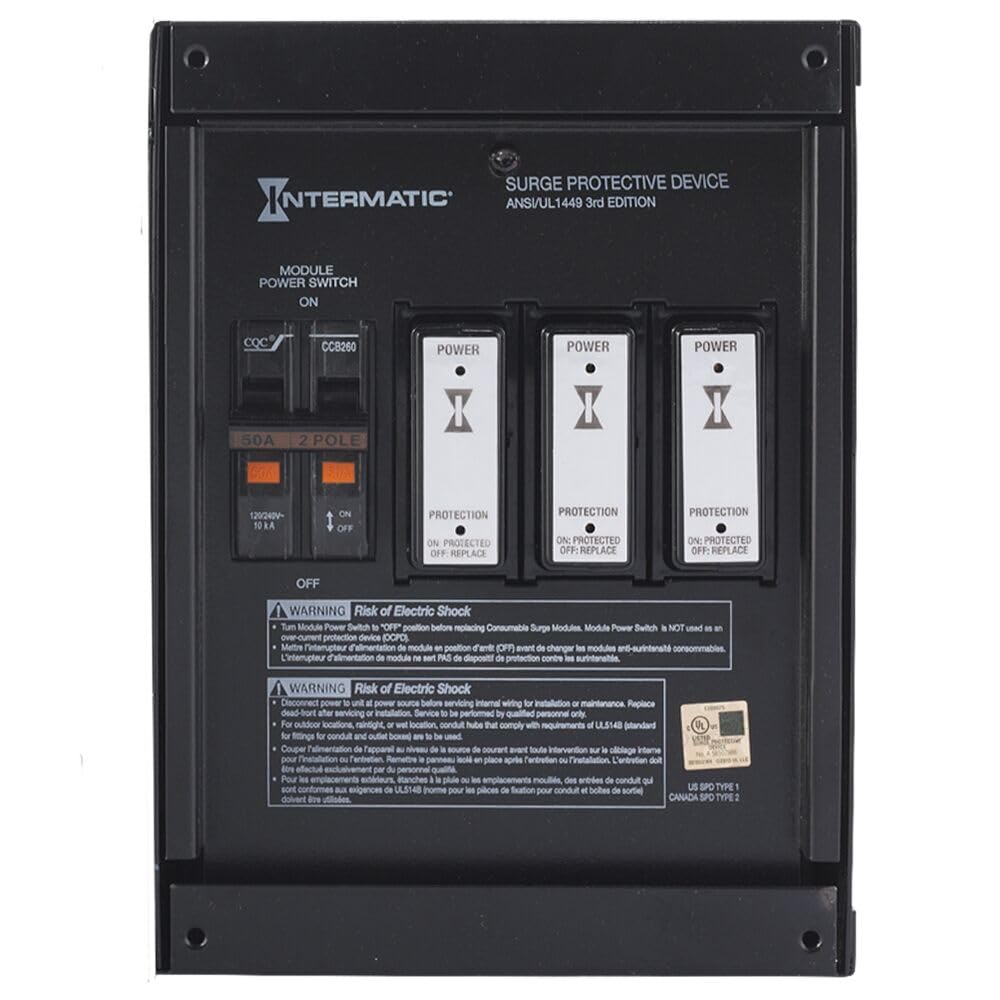
Type: Whole-house surge protector
Voltage: 120/240 VAC
Listing: UL Listed
Maintenance: Replaceable IMODULES
Mounting: Breaker-box compatible
Intermatic IG2240-IMSK Smart Guard Whole-House Surge Protector
The Smart Guard’s distinguishing feature is the replaceable IMODULE design. When a surge consumes the protection elements, the module swaps out without pulling the wiring or re-terminating the unit — a real advantage on a solar service, where the panel is already crowded with inverter feed, rapid shutdown, and monitoring gear. The unit is UL Listed for 120/240 VAC residential service and mounts in conjunction with a breaker box. Intermatic is an established name in residential electrical controls, which helps at inspection time.
This one earns its place for owners who plan to stay in the home long-term and want a maintenance path that does not require an electrician every time protection is spent. It is the pick for a buyer who values serviceability over raw capacity. Buyers chasing the highest possible kA figure, or those mounting outdoors, should keep looking — the design is oriented toward an indoor panel install.
Trade-off: The module format favors serviceability over peak capacity, and the indoor-oriented housing is a poor fit for exposed exterior mounting.
3. Bad Wolf HSD240V — Best for EMP and Lightning Coverage

Capacity: 260kA
Type: Type 1 SPD
Voltage: 120/240V Split Phase
Listings: ETL Listed, FCC Certified
Protection focus: Lightning and EMP
Bad Wolf HSD240V Whole House Lightning & EMP Surge Protector
The HSD240V sits in the middle of the Bad Wolf range with 260kA of capacity and a Type 1 service-entrance rating. The FCC certification alongside ETL listing speaks to the EMI/RFI filtering side of the design, which is relevant in a solar home where inverter switching noise rides the same conductors. Split-phase 120/240V coverage matches standard US residential service. The unit is built for direct connection at the panel without a separate upstream breaker.
Solar owners who want a step up in capacity from the budget tier without jumping to the top of the range get a sensible middle option here. It suits a home with a rooftop array and a conventional 200-amp service. The caution is the same one that applies across this category: EMP-focused marketing is hard to verify independently, and buyers should treat capacity and listings as the concrete facts rather than the label language.
Trade-off: The EMP framing is marketing-forward, so the decision should rest on the kA rating and listings rather than the headline claim.
4. Home EMP & Lightning Protection SP-120-240-RL — Best Flush-Mount Design

Type: Whole-house surge protector
Mounting: Flush-mounted breaker box, concealed model
Voltage: 120/240V
Protection focus: Lightning, solar flare, surge
Design: Concealed installation
Home EMP & Lightning Protection + CME Defense for Flush Mounted Breaker Box
This unit is built specifically for flush-mounted breaker boxes, with a concealed profile that keeps the protector tucked into the wall cavity rather than surface-mounted beside the panel. For a finished garage or a panel set into a hallway wall, that is the difference between a clean install and a box hanging off the drywall. The name calls out lightning, solar flare, and surge coverage, and the 120/240V rating matches standard split-phase residential service.
Buyers with a flush panel and an eye on aesthetics are the natural audience. It also suits a solar home where the main panel lives indoors and surface-mount hardware would be awkward. The trade-off is flexibility: the concealed format is tied to a flush box, so a surface-mounted panel or an exterior meter main is the wrong application. Buyers in those setups should choose a NEMA-rated surface unit instead.
Trade-off: The concealed flush-mount format limits installation to compatible recessed panels, ruling out surface and exterior mounts.
5. Bad Wolf SP240V400KA — Best Premium Pick
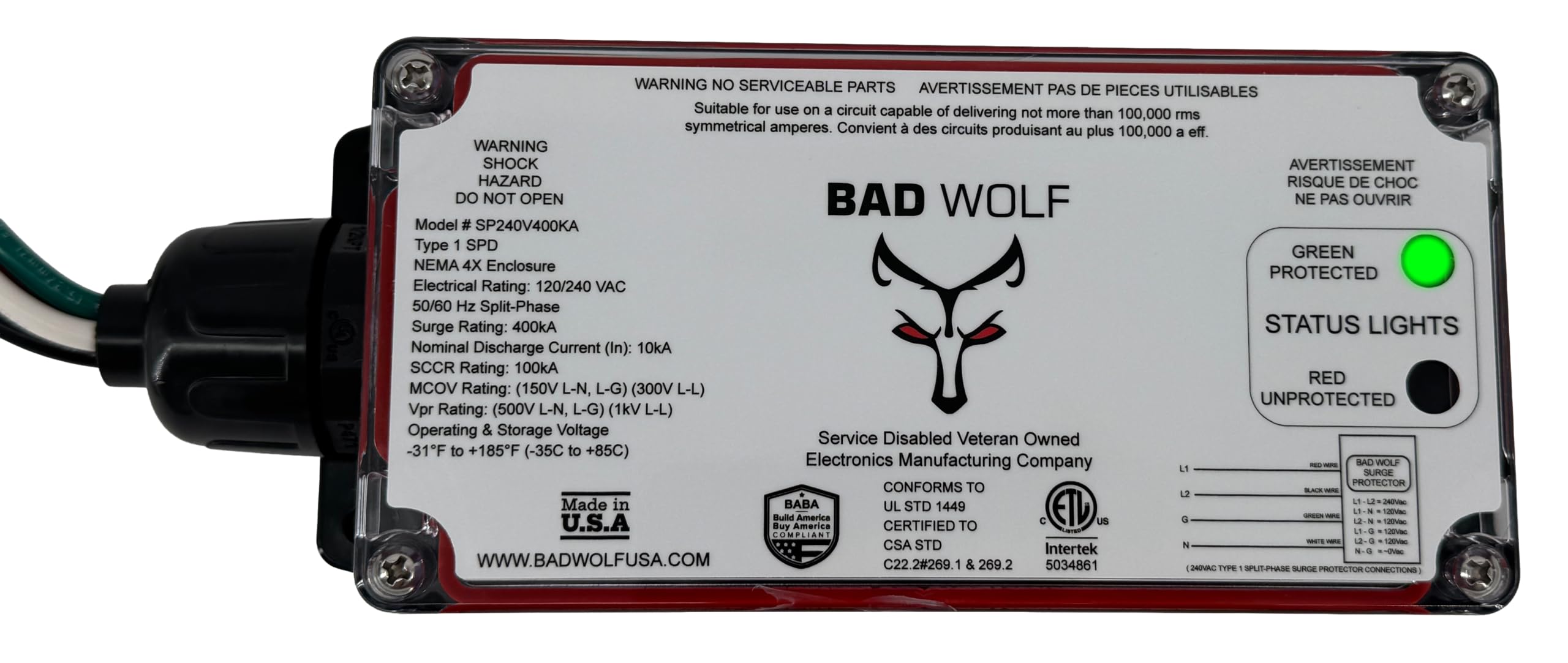
Capacity: 400kA
Type: Type 1 SPD
Voltage: 120/240V Split Phase
Enclosure: NEMA 4X
Listing: ETL Listed
Protection focus: Surge with EM protection
Bad Wolf SP240V400KA Whole House Surge Protector
The SP240V400KA carries the highest capacity in this group at 400kA, and the NEMA 4X enclosure makes it suitable for exterior mounting at the meter or service disconnect. Type 1 rating means it can go on the line side of the main breaker without a dedicated upstream overcurrent device, which simplifies a solar service entrance that is already tight on spaces. ETL listing keeps it inspection-ready, and the EM protection labeling targets the same lightning and electromagnetic concerns as the rest of the Bad Wolf line.
This is the pick for a large service, a ground-mount array with long conductor runs, or a buyer who wants maximum headroom and does not mind paying for it. It also suits exterior installs where the weather rating is non-negotiable. The caution is straightforward: the top capacity commands the top price, and a modest rooftop system on a 200-amp service will not use the extra margin.
Trade-off: The highest capacity comes at the highest price, and smaller services will not realize the extra headroom.
Before You Buy
- Type rating: A Type 1 SPD installs at the service entrance without a dedicated upstream breaker, which is what a solar service with limited panel space needs.
- Capacity: Match the kA rating to the service size and exposure — a large service or long array run justifies more headroom than a small rooftop system.
- Enclosure rating: NEMA 4X and IP67 matter for exterior meter or disconnect mounts; an indoor panel can use a standard housing.
- Mounting style: Confirm whether the panel is flush or surface-mounted before ordering a concealed unit, and check available wall space beside the panel.
- Listings: ETL or UL listing under UL 1449 and CSA 269.1/269.2 keeps the install compliant with local inspection.
- Maintenance path: Replaceable-module designs cost more upfront but simplify the swap when protection is spent.
- Solar coordination: Install the SPD at the service entrance so inverter backfeed and utility surges are both intercepted at the same point.
Frequently Asked Questions
-
Does a whole house surge protector work with solar panels?
Yes. A Type 1 unit at the service entrance protects the same conductors the inverter feeds, so surges arriving from the utility and from the array are handled at one point. -
Is Type 1 or Type 2 better for a solar home?
Type 1 is the more flexible choice at the service entrance because it does not require a dedicated upstream breaker, which helps when the panel is already full of solar hardware. -
Where should the surge protector be mounted?
At the main service panel or meter, as close to the incoming lines as practical. Exterior locations need a NEMA 4X or IP67 enclosure. -
How often does a whole house surge protector need replacing?
Replacement depends on surge exposure and the design. Units with replaceable modules can be serviced without rewiring, while sealed units are swapped as a whole. -
Does a higher kA rating always mean better protection?
Not automatically. A higher rating provides more headroom for repeated events, but a properly sized unit with correct installation protects a modest service well. -
Will a surge protector interfere with solar monitoring or inverter electronics?
A quality unit with filtering can reduce electrical noise on the service, and correct installation at the panel keeps it from affecting inverter communication.
Bottom Line
For most solar homes, the Bad Wolf SP240V400KA is the strongest single choice: 400kA of capacity, a Type 1 service-entrance rating, and a NEMA 4X enclosure that works indoors or out. Buyers on a tighter budget get solid value from the SP240V200KA, and anyone prioritizing easy future maintenance should look at the Intermatic Smart Guard.
