Why there are Amazon links here: Brave Review is paid a commission for qualifying Amazon purchases made through the links below. Your price does not change, and using our links is entirely optional. How this works
Best WiFi Extender for a Brick Built House: 5 Picks That Punch Through Walls
Solid brick and masonry walls soak up WiFi signal, so a router that works fine in a wood-frame home can leave back rooms nearly dead. The picks below are aimed at three kinds of buyers: households in older brick construction, renters who want a quick plug-in fix, and larger homes where one extender alone will not finish the job. The overview table gives a fast read on coverage and price tier, and each review explains who the unit suits and where it falls short.
The Picks at a Glance
| Product | Key Spec | Best Use | Price Tier |
|---|---|---|---|
| TP-Link AC1200 WiFi Extender (RE315) | Dual-band, 1600 sq.ft, 32 devices | Budget plug-in for one weak room | Budget |
| TP-Link AC1900 WiFi Range Extender (RE550) | Dual-band, 2200 sq.ft, 32 devices, Gigabit port | Faster single-room upgrade | Mid-range |
| 2026 Upgraded WiFi Extender for Home | Dual-band repeater, Ethernet port | Buyers chasing maximum stated coverage | Budget |
| TP-Link Deco S4 Mesh AC1900 (3-Pack) | Mesh system, 5500 sq.ft, Gigabit ports | Whole-home replacement in brick | Premium |
| 2026 New WiFi Extender, WiFi Booster 1200Mbps | Dual-band, 18999 sq.ft, 115+ devices | High device counts on a budget | Budget |
1. TP-Link AC1200 WiFi Extender Dual Band 5GHz/2.4GHz (RE315)

Type: Dual-band wall-plug range extender
Speed Class: AC1200 (1.2Gbps)
Coverage: Up to 1600 sq.ft
Device Load: Up to 32 devices
Ports: One Ethernet port
Mesh: EasyMesh compatible
TP-Link AC1200 WiFi Extender Dual Band 5GHz/2.4GHz (RE315)
The RE315 is a compact wall-plug unit built for one job: taking a weak corner of a home and making it usable. Its dual-band design lets it rebroadcast on both the 2.4GHz and 5GHz bands, and the EasyMesh compatibility means it can join a compatible TP-Link mesh network rather than sitting alone. The single Ethernet port is useful for a wired device such as a TV or desktop in a room where signal is poor.
This is the pick for buyers who want the lowest-cost fix for a single dead zone behind a brick wall, and for renters who cannot run cable. It is not for a whole large home, since one unit of this class has a limited reach and the 1600 sq.ft figure assumes open space rather than masonry. Buyers who need to cover several rooms at once should look at the mesh pick below.
Trade-off: The budget build and modest coverage ceiling mean a brick home may need two units to bridge a long hallway.
Check the current price on Amazon
2. TP-Link AC1900 WiFi Range Extender RE550
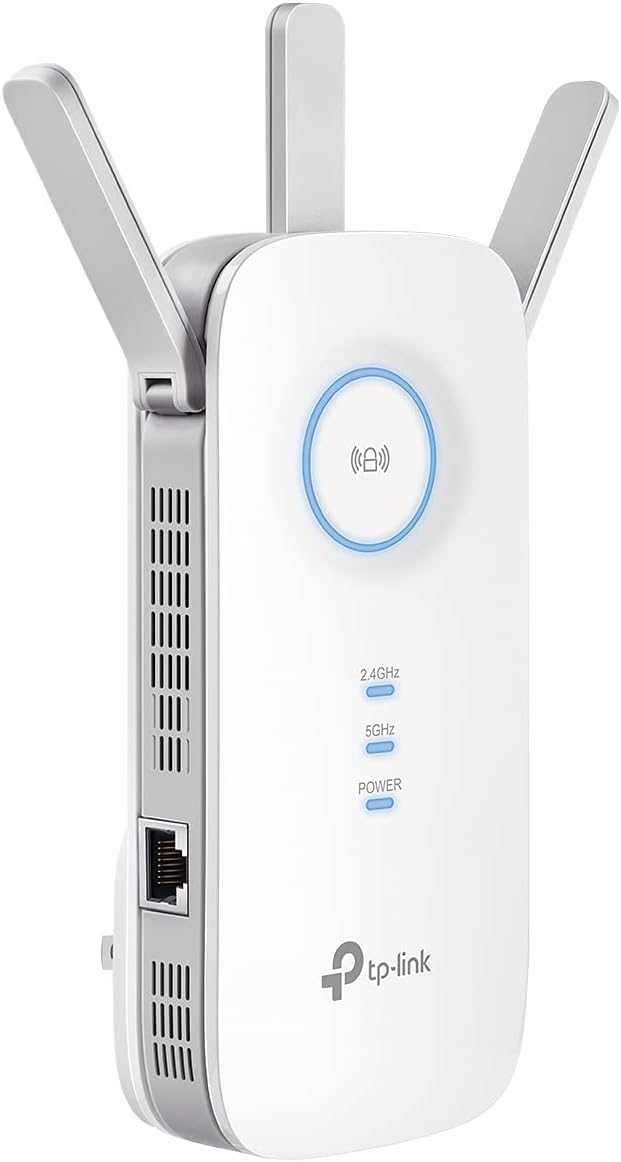
Type: Dual-band range extender with app setup
Speed Class: AC1900
Coverage: Up to 2200 sq.ft
Device Load: Up to 32 devices
Ports: Gigabit Ethernet port
Mesh: EasyMesh compatible
TP-Link AC1900 WiFi Range Extender RE550
The RE550 steps up from the budget pick with a faster AC1900 class and a Gigabit Ethernet port, which matters when the extender is feeding a wired device that needs real throughput. App-based setup keeps installation simple, and the EasyMesh support lets it slot into a compatible network. It is the sensible middle option for a brick home where one room needs strong, fast WiFi rather than just basic connectivity.
Buyers who stream or work from a back room will feel the difference over the entry-level unit, and the Gigabit port makes it more useful for a desktop or console. It is not the right choice for covering an entire multi-floor brick house, since a single extender still has to sit within usable range of the router. Homes with several dead zones should go mesh.
Trade-off: A single extender of this class still struggles to push through more than one thick brick wall between it and the router.
Check the current price on Amazon
3. 2026 Upgraded WiFi Extender for Home, Up to 18000Sq.ft

Type: Dual-band wireless repeater
Ports: Ethernet port
Compatibility: Works with most routers
Coverage Claim: Up to 18000 sq.ft
Setup: Standard repeater pairing
Price Tier: Budget, with coupon available
2026 Upgraded WiFi Extender for Home, Up to 18000Sq.ft
This unit is a general-purpose repeater aimed at buyers who want broad stated coverage at a low price, and the coupon brings the entry cost down further. It carries an Ethernet port for a wired device and is marketed as working with the vast majority of routers, which keeps compatibility worries low. The high coverage figure is best read as a marketing ceiling rather than a promise inside a brick home.
It suits budget-conscious buyers with one or two weak spots who are willing to experiment with placement. It is not for anyone who needs guaranteed performance or a proven brand ecosystem, since it is a new listing with a short track record. Buyers who want predictable mesh behavior should choose a branded system instead.
Trade-off: The headline coverage number is optimistic for masonry construction, and a new, unbranded listing offers less certainty than an established model.
Check the current price on Amazon
4. TP-Link Deco S4 Mesh AC1900 WiFi System (3-Pack)

Type: Mesh WiFi system, three units
Speed Class: AC1900
Coverage: Up to 5500 sq.ft
Ports: Gigabit ports
Voice Control: Works with Alexa
Role: Replaces router and extender
TP-Link Deco S4 Mesh AC1900 WiFi System (3-Pack)
The Deco S4 is the pick for brick homes where a single extender cannot keep up, because three mesh units share one network name and hand devices off as they move between rooms. It replaces both the router and any extender, carries Gigabit ports on the units, and works with Alexa for basic voice control. For a solid-walled house, spreading three nodes across floors is the most reliable way to get consistent coverage.
This is the choice for larger homes, multi-floor layouts, and buyers tired of juggling separate extender networks. It is not for a small apartment or a single weak room, where the cost and extra nodes are unnecessary. Buyers on a tight budget should weigh the higher upfront price against buying two or three separate extenders.
Trade-off: The upfront cost is the highest here, and the system replaces the existing router rather than adding to it.
Check the current price on Amazon
5. 2026 New WiFi Extender, WiFi Booster 1200Mbps Dual Band
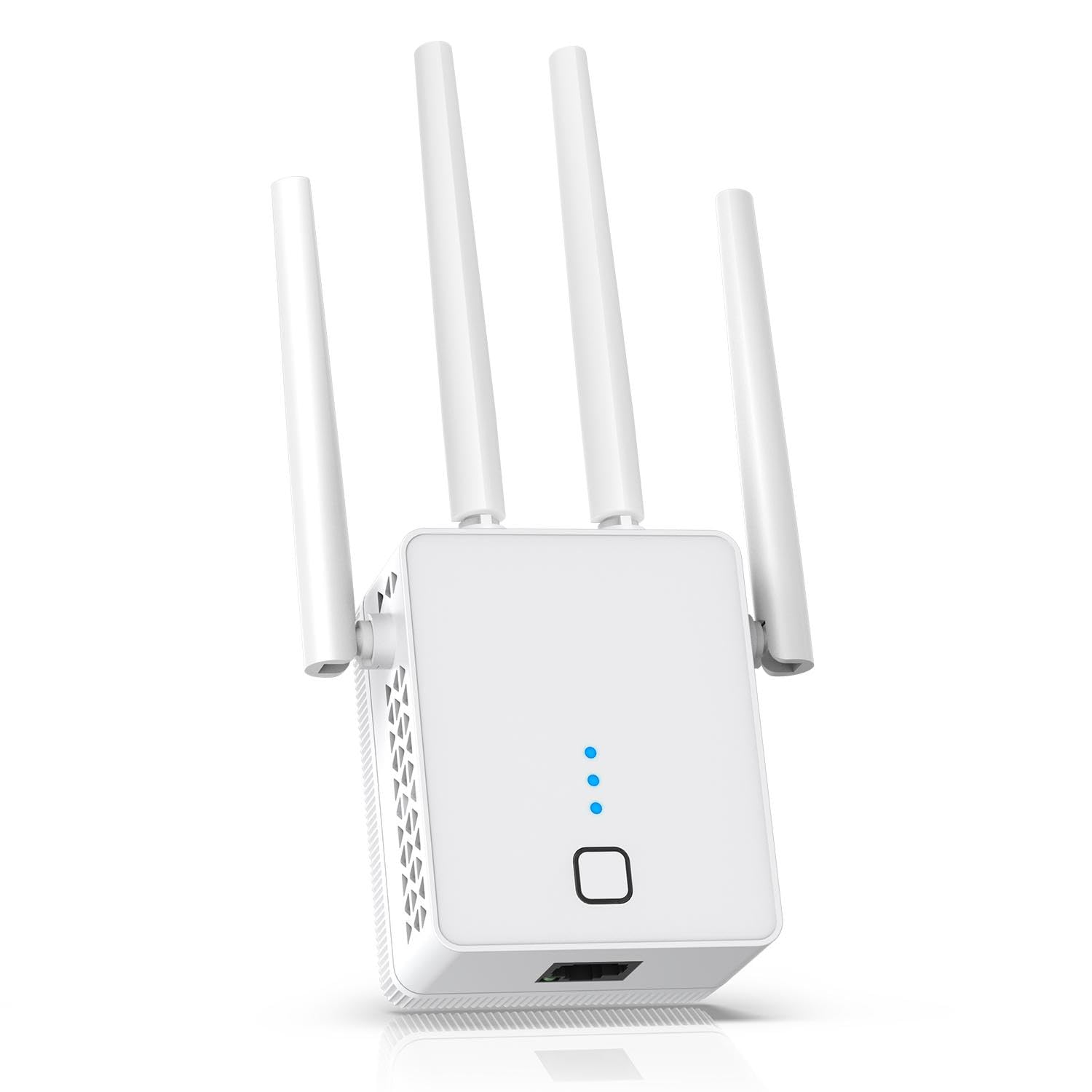
Type: Dual-band WiFi extender
Bands: 5.8GHz and 2.4GHz
Speed Class: 1200Mbps
Coverage Claim: Up to 18999 sq.ft
Device Load: 115+ devices
Ports: Ethernet port
2026 New WiFi Extender, WiFi Booster 1200Mbps Dual Band
This extender targets households with a lot of connected devices, with a stated load of more than a hundred and a dual-band 1200Mbps class. The Ethernet port adds a wired option, and the 5.8GHz band is offered as an alternative to the usual 5GHz for less crowded airwaves. It is a budget-friendly option for buyers who care more about device count than brand pedigree.
It suits busy homes with many phones, tablets and smart devices spread across a few rooms. It is not for buyers who need proven reliability in a difficult brick layout, since the coverage claim is far beyond what a single repeater realistically delivers through masonry. Those buyers are better served by the mesh system.
Trade-off: The very high coverage and device claims are unlikely to hold up through brick walls, and the listing has limited history.
Check the current price on Amazon
Before You Buy
- Wall material: Brick and masonry cut signal far more than drywall, so plan on placing the extender in the same room as the weak spot, not across a thick wall.
- Coverage claims: Treat sq.ft figures as open-space estimates; a brick home typically needs more units than the number suggests.
- Compatibility: Check that the extender supports the router’s bands and, for mesh features, the same brand ecosystem.
- Ports: A Gigabit Ethernet port matters if a TV, console or desktop will be wired to the extender.
- Device load: Count phones, tablets, smart speakers and cameras; high counts favor units rated for many devices.
- Placement: The extender needs a strong router signal where it sits, so a midpoint location beats the dead room itself.
- Budget vs. scale: One budget extender fixes one room; a mesh system is the safer spend for a whole brick house.
Frequently Asked Questions
-
Will a WiFi extender work through a brick wall?
Yes, but with reduced range. Brick absorbs more signal than drywall, so the extender should sit in a spot that still receives a decent router signal. -
Is a mesh system better than an extender for a brick house?
For whole-home coverage, usually yes. Multiple mesh nodes spread the signal and keep one network name, which suits solid-walled layouts. -
How many extenders does a brick home need?
It depends on size and wall thickness. One unit can fix a single room; several rooms or floors generally call for a mesh system with multiple nodes. -
Does an Ethernet port matter on an extender?
It helps when a wired device needs a stable connection, and a Gigabit port is worth having for streaming or gaming gear. -
Can a budget extender handle many devices?
Some are rated for high device counts, but real-world performance in a brick home depends heavily on placement and the router’s own capacity. -
Where should the extender be placed?
Roughly halfway between the router and the weak area, in a spot where the router signal is still usable.
Bottom Line
For a brick built house, the safest buy is the TP-Link Deco S4 Mesh AC1900 WiFi System, because three nodes handle solid walls and multiple floors far better than a single repeater. Buyers with just one stubborn room can save money with the TP-Link AC1200 WiFi Extender (RE315) and place it carefully.
