Why there are Amazon links here: Brave Review is paid a commission for qualifying Amazon purchases made through the links below. Your price does not change, and using our links is entirely optional. How this works
Best WiFi Extender for a House With Foil Backed Insulation
Foil backed insulation is a signal killer: the metallic layer reflects WiFi instead of letting it pass, so rooms that should be covered often are not. The five extenders below are chosen for how well they push a signal through or around that barrier, and each suits a different buyer — the budget fixer, the whole-home mesh builder, or the future-proof upgrader. The overview table gives a one-glance comparison; the reviews that follow explain the fit for each. Buyers should read the placement notes in Before You Buy first, because with foil insulation, position matters as much as the hardware.
Overview of the Picks
| Product | Key Spec | Best Use | Price Tier |
|---|---|---|---|
| TP-Link AC1200 WiFi Extender (RE315) | Dual band, up to 1600 sq.ft, 32 devices | Small homes, single dead zone | Budget |
| TP-Link AX3000 WiFi 6 Extender (RE715X) | WiFi 6, up to 2400 sq.ft, 64 devices | Busy households, mesh-ready | Mid-range |
| WiFi Extender Signal Booster 15715sq.ft | Long-range repeater, 5 working modes | Large single-story layouts | Mid-range |
| ASUS RP-BE58 BE3600 WiFi 7 Extender | WiFi 7, AiMesh, works with any router | Future-proof mesh upgrades | Upper mid-range |
| WiFi Extender Signal Booster 8470 Sq.Ft | Compact repeater, whole-home claim | Tight budgets, light use | Budget |
Best WiFi Extender for Foil Backed Insulation: 5 Picks
TP-Link AC1200 WiFi Extender (RE315)

Type: Dual band WiFi extender
Speed class: AC1200 (5GHz/2.4GHz)
Coverage claim: Up to 1600 sq.ft
Device capacity: 32 devices
Ports: One Ethernet port
Mesh: EasyMesh compatible
TP-Link AC1200 WiFi Extender Dual Band 5GHz/2.4GHz (RE315) is the entry point for a foil-insulated home: a compact dual-band extender that rebroadcasts the existing network into a single stubborn room. The Ethernet port is the useful part here — it lets a wired device like a TV or console join the extended network without relying on the reflected WiFi path. EasyMesh compatibility means it can join a mesh system later rather than being thrown away.
This pick suits buyers with one or two dead zones and a modest number of connected devices. It is not for large homes trying to cover multiple foil-lined rooms, because a single compact extender cannot bridge that much reflected signal. The 2.4GHz band does more of the heavy lifting through foil-backed walls, so expect real-world throughput well below the headline AC1200 figure.
Trade-off: The compact design and budget price mean limited antenna gain, so a single room at the far end of a foil-lined wall may still need a second unit.
TP-Link AX3000 WiFi 6 Dual-Band Range Extender (RE715X)
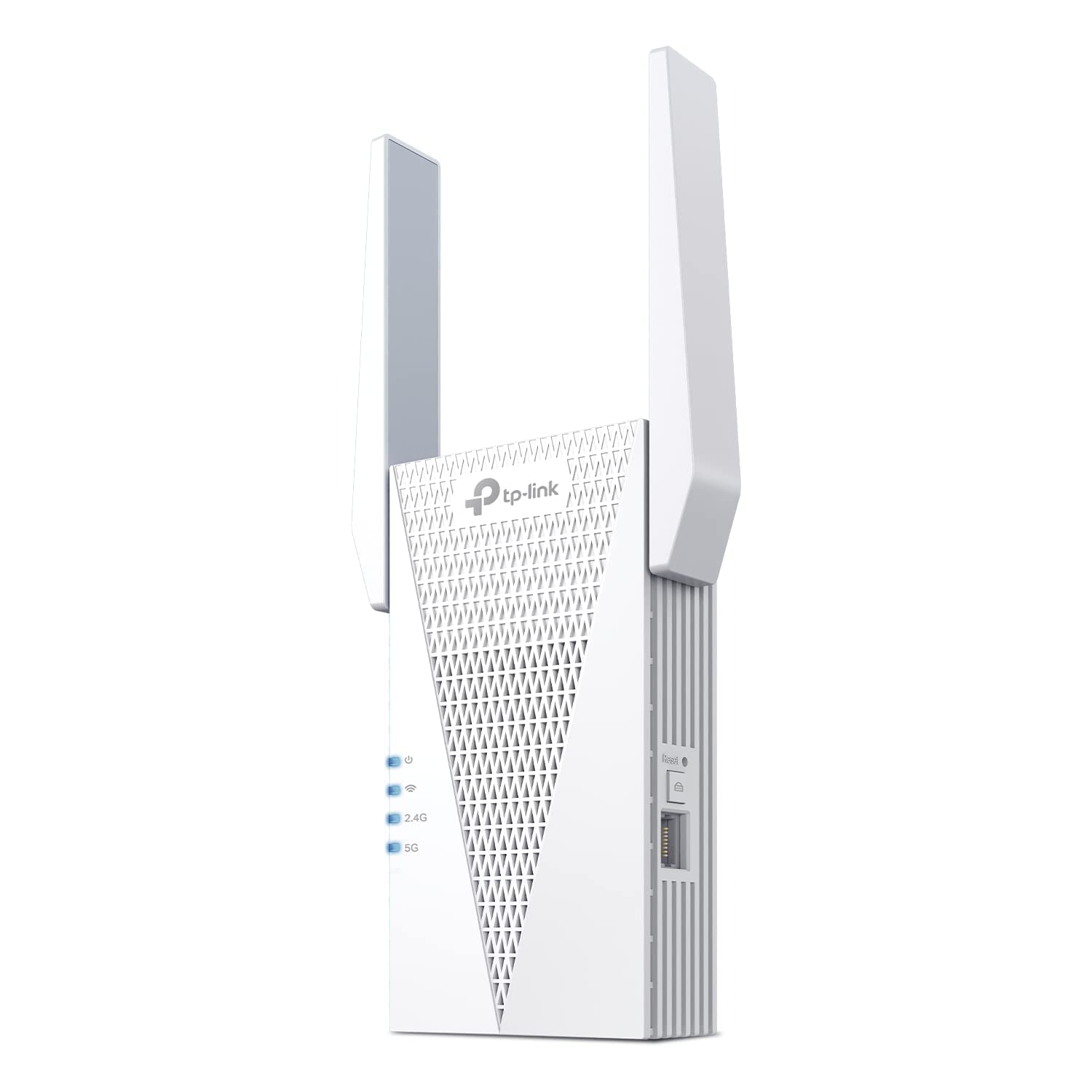
Type: WiFi 6 dual-band range extender
Speed class: AX3000
Coverage claim: Up to 2400 sq.ft
Device capacity: 64 devices
Ports: Ethernet port
Setup: App setup, EasyMesh compatible
Recognition: PCMag Editor’s Choice
TP-Link AX3000 WiFi 6 Dual-Band Range Extender PCMag Editor’s Choice (RE715X) is the strongest all-rounder in this group. WiFi 6 handles dense device loads far better than older standards, which matters in a foil-insulated house where every device competes for a weakened signal. App setup and EasyMesh support make it a sensible building block rather than a one-off fix.
This extender suits households with many connected devices — streaming, gaming, work-from-home — and buyers who expect to add a second unit later. It is not for someone who wants the cheapest possible single-room fix. The premium over the budget pick buys capacity and a more resilient radio, not magic: foil still reflects signal, so placement near a doorway or window between zones remains essential.
Trade-off: The higher price only pays off if the home actually has the device load and the layout to justify WiFi 6; a single dead zone in a small house does not need it.
WiFi Extender Signal Booster for Home, 15715sq.ft Long Range

Type: Long-range WiFi repeater
Coverage claim: Up to 15715 sq.ft
Modes: 5 working modes
Ports: Ethernet port
Setup: Easy setup
Mesh: Mesh WiFi compatible
WiFi Extender Signal Booster for Home, 15715sq.ft Long Range WiFi Repeater (B0HJ1RX489) is aimed at buyers covering a large single-story footprint, where one extender has to reach across several rooms. The five working modes let it act as a repeater, access point, or bridge depending on how the home is wired, which gives flexibility when foil insulation forces a creative placement. The Ethernet port supports a wired backhaul if a cable run is possible.
This pick suits owners of sprawling layouts — long bungalows, converted spaces — who can experiment with placement. It is not for buyers who want a brand-name mesh ecosystem, and the extremely large coverage figure should be read as a best-case lab number rather than a promise through foil-backed walls.
Trade-off: The aggressive coverage claim sets expectations the hardware cannot meet in a foil-lined home, and the unfamiliar brand means less long-term firmware support than the major names.
ASUS RP-BE58 BE3600 Dual Band WiFi 7 Range Extender

Type: WiFi 7 dual-band range extender
Standard: 802.11be
Speed class: BE3600
Mesh: AiMesh, works with any WiFi router
Bands: Dual band
ASUS RP-BE58 BE3600 Dual Band WiFi 7 (802.11be) Range Extender is the future-proof choice. WiFi 7 is the newest standard, and AiMesh support means it can join an ASUS mesh network for seamless roaming — or work with any router as a standalone extender. For a foil-insulated home, the newer radio and mesh handoff reduce the dropouts that happen when a device clings to a weak signal from the wrong node.
This extender suits buyers already in the ASUS ecosystem, or those planning a mesh upgrade and wanting hardware that will not be obsolete soon. It is not for budget-focused buyers, and it is not for anyone whose router cannot take advantage of WiFi 7 — the premium is wasted on an older network.
Trade-off: WiFi 7 only delivers its advantage with a compatible router and client devices; on an older network this is an expensive extender doing a mid-range job.
WiFi Extender Signal Booster for Home, Up to 8470 Sq.Ft

Type: WiFi repeater / signal booster
Coverage claim: Up to 8470 sq.ft
Intended use: Whole-home coverage
Setup: Simple setup
WiFi Extender Signal Booster Internet Repeater for Home Long Range Up to 8470 Sq. Ft. (B0HML2PGHZ) is the lowest-cost way to test whether an extender helps at all. It is a straightforward repeater: plug in, pair with the existing network, and rebroadcast. For a single room cut off by foil-backed insulation, that can be enough to restore a usable connection for light browsing.
This pick suits renters or buyers on a tight budget who want to solve one dead spot without commitment. It is not for heavy streaming, gaming, or multi-room coverage — a budget repeater halves throughput on the rebroadcast, and the huge coverage claim is marketing rather than a realistic expectation through foil.
Trade-off: At the lowest price tier, expect the weakest radio and the least headroom for many devices; it is a stopgap, not a permanent whole-home solution.
Before You Buy
- Placement: Foil reflects signal, so put the extender in the doorway, hallway, or window line between the router and the dead zone — not inside the foil-lined room itself.
- Compatibility: Confirm the extender matches the router’s standard (WiFi 5, 6, or 7); a mismatch wastes the extender’s capability.
- Coverage claims: Treat square-footage figures as lab best-case numbers; through foil-backed walls, expect a fraction of the stated range.
- Ethernet backhaul: If a cable run is possible, a wired connection between router and extender sidesteps the foil problem entirely — favor models with an Ethernet port.
- Mesh support: EasyMesh or AiMesh compatibility lets the extender join a larger system later instead of becoming a standalone orphan.
- Device load: Count the connected devices; a busy household needs the higher-capacity WiFi 6 or WiFi 7 models.
- Setup method: App-based setup is quicker for most buyers; check that the chosen model offers it.
Frequently Asked Questions
-
Will a WiFi extender work through foil backed insulation?
Yes, but with limits. The extender must sit on the router side of the foil barrier and rebroadcast into the dead zone; placing it inside the foil-lined room defeats the purpose. -
Which extender is best for a large house with foil insulation?
The TP-Link AX3000 (RE715X) offers the best balance of capacity and mesh support for most large homes, while the ASUS WiFi 7 model suits buyers planning a long-term mesh upgrade. -
Do I need WiFi 6 or WiFi 7 for a foil-insulated home?
Not strictly, but newer standards handle dense device loads and mesh handoff better, which reduces dropouts in a signal-weakened environment. -
Can I use more than one extender?
Yes. In a foil-insulated home, two well-placed extenders often beat one high-power unit, especially if they support mesh roaming. -
Is an Ethernet port important?
It is if a wired backhaul or a wired device is part of the plan; it removes the foil problem for that connection entirely. -
What is the cheapest option that still helps?
The budget 8470 sq.ft repeater is the lowest-cost test, but buyers with multiple devices should step up to the RE315 at minimum.
Bottom Line
For most foil-insulated homes, the TP-Link AX3000 WiFi 6 Extender (RE715X) is the pick that balances price, capacity, and mesh-ready flexibility. Buyers on a tight budget can start with the RE315 for a single dead zone, while those building a long-term mesh should look at the ASUS WiFi 7 model. Placement between the router and the foil barrier matters more than any single spec.
