Why there are Amazon links here: Brave Review is paid a commission for qualifying Amazon purchases made through the links below. Your price does not change, and using our links is entirely optional. How this works
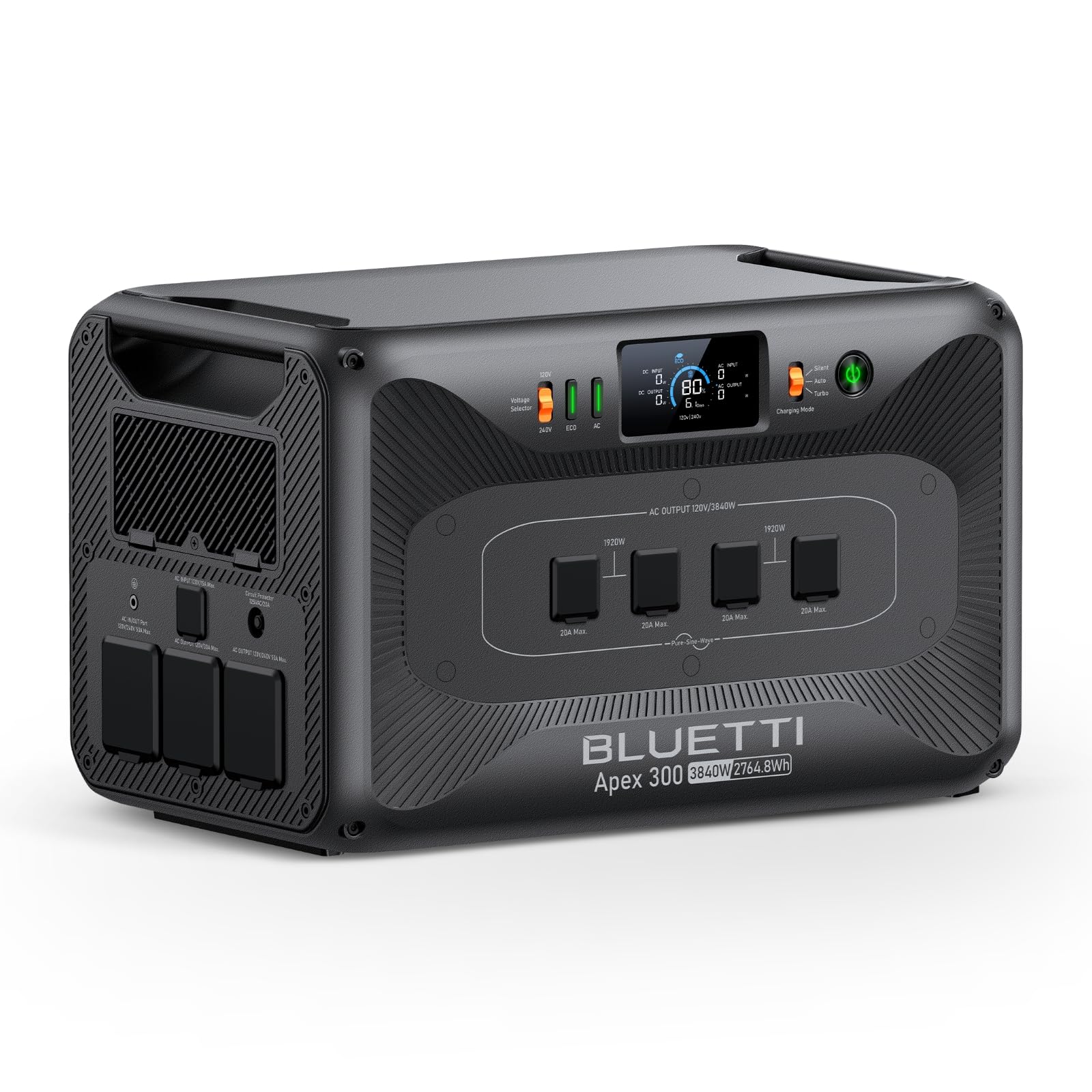
BLUETTI Apex 300 Portable Power Station: 3.8kW of Home Backup Muscle
The BLUETTI Apex 300 is a high-capacity portable power station built for households that want serious backup power without a permanent generator install. It pairs a large LFP battery with enough AC output to run heavy appliances, and it adds dual 120V/240V output plus black start capability for whole-home or RV setups. This review covers what the unit is built to do, the specifications that matter, and the trade-offs to weigh before buying.
Features and Specifications
Battery Type: Lithium iron phosphate (LFP)
Usable Capacity: 2,764.8Wh
AC Output: 3,840W continuous, 7,680W surge
AC Ports: 6
Output Modes: Simultaneous 120V/240V
Start Feature: Black start capable
Intended Use: Home backup, RV, emergencies
 ](https://www.amazon.com/dp/B0F42JY551/?tag=wdowd-20)
Check the current price on Amazon
The headline figure here is the 3,840W continuous output with a 7,680W surge rating. That is a lot of headroom for a portable station, and it is what separates this unit from mid-range models that stall out when a well pump or a power tool kicks on. Six AC ports mean multiple devices can stay plugged in at once rather than forcing a rotation.
The 2,764.8Wh LFP battery is the other pillar. LFP chemistry is the more durable and thermally stable option in this category, and it is what makes a station at this price tier a long-term purchase rather than a stopgap. Dual 120V/240V output is unusual at this size and opens the door to 240V appliances that most portable stations cannot touch.
Build and Portability
A station with this much capacity is not a pocket device. Buyers should expect a substantial, wheeled or heavily reinforced enclosure, because the battery cells alone carry real weight. The build quality at this price tier is generally solid, with molded housings and protected port arrays designed to survive garage and RV life.
The trade-off is mobility. This is a cart-and-roll unit for most people, not something that gets carried up stairs one-handed. Buyers who need something to toss in a backpack should look at much smaller stations and accept far less capacity.
Capacity and Runtime Expectations
Capacity determines how long the lights stay on, not how much can be plugged in at once. A 2,764.8Wh bank runs a refrigerator, router, lights, and phone charging for a meaningful stretch, but it will not carry a whole house through a multi-day outage on its own.
Buyers planning extended backup should think of this as a core unit that can be paired with expansion batteries rather than a standalone solution for week-long grid failures. The capacity is generous for its class, but it has a ceiling.
Power Output and 240V Capability
The dual 120V/240V output is the feature that changes what this station can do. Standard portable stations deliver 120V only, which rules out dryers, well pumps, and some HVAC equipment. The Apex 300 can feed those loads, provided the buyer understands the surge demands involved.
Black start capability matters in a real outage. It means the station can bring itself and connected equipment online without relying on grid power to initialize, which is exactly the scenario buyers are preparing for when they purchase one of these.
Maintenance and Long-Term Ownership
LFP batteries are the low-maintenance choice in this category. They tolerate partial charging, resist the degradation that plagues other chemistries, and do not demand the same careful storage rituals. For a unit that may sit idle for months between outages, that is a real advantage.
Buyers should still plan to check charge levels periodically and store the unit in a temperature-controlled space. The maintenance burden is light, but it is not zero, and a battery left at a deep discharge for a long stretch is a battery that underperforms when needed.
Strengths and Weaknesses
The strongest argument for the Apex 300 is the combination of high continuous output and 240V capability in a single portable unit. Very few stations at this price tier can run heavy loads and still offer the dual-voltage flexibility that home backup and larger RVs demand.
The second strength is the LFP battery. Buyers who intend to keep a station for years get the chemistry that ages best, and the capacity is large enough to matter in a genuine emergency rather than just a camping trip.
The main weakness is weight and footprint. This is a stationary-leaning product, and buyers who pictured carrying it between rooms or vehicles should recalibrate expectations before ordering.
The second caution is cost. This sits in the premium tier for portable power, and buyers who only need to run a laptop and a fan during short outages are paying for capability they will never use. A smaller, cheaper station serves that buyer better.
Trade-off: The Apex 300 delivers serious output and capacity, but it asks buyers to accept real weight and a premium price in exchange.
FAQ
-
What can the BLUETTI Apex 300 power?
With 3,840W continuous and 7,680W surge, it can run refrigerators, well pumps, power tools, and 240V appliances. The 2,764.8Wh capacity determines how long those loads run, so heavy draws shorten runtime considerably. -
Is the Apex 300 good for home backup?
Yes, for short-to-medium outages. The dual 120V/240V output and black start capability make it a credible home backup core, though multi-day outages may call for expansion batteries. -
Can it run a 240V appliance?
The unit supports simultaneous 120V/240V output, which is what allows 240V loads. Buyers should confirm the surge requirements of their specific appliance before relying on it. -
What is black start capability?
Black start means the station can power up and energize connected equipment without grid power to initialize it. In an outage, that is the difference between a usable backup and a dead box. -
Is LFP better than other battery types?
LFP is generally more durable, more thermally stable, and longer-lived than older lithium chemistries. For a station at this price, it is the chemistry buyers should want. -
How long does the battery last?
LFP cells are known for long service life, and the unit is built for years of use with periodic charge checks. Storage conditions and charging habits still affect longevity. -
Is it portable enough for RV use?
It suits RVs that can accommodate a substantial unit, especially with 240V needs. It is not a carry-on station, so buyers should plan for a fixed or cart-assisted placement. -
Does it need special maintenance?
Maintenance is light: periodic charge checks and temperature-controlled storage. There are no fuel or oil rituals, which is a core advantage over gas generators. -
Who should not buy the Apex 300?
Buyers with only light power needs, tight budgets, or a requirement to carry the station by hand should choose a smaller unit. This product is built for heavy loads and stationary backup. -
How does it compare to a gas generator?
It runs silently, produces no exhaust, and needs no fuel, which makes it usable indoors and in RV bays. The trade-off is finite stored energy versus a generator’s refuelable runtime.
Bottom Line
The BLUETTI Apex 300 is the right pick for buyers who need genuine home backup power, 240V capability, and a durable LFP battery in one portable package. It is heavy and priced in the premium tier, so light-duty users should downsize. For everyone else preparing for real outages, it is a serious, capable choice.
