Why there are Amazon links here: Brave Review is paid a commission for qualifying Amazon purchases made through the links below. Your price does not change, and using our links is entirely optional. How this works
Best Charge Controller for a Small Array: 5 Picks for Cabins, Sheds and RVs
A small solar array — a couple of panels on a shed, a cabin roof or an RV — lives or dies by its charge controller. This guide covers five controllers that suit three kinds of buyers: the budget tinkerer wiring a first panel, the RV owner who wants a set-and-forget unit, and the off-grid user willing to pay for MPPT efficiency. The overview table below shows each pick at a glance; the reviews explain who each one fits and where it falls short.
Overview of the Picks
| Product | Key Spec | Best Use | Price Tier |
|---|---|---|---|
| ACEIRMC 2pcs 30A Solar Charge Controller | 30A, 12V/24V, dual USB, LCD | Two-controller budget setup | Budget |
| Renogy Wanderer 10A PWM | 10A, 50V PV input, temp comp | Small RV and cabin arrays | Mid-range |
| 30A PWM Solar Charge Controller with Dual USB | 30A, 12V/24V, adjustable timer | Cheapest working option | Budget |
| Victron Energy SmartSolar MPPT 100V, 50A | MPPT, 100V input, Bluetooth, UL1741 | Maximum harvest, monitoring | Premium |
| Solar Charge Controller 100A SA100A | 100A, 12–48V auto, 100V input | Large mixed-voltage banks | Mid-range |
1. ACEIRMC 2pcs 30A Solar Charge Controller
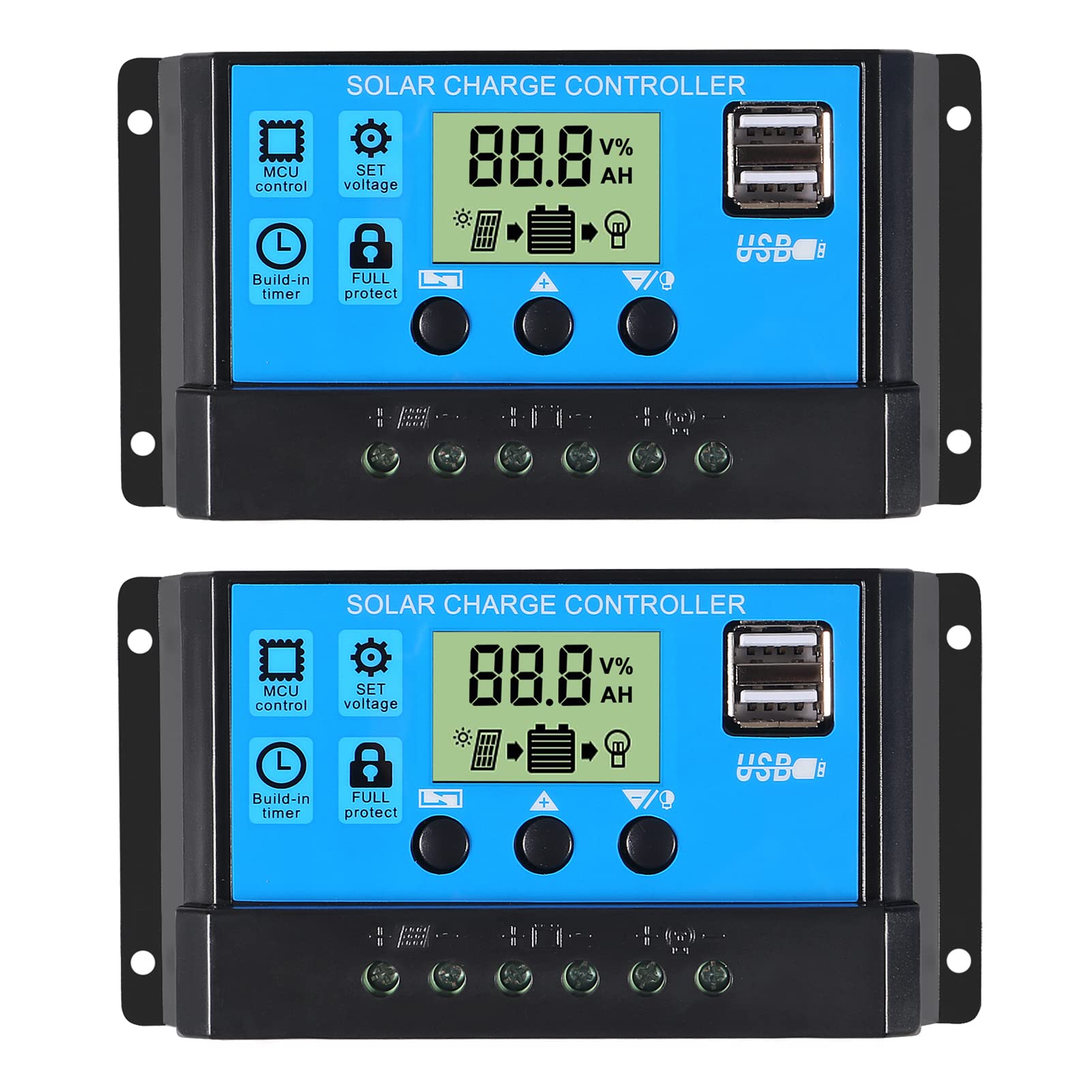
Type: PWM
Rated current: 30A
System voltage: 12V / 24V
Display: LCD with adjustable parameters
Ports: 5V dual USB
Extras: Timer setting with on/off hours
Quantity: 2 pieces
ACEIRMC 2pcs 30A Solar Charge Controller is a two-pack aimed at anyone running more than one small panel setup — a shed and a gate, or a cabin and a backup array. The LCD shows system status and lets the user adjust parameters, and the timer setting switches loads on and off at set hours. The dual USB ports charge phones and small devices directly without a separate adapter.
The pair makes sense for a buyer building two independent small systems who does not want to buy twice. The 30A rating leaves headroom for a modest panel count at 12V or 24V, and the adjustable parameters suit users who like to tune cut-off points themselves. Buyers who want a single controller, or who need MPPT efficiency from a higher-voltage panel, should look elsewhere.
Trade-off: At this price the housing and terminals are basic, so the controller suits sheltered indoor mounting rather than exposed outdoor installation.
2. Renogy Wanderer 10A PWM Solar Charge Controller

Type: PWM
Rated current: 10A
System voltage: 12V / 24V
PV input: 50V
Battery support: AGM, Gel, Flooded (auto); Li (manual)
Display: LCD
Protection: Overcharge and short circuit, negative ground
Extras: Temperature compensation
Renogy Wanderer 10A PWM Solar Charge Controller is the pick for a buyer who wants a familiar brand and automatic battery handling. It detects AGM, gel and flooded batteries on its own, while lithium needs a manual setting — a detail worth knowing before purchase. Overcharge and short-circuit protection plus temperature compensation make it a sensible set-and-forget unit for a small RV or cabin array.
The 10A rating caps the panel size it can handle, so it fits a single panel or a small pair rather than a larger array. Negative-ground wiring and the 50V PV input keep installation straightforward on most vehicles and outbuildings. Buyers planning to expand later, or running lithium as the primary bank, will find the manual lithium setting and current limit restrictive.
Trade-off: The 10A ceiling is the real constraint — this controller will not grow with an array, so it suits a fixed small setup only.
3. 30A PWM Solar Charge Controller with Dual USB

Type: PWM
Rated current: 30A
System voltage: 12V / 24V
Display: Auto-parameter LCD
Ports: Dual USB
Extras: Adjustable timer setting
30A PWM Solar Charge Controller with Dual USB is the cheapest way into a working small-array controller. The auto-parameter LCD cycles through system readings without menu diving, and the adjustable timer handles a load such as a light or pump on a schedule. Dual USB ports add device charging at no extra cost.
This is the pick for a first-time builder testing a single panel on a shed or gate, where the budget matters more than longevity. The 30A rating is generous for the price and covers a modest 12V or 24V array. Buyers who need precise battery profiling, temperature compensation or a branded warranty should step up to the Renogy or Victron options instead.
Trade-off: The very low price points to a light-duty build, so it is best treated as an entry-level controller rather than a long-term installation.
4. Victron Energy SmartSolar MPPT 100V, 50A

Type: MPPT
Rated current: 50A
System voltage: 12V / 24V
PV input: 100V
Connectivity: Bluetooth
Certification: UL1741
Victron Energy SmartSolar MPPT 100V, 50A is the premium pick and the one that squeezes the most out of a small array. MPPT tracking harvests more power than PWM, particularly in low light and cold conditions, and the 100V input allows panels wired in series. Bluetooth monitoring puts live data and history on a phone, and UL1741 certification matters for anyone wiring to code.
The 50A rating is far more than a two-panel array needs today, which is the point: it leaves room to grow and runs cool under light load. This is for the buyer who wants one controller to last through several array upgrades. Buyers on a tight budget, or running a single 100W panel, will pay for capability they never use.
Trade-off: The premium price is hard to justify on a tiny array — the efficiency gain only pays back as the panel count rises.
5. Solar Charge Controller 100A SA100A
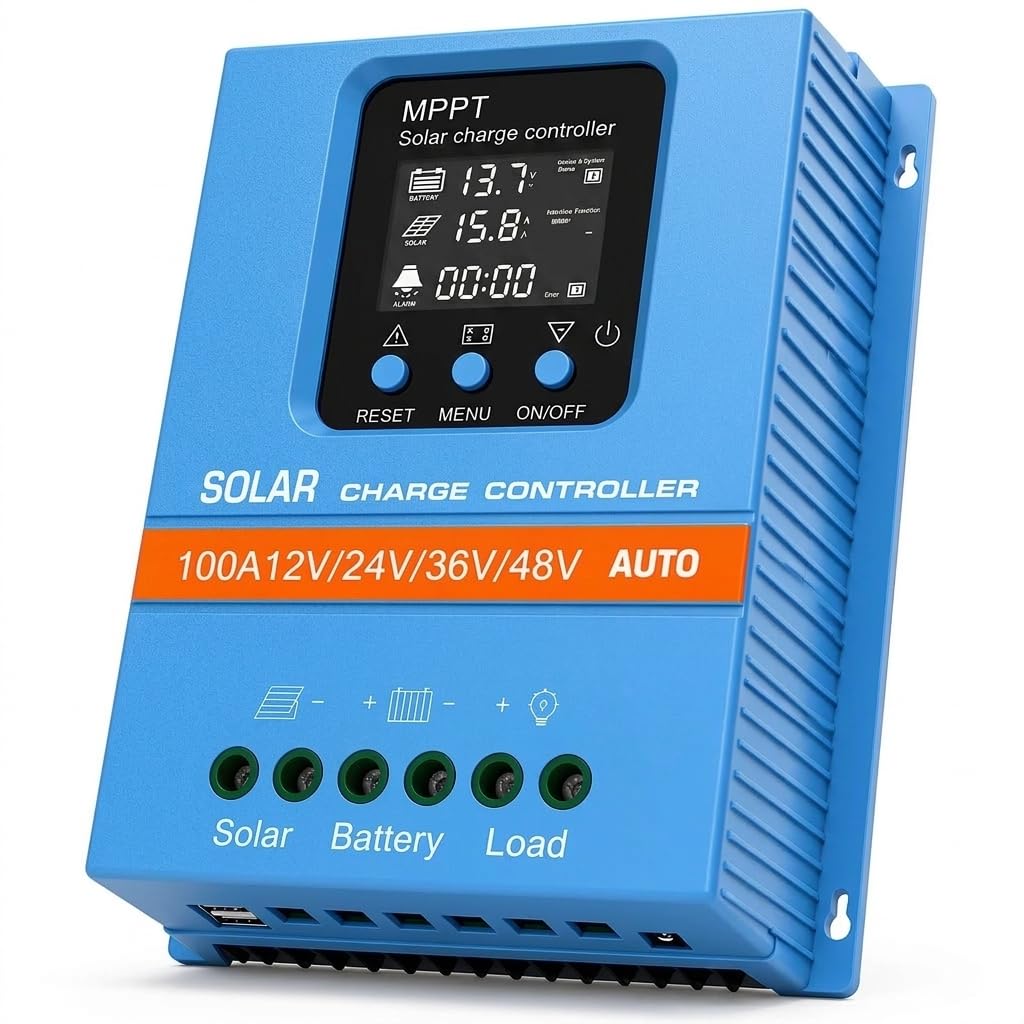
Type: PWM
Rated current: 100A
System voltage: 12V / 24V / 36V / 48V (intelligent recognition)
PV input: 100V maximum
Display: LCD
Battery support: Lead acid and lithium
Ports: Dual USB
Solar Charge Controller 100A SA100A stands out for voltage flexibility: it recognizes 12V, 24V, 36V and 48V banks automatically and handles both lead-acid and lithium chemistries. The 100A rating and 100V input ceiling make it the pick for a buyer consolidating several small strings or running a mixed-voltage setup. The LCD and dual USB ports round out a feature set that reads as a step above the budget units.
This controller fits an off-grid user with a 48V bank or a collection of panels at different voltages who wants one box to manage them. Buyers with a simple 12V two-panel array will find the capacity and the price both unnecessary. The high current rating also demands properly sized cabling and fusing, which adds cost beyond the unit itself.
Trade-off: A 100A rating on a PWM controller at this price suggests the headline number flatters real-world performance, so buyers should size expectations to the array rather than the label.
Before You Buy
- Technology: PWM suits small arrays and tight budgets; MPPT pays off when panel voltage runs well above battery voltage.
- Current rating: Match the controller’s amp rating to the array’s short-circuit current with headroom, not to the panel wattage alone.
- System voltage: Confirm the controller supports the battery bank voltage — 12V, 24V, 36V or 48V — before ordering.
- Battery chemistry: Lithium usually needs a manual setting; lead-acid variants are often detected automatically.
- PV input limit: The panel’s open-circuit voltage must stay under the controller’s input ceiling, especially in cold weather.
- Wiring and fusing: Higher-current controllers need thicker cable and proper fusing, which adds to the total install cost.
- Mounting: Most budget units are best kept dry and shaded; check whether the location is sheltered.
Frequently Asked Questions
-
What size charge controller is needed for a small array?
Size the controller to the array’s current with some headroom. A single 100W panel on a 12V system typically needs a 10A controller, while two or three panels call for 20A to 30A. -
Is MPPT worth it on a small array?
MPPT gains matter most when panel voltage is much higher than battery voltage or when light is poor. On a single low-voltage panel, a good PWM controller is often enough. -
Can a PWM controller charge a lithium battery?
Many can, but lithium usually requires a manual battery-type setting rather than automatic detection. Check the controller’s menu before buying. -
Does the controller need to match the panel voltage exactly?
No — the panel’s open-circuit voltage must simply stay below the controller’s PV input limit. Series wiring raises voltage, so check the total against that ceiling. -
Why do budget controllers list very high amp ratings?
Headline current ratings on low-cost PWM units can overstate real performance. Buyers should size to the array and treat the rating as a ceiling, not a guarantee.
Bottom Line
For most small-array buyers, the Renogy Wanderer 10A PWM is the safest balance of brand support, automatic battery handling and price. Those planning to grow the array should go straight to the Victron SmartSolar MPPT, while the tightest budgets are served by the 30A PWM unit.